Call (888) 295-0220

Fall Armyworms vs. Sod Webworms in Polk County Lawns — Reading the Damage Before You Pay for the Wrong Treatment

Fall armyworms chew a lawn from the edges of the blade inward and move across it like a wave — you’ll see a ragged, advancing front with green grass on one side and shredded stubble on the other. Sod webworms graze in scattered patches, leave notched blades that look like a bad mowing job, and … Read more
How Long Until It’s Safe for Kids and Pets After Pest Control in Your Lakeland Home?

For most routine interior pest control, kids and pets can come back in once the treated surfaces are completely dry — usually 2 to 4 hours. Exterior perimeter sprays are typically 30 minutes to 2 hours. Baits and gels often need no wait at all. Whole-structure fumigation is the outlier: 24 to 72 hours, and … Read more

Bed Bug, Flea, Chigger, or Mosquito? How to Tell the Bites Apart in a Lakeland Home

Bed bug bites usually show up in short lines or tight clusters on skin that was covered by sheets and pajamas — arms, shoulders, upper back, neck. Flea bites are scattered red dots below the knee, mostly ankles and shins. Chigger bites ring the sock line, waistband, and behind the knees. Mosquito bites are single … Read more

Fire Ants After Flooding in Lakeland, FL: Floating Rafts

Quick answer: Floodwater does not drown a fire ant colony — it relocates it. When Lakeland yards flood during summer storms, red imported fire ants link their bodies into floating rafts that carry the entire colony, queen included, until they hit dry ground. That is why new mounds appear in yards that never had them … Read more

Rats Chewing Car Wires in Lakeland, FL: Signs and Fixes

Quick answer: Rats chew car wires because rodent incisors grow constantly and engine bays offer warm, sheltered gnawing spots. In Lakeland, the culprit is usually the roof rat — Florida’s most common rat — moving between trees, attics, and garages. Look for chewed insulation, droppings on the engine cover, and shredded nesting material under the … Read more

Storm-Drain Norway Rats vs. Attic Roof Rats in Lakeland After Heavy Rain: Telling Them Apart

Quick answer: After a heavy Lakeland rain event floods low ground, two different rats move indoors for two different reasons – the ground-burrowing Norway rat pushed out of a flooded storm drain or canal bank, and the tree-climbing roof rat that was already living in your attic and is now more active because the wet … Read more

Subterranean Termite Mud Tubes Rebuilt Overnight After Lakeland’s August Rain? Here’s Why

Quick answer: If you knocked down a mud tube on your slab and it’s back within a day or two after a heavy August rain, the colony is still active – subterranean termites rebuild fastest when soil moisture is highest, which in Lakeland means right after Central Florida’s rainy-season downpours. A rebuilt tube is not … Read more

German Cockroach Bait Not Working in Your Lakeland Kitchen? Ask About Glucose Aversion

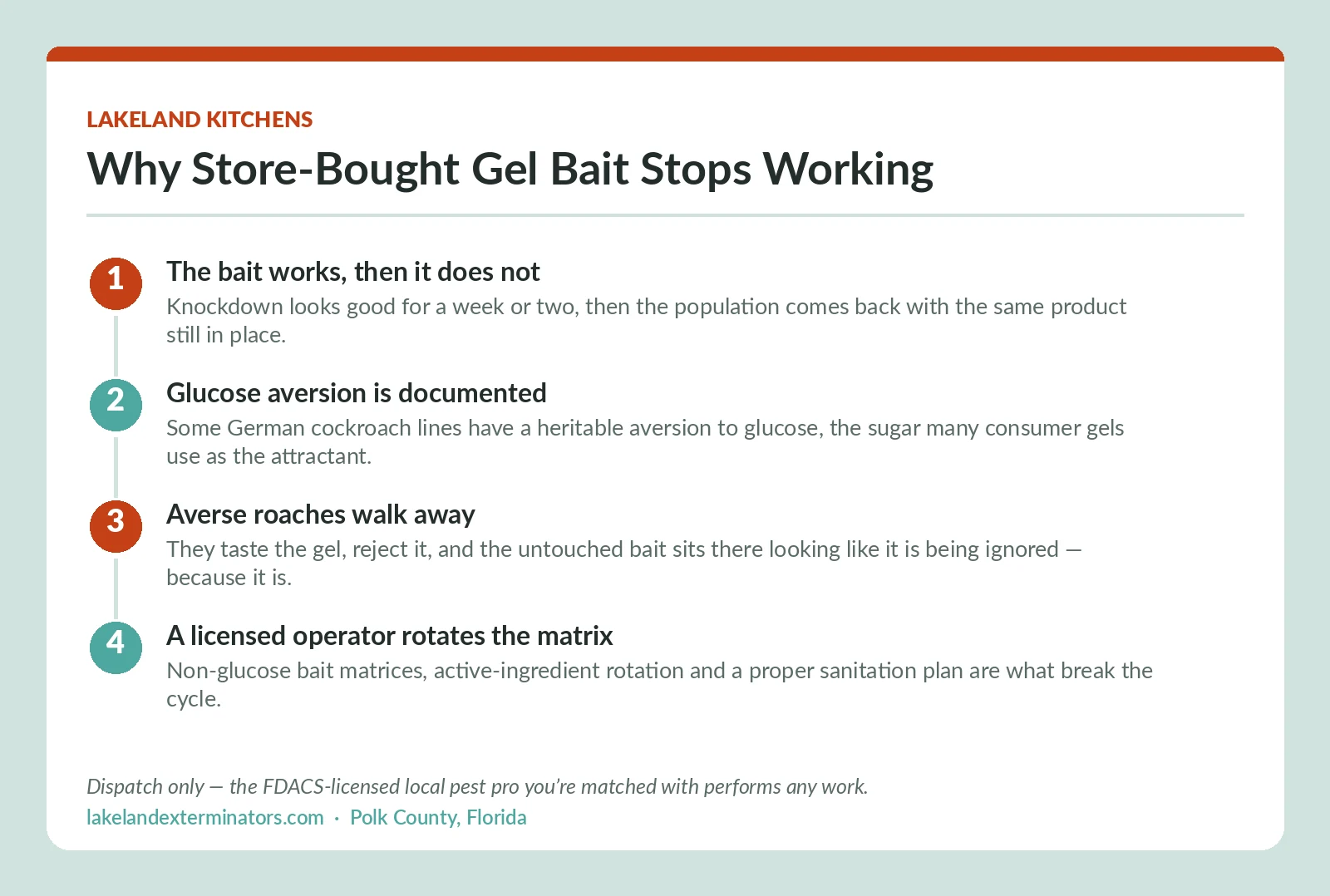
Lakeland FL diagram explaining German cockroach glucose bait aversion and why store-bought gel bait stops working in a kitchen

Quick answer: If German cockroach gel bait worked at first and then stopped, the colony hasn’t necessarily “gotten smart” – some German cockroach populations develop a genetic aversion to glucose, a common sweetener in bait matrices, so they detect and avoid it without touching the actual insecticide. Rotating to a non-glucose bait formulation – something … Read more

Signs of Drywood Termites in a Polk County, FL Home

Quick answer: Drywood termites (Cryptotermes brevis) don’t need soil contact the way subterranean termites do – they live entirely inside dry wood, which means the real warning signs in a Polk County home are small: pepper-flake-sized fecal pellets (frass), tiny kick-out holes, and piles of shed swarmer wings after a flight. Because there’s no mud … Read more

Ghost Ants in Your Lakeland Kitchen: Why They Return

Quick answer: Ghost ants (Tapinoma melanocephalum) are one of Florida’s most common – and most frustrating – kitchen ants because a single colony can have dozens of queens spread across multiple satellite nests. Spraying the trail you can see often triggers “budding,” where the colony splits into new nests to avoid the threat. That’s why … Read more

📞 Tap to call (888) 295-0220