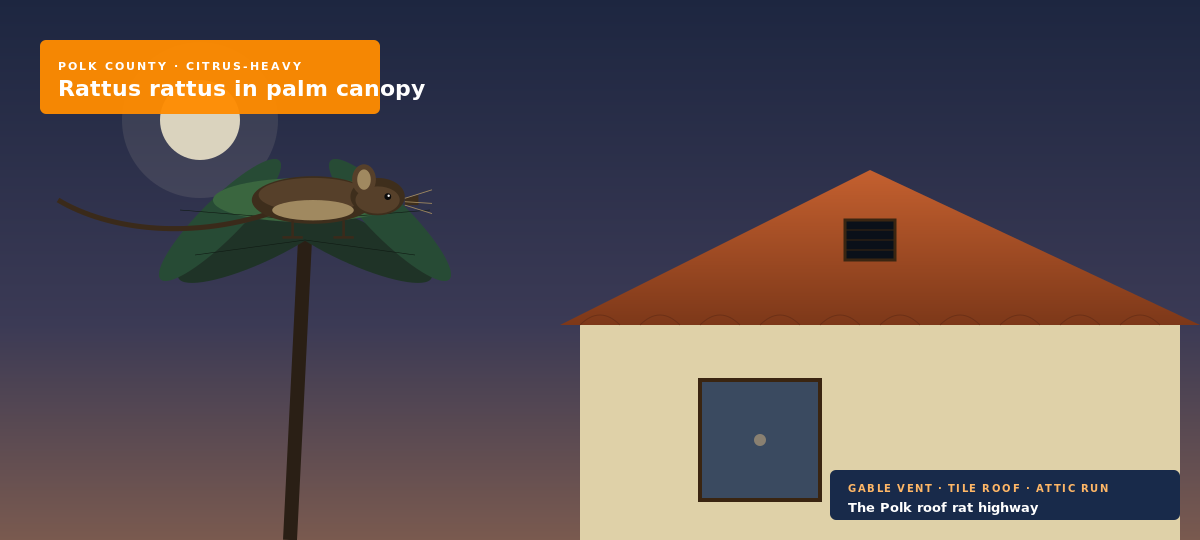
The roof rat (Rattus rattus) is the most common rodent in Polk County residential properties — and Polk County’s distinctive architectural heritage actively favors roof rat establishment. Spanish/Mediterranean barrel tile roofs, mature oak canopy, citrus trees in residential yards, and palm tree landscaping all create the rooftop habitat roof rats prefer. Call the number below for an FDACS-licensed rodent control inspection.
Dealing with a pest problem right now?
📞 Call now — get matched with a licensed local exterminator: (888) 295-0220When you call, stay on the line for a few seconds while we match you with the licensed local exterminator for your area. Have your address and a quick description of the problem ready.
Licensed local pros · Fast response, subject to availability · No obligation
This post explains why roof rats are so prevalent here, and what to look for in your own home. If you live specifically in one of Lakeland’s historic tile-roof districts, see our companion page on Roof Rats in Cleveland Heights, Lake Hollingsworth & Lake Morton for neighborhood-specific detail. Homeowners farther southwest in Polk County can see how the same pressure plays out on our Davenport, FL rodent control page. The same mature oak and palm canopy that gives roof rats a highway to the roofline also gives squirrels one — see our guide on squirrel removal from attics in Lakeland for how to tell the two apart and what the exclusion process looks like.
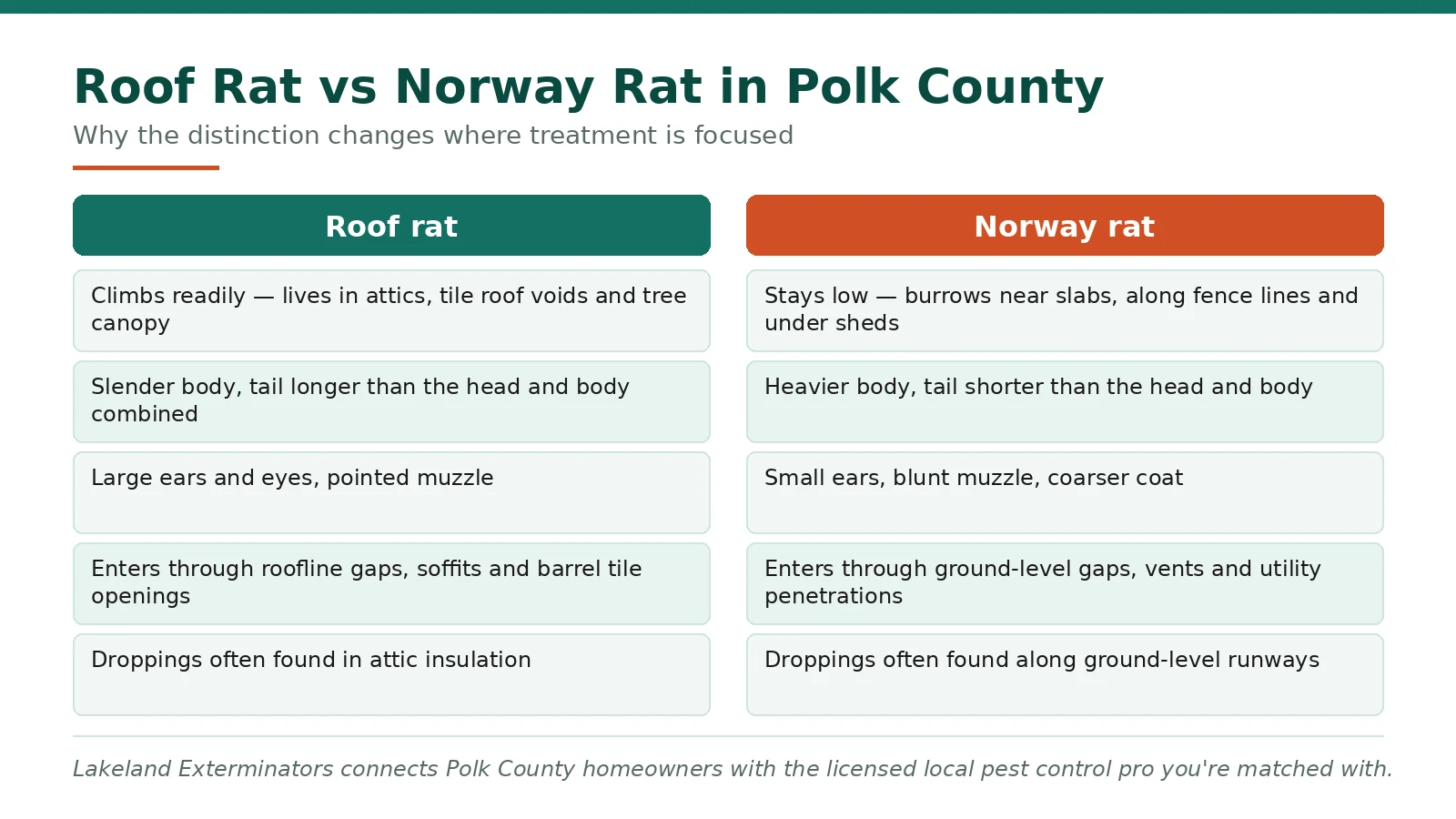
Roof Rat vs Norway Rat — Why the Distinction Matters
Two species of rat are commonly found in Florida residential areas:
Roof rats (Rattus rattus) — the dominant Polk County species:
- Sleek, slender body — typically 13–18 inches total length (tail included)
- Tail longer than body
- Large ears, pointed nose
- Excellent climbers
- Prefer elevated nesting — attics, palm tree fronds, citrus tree canopy, dense vegetation
- Active primarily at night
- Enter homes via roofline gaps, tile roof voids, palm tree branches, citrus trees, electrical lines, fences
Norway rats (Rattus norvegicus):
- Heavier, bulkier body — typically 14–18 inches total length
- Tail shorter than body
- Smaller ears, blunter nose
- Ground/burrow dwellers — prefer crawl spaces, basements, sewer systems
- Less common in Polk County than roof rats
- Enter homes via ground-level gaps, foundation cracks
The distinction matters because treatment differs:
- Roof rats require roofline exclusion (sealing tile gaps, soffit screens, ridge vents) and tree management
- Norway rats require ground-level exclusion (foundation sealing, crawl space access)
In Polk County, roof rat is by far the more common species — partly because of the architectural patterns described in this post.
Why Tile Roofs Favor Roof Rats
Spanish/Mediterranean tile roofing — both barrel tile and S-tile — has been a dominant Polk County architectural style since the 1920s land boom. The Bok Tower historic district, Lakeland’s Cleveland Heights neighborhood, the Lake Hollingsworth area, and dozens of newer subdivisions built in Mediterranean revival style all feature tile roofs.
The roof rat advantage in tile roofs:
Tile valleys and ridge gaps. Where barrel tiles meet ridge caps or where two roof planes meet in a valley, gaps form during installation. Even properly installed tile roofs have small openings — sufficient for roof rat entry. Aging or improperly maintained tile roofs develop larger gaps over time.
Soffit-to-tile transitions. The transition between exterior wall, soffit, and tile roof line creates multiple potential entry points. Damaged soffit screening, gaps where tile meets wall plate, and deteriorated fascia all provide rat access.
Tile voids. Underneath barrel tiles, voids create natural travel pathways across the roof surface. Once rats enter at one point, they can navigate the entire roof envelope.
Heat retention. Tile roofs hold heat better than asphalt shingle — providing warmer winter nesting environments.
Difficult to inspect. Tile roofs are difficult to physically inspect for rodent entry without specialized access — roof rats can establish populations without obvious external evidence.
For these reasons, the dispatched FDACS-licensed exterminator inspecting a Polk County tile-roof home will pay particular attention to the roofline.
Mature Oak Canopy — The Highway to the Roof
Lakeland’s older neighborhoods — Cleveland Heights, Lake Hollingsworth, Lake Morton, Dixieland, Lakeland Highlands — feature mature live oak (Quercus virginiana), laurel oak (Quercus laurifolia), and water oak canopy. Many properties have oak branches overhanging the roof line.
The implications for roof rats:
- Tree-to-roof bridges. Roof rats are excellent climbers. Any branch overhanging the roof line — even a small branch — is a roof rat highway.
- Acorns as food. Live oaks produce acorns that roof rats consume.
- Nesting in canopy. Roof rats can nest in the canopy itself, with the home as a secondary harborage.
Standard rodent management recommendation: trim all tree branches and palm fronds back at least 6 feet from the roof line and home. This is more difficult than it sounds in Polk County’s mature canopy neighborhoods — but it’s the most effective passive defense against roof rat establishment.
Palm Trees and Citrus Trees — The Other Two Pathways
Palm trees. Polk County’s palm tree heritage means thousands of residential properties have mature sabal palms, queen palms, or other species adjacent to the home. Roof rats nest in palm fronds — particularly the dried palm boots at the base of frond clusters. From the palm crown, rats easily transition to adjacent roof lines.
Recommended palm management:
- Trim palm boots (the dried frond bases) annually
- Remove dead fronds
- Keep palm trunks free of vines and adjacent vegetation
- Don’t allow palm fronds to touch the home
Citrus trees. Polk County’s citrus heritage means many residential properties still have orange, grapefruit, lemon, or lime trees. Roof rats consume citrus fruit (often hollowing out the fruit on the tree, leaving the rind intact — a distinctive sign). Citrus trees adjacent to the home become both food source and access pathway.
Recommended citrus tree management:
- Harvest fruit promptly when ripe
- Remove fallen fruit from ground
- Trim branches away from the roof line
- Consider removing very old, no-longer-productive citrus trees adjacent to the home
How to Tell If You Have Roof Rats
Scratching sounds at night. Attic activity, ceiling scrambling, wall void rustling — primarily nighttime (roof rats are nocturnal). Norway rats also scratch but tend toward heavier thumping.
Droppings. Roof rat droppings are ~1/2 inch long, sausage-shaped, pointed at one end. Found in attic insulation, along wall edges, in pantries, in garages.
Gnaw marks. On wooden structural members, electrical wires (fire hazard), plastic pipes, food storage containers.
Hollowed citrus fruit on trees. A distinctive sign — roof rats hollow out citrus fruit from the inside, leaving the rind intact and still on the tree.
Runways. Greasy smudge marks on walls and along baseboards from rat fur rubbing as they travel established pathways.
Nest material. Shredded paper, fabric, insulation, palm frond debris in protected areas.
Sightings. Visual sighting of a rat — particularly during daylight — indicates an established population.
Treatment Approach for Polk County Roof Rats
The dispatched FDACS-licensed operator typically follows a multi-step process:
1. Structural inspection. Roofline, soffit, fascia, eaves, attic, garage, pipe penetrations, electrical entries, dock doors. Identify entry points and active runways.
2. Trapping. Snap traps and electronic kill traps placed along identified runways and at suspected harborage points. Bait stations may be used at exterior perimeter.
3. Exclusion. Critical step. Without exclusion, trapping is just population control — new rats re-populate. The operator seals:
- Tile roof gaps (specialty work)
- Soffit vents (hardware cloth + screening)
- Ridge vents (re-screening)
- Pipe penetrations (steel wool + caulk)
- Garage door sweep
- Foundation gaps
4. Tree and palm management consultation. Recommendation on branch trimming, palm boot removal, citrus tree management.
5. Follow-up. Return visits at 7–14 day intervals until activity ceases. Typically 2–4 visits for moderate infestation.
6. Ongoing service. Many Polk County homeowners maintain quarterly exterior bait station service as a preventive measure.
Cost Expectations
| Service | Relative Cost Level |
|---|---|
| Initial roof rat inspection | Often free with treatment commitment |
| Initial trapping + exclusion (single-family home) | Moderate |
| Extensive exclusion (complex tile roof line) | High |
| Annual exterior bait station monitoring | Low (recurring) |
| Attic cleanout / decontamination (heavy infestation) | High |
| Insulation replacement after contamination | Highest |
Full rodent control overview →
When To Call
- Scratching sounds in attic, especially at night
- Droppings discovered in attic, garage, or interior
- Hollowed citrus fruit on trees adjacent to home
- Live rat sighting (any time)
- New homeowner moving into Polk County tile-roof home (preventive)
- Pre-storm preparation (post-storm rodent migration is documented Polk County pattern — see why Polk County rodent activity migrates indoors before storms for the specific mechanics)
Related Pages
- Roof Rats in Lakeland’s Historic Tile-Roof Neighborhoods (Cleveland Heights, Lake Hollingsworth & Lake Morton)
- Rodent Control in Lakeland
- Rodent Control in Davenport, FL
- Hurricane Pest Prep for Polk County
- Exterminator in Lakeland
- Pest Control in Winter Haven
- Pest Control in Lake Wales
- Roof Rat Control in Winter Haven, FL
- Squirrel Removal from Attics in Lakeland, FL
Disclaimer: Lakeland Exterminators is a local dispatch and referral service, not a licensed pest-control operator. We connect Polk County, Florida homeowners with independent, FDACS-licensed and insured pest-control companies. All inspections and treatments are performed by those independent providers, who set their own pricing, scheduling, and service terms.
Any reference to same-day, emergency, or 24/7 service describes the typical scheduling of matched independent providers and is not guaranteed; actual response times vary by provider, season, location, and demand.