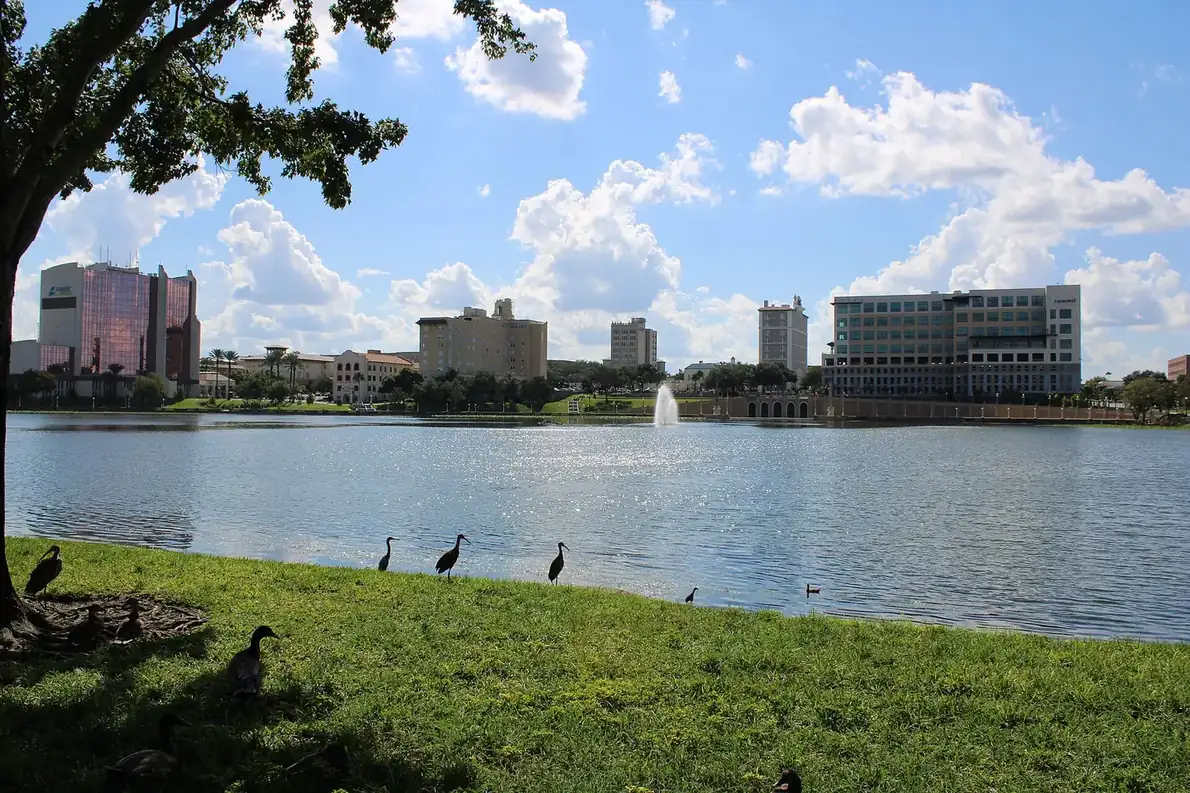
June in Polk County: the rain returns, and every pest shifts to high gear.
One call reaches a licensed, local exterminator who covers your address — and a real person answers, 24/7.
Talk to a licensed exterminator now
Call and we’ll connect you with a licensed, local exterminator who covers your address. It takes about two minutes, and a real person answers.
Free to call. Free to get matched. The licensed operator gives the quote.
24/7 line · A real person answers · Availability of same-day and emergency service depends on the provider.
What June flips on in Polk County
June is when the dry season officially loses. The daily storm cycle returns — build-up by noon, downpour by four — and with it three mechanical changes that drive pest behavior across Lakeland, Winter Haven and the whole lake district. First, saturated ground floods the underground galleries ants and other soil insects live in, pushing them up structures and indoors. Second, the humidity spike gives drywood termite swarmers the warm, damp evenings they wait all year for. Third, every gutter, bromeliad, tarp fold and clogged lanai drain becomes a moisture reservoir that keeps pressure high through September.
The practical takeaway: June problems are moisture problems wearing six legs. The licensed operators this line dispatches spend June treating the same three things over and over — and the homeowner half of the fix is drainage, screens and sealed thresholds.
The June priority list
Drywood termite swarms — dusk, porch lights, soffit vents
Cryptotermes brevis swarms May through August on warm, windless evenings. Swarmers drift through soffit and gable vents and start colonies in attic rafters and window framing — no soil contact required. Wings around interior lights in June are a drywood signature.
Ants at annual peak
Ghost ants in the sugar bowl, white-footed ants running the soffit line, Argentine ant supercolonies moving along irrigation, carpenter ants excavating storm-wet fascia. June rain floods their nests and sends every species indoors at once.
Palmetto bugs walking in
American cockroaches breed outdoors in mulch, palms and sewers all year — June storms flood them out and send the three-inch adults under garage doors and through dryer vents. One or two after a storm is traffic; nightly sightings mean harborage.
Brown widows at population peak
The egg sacs glued under lanai furniture in March are adults by June, webbed into pool cages, meter boxes and grill covers exactly where hands go. Glove up before reaching into anything that sat outside.
The June mosquito note: yes, Aedes pressure peaks with the rains — and area mosquito management in Polk County is county-funded public work run by the Polk County Mosquito Control District, not house-by-house structural pest control. The homeowner lever that actually moves June mosquito numbers is standing water: bromeliads, plant saucers, gutters, tarps and toys, dumped twice a week. Structural operators focus June work on termites, ants, roaches and spiders.
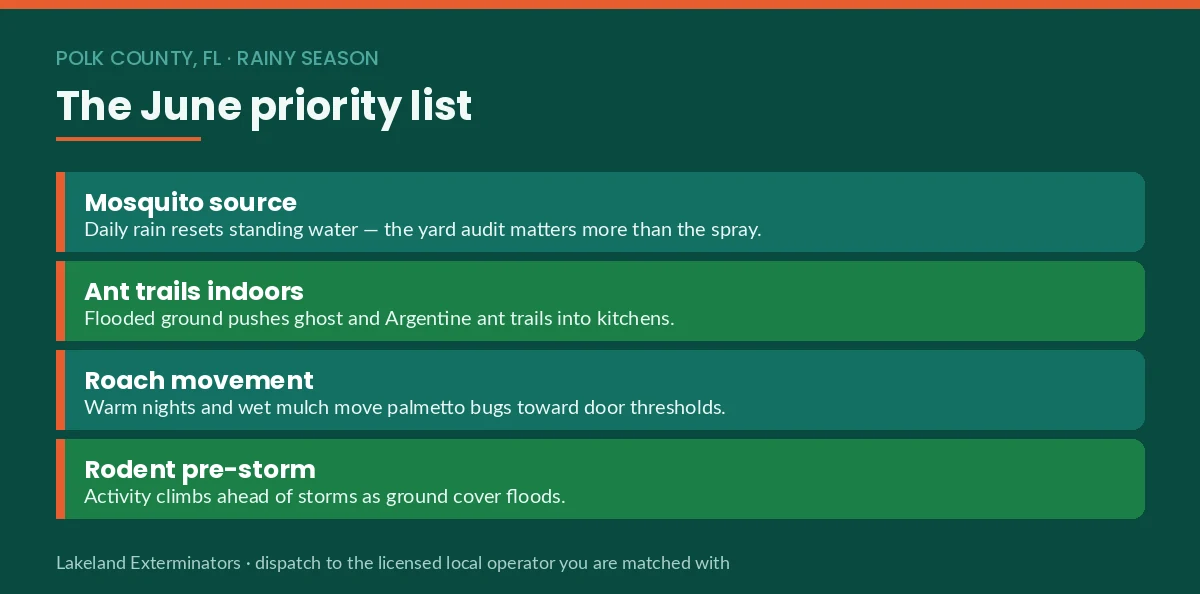
Wings around the porch light? Trails across the kitchen counter?
One call reaches a licensed, local exterminator who covers your address — and a real person answers, 24/7.
Free to call. Free to get matched. The licensed operator gives the quote.
June at a glance: the Polk County pest board
| Pest | June status | What you’ll see | The move |
|---|---|---|---|
| Drywood termite | PEAK swarm season | Dusk swarms at porch lights; smoky wings on sills; frass follows months later | Wings indoors = licensed WDO inspection now |
| Formosan subterranean termite | Late swarms continue | Heavy dusk swarms on humid, windless evenings | Same-week inspection — Formosan colonies scale fast |
| Ghost / white-footed / Argentine ants | Annual peak | Kitchen and bathroom trails, soffit highways after every storm | Species-keyed baiting; repellent sprays split colonies |
| Carpenter ant | Peak, winged reproductives | Large ants at night, wings in window tracks, moist fascia activity | Find the moisture source; treat the nest, not the trail |
| Palmetto bug (American roach) | Storm-driven indoor surge | Big roaches near garage, laundry, bathrooms after rain | Exclusion + perimeter program; German roach protocol differs |
| Fire ant | Active between storms | Rebuilt mounds after each downpour | Licensed broadcast baiting |
| Brown widow | Population peak | Webs in pool cages, furniture, meter boxes | Gloved cleanout + harborage treatment |
| Rodents | Seasonal low indoors | Outdoor food is abundant — attic pressure eases | Seal entry points now, before fall |
The full-year picture lives on the Florida termite swarm calendar and the neighboring monthly pages: March and September.
The June homeowner checklist
Screen the soffit and gable vents
Drywood swarmers enter through attic vents. Intact insect screening on soffit, gable and ridge vents is the single physical barrier between a June swarm and your rafters.
Watch the porch lights at dusk
A cloud of insects around exterior lights on a humid, still evening deserves a look. Kill the lights, collect a few insects in a bag, and check for the four-equal-wings termite signature.
Break the moisture chain
Clear gutters, dump bromeliads and saucers twice a week, re-grade mulch off the slab, fix the hose bib drip. Every June pest — ants, roaches, termites — follows moisture first.
Seal the ground-floor gaps
Garage door sweeps, weep-hole screens and door thresholds stop the after-storm palmetto bug walk-ins. A flashlight check at night shows exactly where light — and roaches — get through.
What moves a June quote
We never set prices — the licensed operator quotes after a real inspection. In June, these are the levers:
- Drywood extent — a colony bounded to one window frame may qualify for localized no-tent treatment; activity spread through the attic points to whole-house fumigation. The inspection settles it, and the honest operator tells you when no-tent is not defensible. The no-tent guide and tenting cost guide cover both paths.
- Ant species and colony structure — a ghost ant kitchen problem and an Argentine supercolony running the irrigation line are different scopes; carpenter ants add the moisture-repair question.
- Recurring cadence — summer is when quarterly programs earn their keep; between-visit re-service terms matter more June through September than any other stretch. The cadence guide compares options.
- Structure factors — pool cages and lanais add treatable surface; pier-and-beam crawl spaces add access scope.
How the dispatch works in the rainy season
Straight up: Lakeland Exterminators is a dispatch and matching service, not a licensed pest control operator. Here is the exact path your request takes.
Describe what you found
Wings, trails, roaches, webs — tell the line what you’re seeing and where. A real person answers around the clock.
Your address picks the operator
The request routes to an FDACS-licensed operator covering your part of Polk County — Lakeland, Winter Haven, Bartow, Lake Wales, the I-4 corridor, all of it. Termite findings route to WDO-licensed operators specifically.
Licensed inspection on site
The operator confirms the species, maps the activity and writes the quote. Pricing comes from them, never from us.
Treatment stays with the pro
Fumigation, baiting, perimeter program — plus any bond or warranty — all owned by the licensed operator under Chapter 482, Florida Statutes.
Verify before you hire — any Florida pest control company’s license status, categories and discipline history is public at the FDACS license search at aessearch.fdacs.gov. Fumigation work requires its own FDACS category — worth checking before you sign a tenting contract.
June pest questions, answered straight
There’s a swarm of winged insects at my porch light every evening. Termites?
In June, possibly — drywood and late Formosan swarms both fly at dusk on humid, windless evenings and both are drawn to lights. The check: four equal-length wings and straight antennae mean termite; unequal wings and elbowed antennae mean ant. Either way, bag a few. If they’re termites and they’re emerging inside, that’s a same-week inspection.
Do I have to tent for drywood termites found in June?
Not automatically. Localized no-tent treatment is legitimate when the colony is verifiably bounded — one window frame, one accessible rafter section. Fumigation is the answer when activity has spread beyond what anyone can map. Be wary of anyone promising either path before inspecting.
Why do giant roaches show up inside every time it storms?
American cockroaches (palmetto bugs) live outdoors in mulch, palm boots and storm sewers. A hard June rain floods that harborage and pushes them toward dry structures. Occasional after-storm walk-ins are an exclusion problem — door sweeps, vent screens, weep-hole covers. Nightly sightings or daytime activity suggest established harborage that needs a licensed treatment plan.
I keep spraying ants and they keep coming back. Why?
Repellent sprays kill the workers you see and split the colony you don’t — several Polk County species (ghost ants, Argentine ants) respond to spray stress by budding into multiple colonies. Licensed operators use non-repellent products and species-keyed baits the workers carry home. The species ID is the whole game, which is why the inspection matters.
Who handles the June mosquito explosion?
Area mosquito control in Polk County is public work run by the Polk County Mosquito Control District — county-funded larviciding and spraying, not house-by-house contracts. The homeowner lever is standing water: dump bromeliads, saucers, gutters and tarps twice a week. Structural operators this line dispatches focus on termites, ants, roaches, spiders and rodents.
Rainy season runs to October. Get ahead of it now.
One call reaches a licensed, local exterminator who covers your address — and a real person answers, 24/7.
Free to call. Free to get matched. The licensed operator gives the quote.
Disclosure
Lakeland Exterminators is a dispatch and matching service. We connect Polk County callers with FDACS-licensed structural pest control operators. We are not a licensed pest control operator. We do not perform pest control treatment, set prices, issue warranties, hold retreatment bonds, or carry pest control trade insurance. All pricing, scheduling, treatment plans, warranties, bonds and service terms are determined by the FDACS-licensed operator dispatched to your address under Chapter 482, Florida Statutes.
Same-day and 24/7 emergency services are subject to provider participation, location, technician availability, and demand. Availability is not guaranteed and may vary by market and appointment capacity.
License status of any operator you connect with is publicly verifiable at the FDACS license search: aessearch.fdacs.gov.