What does termite treatment actually cost in Lakeland? Here is the honest answer.
One call reaches a licensed, local exterminator who covers your address — and a real person answers, 24/7.
Talk to a licensed exterminator now
Call and we’ll connect you with a licensed, local exterminator who covers your address. It takes about two minutes, and a real person answers.
Free to call. Free to get matched. The licensed operator gives the quote.
24/7 line · A real person answers · Availability of same-day and emergency service depends on the provider.
The first honest rule: the treatment path sets the price class
Four different jobs hide behind the phrase “termite treatment,” and they are priced on different units entirely. The inspection determines which one your house needs — which is why a sight-unseen phone quote is worthless.
Liquid soil barrier
Priced on linear footage of your foundation perimeter, plus slab penetrations that need drilling. A wraparound porch, attached garage or complex footprint adds feet; drilling through pavers or a pool deck adds labor. The standard answer for active subterranean colonies.
Bait system
Priced as installation plus recurring monitoring. Station count follows the perimeter, and the quarterly service is where the real cost lives long-term. Often paired with a renewable bond — read the renewal terms before comparing quotes. See the Sentricon guide.
Whole-house fumigation (tenting)
Priced on cubic footage — the volume under the tent — plus your prep and lodging for 2–3 nights. The reference treatment for established drywood colonies that localized work cannot map. See the tenting guide.
No-tent localized treatment
Priced on accessibility and extent of the bounded drywood activity — wood injection, spot foam, targeted heat. Legitimately cheaper when the colony is verifiably contained; the wrong choice when it is not. See the no-tent guide.
The real number comes from an inspection — free to arrange.
One call reaches a licensed, local exterminator who covers your address — and a real person answers, 24/7.
Free to call. Free to get matched. The licensed operator gives the quote.
The seven factors that move a Polk County termite quote
| Factor | Why it moves the number |
|---|---|
| Species | Subterranean, drywood and Formosan need different chemistry, equipment and hours. Formosan colonies are larger and push quotes hardest. Species ID is step one of the inspection. |
| Spread | One bounded gallery vs activity across multiple framing runs is the difference between spot work and whole-structure treatment. |
| Foundation type | Slab-on-grade needs drilling at penetrations; crawl-space homes (common in older Lakeland, Bartow, Lake Wales) need under-floor access work; additions with joined slabs add cold-joint footage. |
| Linear/cubic footage | The billing unit itself — bigger perimeter, bigger volume, bigger number. Two-story matters for tenting, not for barriers. |
| Access complexity | Pool decks, pavers, planters against the foundation, tight crawl spaces and finished garages all add drilling and labor time. |
| Bond terms | Whether the quote includes a retreatment bond, a repair bond, or nothing — and what renewal costs annually — changes the real multi-year price more than the sticker. The bond guide decodes the fine print. |
| Urgency context | A closing-deadline treatment after a WDO finding compresses scheduling and sometimes limits which path is practical. See the WDO guide. |
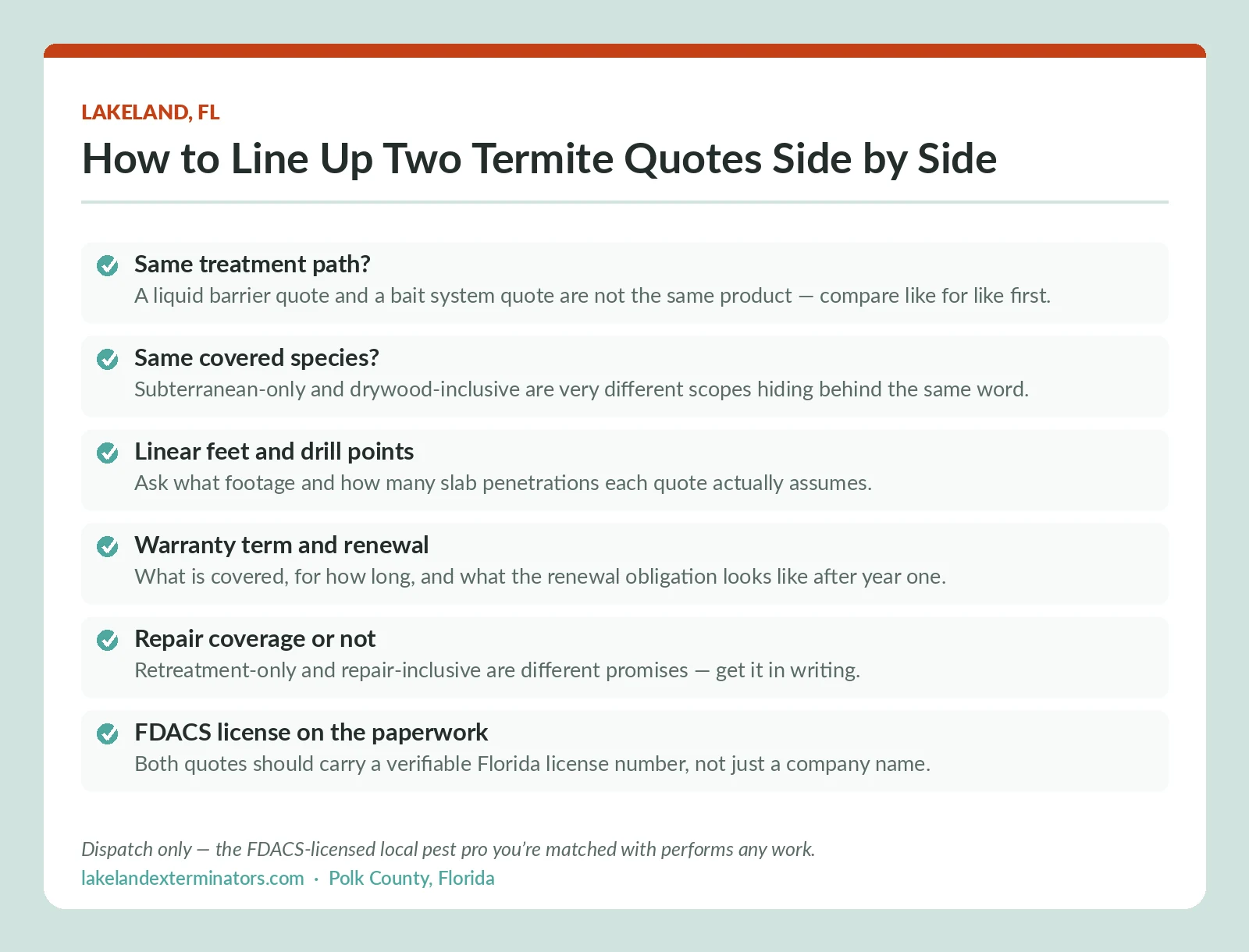
How to compare two termite quotes like a pro
Match the treatment path first
A barrier quote and a bait quote are different products, not different prices for the same product. Make sure both bidders are answering the same question about your house.
Read the bond, not just the sticker
Retreatment-only or repair bond? What is the annual renewal? Transferable at sale? A cheaper job with no bond can cost more by year three — and a transferable bond adds real resale value in Polk County.
Check the license and the label
Verify the company at the FDACS license search and ask what product is going in the ground — reputable operators name it without flinching.
Ask what happens if activity returns
The answer — retreat free under bond, retreat at cost, or shrug — tells you the real difference between the bids.
Lakeland termite cost questions, answered straight
Why will nobody give me a price over the phone?
Because the billing units — linear feet, cubic feet, spread, access — are unknowable without walking the property. An operator who quotes sight-unseen is either padding for worst-case or planning to revise upward on arrival. The inspection-first model protects you, not them.
Is the cheaper no-tent option good enough for drywood termites?
Sometimes genuinely yes — when the colony is bounded, accessible and verifiable. When activity has spread through framing in ways nobody can map, localized work under-treats and you pay twice. The honest answer comes from the inspection, and a good operator will tell you when tenting is not necessary. Both paths: no-tent vs tenting.
Does homeowners insurance cover termite treatment?
Almost never — Florida policies treat termite damage as preventable maintenance, not sudden loss. That reality is the strongest financial argument for keeping a bond current on an older Polk County home.
Is an annual termite bond worth the renewal fee?
For most Polk County homes — especially pre-1990 construction and anything with treatment history — yes, and it is cheap insurance relative to retreatment. Read whether it is retreatment-only or includes repair coverage; that distinction is most of the value. The bond guide goes deep.
Stop guessing. Get the real number from a licensed inspection.
Free to call. Free to get matched. The licensed operator gives the quote.
Free to call. Free to get matched. The licensed operator gives the quote.
Disclosure
Lakeland Exterminators is a dispatch and matching service. We connect Polk County callers with FDACS-licensed structural pest control operators. We are not a licensed pest control operator. We do not perform termite treatment, set prices, issue warranties, hold retreatment bonds, or carry pest control trade insurance. All pricing, scheduling, treatment plans, warranties, bonds and service terms are determined by the FDACS-licensed operator dispatched to your address under Chapter 482, Florida Statutes. Nothing on this page is a price quote.
Same-day and 24/7 emergency services are subject to provider participation, location, technician availability, and demand. Availability is not guaranteed and may vary by market and appointment capacity.
License status of any operator you connect with is publicly verifiable at the FDACS license search.