Ten questions that separate a real pest pro from an expensive disappointment.
One call reaches a licensed, local exterminator who covers your address — and a real person answers, 24/7.
Talk to a licensed exterminator now
Call and we’ll connect you with a licensed, local exterminator who covers your address. It takes about two minutes, and a real person answers.
Free to get matched. The licensed operator gives the quote.
24/7 line · A real person answers · Availability of same-day and emergency service depends on the provider.
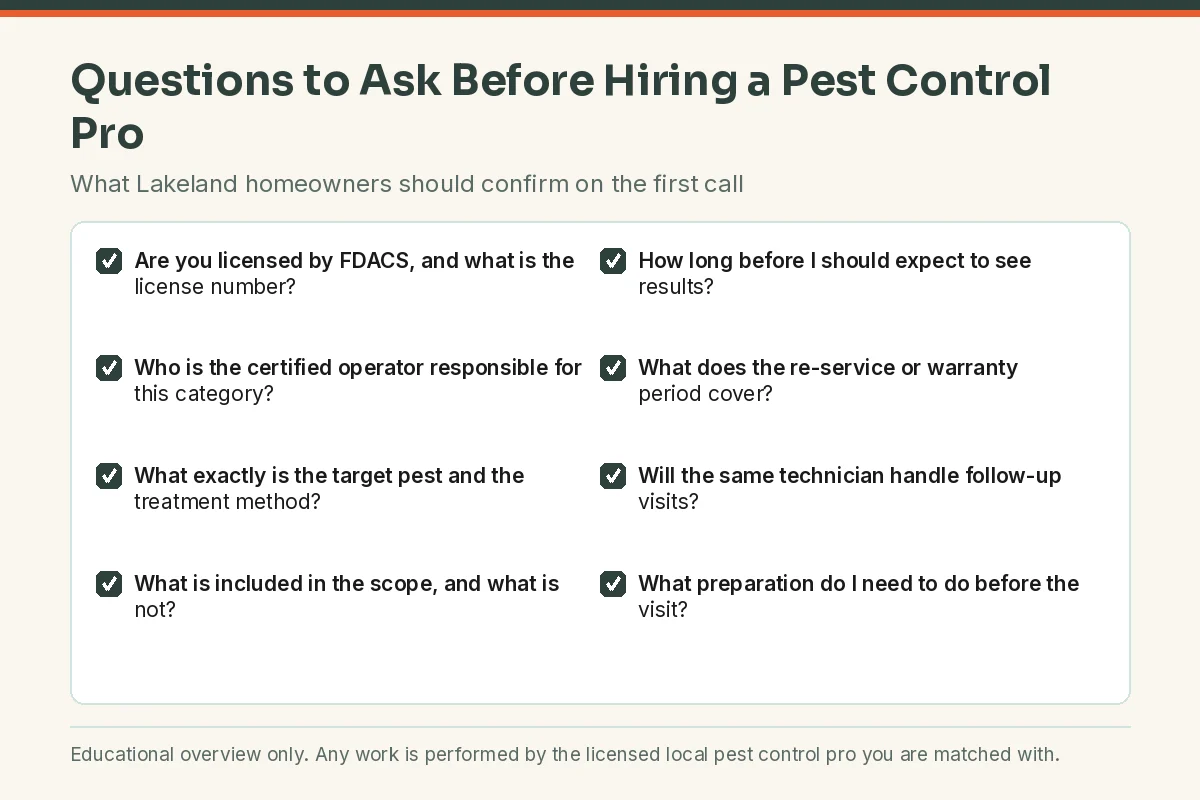
The 10 questions, at a glance
Ask these at the initial inspection. A reputable Polk County operator answers all of them without flinching — hesitation on any one is itself an answer.
- What’s your FDACS Pest Control Business License number?
- Who’s the Certified Operator on staff, and what categories do they hold?
- What active ingredients will you apply, and at what rate?
- What’s the service frequency, and what’s the re-service warranty between visits?
- If this is a termite bond, is it retreat-only or retreat-plus-repair?
- Is the bond transferable if I sell the house?
- Is there a repair cap on the bond, and what is it?
- Can I see your general liability insurance and workers’ comp certificates?
- What voids the bond or warranty?
- What are the cancellation terms?
Licensing & credentials
This is the non-negotiable tier. Everything else depends on the company actually being licensed for the work.
- FDACS Business License number. Every lawful Florida operator has one. Get it and verify it at aessearch.fdacs.gov.
- Certified Operator and categories. Ask who the Certified Operator is and which categories they hold — General Household Pest for routine service, WDO for termite work, Fumigation for tenting. Confirm the category matches your job.
- Insurance and bonding. Ask to see general liability and workers’ comp certificates. If an uninsured technician is hurt on your property, you don’t want that exposure.
- Who actually shows up. Ask whether the technician performing the service is FDACS ID-carded or limited-certified — not just whether the company holds a license.
The full breakdown of Florida categories is on our FDACS licensing guide.
Treatment scope & the honest-diagnosis test
What are you treating, and how?
Ask for the specific pest, the active ingredients, the application method, and the rate. A real answer is species-specific — a German roach plan and a palmetto bug plan should sound completely different. Vague “we’ll spray the perimeter” for a kitchen German-roach problem is a red flag.
One-time, recurring, or specialty?
Clarify whether the proposal is a recurring plan, a one-time treatment, or a specialty job (termite, bed bug). Each covers different things — ask exactly what’s included and what a callback between visits costs.
The best tell of a trustworthy operator: they’ll tell you when you don’t need something. An honest inspector who says a bounded drywood colony qualifies for no-tent treatment instead of pushing a full fumigation is showing you exactly the judgment you’re hiring for.
Bond & warranty terms (especially for termites)
Termite bonds are where the fine print matters most — two bonds at similar prices can offer wildly different protection:
- Retreat-only vs. retreat-plus-repair. A retreat-only bond re-treats if termites return but pays nothing toward damage repair. A retreat-plus-repair bond covers new damage too. Know which you’re buying.
- Repair cap. If it’s a repair bond, ask the dollar cap and what triggers it.
- Transferability. Can the bond transfer to a buyer when you sell? A transferable bond is a selling point; a non-transferable one ends at closing.
- What voids it. Moisture conditions, structural alterations, or missed annual inspections can void a bond. Get the list in writing.
- Renewal and cancellation. Ask the renewal terms, the annual inspection requirement, and how you cancel if you move or switch providers.
For how bond structure fits into termite decisions, see is an annual termite bond worth it.
Price transparency — without the sight-unseen number
A trustworthy operator won’t hand you a firm price over the phone before inspecting — species, spread, home size, and construction all move it. But they should be fully transparent about how the price is built: what the initial service covers, what recurring visits cost, what’s included in a callback, and what a specialty job adds. If a quote lands far below every other operator’s, ask precisely what it includes — an unusually low number often buys a single perimeter spray rather than a real inspect-and-treat program.
The written findings from the inspection are what make comparisons honest. Two quotes are only comparable when you can see what each one actually covers.
Skip the cold-calling — get matched with a licensed pro who’ll answer all ten.
One call reaches a licensed, local exterminator who covers your address — and a real person answers, 24/7.
Free to get matched. The licensed operator gives the quote.
Hiring FAQs
What’s the single most important question to ask?
Should a company give me a firm price over the phone?
What’s the difference between a retreat-only and a repair bond?
Why does bond transferability matter?
Are you the pest control company?
Related Polk County pages
Disclosure
Lakeland Exterminators is a dispatch and matching service. We connect Polk County callers with FDACS-licensed structural pest control operators. We are not a licensed pest control operator. We do not perform treatment, set prices, issue warranties, or carry pest control trade insurance. All pricing, scheduling, treatment plans, and service terms are determined by the FDACS-licensed operator dispatched to your address under Chapter 482, Florida Statutes.
Same-day and 24/7 emergency services are subject to provider participation, location, technician availability, and demand. Availability is not guaranteed and may vary by market and appointment capacity.
License status of any operator you connect with is publicly verifiable at the FDACS license search.