A tent over your Lakeland house is a big deal. Here’s exactly what happens under it.
One call reaches a licensed, local exterminator who covers your address — and a real person answers, 24/7.
Talk to a licensed exterminator now
Call and we’ll connect you with a licensed, local exterminator who covers your address. It takes about two minutes, and a real person answers.
Free to call. Free to get matched. The licensed operator gives the quote.
24/7 line · A real person answers · Availability of same-day and emergency service depends on the provider.
What termite tenting actually is
Whole-structure fumigation means the licensed fumigator seals your house under a heavy nylon-coated or polyethylene tarp, sandbags the perimeter, and introduces a fumigant gas — in Florida that’s almost always sulfuryl fluoride, sold under the Vikane brand by Douglas Products. The gas is a true gas, not a fog or a mist. It moves through wood the way air moves through a screen door: into the studs, into the attic sheathing, into the piano bench, into the picture frame on the wall.
That’s the entire point, and it’s why the tent exists. Drywood termites — in Polk County, mostly the Florida drywood termite Cryptotermes brevis, with Incisitermes snyderi also in the mix — live their whole lives inside the wood, no soil contact, no mud tubes, nothing on the outside of the house to show you where they are. A colony can be sitting in a wall stud you’ll never open. Fumigation doesn’t need to find them. It just fills the envelope.

Two things about Vikane that people get wrong. First: it leaves no chemical residue. Once the structure is aerated and cleared, there’s nothing on your countertops to wipe off and nothing in the drywall to worry about. Second — and this is the one that surprises people — it also leaves no protection. Fumigation eliminates what’s in the wood on the day it’s done. It does not stop a new swarmer from flying in next May and starting over in your fascia board. That’s why fumigators often recommend a borate treatment on exposed or replaced wood afterward, and why keeping eyes on the house matters even after a clean tent.
The tenting timeline, hour by hour
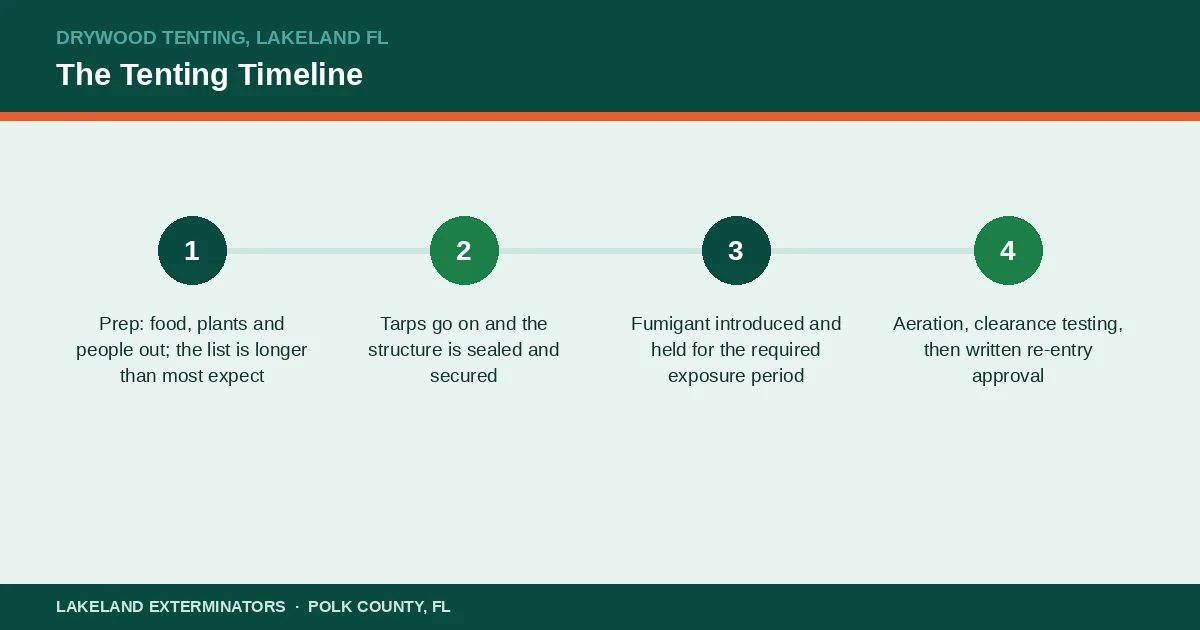
Here’s what the licensed fumigator will walk you through. Exact hours vary with cubic footage, weather and the fumigator’s own protocol — this is the shape of it, not a promise.
| Stage | Typical duration | What’s happening |
|---|---|---|
| Tarping & sealing | Half a day | Tarps are pulled over the structure, seams clamped, perimeter weighted with sand snakes, vents and gas service secured. Your gas utility is coordinated with in advance. |
| Gas introduction & exposure | Roughly 18–24 hours | Sulfuryl fluoride is released at a dose calculated from the structure’s cubic footage and target wood penetration. Fans circulate it. The fumigator monitors concentration with a Fumiscope to confirm the dose is holding. |
| Aeration | Roughly 12–24 hours | Tarps come off, the structure is opened and ventilated, and the gas dissipates. |
| Clearance & re-entry | Same day as aeration | The fumigator tests airborne concentration with a clearance device and only releases the home when it reads below the label’s re-entry threshold. You get the clearance in writing. |
Plan on the household being out of the house for roughly 48 to 72 hours end to end. If you want the deeper version of the prep and logistics — what to bag, what to unlock, what to take with you — read how to prepare for termite tenting in Florida before the truck shows up, not the night before.
Want a licensed fumigator to tell you if you even need the tent?
One call reaches a licensed, local exterminator who covers your address — and a real person answers, 24/7.
Talk to a licensed exterminator now
Call and we’ll connect you with a licensed, local exterminator who covers your address. It takes about two minutes, and a real person answers.
Free to call. Free to get matched. The licensed operator gives the quote.
Your prep list — the part people underestimate
The fumigator will give you their own written prep sheet and it governs. But nobody enjoys discovering the scope of this at 9pm the night before, so here’s the honest preview:
- Food, drink, medication and tobacco. Anything not in an unopened factory-sealed metal can, screw-top glass jar, or unopened foil/poly pouch has to come out or go into the fumigant-proof bags the operator supplies. That includes the pantry, the fridge, the freezer, the dog’s kibble and the vitamins in the bathroom drawer.
- Everything alive leaves. People, pets, fish, reptiles, birds, and houseplants. Aquariums too — you can’t just cover them.
- Gas service. The fumigator coordinates a shut-off with the utility before tarping and a reconnect after clearance. This is scheduled ahead; it’s a common cause of delays when it isn’t.
- Open the house up. Interior doors unlocked and open, cabinets and drawers open, closet doors open, attic access open. The gas needs to reach everywhere.
- Beds and floors. Mattress and pillow covers off if the operator asks. Rugs rolled back and heavy furniture lifted off carpet so wood floor seams are exposed.
- Landscaping. Shrubs, vines and tree limbs touching the structure get trimmed back — typically about 18 inches — so the tarp can seat against the ground. In older Lakeland neighborhoods with mature plantings hugging the foundation, this is often the biggest single prep job.
- Lodging. Book two to three nights somewhere. Take your medications, chargers, work laptop, school stuff — you are not popping back in for something you forgot.
One quiet detail worth knowing: soft turf and tender plants directly under the tarp footprint can take temporary damage even when everything’s done right. A good fumigator will tell you that upfront and shield or move what they can.
When a tent is the right call — and when it isn’t
We route both ways, so we’ve got no reason to sell you the bigger job. Here’s the split as licensed operators actually apply it.
Tenting fits when…
Drywood activity is documented in multiple distinct areas — pellets in the front bedroom and the lanai and the attic. Or the extent is genuinely unknown. Or a real-estate deal needs a clean report and the buyer’s lender isn’t going to accept “only the two spots the inspector could see were treated.” Fumigation is also what typically carries a renewable structural warranty from the operator.
WDO inspection in Lakeland →Tenting is overkill when…
You’ve got one infested window buck, the operator can reach it, and probing confirms the damage stops there. Drill-and-inject foam, borate treatment, gallery dust or localized heat can handle a contained pocket without anyone leaving the house. If that’s your situation, don’t buy a tent.
No-tent termite treatment options →Tenting is the wrong tool when…
What you actually have is subterranean termites — mud tubes running up the slab edge, soil contact, swarms after warm February-to-May rains. Gas in the structure does nothing about a colony living in the ground. That’s a soil barrier or bait station conversation.
Termite control in Lakeland →The chase-your-tail scenario
Multi-area drywood activity treated one spot at a time. You pay for a localized job, the pellets come back somewhere else four months later, you pay again. At some number of locations the arithmetic flips and the tent was the cheaper answer all along. An operator who’s honest about that is one worth keeping.
Termite treatment cost in Lakeland →Why Polk County gets so much drywood work
Two reasons, and they compound. The first is the housing stock. Lakeland’s older core — Dixieland, the Garden District around Lake Morton, Cleveland Heights, the streets ringing Lake Hollingsworth — is full of homes with wood-framed windows, real fascia, deep eaves and exposed trim. That’s drywood habitat with a welcome mat. The second is the calendar: Florida drywood swarms run roughly May into August, usually on humid evenings, and the swarmers do not need to touch the ground. They land on the house, find a crack in the paint or a gap at a joint, chew in, and start a colony that nobody notices for years.
Meanwhile the newer slab-on-grade builds across South Lakeland, Highland City, Christina and Grasslands shift the balance toward subterranean pressure through the sandy soil and slab expansion joints — different termite, different fix. North Lakeland along the I-4 corridor and out toward Kathleen sits near old citrus-grove edges and tree lines, which keeps swarmer pressure high from both directions. And the Chain of Lakes humidity that makes this a nice place to live is the same humidity that keeps wood soft, paint film compromised, and colonies comfortable.
If you want to know which termite you’re dealing with before you call anyone, the tell is simple: pellets mean drywood, mud tubes mean subterranean. The species pages go deeper — Florida drywood termite in Polk County is the one that matters for tenting.
What Polk County fumigators typically quote — and what moves the number
We don’t set prices and we don’t quote them. The licensed operator does, after they’ve measured your house. What we can hand you is the list of things that actually move that number, so you can read a proposal instead of just flinching at it:
- Cubic footage, not square footage. Fumigant dose is calculated on volume. A two-story with vaulted ceilings costs more to fill than a single-story ranch with the same floor plan footprint.
- Roof type and complexity. Tile, multiple gables, dormers and steep pitches all make the tarp work harder and longer.
- Attached structures. Garage, carport, lanai, Florida room — whatever’s inside the seal is inside the dose.
- Landscaping and access. Mature plantings against the foundation and tight lot lines add labor before the tarp ever goes up.
- Warranty terms. A renewable structural warranty with periodic re-inspection prices differently than a one-time treatment.
- Carpentry. The gas kills the colony; it does not rebuild a hollowed fascia board. Repair is usually a separate line, sometimes a separate contractor.
For the full picture, see cost of termite tenting in Florida and termite treatment cost in Lakeland. If you’re thinking past this job to ongoing coverage, whether an annual termite bond is worth it in Lakeland is the follow-on read. Every figure you see anywhere on this site is context, not our price — the licensed operator sets the price after inspection.
How the dispatch works — four steps, no phone tag
You call the dispatch line
That’s the whole ask. Your address tells us which Polk County operators cover your address — and which ones hold the fumigation credentials this job needs.
We match you to a licensed operator
We route to independent, FDACS-licensed and insured pest control operators. Fumigation specifically requires a certified operator in the fumigation category (8E) and a licensed fumigation business. We don’t treat, we don’t take a cut of your quote.
They inspect before they tarp
A real inspection determines whether the activity is contained enough for localized work or extensive enough to justify whole-structure fumigation. Anyone who quotes a tent without inspecting is telling you something about themselves.
They quote, prep, and schedule
Price, method, warranty terms, prep sheet and dates all come from the operator, in writing. You’re free to get a second inspection. Nothing here obligates you to anything.
Questions worth asking before the tarp goes up
- “What’s your FDACS license number, and who’s the certified operator in charge of my fumigation?” — then check it yourself at the FDACS license search. Florida regulates pest control under Chapter 482, Florida Statutes, and licensing is public record. It takes thirty seconds.
- “What dosage are you calculating, and how are you confirming concentration during exposure?”
- “What’s your clearance procedure, and will I get the reading in writing?”
- “What exactly does the warranty cover, for how long, and what voids it?”
- “What are you doing about re-infestation — is a borate treatment on exposed wood part of this, or extra?”
- “Who’s responsible if a tile cracks or a plant dies?”
If the answers are crisp, you’ve got a professional. If they’re vague, keep dialing — you’re about to hand someone the keys to your house for three days.
Get a licensed Polk County fumigator on it
One call reaches a licensed, local exterminator who covers your address — and a real person answers, 24/7.
Talk to a licensed exterminator now
Call and we’ll connect you with a licensed, local exterminator who covers your address. It takes about two minutes, and a real person answers.
Free to call. Free to get matched. The licensed operator gives the quote.
Termite tenting questions, answered straight
How long does termite tenting take?
Roughly 48 to 72 hours end to end. Tarping and sealing takes about half a day, gas exposure runs about 18 to 24 hours, aeration another 12 to 24, then clearance testing before the operator releases the home. Plan on being out for two to three nights. Timing varies with structure size, weather and the fumigator’s protocol — see how long termite treatment takes in Lakeland.
How much does termite tenting cost in Lakeland?
We don’t set or quote prices — the independent licensed operator does that after inspecting, and the figure is driven by cubic footage, roof complexity, attached structures, access and warranty terms. What Polk County operators typically quote is covered in cost of termite tenting in Florida. Whatever number you’re given, it’s the operator’s number, not ours.
Is sulfuryl fluoride dangerous after aeration?
Sulfuryl fluoride is a true gas and it aerates out of the structure — it leaves no chemical residue on surfaces or in soft goods. The fumigator verifies airborne concentration with a clearance device and cannot legally release the home until the reading is below the label’s re-entry threshold. Ask for that clearance reading in writing.
Will tenting damage my roof, paint or landscaping?
Properly executed fumigation doesn’t damage roofing materials or exterior paint. Tender plants and turf directly under the tarp footprint can take temporary damage, which is why operators shield or relocate sensitive vegetation and ask you to trim plantings back from the foundation before the tarp goes up. Ask upfront who’s responsible if a tile cracks.
Does tenting stop termites from coming back?
No — and this is the most commonly misunderstood part. Fumigation eliminates what’s in the wood on the day it’s done, and then it’s gone. It leaves no residual protection. A drywood swarmer can fly in the following May and start over. That’s why operators often pair fumigation with a borate treatment on exposed or replaced wood, and why annual inspection still matters after a tent.
Can I stay in the house during fumigation?
No. Every person, pet, fish, reptile and plant leaves the structure for the duration, and you don’t come back for a forgotten phone charger. Take medications, work equipment and anything you need for two to three days with you when you go.
Do I need a tent, or can I do spot treatment instead?
That’s what the inspection is for. Single accessible pocket of activity: localized treatment is a reasonable route. Activity in several rooms, hidden areas, or unknown extent: fumigation is the method that doesn’t leave a colony behind. Read no-tent termite treatment in Lakeland for the localized options and their honest limits.
How do I find a licensed fumigator in Polk County?
One call reaches a licensed, local exterminator who covers your address — and a real person answers, 24/7.
Disclosure
Lakeland Exterminators is a dispatch and matching service. We connect Polk County callers with FDACS-licensed pest control operators. We are not a licensed pest control operator. We do not perform treatment, set prices, issue warranties, hold bonds, or carry pest control trade insurance. All pricing, scheduling, treatment plans, warranties and service terms are determined by the FDACS-licensed operator dispatched to your address under Chapter 482, Florida Statutes.
Same-day and 24/7 emergency services are subject to provider participation, location, technician availability, and demand. Availability is not guaranteed and may vary by market and appointment capacity.
License status of any operator you connect with is publicly verifiable at the FDACS license search. Vikane is a registered trademark of Douglas Products; we reference it only to describe the fumigant that licensed operators commonly use. We do not sell, endorse, or apply any product.