Termites in a Lakeland home? Here’s how treatment actually works — before anyone hands you a contract.
This is the long version, not the sales version. What a liquid barrier does that bait can’t. Why a tent is sometimes the only honest answer. What the inspector is really looking at when they walk your slab. Read it, then drop your ZIP and we’ll route you to a licensed Polk County operator who can do the work.
Talk to a licensed exterminator now
Call and we’ll connect you with a licensed, local exterminator who covers your address. It takes about two minutes, and a real person answers.
Free to call. Free to get matched. The licensed operator gives the quote.
24/7 line · A real person answers · Availability of same-day and emergency service depends on the provider.
First figure out which termite you have — it decides everything else
Look, here’s the deal. Almost every bad termite outcome in Lakeland starts the same way: somebody buys the wrong treatment for the wrong bug. A soil barrier around the foundation does exactly nothing for a drywood colony chewing through your attic rafters. A localized foam injection in a window frame does nothing for a subterranean colony feeding off a moisture pocket under the slab. Polk County has three termites worth knowing, and they want completely different things from you.
Eastern subterranean
The one you’ll meet most. It lives in the soil and has to stay connected to it, so it builds pencil-width mud tubes up your block, slab edge or pier to reach wood. Swarms February through May, usually in daylight after a warm rain. Because it needs soil contact, it’s the termite that soil barriers and in-ground bait were invented for.
Eastern subterranean termite biology →Formosan subterranean
The aggressive cousin. Far larger colonies, and it builds carton nests — chewed wood cemented with saliva and soil — that can hold their own moisture. That’s the part homeowners miss: a Formosan nest can survive above ground with no soil contact at all, which is why a plain trench-and-treat barrier sometimes isn’t the whole answer. Swarms late spring, humid evenings, around porch and street lights.
Formosan termite guide →Florida drywood
No soil. No mud tubes. It moves in as a swarming pair, bores into dry seasoned wood and never leaves — attic rafters, fascia, window and door frames, hardwood furniture, that antique dresser someone brought down from Georgia. Its tell is frass: hard six-sided pellets that look like coarse sand or coffee grounds piling under a tiny kick-out hole. Swarms May through August.
Florida drywood termite guide →Not sure which one you’re staring at? Start with the visual signs of termites in a Lakeland home and how to tell termite damage from water rot. If you’ve got winged insects in the window sill right now, the Polk County swarm calendar will tell you what month is pointing at what species. And if you just want the overview of every termite option available locally, our termite control hub for Lakeland is the parent page this guide sits under.
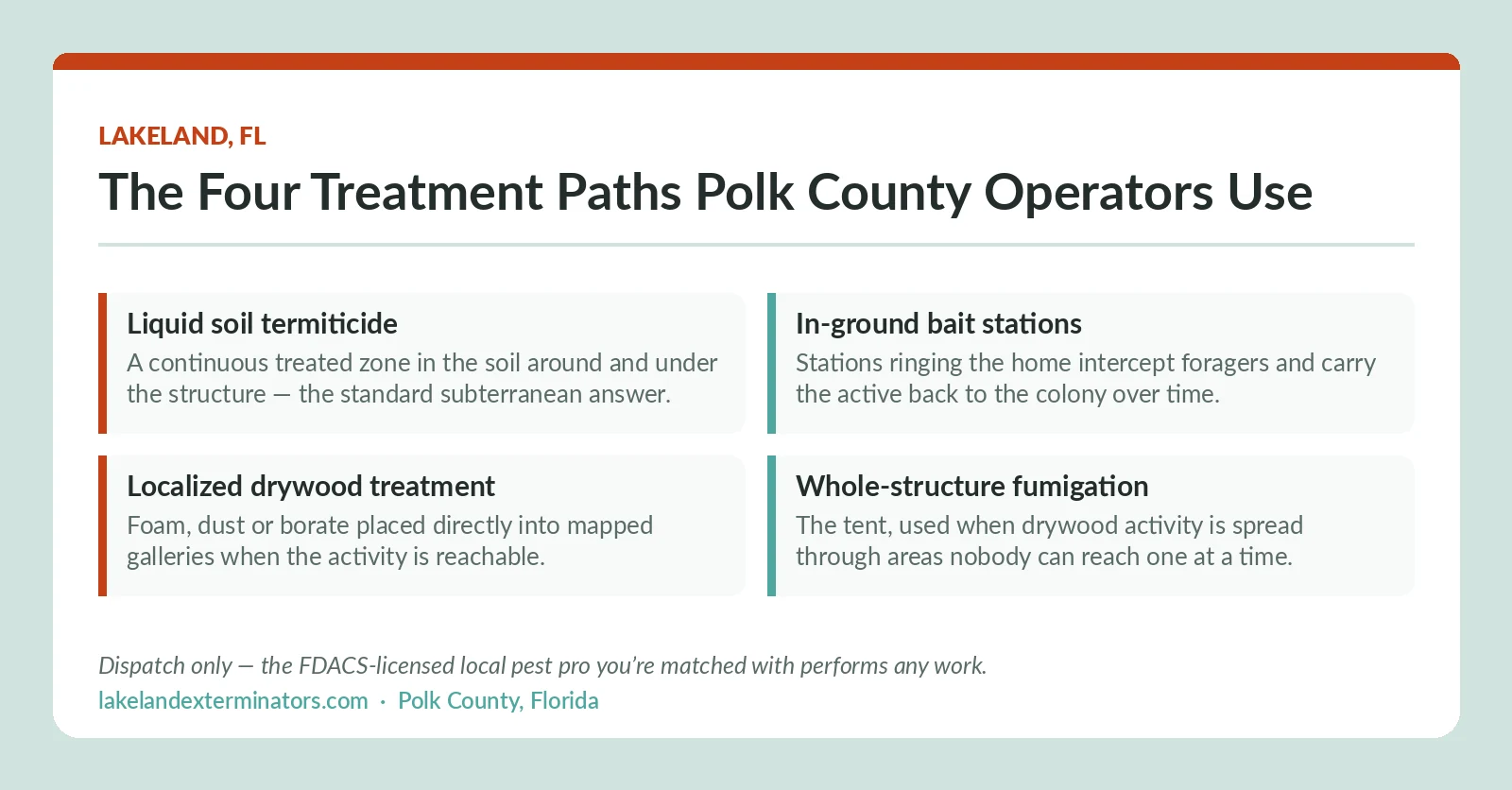
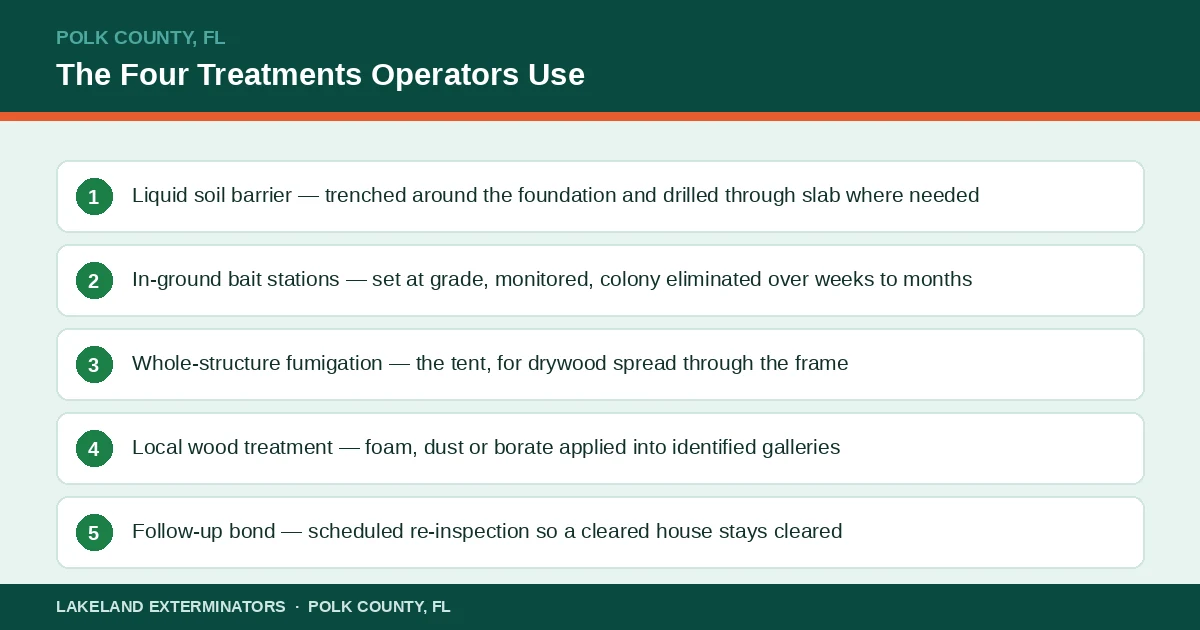
The four treatments Polk County operators actually use
Strip away the brand names and the door-to-door pitch, and there are four real approaches. Everything else is a variation on one of them.
1. Liquid soil barrier (trench and treat)
The classic. The operator digs a narrow trench around the foundation, drills through any concrete that abuts it — driveway seams, patio slabs, garage floors, the porch pour — and injects a termiticide into the soil so it forms a continuous treated zone. Modern non-repellent products are the reason this still works so well: the termites can’t detect the treated soil, so they walk through it, pick up the active ingredient, and carry it back into the colony on their bodies. Nobody gets a warning. The colony declines from the inside.
What it’s good at: subterranean and Formosan termites in slab-on-grade houses, which is most of Lakeland. What it can’t do: touch a drywood colony in your attic, or reach a Formosan carton nest that’s already established above the treated soil line.
2. In-ground bait stations
Instead of poisoning the soil, you poison the food. Stations go in the ground on a ring around the structure, roughly every 10 to 20 feet depending on the label and the layout. Foragers find the bait, feed on it, and haul it back to share — termites feed each other mouth-to-mouth, which is exactly the weakness the bait exploits. The active ingredient blocks molting, so the colony can’t replace workers as they die off.
What it’s good at: houses where drilling the slab is ugly or impractical, homes with lots of hardscape, and owners who want ongoing monitoring rather than one big event. The trade-off is honesty about timelines — bait is a campaign, not a strike. It works on colony time, and it only works if somebody actually services the stations on schedule. Ask who does that and how often before you sign.
3. Whole-structure fumigation (tenting)
The tent goes over the entire house, the structure is sealed, and a fumigant gas is introduced at a concentration and duration calculated for your specific cubic footage. Gas goes everywhere wood goes — inside rafters, behind drywall, into furniture. That is the entire point, and it’s why fumigation is the only method that reaches drywood galleries you cannot see or drill into.
What it’s good at: widespread or multi-site drywood infestations. What it doesn’t do: leave anything behind. Fumigant gas does not residually protect the house. The day the tent comes off, a new drywood swarmer could fly in through an unscreened attic vent. Anyone telling you a tent makes you termite-proof is selling, not explaining.
4. Localized and no-tent drywood work
Spot injection of foam or dust into the galleries, borate treatment of exposed bare wood, targeted heat, or wood replacement. This is the right call when the infestation is genuinely confined — one window frame, one section of fascia, one piece of furniture — and the operator can actually locate the full extent of the galleries.
The catch, and it’s a real one: local treatment only kills what it reaches. If there are three more colonies in the attic nobody found, you paid for a partial answer. A good operator will tell you honestly whether they can bound the problem or not. That’s the single most useful thing you can ask them.
How the Lakeland dispatch line gets you to a licensed operator
Drop your ZIP
33801, 33803, 33809, 33810, 33813, 33815, 33880 — anywhere in Polk County. That one field is all we need to start routing.
A coordinator calls you back
A real person, not a bot. They ask what you saw, where you saw it, and when — mud tubes on the block, pellets on the windowsill, wings in the sink. That triage is what tells us which kind of operator you need.
A licensed operator inspects
An independent, FDACS-licensed pest control operator goes to your address, confirms the species, maps the activity, and works out how far it has spread. No inspection, no honest quote — anyone quoting you a termite price over the phone is guessing.
You get the quote and you decide
The operator sets the price, the treatment plan, the warranty terms and the schedule. Not us. Getting matched costs you nothing, and you are never obligated to accept the plan you’re offered.
Seeing mud tubes or pellets right now?
Termite damage is cumulative. The colony doesn’t pause while you shop.
Talk to a licensed exterminator now
Call and we’ll connect you with a licensed, local exterminator who covers your address. It takes about two minutes, and a real person answers.
Free to call. Free to get matched. The licensed operator gives the quote.
What treatment day actually looks like in a Lakeland house
Nobody tells you this part, and it’s the part you actually have to plan around. Here’s the shape of each one.
A liquid barrier day
Expect a crew, a trench, and noise. They’ll pull mulch and plantings back from the foundation, trench the perimeter soil, and drill through abutting concrete — garage floor, driveway seam, patio, the front porch pour. Those drill holes get plugged and patched afterward; ask to see what the patch looks like before they start, because on a stained or stamped patio it will be visible. Most single-family Lakeland homes are a same-day job. You can usually stay in the house. What you cannot do afterward is re-grade or dig along the foundation — you’d be cutting a door through the barrier you just paid for.
A bait installation day
Much quieter. Stations get augered into the soil around the structure, mapped, and logged. It’s often a couple of hours and you barely notice it happened. The work that matters comes later, at every monitoring visit. Get the service interval in writing and put it on your own calendar, because an unserviced bait station is a piece of plastic in your yard.
A fumigation (tent) week
This is the disruptive one, and you should budget days, not hours. You vacate — people, pets, plants. Food, feed and medicine either leave the house or go into the sealed bags the operator provides. Gas lines get shut off and locked by the utility, and getting them turned back on is its own appointment. The tent goes up, the house is fumigated and then aerated, and nobody re-enters until a licensed fumigator has cleared the structure with an instrument reading. Plan for the pets and the fridge before you plan for anything else.
A localized drywood day
Small, surgical, and fast. Drill, inject, plug, done — often a single visit. The honest question to ask on the way out isn’t “did you kill them”, it’s “how do we know there isn’t another colony you didn’t find?” A straight answer to that is worth more than a discount.
Your build era and your soil change the treatment math
Two houses a mile apart in Lakeland can need genuinely different plans, and it usually comes down to when they were poured and what they were poured on.
The pre-1990s slab neighborhoods. Dixieland, the Garden District around Lake Morton, Cleveland Heights, the older streets ringing Lake Hollingsworth — a lot of that housing stock went down before soil pre-treatment standards tightened up, and decades of settling have opened hairline cracks at plumbing penetrations, expansion joints and slab edges. Eastern subterranean termites don’t need much; a gap the width of a business card will do. On these homes the perimeter is only half the story, and an operator worth their license will want to look at the plumbing penetrations inside too.
The newer South Lakeland, Christina, Grasslands and Highland City builds. Better pre-treats, tighter slabs, but also stucco running to grade, dense foundation plantings and irrigation heads throwing water at the foundation five mornings a week. Termites don’t care that the house is new; they care that it’s damp. Chronic moisture at the foundation is the single most fixable risk factor most Lakeland homeowners have, and nobody has to sell you anything for you to go move a sprinkler head this afternoon.
The North Lakeland and I-4 corridor stock, Kathleen, and the old citrus-grove edges. Land that was grove or scrub carries a lot of buried organic debris — stumps, roots, old landscape timbers, construction lumber that got bulldozed under during the pour. That’s a subterranean colony’s starter kit sitting twenty feet from your footer. Sandy Central Florida soil drains fast, which is good, but it also means termiticide can move differently through it than it would in clay, and a barrier is only as good as the operator’s attention to the awkward corners.
Add the Chain of Lakes to all of it. Humidity in Polk County rarely gives wood a chance to fully dry out, June through September storms dump water at the foundation daily, and any place your roofline dumps runoff without a gutter is a place worth walking after the next hard rain.
When to treat: the Polk County termite calendar
Termites are active here all year — we don’t get a real freeze, so nothing shuts down. What’s seasonal is when you actually see them, and swarm season is when most Lakeland homeowners find out they’ve had a problem for years.
| Termite | When it swarms in Polk County | What that means for your treatment |
|---|---|---|
| Eastern subterranean | February through May, in daylight, typically within a day or two of a warm rain | Swarmers inside the house point to an established colony with soil contact. This is soil barrier or bait territory — the treatment goes in the ground, not the wall. |
| Formosan subterranean | Late spring, on humid evenings, boiling up around porch lights and street lights | Bigger colonies and possible above-ground carton nests. The operator should be checking for nesting sites that a soil-only barrier would never touch. |
| Florida drywood | May through August, warm evenings, often flying toward lights | No soil connection, so nothing in the ground helps you. The decision is localized treatment versus whole-structure fumigation, and that turns entirely on how many separate colonies exist. |
| Everything else, all year | No swarm — just quiet feeding | Not seeing swarmers proves nothing. Mud tubes, frass, hollow-sounding trim and buckling baseboards are the signals that don’t wait for a season. |
One practical note: if you’re a Polk County homeowner who has never had a wood-destroying organism inspection, swarm season is a smart time to get one on the books — before a real-estate deadline forces the issue. Here’s what a WDO inspection covers in Lakeland and why lenders ask for one.
What to ask before you sign the termite contract
You don’t have to know termites to negotiate well. You just have to ask the questions that force specifics. Take this list to whoever shows up.
- “What’s your FDACS license number, and what category is it?” Termite work in Florida requires a WDO category license under Chapter 482, Florida Statutes. You can look up the answer yourself in about a minute — the link’s in the disclosure at the bottom of this page.
- “Which species is this, and what did you see that tells you that?” The answer should reference physical evidence — mud tubes, frass pellets, damaged galleries, live specimens — not a hunch.
- “What’s the product, and is it repellent or non-repellent?” A licensed operator will hand you the product name without blinking, and the label is public record.
- “Is the warranty repair or retreat — and what voids it?” This is the big one. A retreat-only warranty means they come back and spray again; it does not mean they pay to fix the joist. Ask for the difference in writing. Ask what re-grading, adding a deck, or letting mulch pile up against the wall does to your coverage.
- “What does the renewal cost, and can you raise it?” Multi-year termite warranties carry annual renewals. Find out now, not in year three.
- “If you’re proposing localized treatment, how confident are you that you found everything?” Ask them to walk you through why they think the infestation is bounded. If they can’t, that’s your answer about whether local treatment is the right call.
- “What am I expected to do afterward?” Trim plantings back from the wall, fix the leaking hose bib, move the firewood stack off the side of the house, redirect the downspout. Prevention is mostly your job, and it’s free.
On price: we don’t set it and we won’t pretend to. What Polk County operators typically quote depends on linear footage, slab complexity, how much concrete has to be drilled, cubic volume if you’re tenting, and what warranty you buy. The licensed operator sets the price after inspection. For how those variables move the number, see termite treatment cost in Lakeland.
Ready to have a licensed operator look at it?
One ZIP. One call back. You decide from there.
Talk to a licensed exterminator now
Call and we’ll connect you with a licensed, local exterminator who covers your address. It takes about two minutes, and a real person answers.
Free to call. Free to get matched. The licensed operator gives the quote.
Termite treatment questions, answered straight
How long does termite treatment take in a Lakeland home?
It depends entirely on the method. A liquid soil barrier on a typical single-family slab home is usually a same-day job. A bait installation is often a couple of hours, with monitoring visits after that. Whole-structure fumigation is the long one — you vacate the house while it’s tented, fumigated and aerated, and you don’t re-enter until a licensed fumigator clears the structure. Plan on days for a tent, not hours.
Do I have to tent my house for termites in Polk County?
Only if you have drywood termites and the infestation is widespread or spread across multiple areas the operator can’t individually reach. Subterranean and Formosan termites are treated from the soil, not from a tent. And even with drywood, if the activity is genuinely confined to one window frame or one run of fascia, localized treatment can be appropriate. The question that decides it is whether the operator can honestly bound the infestation. Ask them.
Sentricon-style bait or a liquid barrier — which one is right for my slab?
Both are legitimate for subterranean termites and both are used widely across Lakeland. A liquid barrier acts fast and creates a treated soil zone, but it means trenching and drilling through abutting concrete. Bait is far less invasive, gives you ongoing monitoring, and suits homes with a lot of hardscape — but it works on colony time and only if the stations are actually serviced on schedule. Let the licensed operator inspect and recommend, then ask them to explain the trade-off in the terms above.
Can I stay in the house during termite treatment?
For a liquid barrier or a bait installation, usually yes — the operator will tell you what to keep clear and for how long. For whole-structure fumigation, absolutely not. People, pets and plants leave, food and medicine are sealed or removed, and nobody goes back in until the structure has been aerated and cleared by a licensed fumigator with an instrument reading. Follow those instructions exactly.
How fast do the termites die after treatment?
Faster than you can see, and slower than you’d like. Non-repellent liquid termiticides work by transfer — termites walk through treated soil undetected and carry the active ingredient back into the colony — so the colony declines over a period of weeks rather than overnight. Bait works on molting and takes longer still. Fumigation kills what’s in the structure while the gas is present. Seeing a few stragglers shortly after a treatment is not automatically a failure; seeing new mud tubes months later is a reason to call the operator back under the warranty.
Does homeowners insurance cover termite damage in Florida?
Almost never. Standard homeowners policies treat termite damage as a maintenance issue — preventable, gradual, and therefore excluded. That’s exactly why the warranty terms on your termite contract matter so much, and why the repair-versus-retreat distinction is worth pushing on before you sign anything.
What does termite treatment cost in Lakeland?
We don’t set prices and we won’t quote one. What Polk County operators typically quote is driven by linear footage of foundation, how much concrete has to be drilled, the cubic volume of the structure if you’re fumigating, the treatment method, and the warranty you choose. The licensed operator sets the price after inspecting your home. See termite treatment cost in Lakeland for how each of those variables moves the number.
How do I check that the operator is actually licensed?
Look them up yourself. Florida pest control operators are licensed under Chapter 482, Florida Statutes, and license status is public. Search the operator or the business at the FDACS license search linked in the disclosure below. It takes about a minute, and anyone who gets cagey when you say you’re going to do it has told you something useful.
Disclosure
Lakeland Exterminators is a dispatch and matching service. We connect Polk County callers with FDACS-licensed pest control operators. We are not a licensed pest control operator. We do not perform treatment, set prices, issue warranties, hold bonds, or carry pest control trade insurance. All pricing, scheduling, treatment plans, warranties and service terms are determined by the FDACS-licensed operator dispatched to your address under Chapter 482, Florida Statutes.
Same-day and 24/7 emergency services are subject to provider participation, location, technician availability, and demand. Availability is not guaranteed and may vary by market and appointment capacity.
License status of any operator you connect with is publicly verifiable at the FDACS license search.