Termites are the one thing your homeowner’s policy will not pay for. A bond is how Lakeland covers that gap.
One call reaches a licensed, local exterminator who covers your address — and a real person answers, 24/7.
Talk to a licensed exterminator now
Call and we’ll connect you with a licensed, local exterminator who covers your address. It takes about two minutes, and a real person answers.
Free to call. Free to get matched. The licensed operator gives the quote.
24/7 line · A real person answers · Availability of same-day and emergency service depends on the provider.
What a Florida termite bond actually is — and what it is not
Look, here is the deal. A termite bond is not a bond in the bail-bondsman sense, and it is not insurance in the carrier sense. It is a renewable service contract between a homeowner and an FDACS-licensed pest control operator, written under Chapter 482, Florida Statutes. Strip away the sales language and it obligates the operator to do one or both of these things:
- Retreat. If covered termites turn up during the term, the operator comes back and treats again — at no extra charge to you.
- Repair. On the stronger contracts, the operator also pays up to a written dollar cap toward new structural damage the covered termites caused while the bond was in force.
In exchange, you pay an annual renewal, and the operator performs an annual inspection. That inspection is quietly the most valuable line in the contract — it is a licensed set of eyes on your slab line, crawl space and attic framing every twelve months in a county where termites never take a season off.
Three things a bond is not
- It is not a promise termites will stay away. It is a promise about what happens when they do not. Any operator selling it as termite-proofing is selling you the wrong story.
- It is not automatically transferable. Transfer at sale is a clause, not a given. Ask to see it in writing before you sign — it is worth real money at closing.
- It is not one product. “Termite bond” covers everything from a bare retreatment clause to a full damage-repair contract covering both subterranean and drywood termites. The label on the folder tells you almost nothing.
The two bond types — the difference matters more than the price
Almost every conversation about whether a bond is “worth it” goes sideways because the two people talking are describing different products. Here is the honest split.
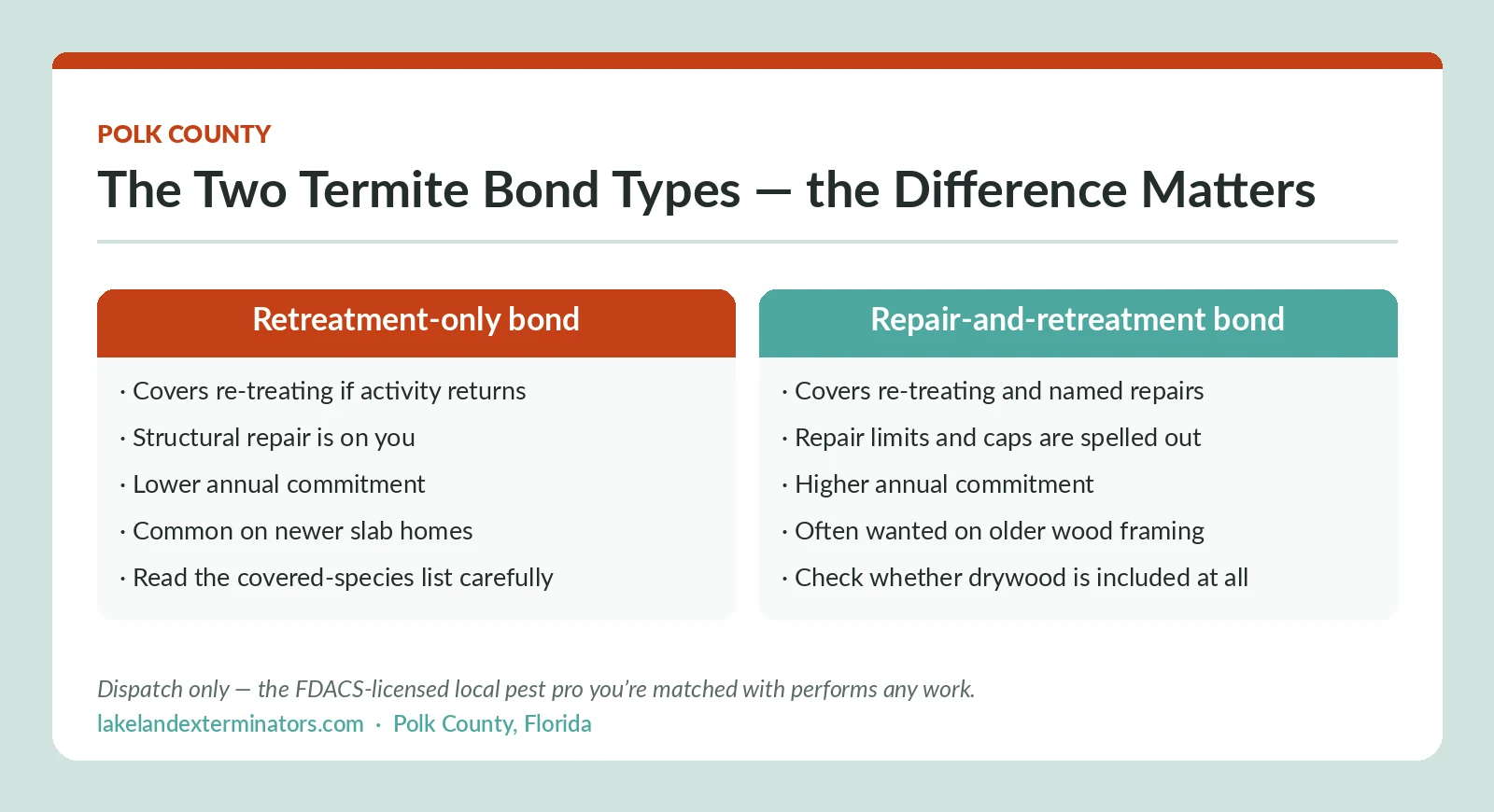
Retreatment-only bond
The operator returns and re-treats if covered termites are found during the term. They pay nothing toward damage. This is the lower-renewal, lower-coverage tier, and it is what most homeowners are actually holding when they say they “have a bond.” It protects your wallet from the second treatment — not from the joist.
Repair bond (retreatment + damage)
Retreatment plus a written dollar cap toward repairing new structural damage caused by covered termites during the term. Higher renewal, and it is the only version that pays out on the event that actually hurts — the one where a sill plate has quietly turned to honeycomb. Read the cap, the exclusions and the claims process before you sign.
Bait-system service agreement
With an in-ground bait system, the “bond” is usually bundled into an ongoing monitoring agreement: quarterly station checks, bait replenishment, retreatment, and on some contracts a damage warranty. Lapse the agreement and you lose the monitoring that made the system work. Compare treatment paths →
The question that separates them
Ask the operator this, word for word: “If I find termite damage next year, what exactly does this contract pay for?” If the answer is “we come back and treat,” you are holding a retreatment bond. That may be the right call for your house — but you should know which one you bought.
Want a bond quoted on your actual house — not a phone estimate?
One call reaches a licensed, local exterminator who covers your address — and a real person answers, 24/7.
Free to call. Free to get matched. The licensed operator gives the quote.
Why the bond math works differently in Lakeland than in Ohio
Termite bonds get argued about on national forums by people who live where the ground freezes. Polk County is a different problem, and three local facts drive the whole calculation.
1. Zone 9b soil never shuts the colony down
Subterranean termites feed as long as the soil stays warm and damp. In Lakeland that is twelve months a year — there is no winter die-back and no off-season where the risk pauses. A colony you discover in November has been feeding since last November. That is the single reason an annual inspection clause carries more weight here than almost anywhere else in the country.
2. The county carries all three structural termites at once
Eastern subterranean termites come up through slab joints and plumbing penetrations. Formosan subterranean termites are established around Lakeland and build above-ground carton nests that hold their own moisture. Florida drywood termites drift in through soffit and gable vents and never touch soil at all. Here is the part that catches people: a subterranean bond usually does not cover drywood termites. Two different pests, two different contracts, and plenty of homeowners find that out the week the frass pellets appear.
3. The older neighborhoods are built out of termite food
Dixieland, South Lake Morton and the Garden District, Cleveland Heights, Beacon Hill — cypress and pine framing, early slab and pier-and-beam foundations, stucco over original wood, soffit details with exposed end grain. Sandy Central Florida soil drains fast and makes trenching straightforward, but it also means a barrier can be disturbed by landscaping, a new patio pour or a French drain without anyone noticing. In the newer South Lakeland, Christina and Grasslands builds, the exposure shifts: monolithic slabs, pre-construction treatment that ages out, and irrigation lines running right along the stem wall.
The Polk County swarm calendar — when a bond earns its inspection
| Season | What swarms | What the annual inspection is looking for |
|---|---|---|
| February – May | Eastern subterranean | Mud tubes at the slab edge, stem wall and garage expansion joints; discarded wings on sills after warm rain. |
| April – July | Formosan subterranean | Carton nesting in wall voids and attics; heavy dusk swarms on humid, windless evenings near porch lights. |
| May – August | Florida drywood | Six-sided frass pellets under attic framing, window sills and furniture — the pest most bonds exclude. |
| Year-round | Workers of all three | Feeding never stops. Tubes, frass and hollow-sounding trim are the tell in any month. |
If you want the full treatment picture behind the bond, start with the termite treatment guide for Lakeland — it walks through liquid barriers, bait systems, tenting and no-tent work.
What a termite bond costs in Polk County (and why we will not put a number on it)
Straight answer: we do not publish prices, because we do not have any. Lakeland Exterminators is a dispatch line, not a pest control company. Every dollar figure in this decision belongs to the FDACS-licensed operator who walks your property. Anyone quoting you a bond price over the phone, sight unseen, is guessing — and you should treat that guess as a red flag.
What we can tell you is how Polk County operators typically build the number, so the quote makes sense when you get it:
- Initial treatment vs. renewal are two different line items. The bond usually starts with an initial treatment (liquid barrier or bait installation), then an annual renewal that is a fraction of it. Industry cost guides generally describe the renewal as the smaller, recurring number — but the split varies by operator and system, and the licensed operator sets the real figure after inspection.
- Linear footage of foundation drives liquid barrier work far more than square footage does. A sprawling ranch with a wrapped lanai costs more to trench than a compact two-story with the same interior space.
- Construction type. Monolithic slab, block-on-slab, pier-and-beam, added lanais and Florida rooms poured against the original slab — each one changes how much drilling is involved.
- Species covered. Subterranean-only, drywood-only, or both. Adding drywood coverage is a materially different contract, not a checkbox.
- Repair cap size. A higher written damage cap generally means a higher renewal. Ask what the cap is; ask what it excludes.
- Prior treatment history. A documented, recent treatment with a clean inspection is a different risk to underwrite than a home that has never been evaluated.
For a full breakdown of the treatment numbers behind a bond, see the termite treatment cost guide for Lakeland and the cost of termite tenting in Florida. Both explain the drivers without pretending anyone can price your house from a keyboard.
Nine things to check before you sign the bond
Print this. Ask every one of them out loud, and get the answers in the contract rather than in conversation.
- 1. Which species are named? Subterranean, drywood, or both. If drywood is not named, the tent is on you.
- 2. Retreatment-only or retreatment plus repair? Say the words back to the operator and confirm.
- 3. What is the written damage cap? A repair bond with a cap you have not read is a repair bond you cannot evaluate.
- 4. Is it transferable at sale, and at what fee? A transferable bond is a genuine asset at the closing table. Get the transfer clause in writing.
- 5. Is the renewal price locked, or re-priced annually? Some contracts hold the renewal steady; others move with the market. Ask which.
- 6. What areas are excluded? Inaccessible walls, pool decks, detached structures, certain attic areas. Exclusions are where claims go to die.
- 7. What voids it? Common triggers: homeowner-applied soil treatments inside the treated zone, landscaping or hardscaping that disturbs the barrier, structural changes, and lapsed renewal past the grace period.
- 8. What is the grace period on a missed renewal? Once a bond lapses, reinstatement usually means a new inspection and often a new treatment — not a back payment.
- 9. Is the company FDACS-licensed for the categories this work requires? Termite work requires a WDO category; fumigation requires a separate one. Verify it yourself before you sign.
Verify before you hire — any Florida pest control company’s license status, categories and discipline history is public at the FDACS license search. Check the operator you are matched with. The good ones expect it.
Buying or selling? The bond and the WDO report travel together
This is where the bond stops being a maintenance question and starts being a closing question. Most Florida lenders want a WDO (wood-destroying organism) inspection before funding — If the report shows active termites, treatment typically becomes a condition of closing, on somebody else’s clock.
Two practical consequences for Polk County sellers and buyers:
- Sellers: a transferable bond with a documented treatment history and clean annual inspections is one of the few pieces of paper that makes a WDO finding a non-event. A non-transferable bond is worth nothing to the buyer.
- Buyers: ask for the bond paperwork, not the reassurance. Confirm the species named, the transfer fee, and whether the seller kept the renewals current. A lapsed bond on a 1970s Dixieland bungalow is a different purchase than an active one.
Start here: the WDO inspection guide for Lakeland, the WDO termite report explained, and — if you are building — pre-construction termite treatment in Lakeland, which is where a new-construction bond usually begins.
How the dispatch works
Straight up: Lakeland Exterminators is a dispatch and matching service, not a licensed pest control operator. Here is the exact path your call takes.
Tell the line what you need
A new bond, a second opinion on a renewal you were just handed, or an inspection because you saw wings. A real person answers around the clock.
Your address picks the operator
The call routes to an FDACS-licensed operator covering your part of Polk County — Lakeland, Winter Haven, Bartow, Lake Wales, Highland City, the I-4 corridor.
Licensed inspection on site
The operator inspects the structure, identifies the species and conducive conditions, then writes the bond terms and the price. Pricing comes from them, never from us.
The bond stays with the pro
Retreatment obligations, damage caps, warranties and renewals are all held by the licensed operator under Chapter 482, Florida Statutes. We hold none of it.
Get the bond terms in writing, from a licensed Polk County operator.
One call reaches a licensed, local exterminator who covers your address — and a real person answers, 24/7.
Free to call. Free to get matched. The licensed operator gives the quote.
Termite bond questions, answered straight
Is an annual termite bond worth it in Lakeland?
For most Polk County homes, the case is strong — and it rests on three local facts, not on a sales pitch. Soil here stays warm enough for subterranean termites to feed year-round, all three structural termite species are present in the county, and homeowner insurance in Florida almost never pays for termite damage. The bond is the only contract that responds when termites turn up. Where it gets genuinely arguable: a home inside a fresh treatment residual window, a home with an actively maintained bait system, or new construction still inside a builder warranty. Even then, someone has to be doing an annual inspection — if that is not you, it should be a licensed operator.
What is the difference between a retreatment bond and a repair bond?
A retreatment-only bond obligates the operator to come back and treat again if covered termites are found — but pays nothing toward damage. A repair bond adds a written dollar cap toward repairing new structural damage caused by covered termites during the term. The renewal is higher on a repair bond, and it is the only version that pays out on the event that actually costs you money. Ask the operator to state, in the contract, exactly what the bond pays for if damage is found next year.
Does homeowners insurance cover termite damage in Florida?
Almost never. Standard Florida homeowner policies exclude termite damage as a preventable maintenance issue — the reasoning being that termites work slowly enough that the homeowner is expected to catch them. That exclusion is the entire reason termite bonds exist as a product. If you are unsure, read your policy language or ask your carrier in writing; the exclusion is usually explicit.
What does a termite bond cost in Polk County?
We do not set or publish prices — we are a dispatch service, not a pest control operator. The licensed operator sets the number after inspecting your property. What drives it: linear footage of foundation, construction type, which species are named, the size of the repair cap, the treatment system (liquid barrier vs. in-ground bait), and prior treatment history. Industry cost guides typically describe the annual renewal as a fraction of the initial treatment, but the split varies by operator and system. Anyone quoting a firm bond price before inspecting is guessing.
Does a termite bond transfer when I sell my house?
Only if the contract says so. Transferability is a clause, not a default, and it usually carries a transfer fee and a fresh inspection. It is worth confirming in writing before you sign, because a transferable bond with clean annual inspection records is a real asset at the closing table — especially when the WDO report comes back with findings. A non-transferable bond is worth nothing to your buyer.
What voids a termite bond?
The common triggers are consistent across Polk County operators: applying your own termiticide to soil inside the treated zone, disturbing the barrier with landscaping, a new patio pour, a French drain or irrigation work, structural modifications that breach the treated zone, denying access for the annual inspection, and letting the renewal lapse past the grace period. If you are about to do hardscaping or a room addition on a bonded house, call the operator first. That one phone call has saved a lot of bonds.
Is a bond worth it on new construction?
New Florida construction typically gets a pre-construction soil treatment before the slab is poured, often with a builder-backed warranty for an initial period. That coverage is real, but it is finite, and it usually stops well short of the life of the house — which is exactly when many owners discover the barrier has aged out. Read what the builder warranty covers, when it expires, and whether the treating company offers a renewable bond that picks up where it ends. The pre-construction treatment guide covers how that first barrier is installed and inspected.
Disclosure
Lakeland Exterminators is a dispatch and matching service. We connect Polk County callers with FDACS-licensed pest control operators. We are not a licensed pest control operator. We do not perform treatment, set prices, issue warranties, hold bonds, or carry pest control trade insurance. All pricing, scheduling, treatment plans, warranties, bonds and service terms are determined by the FDACS-licensed operator dispatched to your address under Chapter 482, Florida Statutes.
Same-day and 24/7 emergency services are subject to provider participation, location, technician availability, and demand. Availability is not guaranteed and may vary by market and appointment capacity.
License status of any operator you connect with is publicly verifiable at the FDACS license search.