Little piles of pellets on the windowsill? That’s a drywood termite — and it’s living inside the wood, not under your house.
Drywood termites in Lakeland don’t build mud tubes and don’t touch your soil, which means every treatment you’ve read about for “regular” termites is the wrong one. Here’s how to tell what you’ve got, when a tent is genuinely necessary, and when it absolutely isn’t. Then drop your ZIP and we’ll route you to a licensed Polk County operator.
Talk to a licensed exterminator now
Call and we’ll connect you with a licensed, local exterminator who covers your address. It takes about two minutes, and a real person answers.
Free to call. Free to get matched. The licensed operator gives the quote.
24/7 line · A real person answers · Availability of same-day and emergency service depends on the provider.
Before anything else: make sure it’s actually drywood
Look, here’s the deal. Half the people who call about “drywood termites” in Lakeland have subterranean termites, and half the people who call about subterranean termites have drywood. It matters enormously, because the two get treated in completely different places — one in the soil, one in the wood — and buying the wrong one is just an expensive way to keep your infestation.
The single fastest way to separate them: go look for mud.
It’s drywood if…
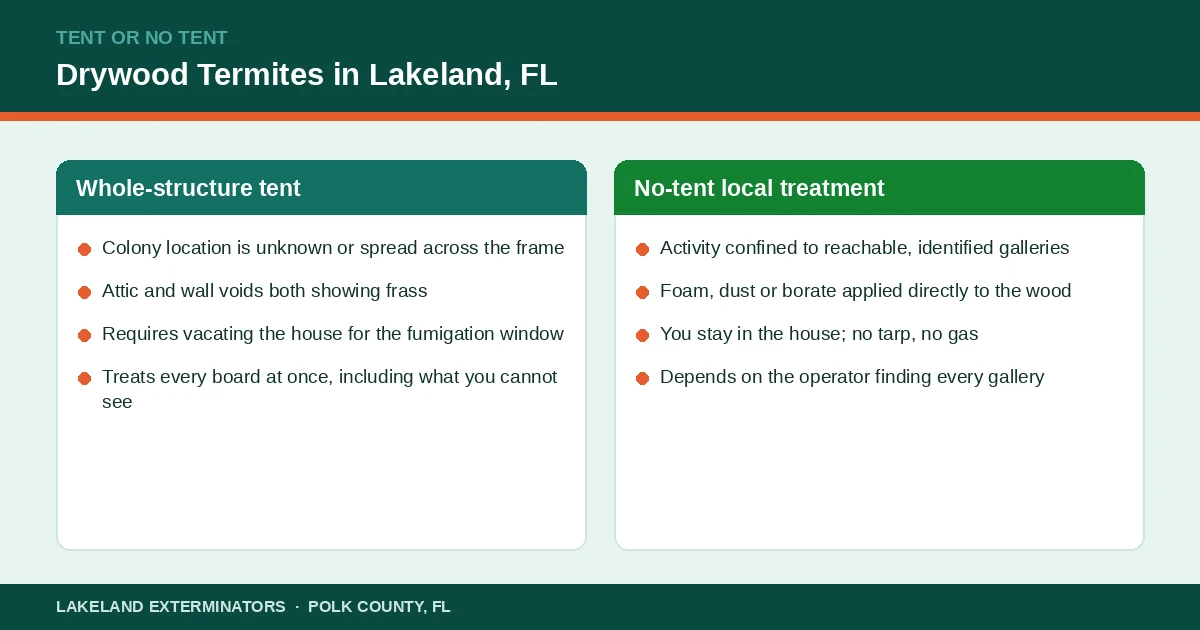
You’re finding small piles of hard pellets. No mud, anywhere. The activity is up high — attic, rafters, fascia, window and door frames, crown moulding, furniture — rather than down at the foundation. There are tiny round kick-out holes about the size of a pinhead. And the wood in question has no contact with the ground whatsoever.
Florida drywood termite biology →It’s subterranean if…
You see pencil-width mud tubes running up the block, the slab edge, a pier or the inside of the garage wall. Damaged wood packed with soil and mud rather than clean and hollow. Activity concentrated low, near grade, near plumbing penetrations, near anything chronically damp. That’s a colony living in the ground and commuting into your house.
Subterranean termite treatment in Polk County →Still not certain? Run through the full visual sign checklist, or compare against what termite damage looks like versus water rot. And for the overview of every termite service available locally, start at termite control in Lakeland.
The three tells: frass, kick-out holes, and a wall that sounds wrong
1. Frass — and it is genuinely distinctive
This is the one that brings most Lakeland homeowners to this page. Drywood termites are tidy in the strangest way: they push their droppings out of the gallery rather than living with them. The pellets pile up below the hole, and they don’t look like anything else in your house.
Get close. Each pellet is about a millimetre long, hard, and — here’s the giveaway — six-sided, with concave faces, like a tiny grain of rice that’s been pressed flat on six sides. People describe it as coarse sand, sawdust, or coffee grounds, and it’s none of those. Sawdust from a carpenter bee or a drill is fibrous and irregular. Frass is uniform, granular and hard. Colour tracks the wood the termites are eating, so it can be anything from pale tan to near-black — don’t use colour to rule it in or out.
The other clue frass gives you is location. It falls straight down. A pile on the windowsill points at the frame above it. A pile on the garage floor points at the rafter over it. A pile that keeps reappearing after you sweep it up means the colony is active right now, not a ghost of something that got treated in 2019.
2. Kick-out holes
The pellets have to come from somewhere. Look directly above the pile for a pinhead-sized round hole. Sometimes it’s plugged with a bit of frass, sometimes it’s open. Sometimes there are several. It’s easy to miss on textured or dark-stained trim, so use a flashlight held at a low angle across the surface — that’s the trick that makes a tiny hole throw a shadow.
3. The sound and the surface
Drywood termites eat the inside of the board and leave the outer skin and the paint film intact. That’s why a piece of fascia can be structurally junk and still look fine from the driveway. Tap along the trim with the handle of a screwdriver: solid wood thuds, hollowed wood gives you a papery, drum-like knock. Blistered, rippled or slightly sunken paint over a board is the same story told visually — the surface has nothing left behind it.
And of course there are the swarmers. Drywood alates fly in Lakeland from roughly May through August on warm evenings, often toward lights. What you’re more likely to find than the insects themselves is the aftermath: a scatter of shed wings on a windowsill or in a light fixture, all four the same size. That’s worth pinning down by month — the Polk County swarm calendar will tell you which species the timing points to.
How the Lakeland dispatch line gets you to a licensed operator
Drop your ZIP
33801, 33803, 33809, 33810, 33813, 33815, 33880 — anywhere in Polk County. That’s all we need to start routing.
A coordinator calls you back
A real person. Tell them what you found and where — pellets under a window, wings in the sink, a hollow-sounding rafter. Drywood work needs a specific kind of operator, and that triage is how we get you one.
A licensed operator inspects
An independent, FDACS-licensed pest control operator confirms the species and — critically for drywood — tries to establish how many separate colonies exist. Nobody can answer the tent question without doing that first.
You get the quote and you decide
The operator sets the price, the method, the warranty and the schedule. Not us. Getting matched costs nothing, and you’re never obligated to take the plan you’re offered.
Sweeping up the same pile of pellets twice?
Then it’s active. A licensed operator can tell you how far it’s gone.
Talk to a licensed exterminator now
Call and we’ll connect you with a licensed, local exterminator who covers your address. It takes about two minutes, and a real person answers.
Free to call. Free to get matched. The licensed operator gives the quote.
Tent or no tent? Here’s how the decision actually gets made
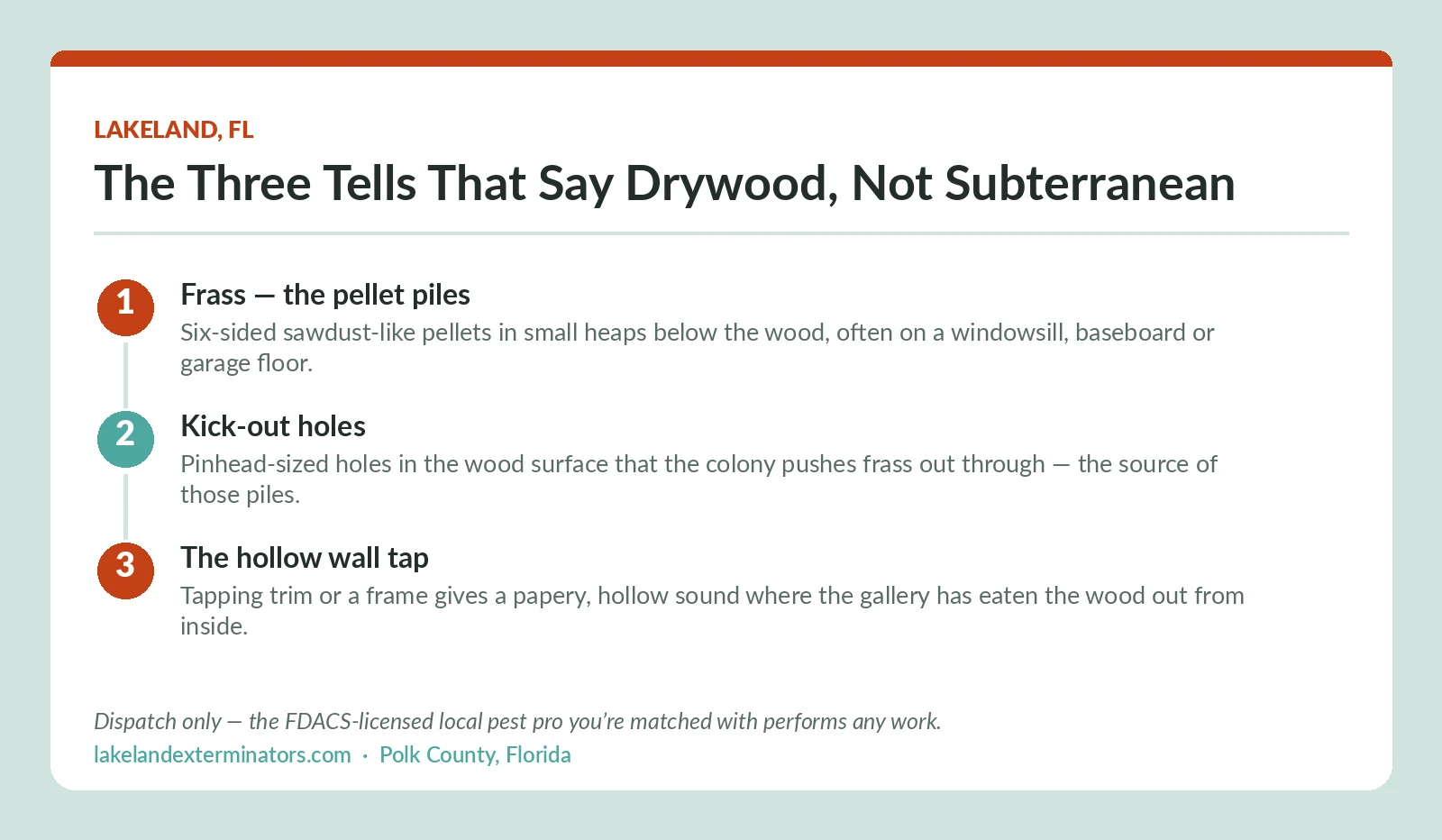
This is the whole question with drywood termites, and it comes down to one thing: can the operator find and reach every colony, or can’t they? Everything else is detail.
Whole-structure fumigation (tenting)
The tent seals the house and a fumigant gas is introduced at a concentration and duration calculated for your specific cubic footage. Gas goes wherever wood goes: inside rafters, behind drywall, into the piano. That reach is the point. If drywood activity is showing up in three different parts of the house, or if it’s in framing nobody can drill into without demolishing a ceiling, fumigation is the only method that gets everything.
What it does not do is leave anything behind. Fumigation has no residual effect — the day the tent comes off, a new drywood swarmer could fly in through an unscreened gable vent and start over. That’s not a flaw, it’s just how gas works, and anyone selling a tent as permanent immunity is selling rather than explaining. Ask instead about the post-fumigation warranty and what it actually covers.
Practically: you vacate. People, pets and plants out. Food, feed and medicine either leave or go into the sealed bags the operator provides. The gas utility shuts off and locks the meter, and turning it back on is its own appointment. Nobody re-enters until a licensed fumigator has cleared the structure with an instrument reading. Budget days, and sort out the pets and the fridge before you sort out anything else.
No-tent and localized options
Drill-and-inject foam or dust into the galleries. Borate treatment of accessible bare wood. Targeted heat. Straight-up replacement of the affected board. These are legitimate, they’re far less disruptive, and for a genuinely contained infestation they’re often the sensible answer — one window frame, one run of fascia, one antique dresser.
The catch is real and you should hold it firmly: localized treatment only kills what it reaches. If there are two more colonies in the attic that nobody located, you’ve bought a partial answer at a full price, and you’ll find out in eighteen months. There’s more detail on the trade-offs on our no-tent termite treatment page.
So the question to put to the licensed operator, in these words, is: “How confident are you that you’ve found all of it — and what did you inspect to get to that confidence?” A straight answer is worth more than a discount. An operator who says “honestly, I can’t rule out the attic” is being more useful to you than one who promises a cheap fix.
Why Lakeland houses are such comfortable drywood territory
Drywood termites don’t need your soil, your leaky hose bib or your irrigation overspray. They need seasoned wood and warm air, and Polk County hands them both for most of the year. We don’t get a hard freeze, so nothing resets the clock. Chain of Lakes humidity keeps the wood moisture content in a range they’re happy with. And the swarming pairs fly — which means the risk isn’t about how tidy your yard is, it’s about what your house lets in through the air.
The specific entry points worth walking this weekend:
- Attic and gable vents with torn or missing screening. This is the classic Lakeland one. A swarmer needs an opening the width of a pencil lead. Fine mesh screening on every vent is cheap and it’s the highest-leverage thing most homeowners can do themselves.
- Bare, unpainted, weathered wood. Fascia boards, soffit trim, the exposed rafter tails on the older Dixieland and Garden District bungalows, the wooden fence panel that’s touching the garage wall. Paint and sealant are a genuine physical barrier — a swarming pair can’t bore into a properly sealed surface.
- Wooden window and door frames on the sun-and-rain side. The south and west elevations take the worst of the Central Florida weather cycle, and that’s where the paint film cracks first.
- Second-hand furniture. Drywood termites travel in furniture, and they always have. That estate-sale armoire, the reclaimed barn wood, the wooden crate someone gave you — check the underside and the back panel before it comes in the house.
- Attached wooden structures. Pergolas, trellises, decks, fence rails bolted into the wall. They’re a bridge, and they’re usually the least-maintained wood on the property.
Housing stock matters too. The pre-1990s neighborhoods — Dixieland, Cleveland Heights, the streets around Lake Morton and Lake Hollingsworth — carry a lot of exposed original woodwork, decorative trim and real wood windows, which is exactly the surface area drywood termites want. The newer South Lakeland, Christina, Grasslands and Highland City builds have less exposed timber, but they also have attics full of untreated framing and vents that nobody has looked at since the certificate of occupancy.
Drywood swarm timing in Polk County, and what to do with it
| Window | What happens | What it means for you |
|---|---|---|
| May – August | Florida drywood termites swarm on warm evenings, frequently flying toward lights. | Shed wings on a sill or in a light fixture are the most common way Lakeland homeowners discover drywood. Bag a few insects if you can — a real specimen makes the operator’s identification faster and firmer. |
| Year round | Established colonies eat continuously. There’s no dormant season in Polk County. | Frass appearing in November means just as much as frass appearing in June. Don’t wait for a swarm to confirm what the pellets already told you. |
| For contrast: February – May | Eastern subterranean termites swarm in daylight after warm rain. | If you’re seeing swarmers in March, you’re probably not looking at drywood at all. Go check the foundation for mud tubes. |
One more thing worth knowing: a swarm coming out of your house means the colony inside is mature enough to reproduce, which takes years. A swarm arriving at your house from a neighbour’s tree or roofline is a fresh risk, not proof of an infestation. The operator can usually tell which is which by where the wings are and where the frass is. If you’re also buying or selling, a WDO inspection in Lakeland is the formal version of this whole conversation.
What to ask before you sign anything
- “What’s your FDACS license number?” Termite work in Florida is licensed under Chapter 482, Florida Statutes, and the status is public. The verification link is in the disclosure at the bottom of this page. It takes a minute. Do it.
- “How many separate colonies do you think there are, and what makes you say that?” This is the drywood question. Everything about tent-versus-no-tent hangs on the answer.
- “If you’re recommending local treatment, what happens if you missed one?” The answer should be a warranty term you can read, not a reassuring noise.
- “Is the warranty repair or retreat?” Retreat means they come back and treat again. Repair means they pay to fix the wood. Those are wildly different products and they get sold with similar-sounding words.
- “What’s the renewal, and can it go up?” Ask in year one, not in year three.
- “What do I need to do afterward?” Screen the vents. Paint the bare fascia. Seal the trim. Prevention is mostly your job and it doesn’t cost anything but a Saturday.
On price: we don’t set it and won’t guess at it. What Polk County operators typically quote for drywood work depends on whether it’s a tent or a spot treatment, the cubic volume of the structure, how accessible the galleries are, and the warranty you buy. The licensed operator sets the price after inspection. For how those variables move the number, see termite treatment cost in Lakeland. If you want the full method-by-method walkthrough, the complete Lakeland termite treatment guide covers all four approaches end to end.
Get a licensed operator to look at the pellets
One ZIP. One call back. You decide from there.
Talk to a licensed exterminator now
Call and we’ll connect you with a licensed, local exterminator who covers your address. It takes about two minutes, and a real person answers.
Free to call. Free to get matched. The licensed operator gives the quote.
Drywood termite questions, answered straight
How do I know it’s frass and not sawdust?
Look at a pellet under decent light, ideally with a phone camera zoomed in. Drywood frass is hard, uniform, about a millimetre long and six-sided with slightly concave faces. Sawdust is fibrous, irregular and soft. Colour tells you nothing useful — frass takes on the colour of whatever wood is being eaten, so it ranges from pale tan to nearly black. The other tell is that frass reappears: sweep it up, and if it’s back in a few days, the colony is active.
Do I have to tent my house for drywood termites?
Not automatically. Tenting is the answer when the infestation is widespread, or when it’s in framing the operator can’t reach any other way. If the activity is genuinely confined to one accessible area, localized treatment can be appropriate. The deciding question is whether the operator can honestly bound the infestation — ask them directly how confident they are that they found all of it, and what they inspected to get there.
Can drywood termites spread from my furniture into the house?
Yes, and it’s a genuinely common route into Lakeland homes. Drywood termites live entirely inside wood with no soil connection, so an infested piece of furniture is a self-contained colony that can produce swarmers, and those swarmers can start new colonies in your framing. Check the underside and back panel of any second-hand wooden furniture before it comes indoors, and take frass on a shelf or in a drawer seriously.
Does a tent protect my house from future drywood termites?
No. Fumigant gas kills what is in the structure while it is present and then dissipates completely — there is no residual protection. A new swarming pair could enter through an unscreened attic vent the following season. That’s why the follow-up matters: screen the vents, keep exposed wood painted and sealed, and understand what your post-treatment warranty actually covers.
Will a liquid soil treatment kill drywood termites?
No, and this is the mistake that costs people the most money. Liquid termiticide barriers and in-ground bait stations both work by intercepting termites that travel through soil. Drywood termites never touch the soil — they arrive by air and live entirely inside the wood. Treating the ground around a drywood infestation does nothing at all.
How long have they been there if I’m only seeing pellets now?
Probably longer than you’d like. Drywood colonies grow slowly and stay hidden, and a colony usually has to reach a few years of maturity before it produces enough frass to be noticeable or enough swarmers to fly. The reassuring flip side is that drywood colonies are also comparatively small and slow feeders, so the damage accumulates gradually. Finding pellets is not an emergency in the sense of a burst pipe — but it does mean the clock has been running for a while.
What does drywood termite treatment cost in Lakeland?
We don’t set prices and won’t quote one. What Polk County operators typically quote depends on whether the job is a whole-structure fumigation or a localized treatment, the cubic volume of the house, how accessible the galleries are, and the warranty terms you choose. The licensed operator sets the price after inspecting. See termite treatment cost in Lakeland for how each variable moves the number.
Disclosure
Lakeland Exterminators is a dispatch and matching service. We connect Polk County callers with FDACS-licensed pest control operators. We are not a licensed pest control operator. We do not perform treatment, set prices, issue warranties, hold bonds, or carry pest control trade insurance. All pricing, scheduling, treatment plans, warranties and service terms are determined by the FDACS-licensed operator dispatched to your address under Chapter 482, Florida Statutes.
Same-day and 24/7 emergency services are subject to provider participation, location, technician availability, and demand. Availability is not guaranteed and may vary by market and appointment capacity.
License status of any operator you connect with is publicly verifiable at the FDACS license search.