Heavy footsteps in the attic aren’t rats. Here’s who’s actually up there.
One call reaches a licensed, local exterminator who covers your address — and a real person answers, 24/7.
Talk to a licensed exterminator now
Call and we’ll connect you with a licensed, local exterminator who covers your address. It takes about two minutes, and a real person answers.
Note: this line is for raccoon, opossum, squirrel, and bat wildlife issues specifically. If your issue is ants, roaches, termites, rodents indoors, or other general household pests, use our main pest match instead.
Free to call. Free to get matched. The licensed operator gives the quote.
24/7 line · A real person answers · Availability of same-day and emergency service depends on the provider.
Sort the animal by the sound and the season
Wildlife work starts with an ID you can often make from the living room. Heavy, slow thumps at night: raccoon. Fast scampering at dawn and dusk: squirrel. Slow shuffling and a musky smell under the deck or in the garage: opossum. High chittering at dusk from a gable end, with staining around a gap: bats. Light, quick scratching after midnight is usually not wildlife at all — that’s the roof rat pattern, which routes to rodent work instead.
Raccoon (Procyon lotor)
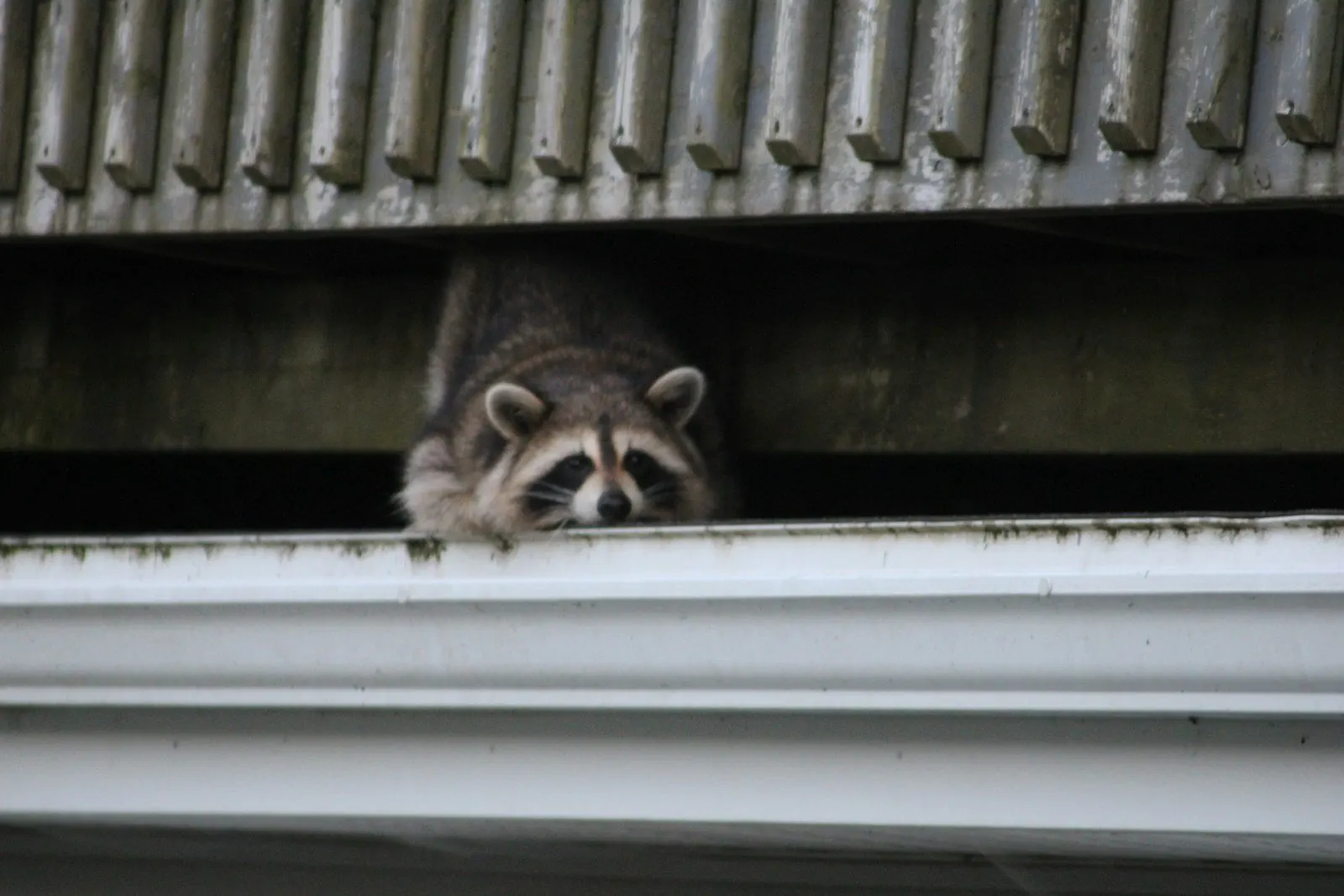
Enters at roof junctions, pried-back soffit returns and dormer flashing — a determined sow can open a gap a builder would swear was sealed. February through summer, assume young in the den: Florida rules require the kits to come out with the female, which changes the operator’s whole approach.
Squirrel — eastern gray and fox
Eave gaps, gable vents and dormer junctions, active at dawn and dusk. Polk County squirrels raise litters twice a year (roughly January–March and July–September), and exclusion during a maternity window strands the litter — which is why timing is an inspection question, not a calendar guess.
Opossum (Didelphis virginiana)
Under decks, in crawl spaces and garages — generally docile, usually transient, and gone in days if the attractant (pet food, open garbage, fallen fruit) leaves first. Handled as a rabies-vector species under Florida public-health rules, so hands-off until the operator arrives.
Bats — free-tailed, evening, big brown
Enter through gaps as small as 3/8″ at gable ends, ridge caps and barrel-tile openings. Florida protects bat maternity season — roughly April 16 through August 14 — during which exclusion is prohibited statewide. Legal removal is a one-way valve installed outside that window, never trapping or poisoning.
Something heavy moved in upstairs?
One call reaches a licensed, local exterminator who covers your address — and a real person answers, 24/7.
Free to call. Free to get matched. The licensed operator gives the quote.
What legal wildlife removal actually involves in Florida
Nuisance wildlife work in Florida runs under FWC authorization, and the rules shape everything the operator does — which is a feature, not friction: they exist so the animal problem gets solved without creating a legal or humane one.
Inspection and entry-point map
The operator identifies the species, finds every entry point (there is rarely just one), and checks for young — the finding that changes the plan more than any other.
Humane capture or eviction
Live traps sized to species, one-way doors, or hands-on removal of kits with reunion boxes. FWC rules require captured nuisance wildlife to be released legally within 24 hours or humanely handled per regulation — relocation options are tightly limited, which is why eviction-plus-exclusion beats trap-and-haul.
Exclusion — the part that makes it permanent
Sealing roof junctions, soffit returns, gable vents and builder’s gaps with animal-rated materials. Skip this step and the vacancy sign stays lit for the next raccoon. Rodent-scale sealing is its own trade — see the rodent exclusion guide.
Cleanup and restoration
Droppings, urine-soaked insulation and nesting material carry real pathogen load (raccoon roundworm, histoplasmosis risk with bat guano). Remediation and re-insulation are scoped separately from removal — ask what the quote includes.
What moves a wildlife quote (we never set prices)
- Species and season — a transient opossum under a deck and a bat colony in a barrel-tile roof during the maternity blackout are different jobs on different clocks.
- Entry-point count and roof complexity — exclusion is priced by what has to be sealed; tile roofs and multi-dormer rooflines multiply scope.
- Young in the den — kit removal and reunion protocols add visits.
- Remediation scope — contaminated insulation removal and sanitizing often exceeds the removal itself. The cost-factor guide explains the levers — the quote belongs to the licensed operator who climbs the roof.
Verify before you hire — wildlife trapping runs under FWC authorization, and any operator also doing structural pest work carries FDACS licensing you can check at the FDACS license search at aessearch.fdacs.gov. Storm weeks bring out-of-area trappers — thirty seconds of verification filters them. Post-hurricane wildlife displacement is its own pattern; the September guide covers it.
Wildlife removal questions, answered straight
Can’t I just trap the raccoon myself and drive it somewhere?
Florida law is genuinely restrictive here: relocating nuisance wildlife off your property generally requires landowner permission at the release site and compliance with FWC rules, and several species can’t be relocated at all. DIY trap-and-haul commonly strands dependent young in your attic — which becomes a worse problem in a week. Licensed operators evict, reunite and exclude instead.
Why can’t the bats be removed right now?
If it’s between mid-April and mid-August, Florida’s bat maternity season prohibits exclusion statewide — flightless pups would be sealed inside. A licensed operator can inspect now, stage the one-way valves, and legally exclude the colony the day the window opens. Bats are also the one invader you genuinely want in the neighborhood — just not in the gable.
The animal left on its own. Am I done?
No — you’re between tenants. An entry point that admitted one raccoon is now a scent-marked vacancy ad for the next one, and the insulation damage stays. Exclusion and cleanup are the actual fix; removal only ends the current occupancy.
Is it rats or wildlife up there?
Weight and schedule. Rats: light, fast scratching, mostly after midnight, pencil-width droppings. Squirrels: daytime, especially dawn/dusk. Raccoons: slow, heavy, nocturnal thumps — you’ll swear it’s a person. The distinction matters because rats route to rodent control and wildlife routes to FWC-governed trapping — the dispatch line sorts it from your description.
Are opossums dangerous?
Mostly no — they’re docile, eat ticks and carrion, and body temperature makes rabies rare in them, though Florida still handles them as a vector species. The real risk is under-deck denning that attracts flies and secondary pests. Remove the attractant, and most opossums remove themselves; a licensed operator handles the ones that don’t.
Humane for the animal. Permanent for the house.
One call reaches a licensed, local exterminator who covers your address — and a real person answers, 24/7.
Free to call. Free to get matched. The licensed operator gives the quote.
Related Polk County wildlife reading
Two of the species Polk County attics produce most, and the legal timing rules that decide when exclusion can happen.
- Bat removal in Polk County: what you can and can’t do during maternity season — the state-protected window that makes timing non-negotiable
- Raccoons in the attic in Lakeland — summer signs, and why exclusion has to wait for the young to be mobile
Disclosure
Lakeland Exterminators is a dispatch and matching service. We connect Polk County callers with licensed, insured wildlife and pest control operators. We are not a licensed pest control operator or wildlife trapper. We do not perform removal or exclusion, set prices, issue warranties, or carry trade insurance. All pricing, scheduling, treatment plans, warranties and service terms are determined by the licensed operator dispatched to your address, under FWC rules and — for structural pest work — Chapter 482, Florida Statutes.
Same-day and 24/7 emergency services are subject to provider participation, location, technician availability, and demand. Availability is not guaranteed and may vary by market and appointment capacity.
License status of any pest control operator you connect with is publicly verifiable at the FDACS license search: aessearch.fdacs.gov.