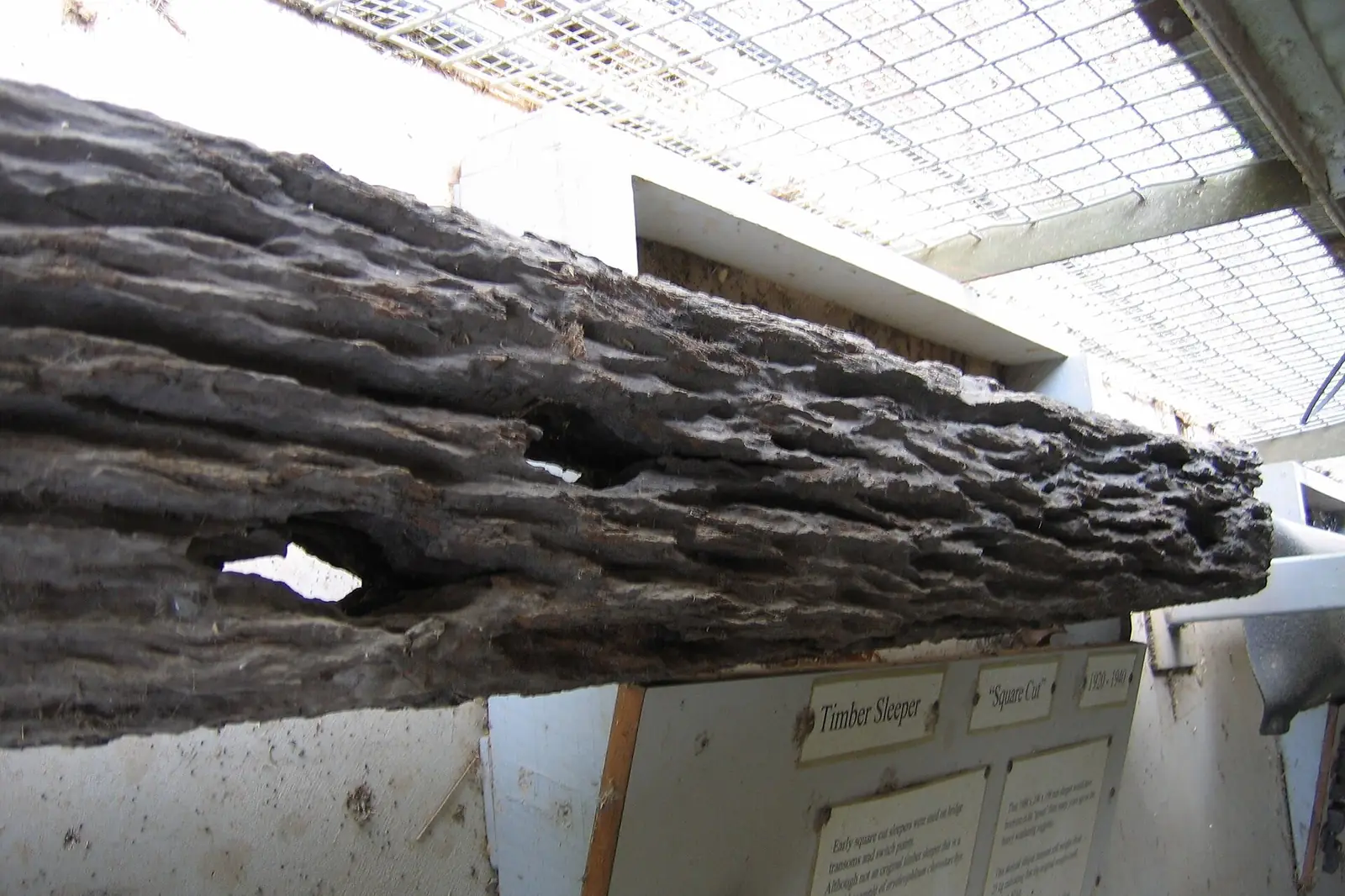
Is that termite damage — or water rot? Here’s how to read the wood in a Lakeland home.
Termite-damaged wood looks a very particular way once you know what you’re looking at, and it looks nothing like the three things people usually confuse it with. This is how to probe it, how to read the galleries, how to judge whether it’s cosmetic or structural — and then how to get a licensed Polk County operator to confirm it.
Talk to a licensed exterminator now
Call and we’ll connect you with a licensed, local exterminator who covers your address. It takes about two minutes, and a real person answers.
Free to call. Free to get matched. The licensed operator gives the quote.
24/7 line · A real person answers · Availability of same-day and emergency service depends on the provider.
What termite damage actually looks like inside the wood
Look, here’s the deal. The reason termite damage goes unnoticed for years in Lakeland houses is that termites are careful never to break the surface. They eat the soft springwood inside the board and leave the hard grain lines and the paint film standing, like scaffolding. From the driveway everything looks fine. Behind that skin, the board can be more air than timber.
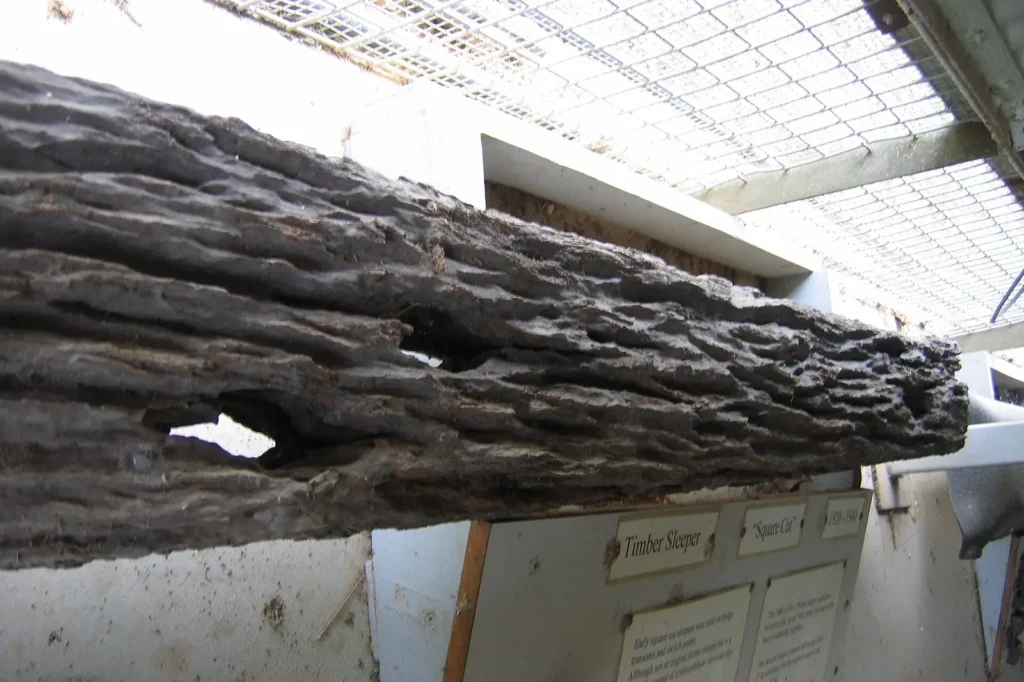
When you finally open a damaged board up, this is what you see:
- Galleries that follow the grain. Termites eat with the wood, not across it. The tunnels run lengthwise along the board, following the soft layers, which is what gives the damage that layered, honeycombed, almost geological look. Water rot doesn’t do that. Drill holes don’t do that.
- Hard grain lines left standing. The dense, dark late-wood is too tough to bother with, so it survives as thin ridges and walls between the eaten-out layers. That striped, stratified appearance is one of the most reliable identifiers there is.
- The surface intact. Paper-thin. It’s why the board still holds its shape, and why the very first thing you actually notice is usually a hollow sound rather than a visible hole.
Now, the crucial fork: is the gallery clean, or is it packed with dirt? That one question separates the two termites and therefore the two treatments.
Reading the gallery: subterranean vs drywood
Packed with soil → subterranean
The galleries are smeared and stuffed with mud, soil and dark faecal material. It looks dirty, because it is — these termites carry soil in with them and use it to keep the humidity up. You’ll usually also find mud tubes somewhere on the foundation, and the damage tends to be low: sills, bottom plates, subfloor, the bottom of door frames, anywhere near grade or near a chronic damp spot.
Subterranean termites in Polk County →Clean and smooth → drywood
The galleries are clean, sanded-looking, almost polished, with no soil at all — and they contain little chambers of hard six-sided pellets. Drywood termites push their frass out through pinhead kick-out holes rather than living in it. The damage is usually high and dry: attic rafters, fascia, window and door frames, furniture. No mud tubes anywhere.
Drywood termites in Lakeland →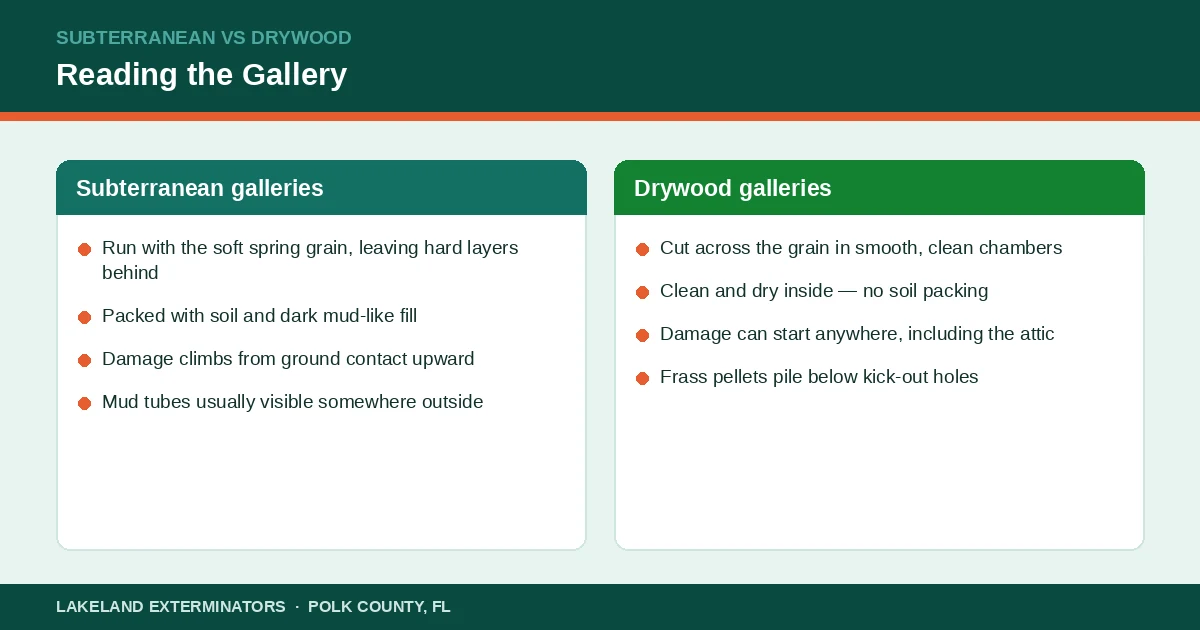
Get this right and everything downstream gets easier, because the two get treated in completely different places — one in the soil, one in the wood. Buying the wrong one is an expensive way to keep your infestation. The complete Lakeland termite treatment guide walks through what each method actually involves.
The screwdriver test, done properly
You need a flathead screwdriver and a flashlight. That’s the whole toolkit, and it’s genuinely most of what a first-pass inspection is.
Tap first
Work the handle along baseboards, door and window casings, exposed beams, the bottom of door frames, and any structural timber you can reach. Solid wood answers with a dull, dense thud. Compromised wood answers with a papery, drum-like knock — and once you’ve heard the difference once, you can’t un-hear it. Tap a board you know is sound first, so you’ve got a baseline in your ear.
Then probe
Where something sounds wrong, press the screwdriver tip into the wood with steady, moderate pressure. Sound wood resists firmly. Termite-damaged wood gives suddenly, and then the tip drops into a void — that sudden loss of resistance is the giveaway. Push a little further and you may break through the paper-thin surface into the galleries underneath.
Do this gently. You’re testing, not demolishing. If you punch through into an active subterranean gallery you’ll disturb the colony, and disturbed subterranean termites relocate deeper into the structure — which makes them harder for the licensed operator to find and treat. Confirm it’s hollow, take a photo, and stop.
Then look at what came out
Soil and mud in the void: subterranean. Clean, dry galleries plus hard granular pellets: drywood. Dark, crumbly, cubed material that smells faintly musty and that you can crush between your fingers: that’s probably not a termite at all. Keep reading.
How the Lakeland dispatch line gets you to a licensed operator
Drop your ZIP
33801, 33803, 33809, 33810, 33813, 33815, 33880 — anywhere in Polk County. That’s all we need to start routing.
A coordinator calls you back
A real person. Describe the damage: where it is, whether the galleries had soil in them, whether you found pellets, how much of the board gave way.
A licensed operator inspects
An independent, FDACS-licensed operator confirms whether it’s termites at all, identifies the species, and maps how far it has gone. They’ll also tell you honestly if what you found is old damage or water rot.
You get the quote and you decide
The operator sets the price, the method, the warranty and the schedule. Not us. Getting matched costs nothing and commits you to nothing.
Screwdriver went straight through the trim?
Then something has been eating it. Get a licensed operator to say what.
Talk to a licensed exterminator now
Call and we’ll connect you with a licensed, local exterminator who covers your address. It takes about two minutes, and a real person answers.
Free to call. Free to get matched. The licensed operator gives the quote.
The four things Lakeland homeowners mistake for termite damage
Not every soft board is a termite, and honestly, in Central Florida a good number of them aren’t. Here’s how to sort it out before you spend anything.
| It might be… | What it looks like | How you tell it apart |
|---|---|---|
| Water rot / fungal decay | Dark, soft, spongy wood that crumbles into small cubes. Often smells musty. Very common in Polk County, where humidity and daily summer storms keep everything damp. | Rot crumbles across the grain into cube-like chunks; termite damage runs with the grain in long layered galleries. Rot has no tunnels, no pellets, no soil and no insects. And it always has a moisture source — a leaking hose bib, a failed flashing, a downspout dumping at the footer. Find the water and you’ve found the cause. (Worth knowing: rot-softened wood also attracts termites, so the two genuinely do show up together.) |
| Carpenter ants | Hollowed wood, sometimes with piles of what looks like coarse sawdust nearby. | Carpenter ants don’t eat wood — they excavate it to nest, and they throw the debris out. So their galleries are clean, smooth and completely empty, and the sawdust below is fibrous and shredded, often mixed with insect body parts. Termite galleries are either soil-packed or full of hard six-sided pellets. Also, you’ll see the ants: large, dark, obvious, walking around in the open. |
| Wood-boring beetles | Small round exit holes in the surface of the wood, with fine powder underneath. | Beetles leave round holes on the surface and a very fine, flour-like powder. Termites don’t make surface exit holes at all — other than the pinhead kick-out holes drywoods use for frass, and those come with hard granular pellets, not flour. If you can see lots of little round holes, think beetle first. |
| Old, already-treated damage | Hollow, galleried wood — with nothing alive in it. | Galleries that are dry, dusty, empty and undisturbed over weeks suggest a colony that’s gone or was treated. This is not an all-clear. Something got in once, and whatever let it in — the crack, the damp spot, the wood-to-soil contact — is very likely still there. Old damage also still needs assessing for structural strength; dead termites don’t put the wood back. |
If the answer turns out to be carpenter ants rather than termites, ant control in Lakeland is the page you want.
How bad is it? Cosmetic versus structural
This is the question that actually keeps people up at night, and it deserves a straight answer: you cannot reliably judge severity from the outside, and neither can anyone else. The visible damage is essentially always the smallest part of the picture, because termites work from the inside out.
What you can do is sort what you’ve found into rough tiers, so you know how hard to push.
Probably cosmetic — but still evidence
Damage confined to trim, baseboards, a window casing, decorative moulding, a single piece of fascia. None of it is holding the house up. But every one of those is also a signpost: something is feeding, and it got there somehow. Trim damage is the beginning of the conversation, not the end of it.
Take this seriously
Damage in anything that carries load: sill plates, bottom plates, joists, headers over doors and windows, studs, roof rafters, the subfloor. Floors that sag, bounce or feel spongy. Tile cracking in a line. A door frame that’s visibly out of square. These say the infestation has been running long enough to reach the frame of the building.
Get a second, structural opinion
Here’s a distinction worth holding onto: a pest control operator treats the termites; they do not certify your structure. Those are two different jobs and often two different professionals. If the damage is in load-bearing timber, the licensed operator handles the colony, and you may also want a qualified contractor or structural professional to assess and repair the wood. Ask the operator directly whether what they’re seeing warrants that. A good one will tell you plainly.
And know this going in: standard Florida homeowners insurance almost never covers termite damage. It’s treated as a maintenance issue — gradual, preventable, excluded. Which is exactly why the warranty terms on any treatment contract matter so much, and why “repair” versus “retreat” is the single most important phrase in the document.
What to do with what you found
- Photograph it before you touch anything else. Include something for scale. Shoot the galleries, the surrounding area, and anything you found inside them.
- Keep a sample. A pinch of the soil from the gallery, a few pellets, a piece of the broken board. It speeds up identification enormously.
- Stop probing once you’ve confirmed it’s hollow. Further excavation disturbs the colony and destroys the evidence the operator needs.
- Don’t spray it. Repellent hardware-store products can push a subterranean colony to route around the treated zone and deeper into the structure. You won’t have killed it — you’ll have hidden it.
- Go find the water. If it’s rot, or rot plus termites, the moisture source is the actual problem. Leaking hose bib, sprinkler hitting the stucco, mulch piled over the weep screed, downspout discharging at the footer. Fixing those is free and it lowers your risk permanently.
- Check the rest of the house. Damage in one spot means an active or historic colony somewhere. Walk the whole foundation, the garage block wall from the inside, and the attic.
For the full evidence checklist beyond the wood itself — tubes, frass, wings, swarmers — see signs of termites in a Lakeland home. If you’re buying or selling, a WDO inspection is the formal documented version that lenders will ask for. And for what any of this ends up costing, termite treatment cost in Lakeland breaks down the variables — the licensed operator sets the price after inspecting.
Get the damage identified properly
One ZIP. One call back. You decide from there.
Talk to a licensed exterminator now
Call and we’ll connect you with a licensed, local exterminator who covers your address. It takes about two minutes, and a real person answers.
Free to call. Free to get matched. The licensed operator gives the quote.
Termite damage questions, answered straight
How do I tell termite damage from water rot?
Direction and debris. Termite galleries run with the grain in long, layered tunnels, and they contain something — soil and mud if subterranean, hard six-sided pellets if drywood. Fungal rot crumbles across the grain into small cube-like chunks, smells musty, contains no tunnels or insects, and always has a moisture source behind it. Worth knowing: the two often occur together, because rot-softened wood is easier for termites to attack.
Can I tell how bad the damage is by looking?
No, and nor can anyone else without opening things up. Termites eat from the inside out and leave the surface intact, so what you can see is essentially always the smallest part of the picture. A board that looks fine can be structurally worthless. That’s the whole reason a licensed inspection exists — the operator has the tools and the access to establish the actual extent.
Is it termites or carpenter ants?
Look inside the tunnel. Carpenter ants excavate wood to nest but don’t eat it, so they throw the debris out — their galleries are clean, smooth and empty, and the material below is fibrous, shredded and often mixed with insect body parts. Termite galleries are either packed with soil or contain hard granular pellets. You’ll also usually see carpenter ants themselves: big, dark, and walking around in the open.
Does termite damage keep getting worse if the termites are gone?
The damage doesn’t spread on its own — but it doesn’t heal either. Wood that’s been hollowed out stays hollowed out, and if it’s carrying load it stays weakened until it’s repaired or replaced. Treating the colony stops the loss; it doesn’t restore the timber. And an empty gallery is a warning that whatever let them in the first time is probably still there.
Will homeowners insurance pay for termite damage in Florida?
Almost never. Standard policies treat termite damage as a maintenance issue — gradual, preventable, and specifically excluded. That’s precisely why the warranty on your termite contract matters. Ask whether it’s a repair warranty (the operator pays to fix damaged wood) or a retreat warranty (they come back and treat again). Those are very different products described in very similar language.
Do I need to replace all the damaged wood?
It depends entirely on what the wood was doing. Damaged trim, baseboards and decorative moulding are cosmetic and can be handled at your leisure. Damaged sill plates, joists, headers and studs are structural and that’s a different conversation — one usually involving a qualified contractor, not the pest control operator. The pest operator treats the termites; they don’t certify your structure. Ask them plainly whether what they’re seeing needs a structural opinion.
Should I dig further into the damaged wood to see how far it goes?
No. Confirm it’s hollow, photograph it, and stop. Excavating an active subterranean gallery disturbs the colony, and disturbed subterranean termites tend to relocate deeper into the structure — which makes them harder for the licensed operator to locate and treat, and makes the whole job more expensive. You’ve found what you needed to find.
Disclosure
Lakeland Exterminators is a dispatch and matching service. We connect Polk County callers with FDACS-licensed pest control operators. We are not a licensed pest control operator. We do not perform treatment, set prices, issue warranties, hold bonds, or carry pest control trade insurance. All pricing, scheduling, treatment plans, warranties and service terms are determined by the FDACS-licensed operator dispatched to your address under Chapter 482, Florida Statutes.
Same-day and 24/7 emergency services are subject to provider participation, location, technician availability, and demand. Availability is not guaranteed and may vary by market and appointment capacity.
License status of any operator you connect with is publicly verifiable at the FDACS license search.