Spiky egg sacs in the lanai track? That’s a brown widow — here’s what to do.
One call reaches a licensed, local exterminator who covers your address — and a real person answers, 24/7.
Talk to a licensed exterminator now
Call and we’ll connect you with a licensed, local exterminator who covers your address. It takes about two minutes, and a real person answers.
Free to get matched. The licensed operator gives the quote.
24/7 line · A real person answers · Availability of same-day and emergency service depends on the provider.
Quick answer: is it a brown widow?
Brown widows (Latrodectus geometricus) are tan to dark brown with a variable banded pattern on the legs and a faint orange-to-yellow hourglass on the underside of the abdomen — muddier than the vivid red of a black widow. The single most reliable field mark isn’t the spider at all: it’s the egg sac. A brown widow’s sac is spherical and covered in soft surface spikes, like a tiny sea urchin. A black widow’s sac is smooth and round. If you’re seeing spiky egg sacs tucked into corners, you have brown widows.
They’ve become the dominant widow across Polk County over the past 15–20 years, displacing the southern black widow in most residential settings from Lakeland Highlands to Winter Haven. Control is straightforward for a licensed operator: exterior perimeter barrier, physical egg-sac removal, and harborage reduction. Most quarterly programs keep them suppressed.
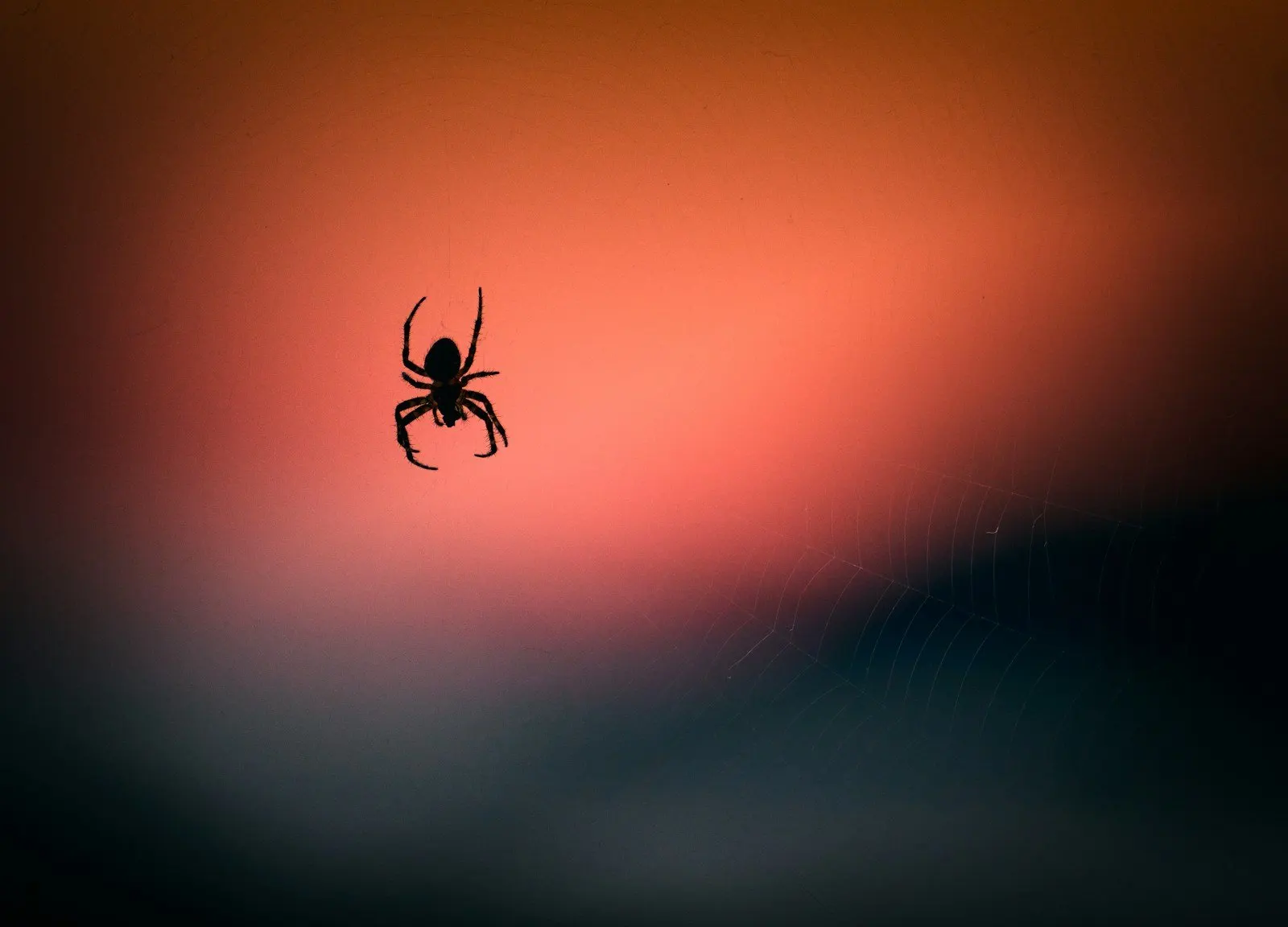
Brown widow vs. southern black widow
Brown widow
Tan to dark brown, faint orange/yellow hourglass, spiky egg sac. Venom is a milder form of widow neurotoxin. Dominant in Polk County residential settings, and far more likely to be what you find in the lanai.
Southern black widow
Glossy jet-black, vivid red hourglass, smooth round egg sac. More potent venom. Less common in occupied structures now, but persists in sheds, woodpiles, and garage corners.
Bite reality: both species carry venom that can cause real pain, muscle cramping, and systemic symptoms. Brown widow bites are typically milder and more localized because the spider injects less venom, but any suspected widow bite — especially with spreading pain, sweating, or nausea — warrants prompt medical evaluation. Widows are not aggressive; almost all bites happen when a spider is pressed against skin inside a glove, shoe, or cushion.
Where brown widows live in Polk County
They want tight, protected, weather-sheltered voids near an outdoor light that draws prey. In central Florida that means:
- Lanai screen-track corners and pool-deck expansion joints — the number-one call location.
- Irrigation valve boxes — one of the highest-density harborage sites anywhere on the property.
- Under patio furniture, in cushion folds, and inside the ends of hollow chair legs.
- Grill housings, propane-tank shelters, and outdoor cabinet voids.
- Mailbox slots, house-number backing, and behind exterior fixtures.
- Garage corners, under workbenches, and inside long-stored boxes.
- Around porch and soffit lighting — the light pulls in the insects the widow eats.
Because they nest outdoors, the treatment is an outside-in job. Indoor fogging does nothing for a population living in the valve box — which is why retail spray cans rarely resolve a widow problem.
How a licensed operator treats them
Effective Polk County widow control layers three moves, and the physical one matters as much as the chemical:
1. Perimeter barrier
A residual exterior treatment (bifenthrin or lambda-cyhalothrin class) banded across eaves, soffits, window frames, door thresholds, and the base of exterior walls where widows travel and hunt.
2. Egg-sac removal
The spiky sacs are physically knocked down and removed from tracks, boxes, and furniture. Every sac left behind can hatch dozens of spiderlings — this step is why DIY fails and a trained tech succeeds.
3. Harborage reduction
De-webbing, clearing valve boxes, moving stored items off the ground, and adjusting exterior lighting so it stops functioning as a widow buffet.
For a whole-property approach to spiders and their prey base, this pairs naturally with spider control in Lakeland and a recurring quarterly perimeter program.
Widow spiders where the kids play? Get eyes on it.
One call reaches a licensed, local exterminator who covers your address — and a real person answers, 24/7.
Free to get matched. The licensed operator gives the quote.
Brown widow FAQs
How dangerous is a brown widow bite?
How do I tell a brown widow from a harmless spider?
Will a quarterly pest plan keep them away?
Why do I keep finding them in the same spots?
Are you the pest control company?
Related Polk County pages
Disclosure
Lakeland Exterminators is a dispatch and matching service. We connect Polk County callers with FDACS-licensed structural pest control operators. We are not a licensed pest control operator. We do not perform treatment, set prices, issue warranties, or carry pest control trade insurance. All pricing, scheduling, treatment plans, and service terms are determined by the FDACS-licensed operator dispatched to your address under Chapter 482, Florida Statutes.
Same-day and 24/7 emergency services are subject to provider participation, location, technician availability, and demand. Availability is not guaranteed and may vary by market and appointment capacity.
License status of any operator you connect with is publicly verifiable at the FDACS license search.