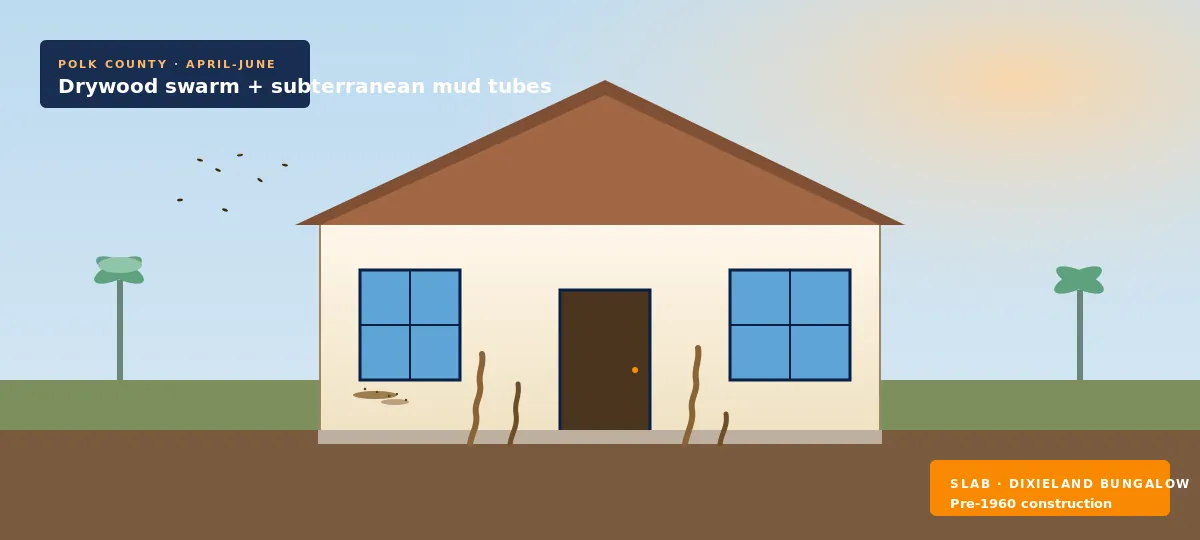
Sentricon or Termidor? It’s not a brand fight — it’s a question about your slab.
One call reaches a licensed, local exterminator who covers your address — and a real person answers, 24/7.
Talk to a licensed exterminator now
Call and we’ll connect you with a licensed, local exterminator who covers your address. It takes about two minutes, and a real person answers.
Free to call. Free to get matched. The licensed operator gives the quote.
24/7 line · A real person answers · Availability of same-day and emergency service depends on the provider.
The short version, before we get technical
Both systems are aimed at the same enemy: subterranean termites living in the soil around and under your house. In Polk County that’s mainly the eastern subterranean termite (Reticulitermes flavipes) and, in the neighborhoods where it’s established, the Formosan (Coptotermes formosanus). Both systems are EPA-registered and both are applied by FDACS-licensed operators. They are not interchangeable, and they don’t fail in the same way.
- Sentricon is bait. Stations in the soil, colony dies over weeks to months, monitored forever under a bond.
- Termidor is a liquid. Trenched into the soil around the foundation and injected through the slab where needed, creating a continuous treated zone that termites can’t detect and don’t avoid.
- The deciding factor is usually your foundation, not the chemistry. Can the operator get a continuous trench and a proper drill pattern around your house? If yes, liquid is on the table. If your lanai, pool deck, mature hedges and irregular footprint make that a demolition project, baiting starts looking sensible.
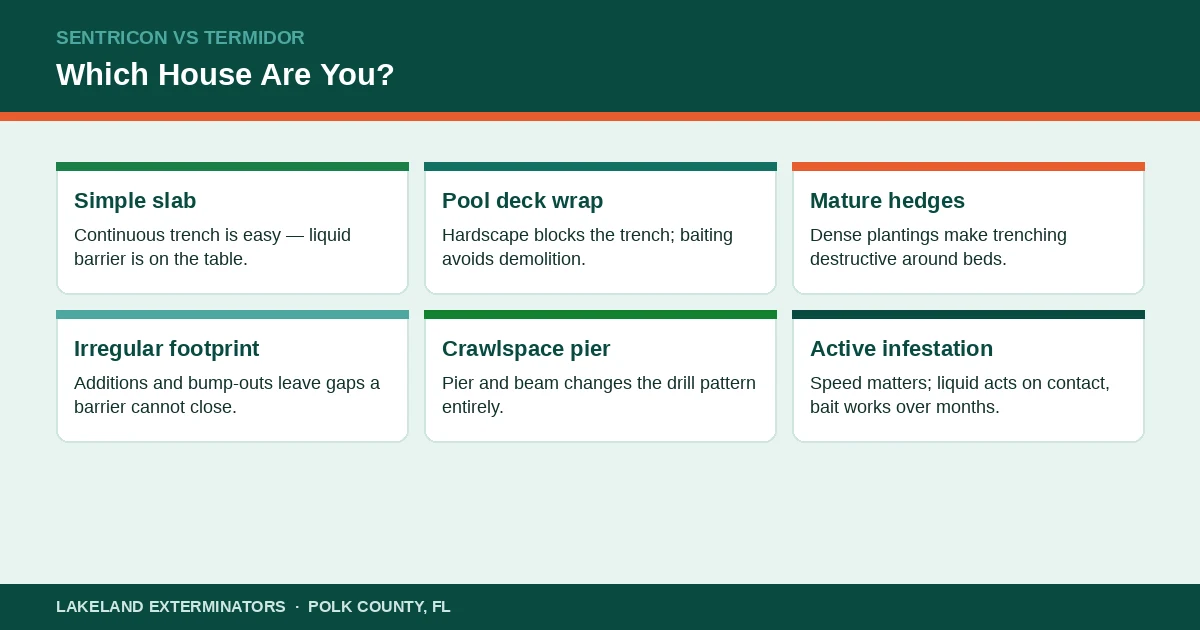
How Sentricon works — kill the colony
A certified operator places bait stations in the soil around your foundation, roughly every ten feet, set flush with grade. Each holds a cellulose bait matrix loaded with noviflumuron, a chitin-synthesis inhibitor — meaning it stops termites from molting successfully. Foraging workers find the cellulose the same way they’d find your fascia board, feed on it, and carry it home, where it spreads through the colony by trophallaxis (mouth-to-mouth feeding, which is how termites share everything).
The worker population can’t replace itself, numbers crash, and the colony fails. Then the operator keeps coming — quarterly or twice a year — to check stations, refill bait as it’s eaten, and replace stations the lawn crew ran over. That monitoring is the product. Stop it and you’ve stopped the system. The full walkthrough is on Sentricon installation in Lakeland.
Where baiting struggles
It’s not instant. Nothing happens until foraging workers actually hit a station, and colony collapse typically runs two weeks to six months from that first hit. If you’ve got termites chewing an active feeding site in your den right now, an operator may want to pair baiting with a localized treatment to stop the immediate damage while the bait does its slower work. Ask about that directly.
How Termidor works — own the ground
Termidor’s active ingredient is fipronil, and the thing that makes it interesting is that it’s non-repellent. Termites can’t smell it, taste it, or detect it. They walk into the treated soil like it’s ordinary dirt, pick the active ingredient up on their bodies, and carry it back — where it moves through the colony by contact and grooming. So it’s not just a wall; it’s a wall that hitchhikes.
Application is real work: the operator trenches the soil around the foundation perimeter, drills through the slab at interior wall lines, utility chases and attached slabs where the trench can’t reach, and applies the diluted product at the label rate to build a continuous treated zone. On a typical Polk County home that’s most of a workday, versus an hour or two for stations. Afterward it’s usually an annual inspection under the bond rather than quarterly visits.
Where liquid struggles
Continuity. A treated zone with a gap in it is a door. Pool decks, attached lanais, planter boxes stacked against the foundation, mature root balls, utility penetrations — anything that stops the trench or blocks the drill pattern is a place a colony can walk through. That’s a workmanship question as much as a product question, which is why the operator’s care matters more than the label.
Get both options priced by someone who’s seen your foundation
One call reaches a licensed, local exterminator who covers your address — and a real person answers, 24/7.
Talk to a licensed exterminator now
Call and we’ll connect you with a licensed, local exterminator who covers your address. It takes about two minutes, and a real person answers.
Free to call. Free to get matched. The licensed operator gives the quote.
Side by side, on a Polk County house
| Factor | Sentricon (bait) | Termidor (liquid) |
|---|---|---|
| Mechanism | Colony elimination — bait carried home and shared | Continuous treated soil zone — non-repellent, transferred by contact |
| Active ingredient | Noviflumuron (chitin-synthesis inhibitor) | Fipronil (non-repellent contact insecticide) |
| Install time | Roughly 1–2 hours | Most of a workday — trenching plus slab drilling |
| Foundation disturbance | None — stations sit in soil at the perimeter | Trench around the perimeter, drill holes at interior wall lines and attached slabs |
| Speed | Weeks to months from first station hit | Works as soon as foragers cross the treated zone |
| Residual life | Indefinite while the bond and monitoring are maintained | Several years in well-drained sand; operators generally cite a multi-year window before re-treatment |
| Ongoing visits | Quarterly or twice yearly | Typically an annual bond inspection |
| Handles messy perimeters | Yes — landscaping and lanais aren’t obstacles | Only as well as the trench and drill pattern can be completed |
Notice what’s not in that table: a price. We don’t set prices and we don’t quote them. Both systems are a two-number product — up-front cost plus annual renewal — and comparing only the up-front number is how people get surprised in year three. Get both figures in writing from the licensed operator, and see termite treatment cost in Lakeland for what actually drives them.
Which house are you? A Polk County reality check
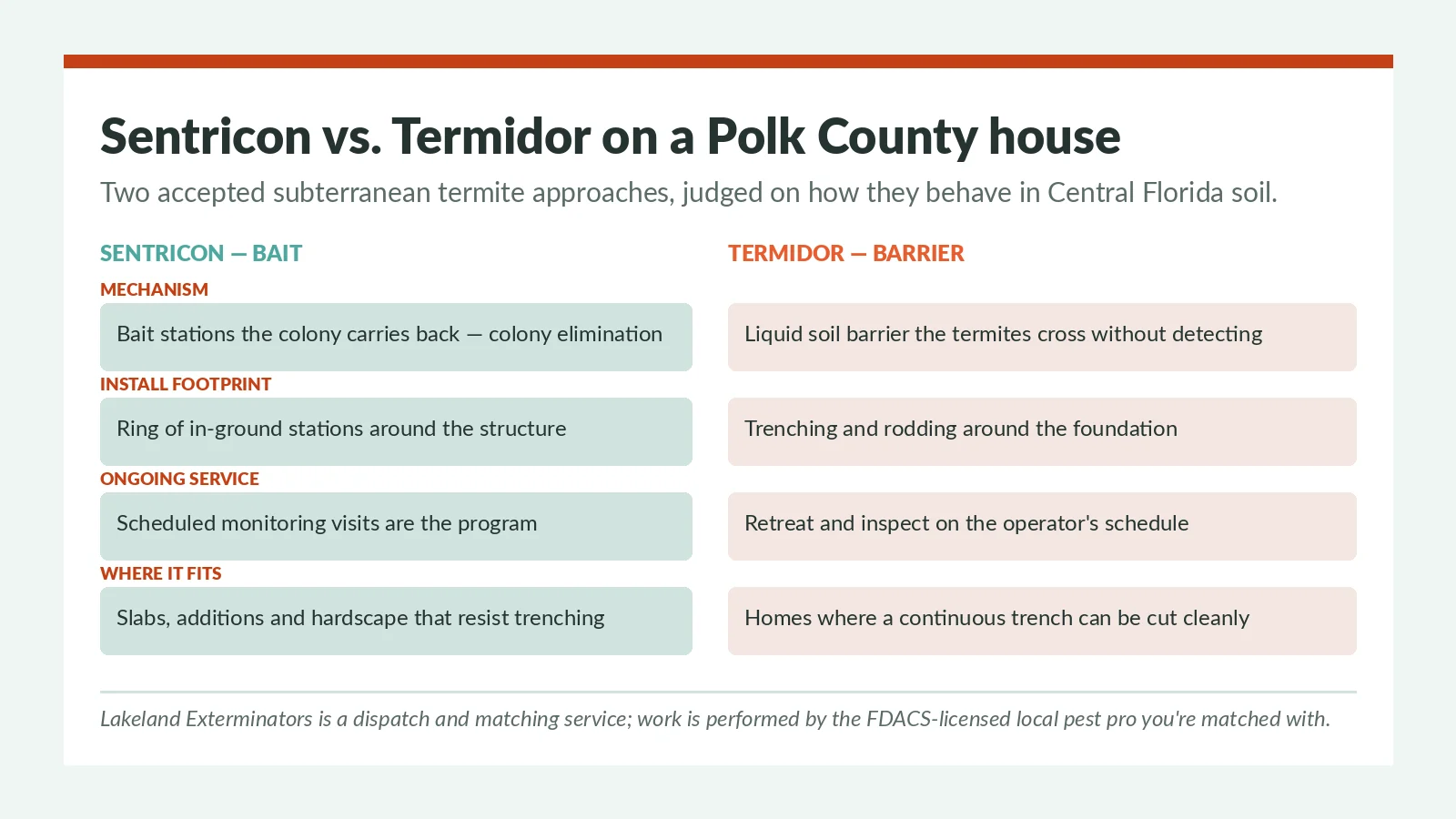
Newer slab, simple footprint, open perimeter
Much of South Lakeland, Highland City, Christina and the newer North Lakeland builds. A clean rectangle, grass to the wall, nothing in the way. The operator can trench the whole perimeter and drill a proper pattern — liquid is genuinely on the table and often the straightforward answer.
Older home, mature beds, added-on rooms
Dixieland, the Garden District around Lake Morton, Cleveland Heights, the Lake Hollingsworth streets. Forty-year-old plantings against the block, a Florida room added in 1994, a porch slab poured over who-knows-what. Continuity gets hard. This is where baiting earns its keep.
Pool deck and screened lanai
Extremely common across Polk County. Reaching under that slab with liquid means drilling through your deck. Some homeowners are fine with that; plenty aren’t. Stations don’t care.
Active infestation vs. prevention
Live colony, mud tubes, a swarm in the living room in March? Speed matters, and the operator may want liquid, or a combination. Playing defense on a clean house with no activity? The calculus is different. Say which you are, out loud, when you get quoted.
Worth knowing: Polk County’s sandy, well-drained soils are cooperative for both approaches — fipronil binds well in sand, and bait isn’t soil-bound at all. Neither product is fighting the dirt here. What they’re fighting is your floor plan.
How the dispatch works — four steps, no phone tag
You call the dispatch line
That’s the whole ask. Your address tells us which FDACS-licensed operators cover your address.
We match you to a licensed operator
Independent, licensed and insured. We’re a dispatch service — we don’t treat, we don’t install, we hold no product affiliation and we take no cut of your quote.
They inspect and recommend
They walk the foundation, look for tubes and damage, assess whether a continuous trench is even achievable on your lot, and tell you which system fits — and why.
They quote, you decide
Price, bond terms, warranty, monitoring cadence — all from the operator, in writing. Get a second inspection if you want one. Nothing here obligates you.
Questions that separate a good proposal from a sales pitch
- “What’s your FDACS license number?” — then verify it at the FDACS license search. Florida regulates pest control under Chapter 482, Florida Statutes, and it’s public record.
- “If you’re proposing liquid: can you actually achieve a continuous treated zone on my lot? Show me where you’d trench and where you’d drill.”
- “If you’re proposing bait: what’s the monitoring cadence, and what happens if I miss a renewal?”
- “Give me both numbers — install and annual renewal — for five years.”
- “Is the bond retreat-only, or retreat-and-repair? What’s the damage cap, and what’s excluded?”
- “Does the bond transfer if I sell the house?”
- “Which one would you put on your own house, and why?” — the “why” is the part that tells you something.
If a bond is the real question underneath all this, read is an annual termite bond worth it in Lakeland. And if you’re not actually sure you have subterranean termites at all, back up to termite control in Lakeland — because if you’re finding pellets instead of mud tubes, neither of these products is your answer. That’s drywood, and it goes to localized no-tent treatment or tenting.
Let a licensed operator settle it
One call reaches a licensed, local exterminator who covers your address — and a real person answers, 24/7.
Talk to a licensed exterminator now
Call and we’ll connect you with a licensed, local exterminator who covers your address. It takes about two minutes, and a real person answers.
Free to call. Free to get matched. The licensed operator gives the quote.
Sentricon vs. Termidor questions, answered straight
Which one is more effective?
Wrong question, honestly. Both are EPA-registered and both are used successfully across Polk County every week. What differs is fit: a liquid treated zone only performs as well as its continuity, and baiting only performs as long as somebody keeps monitoring it. The failure modes are different, not the effectiveness ceiling. The licensed operator matches the method to your foundation.
Which one works faster?
Liquid. A treated zone starts working the moment foraging termites cross it. Baiting has to wait for workers to find a station, then run its course — commonly two weeks to six months from that first hit. If there’s active feeding damage happening right now, speed is a legitimate factor and you should raise it.
Do I have to drill my slab for Termidor?
Usually yes, at least somewhere. Trenching handles the open perimeter, but interior wall lines, utility chases, attached porches, garages and pool decks generally need drilling so the treated zone stays continuous under them. Holes are patched. If drilling your pool deck is a dealbreaker, say so early — that’s often what pushes the recommendation toward baiting.
How long does each one last?
A fipronil-treated soil zone holds for several years in well-drained Central Florida sand before an operator would look at re-treating — they’ll give you their specific figure. Baiting lasts as long as you maintain the bond and the monitoring visits, in principle indefinitely. One is a product with a shelf life in the ground; the other is a subscription.
Can an operator use both?
Yes, and on a house with an active infestation plus a messy perimeter that’s sometimes exactly what gets proposed — liquid where the trench can be completed, stations where it can’t, or a localized treatment to stop active feeding while bait works the colony. Ask whether a combination makes sense for your house.
Will either one handle drywood termites?
No. Both are aimed at subterranean colonies living in soil. Drywood termites live inside the wood with no soil contact at all — there’s no ground for a station to intercept and no soil zone to cross. If you’re finding six-sided pellets rather than mud tubes, you want localized no-tent treatment or whole-structure tenting.
Which is cheaper?
We don’t set or quote prices, so we won’t pretend to answer that with a number. What we’ll tell you is how to compare honestly: get the install cost and the annual renewal for both, project five years out, and read the bond terms — retreat-only versus retreat-and-repair changes what you’re actually buying more than the sticker does.
How do I get both quoted?
One call reaches a licensed, local exterminator who covers your address — and a real person answers, 24/7.
Disclosure
Lakeland Exterminators is a dispatch and matching service. We connect Polk County callers with FDACS-licensed pest control operators. We are not a licensed pest control operator. We do not perform treatment, set prices, issue warranties, hold bonds, or carry pest control trade insurance. All pricing, scheduling, treatment plans, warranties and service terms are determined by the FDACS-licensed operator dispatched to your address under Chapter 482, Florida Statutes.
Same-day and 24/7 emergency services are subject to provider participation, location, technician availability, and demand. Availability is not guaranteed and may vary by market and appointment capacity.
License status of any operator you connect with is publicly verifiable at the FDACS license search. Sentricon is a registered trademark of Corteva Agriscience; Termidor is a registered trademark of BASF. We describe both factually as products that licensed operators install. We are not affiliated with, sponsored by, or compensated by either manufacturer, and we sell, endorse and apply nothing.