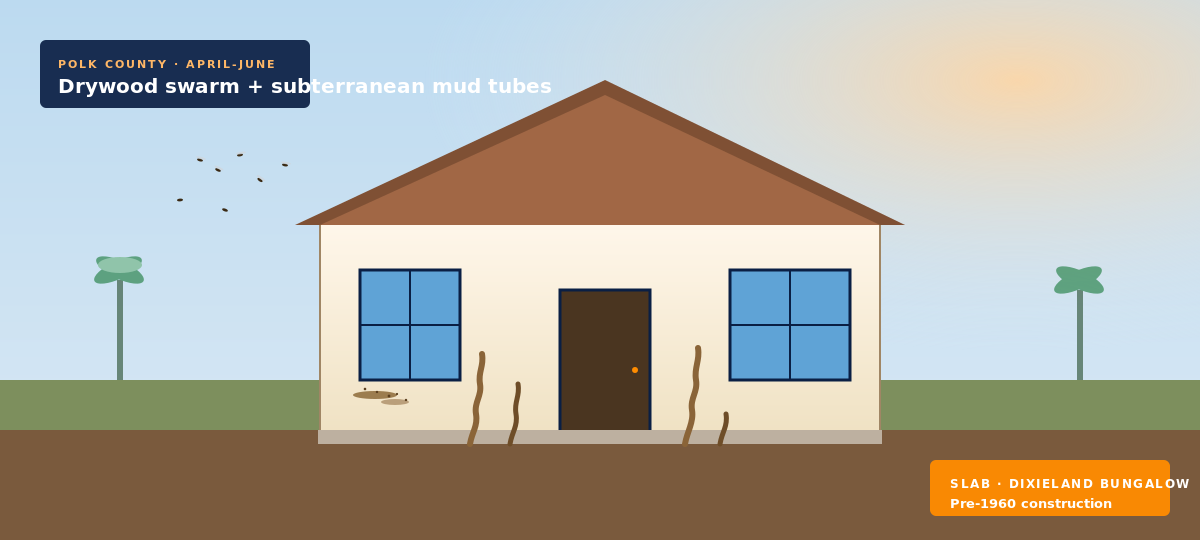
One call reaches a licensed, local exterminator who covers your address — and a real person answers, 24/7.
Dealing with a pest problem right now?
📞 Call now — get matched with a licensed local exterminator: (888) 295-0220When you call, stay on the line for a few seconds while we match you with the licensed local exterminator for your area. Have your address and a quick description of the problem ready.
Licensed local pros · Fast response, subject to availability · No obligation
✅ FDACS-Licensed • 🏠 Polk County Local • 🔍 Inspection • ⚡ Same-Day Available
- Same-day inspection available across Polk County
- Initial inspection — written quote
- FDACS-licensed — both species, both treatment categories
The Single Biggest Difference: Soil Contact
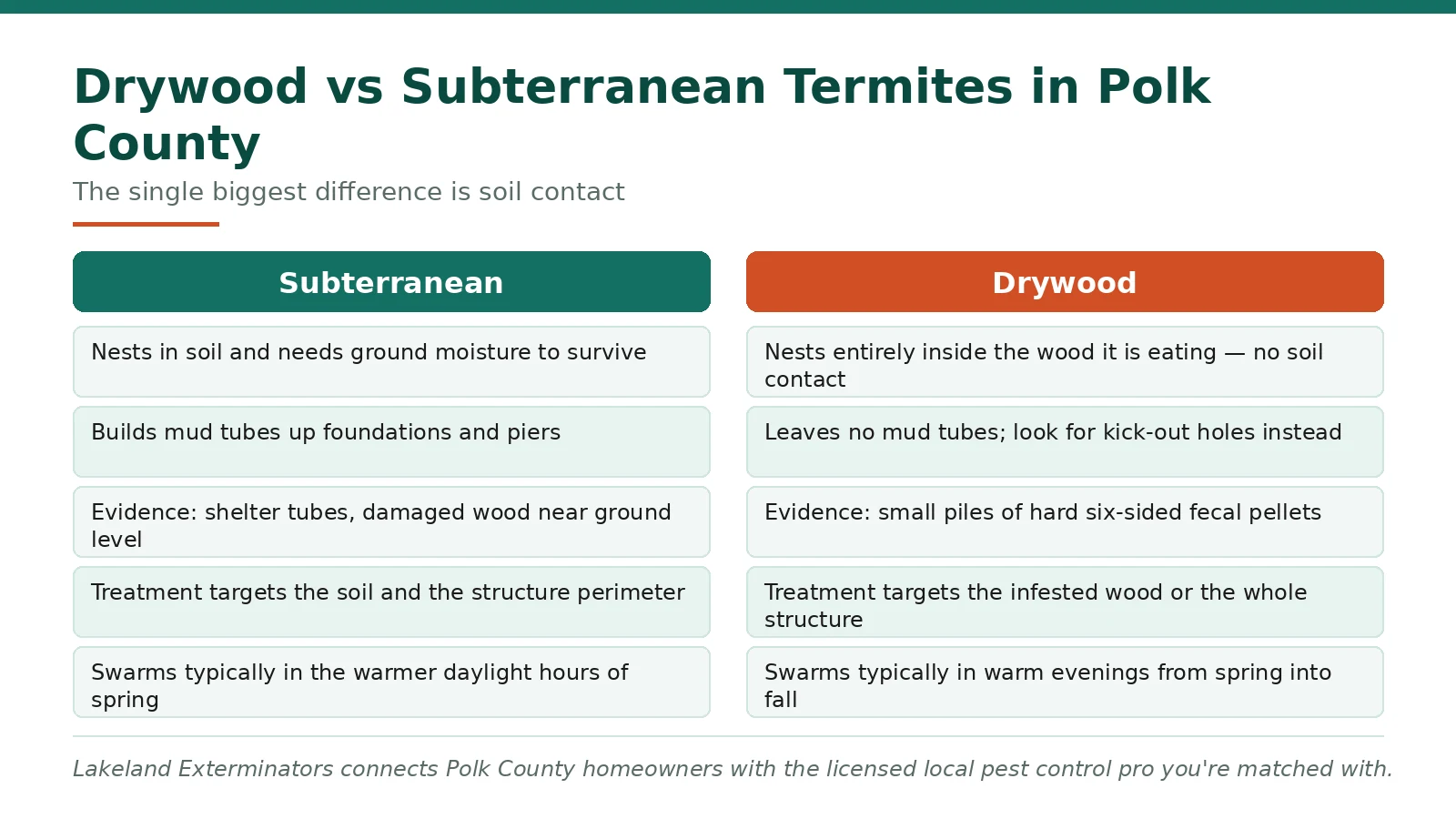
Subterranean termites need soil contact to survive. Their colonies live underground, where they extract moisture from the soil. Worker termites travel up into wood structures through mud tubes — pencil-width covered passageways that protect them from drying out. If you see a mud tube on a foundation wall, slab edge, or interior wall, you’re looking at a subterranean termite.
Drywood termites don’t need soil contact. Drywood colonies live entirely within the wood they’re eating. They extract enough moisture from the wood itself and from atmospheric humidity (which is why Florida’s 75% mean humidity is ideal for them). Drywood termites don’t build mud tubes — instead, they create kick-out holes (tiny ~1mm round holes) to expel waste, and they push fecal pellets — frass — out through these holes.
The consequence: subterranean termite treatment is fundamentally about the soil and the foundation, while drywood termite treatment is fundamentally about the entire structure including all the wood inside it. Our termite treatment in Lakeland, FL guide covers both treatment paths in depth.
Identifying Subterranean Termites in Polk County
What to look for:
- Mud tubes on foundation walls, slab edges, CBS-block walls, plumbing penetrations, garage walls, or interior wall surfaces.
- Swarmers in late winter through spring (February–May in Polk County, peaking in March). Black bodies, pale gray equal-length wings, ~3/8 inch long.
- Discarded wings in small piles near windows, light fixtures, or door frames.
- Damaged wood with mud-packed galleries following the wood grain.
- Hollow-sounding wood when tapped.
Polk County subterranean termite season: Year-round colony activity, swarming peaks February–May after the first warm rains.
Identifying Drywood Termites in Polk County
What to look for:
- Frass piles — small accumulations of pellet-like droppings, often confused with sawdust or ground pepper. Six-sided pellets, ~1mm long, vary in color from light tan to dark brown.
- Kick-out holes — tiny round 1mm holes in wooden surfaces.
- Swarmers in late spring through summer (May–August in Polk County, peaking June–July). Pale-tan to reddish-brown bodies, smoky/translucent wings often of unequal length.
- Discarded wings near windows or light fixtures.
- Hollow-sounding or crumbling wood when probed with a screwdriver.
Polk County drywood termite season: Year-round colony activity, swarming peaks May–August on warm humid evenings after rainfall.
Quick-Reference Comparison Table
| Feature | Subterranean | Drywood |
|---|---|---|
| Colony location | Underground | Inside wood |
| Needs soil contact? | Yes | No |
| Builds mud tubes? | Yes | No |
| Produces frass (pellets)? | No | Yes |
| Kick-out holes? | No | Yes |
| Polk County swarm season | Feb–May | May–Aug |
| Swarmer body color | Black | Pale tan to reddish brown |
| Standard treatment | Liquid soil barrier OR bait stations | Whole-house fumigation OR spot treatment |
| Relative Cost Level | Moderate-to-high | Wide range — Lowest (spot) to Highest (whole-house fumigation) |
Why the Treatment Difference Matters Financially
Subterranean termite treatment targets the soil and foundation. Liquid termiticide barriers (using fipronil-based products like Termidor SC) sit in the moderate-to-high cost tier in Polk County. Bait station systems (Sentricon, Trelona, Recruit HD) carry a similarly moderate-to-high initial cost plus a modest annual monitoring fee.
Drywood termite treatment, by contrast, has to address every infested portion of the wood structure. For widespread infestation, whole-house fumigation (tenting) with Vikane (sulfuryl fluoride) is the highest-cost option in Polk County. For limited infestation, spot treatment with foam termiticide injection is far more affordable and can be effective. Our no-tent termite treatment in Lakeland page covers when spot treatment is the honest answer versus when tenting is required.
What If Both Species Are Present?
Many older Polk County homes — particularly the historic districts of Lakeland (Cleveland Heights, Lake Hollingsworth), Lake Wales (Bok Tower area), and Bartow (downtown) — show evidence of both subterranean and drywood activity. Combined treatment may require subterranean treatment for the foundation, drywood treatment for the structure, and annual WDO inspection.
Florida Regulatory Note
All Polk County termite treatment must be performed by operators holding active FDACS licenses under the Termite/WDO category. Whole-house fumigation additionally requires the Fumigation category license. You can verify any operator’s license at the FDACS Public License Search.
One call reaches a licensed, local exterminator who covers your address — and a real person answers, 24/7.
Disclaimer: Lakeland Exterminators is a local dispatch and referral service, not a licensed pest-control operator. We connect Polk County, Florida homeowners with independent, FDACS-licensed and insured pest-control companies. All inspections and treatments are performed by those independent providers, who set their own pricing, scheduling, and service terms.
Any reference to same-day, emergency, or 24/7 service describes the typical scheduling of matched independent providers and is not guaranteed; actual response times vary by provider, season, location, and demand.