FDACS L&O Dispatch Line · Polk County, FL
Dealing with a pest problem right now?
📞 Call now — get matched with a licensed local exterminator: (888) 295-0220When you call, stay on the line for a few seconds while we match you with the licensed local exterminator for your area. Have your address and a quick description of the problem ready.
Licensed local pros · Fast response, subject to availability · No obligation
Mosquito Control in Lakeland, FL — Aedes aegypti Dispatch & Polk County Chain-of-Lakes Pressure
It’s 6:42 PM in July. You step out onto the lanai with a glass of unsweetened off Lake Hollingsworth, and within 11 seconds you’ve been hit four times — two on the calf, one on the inside elbow, one behind the ear. Aedes aegypti doesn’t care about your candle. The Polk County Mosquito Control District in Bartow is great at the regional spray, but they don’t treat your perimeter — that’s on the independent, FDACS-licensed L&O operator.
Polk County is mosquito country in a way that surprises people who move here from anywhere north of I-10. The Chain of Lakes — Lake Hollingsworth, Mirror Lake, Lake Parker, Lake Morton, Lake Hunter, Lake Wire, Lake Hunter, plus the thirty-odd other lakes inside the Lakeland city limits — provides constant edge-water breeding habitat. The Green Swamp drains into Polk from the north. The 49 inches of annual rainfall, concentrated in June-September, refills every container, gutter, bromeliad, and stagnant flower-pot saucer on a weekly cycle.
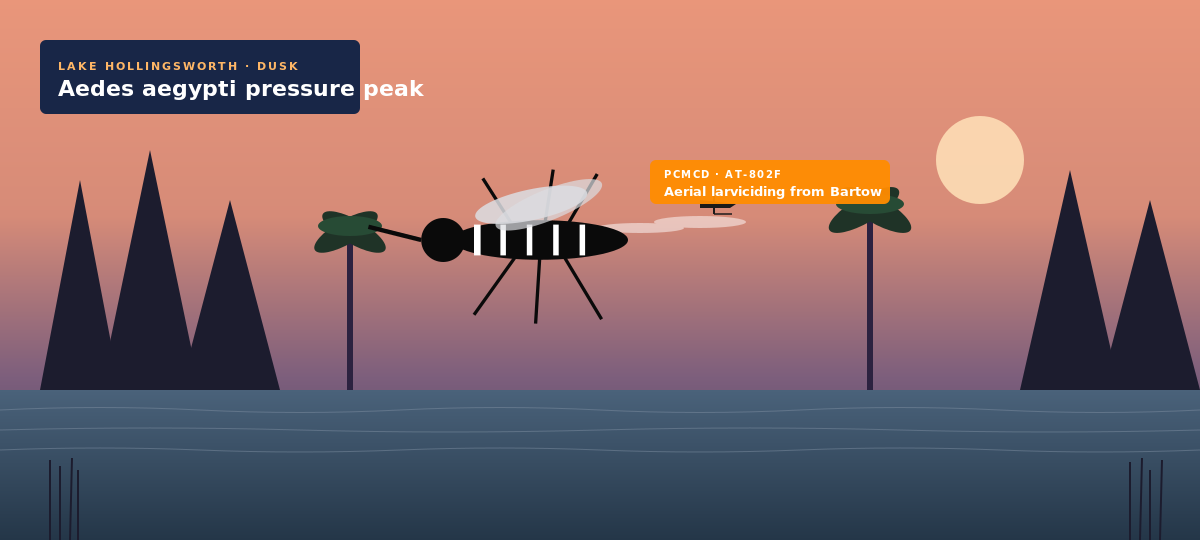
The Polk County Mosquito Control District (PCMCD) headquartered in Bartow runs the regional surveillance, larviciding, and adulticiding program. Their hangar fleet includes Beechcraft AT-802F aerial spray aircraft that handle naled and Dibrom adulticide overflights on declared high-pressure days. PCMCD is the reason Lakeland isn’t actively unlivable in August. But PCMCD’s mandate stops at the property line. Your yard’s breeding cups, your perimeter shrub line, your kid’s pool toy holding 200 cc of stagnant water — that’s on you, or on the licensed L&O (Lawn & Ornamental) pest control operator the dispatch line routes you to.
Lakeland Exterminators is a dispatch and referral service — not a licensed pest control company. Mosquito control in Polk County is performed by independent, FDACS-licensed Florida pest control operators carrying the L&O endorsement. The operator surveys the property, reviews where biting pressure is heaviest and what standing water is present, and triages the treatment plan from there. Scheduling and response times are set by the independent operator and vary by season and demand.
How the Lakeland dispatch line handles a mosquito control call
- Step 1You describe the mosquito pressureDescribe the pressure — front yard at dusk? Back patio all day? Specific corner near a bromeliad bed? The geography matters because Aedes aegypti is a daytime container-breeder and the treatment approach differs from generalist nighttime Culex species.
- Step 2Your ZIP routes the callLakeland, Winter Haven, Bartow, Plant City, Auburndale, Haines City, Lake Wales, Mulberry, Davenport, Polk City — each has different operator coverage. The licensed L&O pro serving Lake Hollingsworth lakefront is rarely the same one serving Hartford Park or the Hallam Preserve flanks.
- Step 3Match to an L&O-endorsed operatorFDACS Category 6 — Lawn & Ornamental — is the licensing for residential perimeter mosquito treatment. Some general-household-pest (GHP) operators add the L&O endorsement; some don’t. The dispatch line only routes mosquito calls to operators carrying the right endorsement.
- Step 4On-site survey & quoteThe licensed operator walks the property, identifies the breeding sources (gutters, bromeliads, planter saucers, kids’ toys, AC drain pans, blocked French drains), and quotes the treatment. They carry the residual product (typically bifenthrin or lambda-cyhalothrin), the larvicide tablets (methoprene or Bti — Bacillus thuringiensis israelensis), and the post-treatment maintenance schedule. You decide.
The mosquitoes biting you in Polk County and which one is which
UF/IFAS lists 60+ mosquito species documented in Polk County. The four you actually care about for residential biting pressure are:
Yellow fever mosquito (Aedes aegypti)
The big one. Container-breeder, daytime biter, prefers human blood over animal blood (anthropophilic). Distinctive lyre-shaped white markings on the dorsal thorax. The Aedes aegypti you slap on your calf at 4:23 PM was almost certainly bred in something on your own property — a bromeliad cup, a planter saucer, a tarp fold holding rainwater, a clogged gutter section, a stagnant birdbath. Generation time in 9b summer heat: 7-10 days from egg to adult. Flight range: typically less than 100 yards from breeding site. This is why container source-reduction works.
Aedes aegypti is also the vector species for dengue, Zika, yellow fever, and chikungunya. Polk County has logged sporadic locally-acquired dengue cases in the last decade. PCMCD surveillance is specifically tuned to Aedes aegypti population indices.
Asian tiger mosquito (Aedes albopictus)
Similar container-breeding strategy, similar daytime biting, but slightly more catholic about host blood (will bite humans, dogs, deer, anything warm). Distinctive single white stripe down the center of the dorsal thorax. Asian tiger has been displacing Aedes aegypti in some Polk County neighborhoods since the early 2000s, though both coexist. Slightly larger than aegypti, slightly more aggressive about biting through clothing. Same flight range, same 7-10 day generation in summer.
Common house mosquito (Culex quinquefasciatus)
Nighttime biter. Breeds in foul standing water — storm drains, septic seepage, neglected swimming pools, the algae-mat edge of a stagnant retention pond. Prefers bird blood but will bite humans readily after dusk. Vector for West Nile virus and St. Louis encephalitis in Florida — PCMCD surveillance traps include Culex-specific gravid trap configurations.
If you’re getting bitten on the patio at 10:30 PM, it’s likely Culex. If you’re getting bitten at 4 PM in full sun, it’s likely Aedes. That timing distinction often points the licensed operator at different treatment priorities — Aedes is a container problem, Culex is a perimeter + larvicide-in-standing-water problem.
Black salt-marsh mosquito (Aedes taeniorhynchus)
Lower-prevalence in Polk than along the coasts, but Lake Hollingsworth and the surrounding marsh edges can host populations. Aggressive daytime biter when populations spike. PCMCD’s AT-802F aerial sprays during declared high-density events are usually aimed at black salt-marsh outbreaks rather than residential Aedes aegypti — the aircraft economics only justify aerial work when populations exceed certain thresholds.
Where your property is breeding mosquitoes right now
The licensed L&O operator the dispatch line routes to spends the first part of every initial visit walking the property looking for breeding containers. You can shorten that walk and lower the eventual treatment cost by doing the same pre-visit. Here’s the field cheat-sheet for Polk County yards:
Bromeliads
Polk County’s landscaping favorite. Every bromeliad cup holds a teaspoon to a tablespoon of water at any given time and refills every rain. Each cup is a potential Aedes aegypti factory. Source-reduction options: rinse the cups weekly with a hose, drop a Bti dunk fragment into each cup (Bti is selective for mosquito larvae, harmless to plants and pets), or replace bromeliads with non-cup-holding alternatives in heavily affected zones.
Gutters and downspouts
A clogged gutter holding 1/2 inch of standing water along a 30-foot run is a top-tier Aedes breeding site. Polk County’s daily afternoon thunderstorms refill them constantly during June-September. Visual inspection: cup your hand under each downspout 15 minutes after a rain — if water is still dripping six hours later, the gutter’s holding water somewhere. Clean and pitch them, or install gutter guards.
Planter saucers
The plastic plant saucers under every potted plant on every Lakeland lanai. Each holds a few tablespoons. Each refills with every watering and every rain. Source-reduction: pour them out twice a week, fill with sand to wick the water away, or replace with no-saucer self-watering pots.
Bird baths, fountains, and water features
Bird baths refill via rain and need weekly dump-and-scrub. Decorative fountains either need to be running constantly (moving water disrupts Aedes oviposition) or drained. Lake Hollingsworth-edge homes with seasonal water features often forget to drain them at the end of summer.
AC condensate drains
The PVC pipe from your air handler that drips condensate onto the side yard. Every Lakeland house has one. During humid season it can produce a steady drip that pools at the base, creating a constant micro-breeding zone. Direct the drain into a French drain or a dry well rather than letting it pool.
Tarps, kids’ toys, kayaks, bbq covers, sand-pail outdoor toys
Anything that can fold, dip, or capture water. The licensed operator can’t treat the inside of a wadded-up pool tarp. They can spray the perimeter and treat the standing water around the tarp, but you have to actually unfold and drain the tarp. Polk County’s 2:30 PM thunderstorms refill the tarp the next day.
Bromeliad-like cup plants beyond bromeliads
Bird-of-paradise leaves, croton lower leaves, palmetto fronds in some configurations — anything with a cup-like geometry that captures rainwater. Polk landscaping is full of these. The licensed L&O operator can include a Bti treatment of the planted area as part of the perimeter visit.
Tires, neglected pool, stagnant pond edges
The classics. An old tire holding rainwater in a side yard is the textbook Aedes breeding site. A pool that’s been sitting with stagnant water for three weeks during a between-tenant period (common in the Davenport short-term-rental belt) becomes a Culex nursery. Stagnant pond edges are PCMCD’s territory but the perimeter of the pond on your property is the licensed operator’s.
Perimeter spray vs misting system vs larvicide — what the L&O operator weighs
Three commonly-deployed residential mosquito treatments in Polk County, plus a couple of edge cases:
Residential perimeter barrier treatment
The standard initial visit. The licensed L&O operator sprays a residual pyrethroid (bifenthrin — Talstar P; lambda-cyhalothrin — Demand CS) on the underside of leaves around the property perimeter, along the fence line, into shaded resting areas where adult mosquitoes harbor between blood meals. The residual lasts 21-30 days in Polk County summer humidity. Treatments are typically monthly during peak season (April-October) and quarterly or paused during the cooler dry months (Dec-Feb).
Polk County typical cost: priced per visit by the independent licensed operator, based on lot size and shade coverage. Season packages (8 visits, monthly Apr-Oct + post-storm extras) are quoted as a bundle by the operator.
In-line misting system (permanent install)
Brands like MistAway, Mosquito Squad, Mosquito Nix. A network of small nozzles installed along eaves, fence tops, and shrub lines, fed by a central reservoir of pyrethroid concentrate (typically a permethrin or pyrethrum formulation). The system pulses 30-60 seconds of fine mist at programmed times (dusk and dawn typically) and provides continuous protection during the misting cycle.
Polk County typical install: priced by the independent licensed operator based on perimeter length, nozzle count, reservoir size, and integration with smart-home schedulers. Refill costs are billed quarterly by the operator and depend on usage. Ideal for: large lots with chronic Aedes pressure, lakefront homes on the Chain of Lakes where source-reduction can’t keep up, families with members who can’t tolerate bites medically.
Larvicide treatment of standing water
Bti dunks (Bacillus thuringiensis israelensis) or methoprene tablets dropped into permanent standing water sources — French drain catch basins, stormwater retention area edges where the operator has property-owner permission, septic vent lids, rain barrels, decorative fountains that can’t be drained. Bti is biologically selective — it kills mosquito and black-fly larvae and is non-toxic to other aquatic life. Methoprene is an insect growth regulator that prevents larval pupation.
Polk County typical cost: rolled into perimeter visit pricing, or quoted as a per-source add-on by the independent licensed operator. Larvicide is the single most cost-effective intervention for chronic property-edge Aedes pressure because it targets the source.
Backpack ULV (ultra-low volume) fogging
A space spray of pyrethroid fog for an event window — backyard wedding, graduation party, July 4 cookout. Provides 4-8 hour knockdown. The licensed operator runs the backpack ULV unit through the yard the morning of or the day before. Polk County typical event cost: quoted per event by the independent licensed operator, based on yard size and treatment scope.
Long-residual In2Care station (specialty)
An adult-mosquito station that uses pyriproxyfen + Beauveria bassiana fungus. The female Aedes aegypti enters the station, picks up the fungus and pyriproxyfen on her body, then carries it back to multiple breeding sites. It’s autodissemination — one station can treat many breeding containers indirectly. Not every Polk County L&O operator deploys In2Care; the ones who do typically use it for heavy chronic Aedes pressure where source-reduction alone hasn’t worked.
What Polk County Mosquito Control does, and what it doesn’t do for your yard
Polk County Mosquito Control District (PCMCD) is the public-sector regional mosquito program. Headquartered in Bartow with operations facilities including aircraft hangars for fixed-wing aerial spray, PCMCD runs a sophisticated surveillance and treatment program covering the full 2,011 square miles of Polk County. Understanding what PCMCD does — and where it stops — helps you set expectations for what the licensed L&O operator the dispatch line routes to is actually being hired to handle.
What PCMCD does
- Surveillance traps — CDC light traps and BG-Sentinel traps deployed across Polk County weighting for Aedes aegypti, Culex quinquefasciatus, and Aedes taeniorhynchus indices. Data feeds the spray decision matrix.
- Regional aerial spray — Beechcraft AT-802F (Air Tractor) aircraft operating out of Bartow ops, applying naled or Dibrom adulticide during declared high-density events. Public notice precedes spray events.
- Truck-mounted ULV ground spray — pickup-mounted ULV foggers covering public rights-of-way, neighborhood streets, parks, and other public access areas during target events.
- Public-area larviciding — Bti and methoprene treatment of public stormwater retention ponds, drainage ditches, swamp edges, public lake edges, salt-marsh interface areas.
- Mosquito-borne disease surveillance — coordinated with Florida Department of Health for West Nile, EEE, dengue, Zika surveillance.
What PCMCD does NOT do
- Treat your specific residential property perimeter on request.
- Drain your gutters, empty your bromeliads, or do property-level source-reduction.
- Install or service residential misting systems.
- Provide an L&O treatment scope, retreatment bond, or season package for individual homeowners.
That residential gap is what the FDACS-licensed L&O operator on the receiving end of the dispatch line fills. PCMCD handles the regional baseline; the licensed private-sector operator handles your yard. Both are legit. Both are necessary in Polk County summer. PCMCD’s public-facing spray schedule is published — the licensed operator coordinates around it (no point running a perimeter treatment 6 hours before PCMCD overflies your block, for instance).
Month-by-month pressure and when the dispatch line gets busy
9b humid subtropical means Polk County has mosquitoes year-round, but the pressure curve is real and the licensed operator’s service cadence matches it:
January-February — quiet shoulder
Lowest pressure of the year. Daytime highs in the 70s, overnight lows in the 50s suppress oviposition and slow generation times. Aedes aegypti still produces a low-density population around heated lanais and irrigated landscapes. Many L&O perimeter season packages skip or reduce this window. PCMCD aerial work is minimal.
March-April — ramp-up
Spring rains kick off the new generation. Aedes aegypti populations rebuild from the overwinter egg bank — eggs that were dropped on container sides last fall and survived the dry winter, now hatching as containers refill. Peak biting pressure starts emerging late April. L&O season packages typically start late March or April 1.
May-July — peak buildup
Rainy season begins. Generation times shorten to 7-10 days. Container breeding accelerates. Daytime Aedes pressure becomes the dominant complaint. PCMCD aerial work picks up. Perimeter treatments most effective during this window; misting systems and In2Care stations earn their cost during this window.
August-September — high plateau
Highest sustained biting pressure of the year. Daily afternoon thunderstorms refill every container daily. Mosquito-borne disease surveillance peaks. Hurricane-season standing water (after a tropical storm passes through) compounds pressure for 2-3 weeks. Source-reduction visits and post-storm cleanups are the operator’s busiest weeks.
October-November — gradual decline
Daily rain frequency drops. Container refills become less frequent. Aedes populations crash gradually as oviposition slows. L&O perimeter visits go from monthly to bi-monthly. PCMCD aerial work reduces.
December — quiet
Lowest pressure window. Operators offer reduced-frequency winter packages or pause until spring.
| What you’ll see on the quote | Pricing | What drives the number |
|---|---|---|
| Initial perimeter survey + first treatment | Varies by provider | Quarter to half-acre lot, walk-through identification of breeding sources, residual pyrethroid spray (bifenthrin / lambda-cyhalothrin) on shrub line and shaded resting areas. |
| Monthly perimeter maintenance (April-October) | Varies by provider | Standard L&O perimeter retreatment. 21-30 day residual. Most operators bundle as 6-8 visit season packages. |
| Season package (8 visits, monthly) | Varies by provider | Apr-Oct standard with one post-storm extra. Sometimes prepaid with discount. |
| Bti larvicide add-on (per standing-water source) | Varies by provider | Per significant source. Bromeliad bed, French drain catch basin, retention edge with permission. |
| In2Care station rental | Varies by provider | Autodissemination station. Specialty operator inventory. 4-8 stations on typical Polk lot. |
| Misting system install (perimeter) | Varies by provider | Permanent install, nozzle network, reservoir. MistAway / Mosquito Squad-style. Lakefront premium. |
| Misting system refills (per quarter) | Varies by provider | Pyrethroid concentrate refill. Usage-dependent. |
| Event ULV fogging (single event) | Varies by provider | Backpack ULV space-spray for outdoor event. 4-8 hour knockdown. |
Pricing is set independently by each FDACS-registered Polk County operator based on property size, scope, and season — this table reflects typical service types, not price figures.
Lakeland, Winter Haven & Polk County neighborhoods the dispatch line covers
Polk County is bigger than most people who haven’t lived here realize — 2,011 square miles, 17 incorporated cities, 30+ unincorporated communities, three different USDA microclimate pockets, and a tax base spanning modest starter homes in older Lakeland neighborhoods to multi-million-dollar lakefront estates on the Chain of Lakes. Your ZIP routes you to the licensed Polk County operator who actually serves your address.
Other Polk County pest services the line routes
Termite Treatment Lakeland
Eastern subterranean, drywood, Formosan — Sentricon, liquid termiticide, Vikane tent.
See the termite guide →Roach Extermination Lakeland
German indoor, palmetto bug outdoor, year-round 9b pressure.
See the roach guide →Fire Ant Control Lakeland
RIFA mounds, citrus-belt drift, broadcast bait vs mound treatment.
See the fire ant guide →Rodent Control Lakeland
Roof rat dominance, palm-canopy harborage, gable-vent exclusion.
See the rodent guide →Bed Bug Heat Treatment
STR belt, Davenport / Lake Wales hotel triangle, heat or chemical.
See the bed bug guide →Wasp / Yellow Jacket
Paper wasps, mud daubers, yellow jackets — pool cage and lanai pressure.
See the wasp guide →Mosquito Control in Lakeland, FL — Polk County FAQ
Does Polk County Mosquito Control treat my yard if I call them?
No, not the way you mean. PCMCD’s mandate is regional — they handle aerial spray over wide swaths of the county during declared high-density events, truck-mounted ULV ground spray of public rights-of-way, and larvicide treatment of public water bodies and drainage areas. They do not treat individual residential property perimeters on request. You can report standing water or heavy biting pressure to PCMCD, and they’ll factor that into their surveillance, but the actual residential perimeter treatment, source-reduction visits, and misting system installs come from FDACS-licensed L&O private operators.
Why am I getting bitten in the daytime if Polk has so many night mosquitoes?
Because the daytime biter is Aedes aegypti (and to a lesser extent Asian tiger, Aedes albopictus), and those species breed almost entirely in containers on residential properties. Culex (night biters) need foul standing water — storm drains, septic seepage, neglected pools. The L&O operator will treat both, but daytime Aedes pressure usually responds dramatically to container source-reduction within 7-14 days, while nighttime Culex pressure responds more to perimeter residual spray and larvicide in standing water sources.
How long does the perimeter spray last in Lakeland humidity?
21-30 days under typical Polk County summer conditions for bifenthrin or lambda-cyhalothrin residuals. Heavy thunderstorm activity shortens that — washoff on shrub line foliage is real. The licensed L&O operator’s monthly cadence accounts for it. After Hurricane Ian-scale events or any tropical storm that drops more than 4 inches in 24 hours, expect to need a post-storm retreatment 5-7 days after the storm clears.
Are misting systems worth the cost?
Depends on the lot and the chronic-pressure level. For a quarter-acre Lakeland Highlands lot with moderate Aedes pressure, monthly perimeter treatments are usually more cost-effective than installing a misting system — break-even on the install often takes 3-5 years. For a half-acre lakefront Lake Hollingsworth or Lake Parker property with chronic peak-season pressure that perimeter treatments can’t fully knock down, a misting system earns its cost in 2-3 seasons. The licensed L&O operator can give a specific recommendation based on what they find during the initial survey.
Is the spray safe for my dog / cat / kids?
The licensed L&O operator’s product (bifenthrin, lambda-cyhalothrin, or pyrethrin-based) is residual on foliage after a brief drying period. FDACS-registered protocols call for a re-entry window of typically 30 minutes to 2 hours after application before pets and humans should be on the treated areas. Once dry, the residual is bound to leaf surfaces and presents minimal contact exposure. The operator will explain the specific re-entry window for the product they’re using. Bti larvicide is biologically selective for mosquito and black-fly larvae — it’s the safest commonly-used product in the toolkit and is approved for organic-certified applications.
Why does the perimeter spray work for a few weeks then mosquito pressure comes back?
Because the perimeter spray kills adult mosquitoes resting in the treated zone — but it doesn’t prevent new adults from emerging from breeding containers on your property. Aedes aegypti generation time in 9b summer is 7-10 days, so a fresh wave of adults emerges from each unaddressed container roughly weekly. The cost-effective control combines (1) source-reduction of breeding containers, (2) larvicide of permanent standing water that can’t be eliminated, and (3) perimeter residual to handle adult-stage mosquitoes that fly in from neighbors’ properties. Skip any of those three and pressure rebuilds.
How quickly can the dispatch line get someone out during peak season?
During April-September peak in Polk County, most L&O operators in the routing network book initial visits inside 3-7 business days. Response times vary by provider, season, and demand; faster scheduling is sometimes possible during shoulder season. Appointments are set on the independent operator’s calendar. Mosquito treatment in Polk County is performed by independent, FDACS-licensed pest-control companies (FDACS Category 8B or 8C).
Do I need to worry about West Nile or dengue in Lakeland?
Polk County has logged occasional locally-acquired dengue cases over the past decade and West Nile is detected in Culex populations during PCMCD surveillance most years. Risk varies year to year and neighborhood to neighborhood. Florida Department of Health and CDC publish current advisories — check those for season-specific guidance. The functional answer is: source-reduce containers, treat your perimeter, use EPA-registered repellent (DEET, picaridin, or oil of lemon eucalyptus) during peak biting hours if you’re outside, and don’t panic. The L&O operator handling your perimeter is part of the layered defense.
Why Lakeland’s mosquito pressure runs higher than the rest of Polk County
- Why Lakeland’s lakes mean more mosquito breeding ground than most of Polk County — how 38 named lakes change the container-and-marsh math
- Lovebug season in Lakeland: why swarms peak twice a year — the other flying-insect season residents call about, and why it is not a mosquito problem
Disclaimer: Lakeland Exterminators is a local dispatch and referral service, not a licensed pest-control operator. We connect Polk County, Florida homeowners with independent, FDACS-licensed and insured pest-control companies. All inspections and treatments are performed by those independent providers, who set their own pricing, scheduling, and service terms.
Any reference to same-day, emergency, or 24/7 service describes the typical scheduling of matched independent providers and is not guaranteed; actual response times vary by provider, season, location, and demand.