Mounds in the yard, welts on your ankle. Fire ants don’t negotiate — and one mound treatment won’t hold.
One call reaches a licensed, local exterminator who covers your address — and a real person answers, 24/7.
Talk to a licensed exterminator now
Call and we’ll connect you with a licensed, local exterminator who covers your address. It takes about two minutes, and a real person answers.
Free to call. Free to get matched. The licensed operator gives the quote.
24/7 line · A real person answers · Availability of same-day and emergency service depends on the provider.
Is it actually a fire ant? Three species get called one name
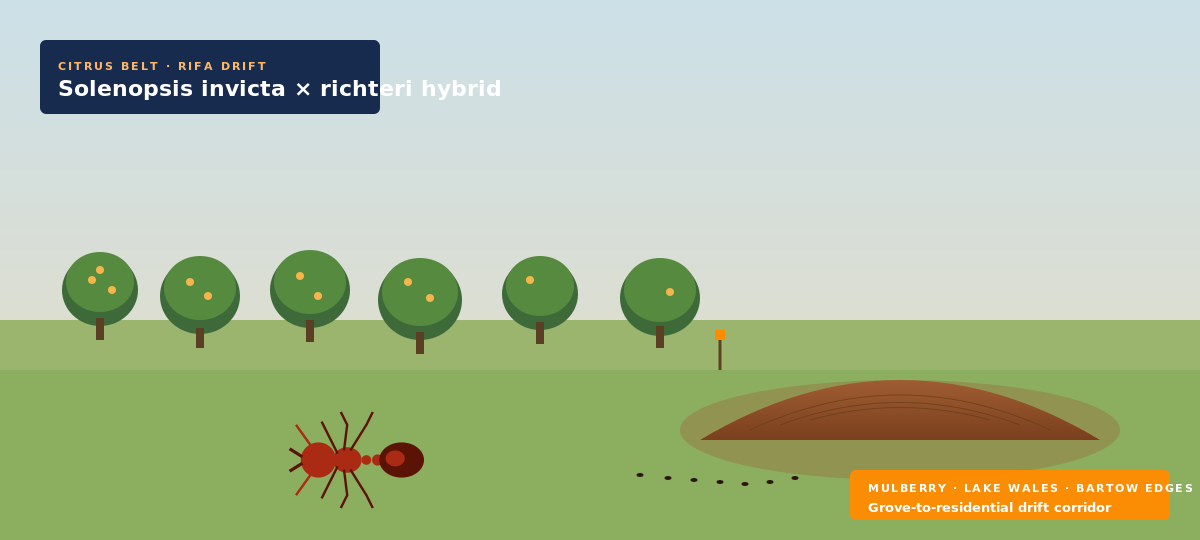
Here’s the deal — “fire ant” in Polk County almost always means the red imported fire ant, Solenopsis invicta. But not every ant that stings is RIFA, and not every mound in your St. Augustine is worth panicking over. Getting the ID right changes the bait, the timing and the price.
Red imported fire ant
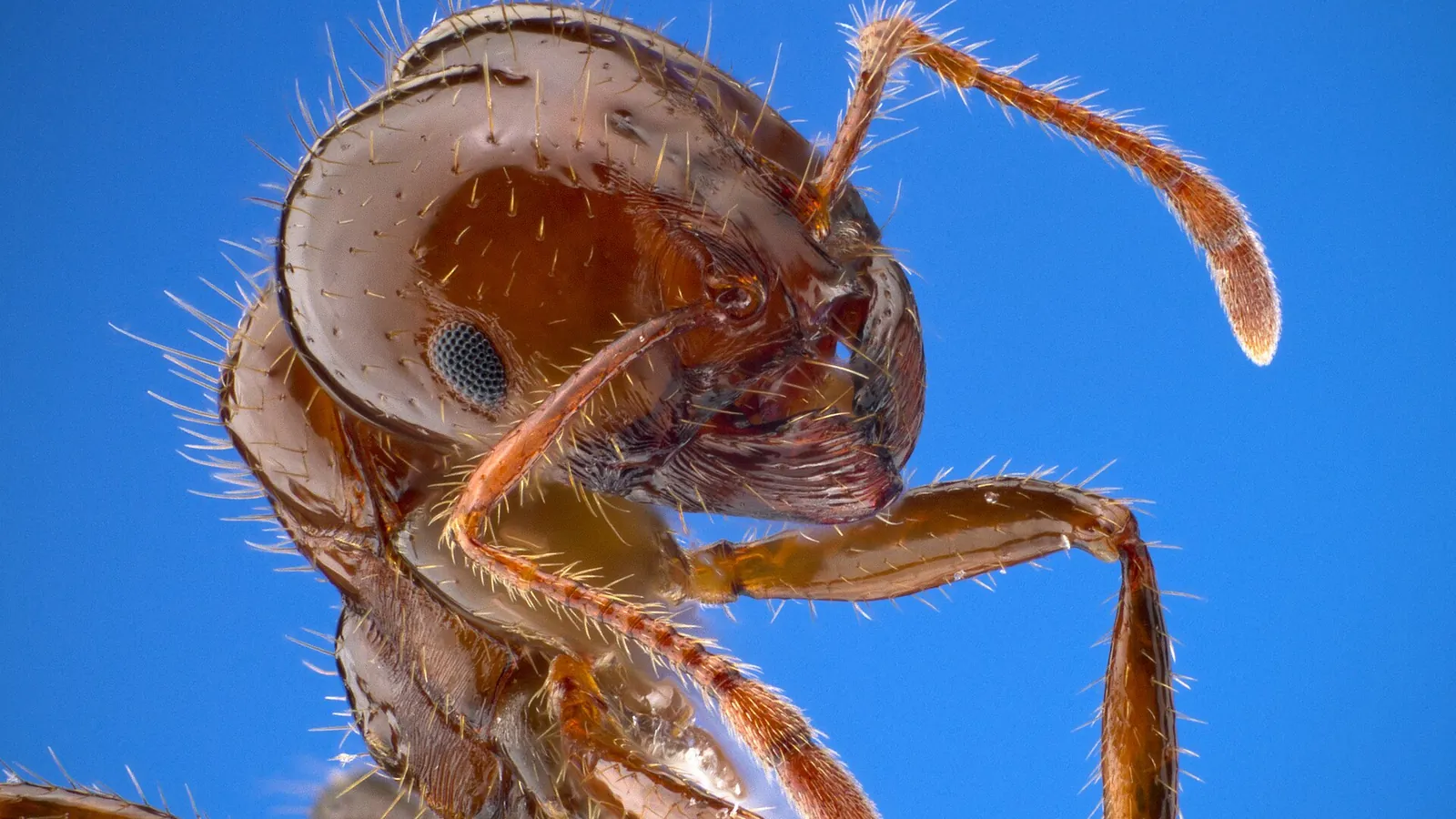
Solenopsis invicta. The one you’re dealing with. Reddish-brown, workers in a range of sizes in the same mound, and the mound has no visible entry hole — they tunnel in from below. Disturb it and the whole surface boils in seconds.
Hybrid fire ant
S. invicta × S. richteri. Present in parts of the Southeast; behaves like RIFA for treatment purposes. Not something you’ll separate by eye in the yard, and it doesn’t change the plan.
Native tropical fire ant
Solenopsis geminata. Florida’s own. Big-headed major workers, less aggressive, and it’s been steadily pushed out by RIFA. It still stings — but it isn’t the reason your yard has forty mounds.
What it’s not
If the ants are indoors on the counter and don’t sting, you’re not looking at fire ants. Fire ants are a yard problem that occasionally comes inside; kitchen ants are usually ghost ants or another sugar-feeding species. If they’re big, black-and-red and dropping coarse sawdust, those are carpenter ants. And if they’re swarming your A/C disconnect in a jerky, frantic mass, that’s a tawny crazy ant problem, which is a completely different fight. Not sure? Start at the Lakeland ant control hub.
The mound is not the colony
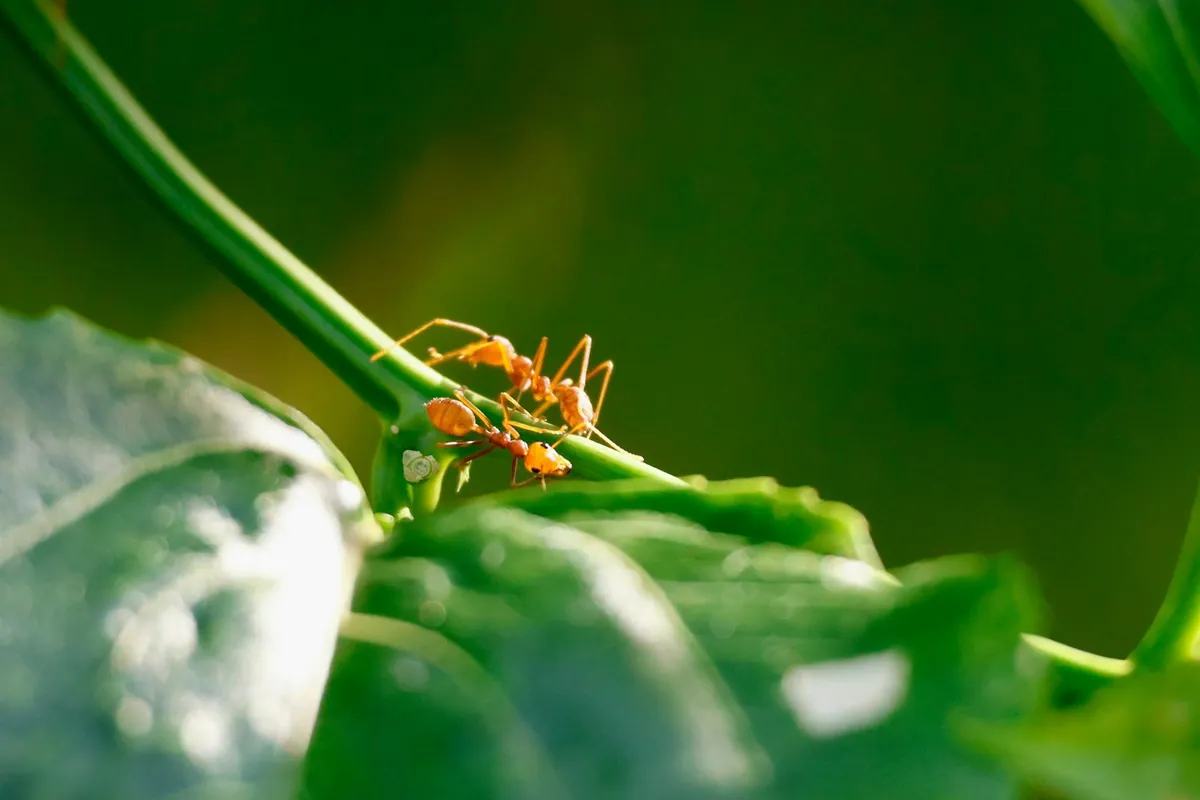
A fire ant mound is a ventilation and brood chamber, not the whole nest. The tunnels run out well past the visible dirt, and the queens sit deep. That’s why a jug of hardware-store mound drench feels satisfying and changes nothing: you scald the top few inches, the colony relocates a few feet, and in ten days there’s a fresh mound near the mailbox.
Two more facts that shape every real treatment plan:
- Many colonies here are polygyne — multiple queens in one colony. Polygyne populations pack far more mounds per acre than single-queen colonies do, and killing one queen doesn’t end anything. It’s the reason a yard can look like a minefield.
- They fly. Newly mated queens disperse on the wing, especially after warm rain. Your neighbor’s untreated pasture is a queen factory, and a treated yard with no ongoing program will be re-colonized from the air. This isn’t a failure of the treatment — it’s the nature of an open, mobile pest.
So the honest framing is: fire ant work is population suppression, not eradication. Any operator who says otherwise about an open Florida yard is selling something.
The three approaches a licensed operator will weigh
Individual mound treatment
Direct treatment of each visible mound. Fast knockdown, ideal when there are only a handful of mounds and one is next to the swing set. Does nothing about the colonies you haven’t spotted yet or the queens flying in next week.
Broadcast bait
A granular bait spread across the whole property. Foragers carry it back and feed it to the brood and queens. Slower — weeks, not hours — but it reaches colonies you never saw, and it’s the backbone of any real suppression program.
The two-step
Broadcast bait across the yard, then spot-treat the mounds that matter most while the bait works. This is the approach most Polk County operators land on for a family yard with real mound pressure, and it’s what university extension programs across the Gulf South recommend.
Why timing decides whether the bait works
Bait only works if ants are actively foraging when it hits the ground. Broadcast onto scorching midday turf in July and the oil in the bait goes rancid before anyone picks it up. Broadcast into wet grass and it clumps and gets ignored. A licensed operator times application to the ants’ foraging window — typically the cooler ends of the day — and won’t put bait out ahead of an afternoon storm. That single judgment call is most of the difference between a professional bait program and a bag from the big-box store.
The Polk County fire ant calendar
| When | What the ants are doing | What it means for treatment |
|---|---|---|
| Feb – Apr spring flare-up | Soil warms, colonies push brood toward the surface, and mounds seem to appear overnight after the first warm rains. Mating flights ramp up. | Prime bait window. Ants forage hard, and knocking the population down now means fewer mounds all summer. The single most useful service call of the year. |
| May – Jun | Peak mating flights. Newly mated queens land and dig in — often in freshly disturbed soil, new sod and fill dirt. | New sod and construction lots get colonized fast. Re-treatment after landscaping isn’t upselling; it’s how the biology works. |
| Jun – Sep storm season | Daily convective storms flood tunnels. Colonies raft, relocate and rebuild — mounds pop up along driveways, sidewalks and slab edges the morning after a downpour. | Baiting gets tricky between storms. Expect mounds to move rather than disappear. Foraging shifts to dawn and dusk. |
| Oct – Nov | Rain tapers, temperatures moderate, foraging picks back up. | The second strong bait window of the year. A fall broadcast sets you up for a quieter spring. |
| Dec – Feb | Colonies drop deeper on cold snaps but never truly go dormant in Central Florida. | Mound treatment still works on warm afternoons. Bait uptake is unreliable when it’s cold — ants aren’t out looking. |
Counting mounds instead of enjoying the yard?
A licensed operator can bait the whole property, not just the piles you found.
Talk to a licensed exterminator now
Call and we’ll connect you with a licensed, local exterminator who covers your address. It takes about two minutes, and a real person answers.
Free to call. Free to get matched. The licensed operator gives the quote.
Why grove-edge and pasture-adjacent lots never stay clear
Polk County is citrus and cattle country that grew houses. A huge share of our subdivisions back up to an old grove line, a pasture, a retention pond bank or a strip of unmaintained county right-of-way — and every one of those is untreated fire ant habitat with a steady supply of mated queens.
If you’re out toward Highland City, east of Lakeland along the SR-60 and Bartow corridors, out past Kathleen, or anywhere the subdivision ends and the sod farm begins, this is your reality: your yard is a treated island in an untreated sea. Suppression holds; permanent elimination doesn’t. Operators who work these properties typically build a recurring exterior program with scheduled broadcast bait rather than selling a one-and-done, because the one-and-done gets re-colonized from the fence line.
Same story in reverse for South Lakeland, Grasslands and Christina — heavily irrigated, well-drained sandy soils on 1980s-and-newer slabs are ideal mound-building ground, and irrigated turf keeps colonies fed through the dry spring when unwatered ground goes hard.
Stings: what’s normal, what isn’t, and what to tell the operator
Not medical advice — just what to expect and when to take it seriously.
The typical reaction
A fire ant grips with its jaws and stings repeatedly in an arc, which is why you get a ring of welts rather than one bite. Burning and itching come first; within a day most stings form a small sterile pustule. Leave it alone. Breaking it open is how a nuisance sting turns into a secondary skin infection, and that’s the outcome that actually sends people to a clinic. Cold compress, wash it, don’t scratch.
When it’s more than a sting
A small share of people react systemically. Hives spreading away from the sting site, swelling of the face, lips or throat, trouble breathing, dizziness or a fainting feeling after stings are emergency signs — seek immediate medical care, don’t wait it out. If anyone in the household has ever reacted that way to a sting, say so when the coordinator calls. It changes how urgently the job gets routed and how the operator schedules the work around your family.
Kids, pets and re-entry
- Toddlers and mounds are a bad mix. Kids stand on the mound before they notice it, which is how single stings become dozens. Mounds near a swing set, sandbox or the path to the school bus stop get priority treatment for a reason.
- Pets. Dogs nose into mounds and get stung on the muzzle and paws. Ask the operator directly about the re-entry interval for the products used and whether granular bait poses any risk to a pet that eats things off the lawn.
- Re-entry after treatment. Every product has a label, and the label is the law. The licensed operator will tell you how long to keep kids and pets off treated turf — usually until a liquid application has dried. Ask, and get it in writing on the service ticket.
How the dispatch works — four steps, no phone tag
You call the dispatch line
That’s the form. It tells us which corner of Polk County you’re in — a Highland City acre and a Dixieland courtyard get routed differently.
A coordinator reaches out
A real person. They’ll ask how many mounds, how big the lot is, whether anyone’s been stung, and whether there are kids or pets on that turf.
You’re matched to a licensed operator
An independent, FDACS-licensed pest control company that covers your address and does lawn and ant work. Verify their license yourself before anyone treats.
The operator inspects and quotes
They set the price, the products, the schedule and any service terms — we don’t. Free to call, free to get matched, and the quote comes from the licensed pro.
What the licensed operator will ask you
- How many mounds, and where? Six mounds along a fence line is a different job from forty across a half acre.
- Lot size and turf type. Bait is priced and applied by area, and St. Augustine, bahia and bare sand behave differently.
- What’s next door? Pasture, grove, pond bank, vacant lot — that’s the re-infestation source, and it drives whether they recommend a recurring program.
- Has anyone been stung, and did they react badly? Say so up front.
- Kids, pets, chickens, a vegetable garden, a pond with fish? All of it constrains which products are on the table.
- What have you already put down? Leftover granules and DIY drenches change what the operator can layer on top.
What fire ant work costs in Polk County
We don’t set prices and never quote them. What we can do is explain how Polk County operators structure the job so the number you hear makes sense:
- One-time mound treatment. Priced by the number of mounds. Lowest line item on the menu, and the shortest-lived result.
- Broadcast bait, whole property. Priced by treated square footage or acreage. The real workhorse.
- Recurring fire ant program. Scheduled broadcast applications, usually a few times a year, timed to the spring and fall foraging windows. What most grove-edge and pasture-adjacent properties end up on.
- Add-ons. Some operators fold fire ant suppression into a broader lawn or perimeter pest program; others price it standalone. Ask which, before you book.
For how ant work compares to termite, rodent and general pest pricing in this market, see the Lakeland pest control cost breakdown. The number itself comes from the licensed operator after they’ve walked your property.
Other pests we route across Polk County
All ant species
Not sure what you’ve got? The hub covers every ant we dispatch for across Lakeland and Polk County.
Ant control in Lakeland →Ghost ants
Tiny, pale, indoors, trailing to the sink. Bait-only species — and spraying makes it spread.
Ghost ant control →Tawny crazy ants
Reddish, frantic, and drawn to electrical equipment. They can bury a fire ant population — and then you have a worse problem.
Tawny crazy ants →Termites
Mud tubes on the slab, wings on the windowsill in spring. Different animal, different license class.
Termite control in Lakeland →Rodents
Roof rats in the palms and attic. Polk County’s other year-round pressure.
Rodent control in Lakeland →County-wide service
Winter Haven, Bartow, Auburndale, Haines City, Lake Wales — same dispatch, same licensed network.
Pest control in Polk County →Get the yard back.
One ZIP. A real person on the line. An FDACS-licensed operator who bait-times for a living.
Talk to a licensed exterminator now
Call and we’ll connect you with a licensed, local exterminator who covers your address. It takes about two minutes, and a real person answers.
Free to call. Free to get matched. The licensed operator gives the quote.
Fire ant questions, answered straight
Why do the mounds come back a week after I treat them?
Because a mound drench only reaches the top of the nest. The colony relocates a few feet and rebuilds, and it looks like a brand-new mound. On top of that, newly mated queens fly in from surrounding pasture, grove edges and untreated lots, especially after warm rain. Lasting relief comes from broadcast bait across the whole property, usually on a recurring schedule — not from chasing individual mounds.
How long does fire ant bait take to work?
Weeks, not hours. Foragers have to find the bait, carry it back and feed it through the colony to the brood and queens. You’ll still see ants for a while after application. That’s normal. Anyone promising an instant empty yard from a bait program is describing something bait does not do.
Can fire ants ever be eliminated from my yard for good?
Not in an open Florida landscape. Mated queens fly, and Polk County is full of untreated pasture, grove edge and right-of-way that keeps producing them. The realistic goal is population suppression maintained on a schedule — a yard your kids and dogs can use. Treat any claim of permanent eradication with suspicion.
When is the right time of year to treat fire ants in Polk County?
Spring, roughly February through April, is the strongest window: the soil is warming, colonies are foraging hard, and knocking the population down before mating-flight season means fewer mounds all summer. Fall, October and November, is the second window. Deep summer works but is complicated by daily storms, and cold snaps in winter suppress the foraging that bait depends on.
What should I do if my child or dog gets stung?
Move away from the mound, brush the ants off dry rather than swatting, wash the area, and use a cold compress. Most stings form a small pustule within a day — leave it intact, since breaking it open is what invites a skin infection. Spreading hives, swelling of the face or throat, trouble breathing or faintness after stings are emergency signs and warrant immediate medical care. Tell the coordinator if anyone in the home has reacted that way before.
Is treated turf safe for kids and pets?
Every product carries a label with a re-entry interval, and the label is legally binding on the licensed operator. Ask them directly how long to stay off treated turf — commonly until a liquid application has dried — and ask them to note it on your service ticket. If you have chickens, a pond with fish, or a vegetable garden, say so before treatment, because it narrows the product list.
Do I need fire ant treatment if the mounds are only in the back pasture?
It depends on how you use the property. Fire ants in an unused back acre are a nuisance; fire ants where the kids play, where the dog runs, or along a fence line you handle daily are a hazard. Operators will often treat priority zones and a buffer rather than the whole parcel, which keeps the cost proportionate. That’s a conversation to have during the inspection.
Is the pest control company actually licensed?
Every operator in the network is a licensed Florida pest control business, and you never have to take our word for it. License status is public: search the company at the Florida Department of Agriculture and Consumer Services license lookup before anyone treats your property. Florida pest control is regulated under Chapter 482, Florida Statutes.
Disclosure
Lakeland Exterminators is a dispatch and matching service. We connect Polk County callers with FDACS-licensed pest control operators. We are not a licensed pest control operator. We do not perform treatment, set prices, issue warranties, hold bonds, or carry pest control trade insurance. All pricing, scheduling, treatment plans, warranties and service terms are determined by the FDACS-licensed operator dispatched to your address under Chapter 482, Florida Statutes.
Same-day and 24/7 emergency services are subject to provider participation, location, technician availability, and demand. Availability is not guaranteed and may vary by market and appointment capacity.
License status of any operator you connect with is publicly verifiable at the FDACS license search.
Nothing on this page is medical advice. If you or someone in your household has a severe reaction to insect stings, seek qualified medical care.