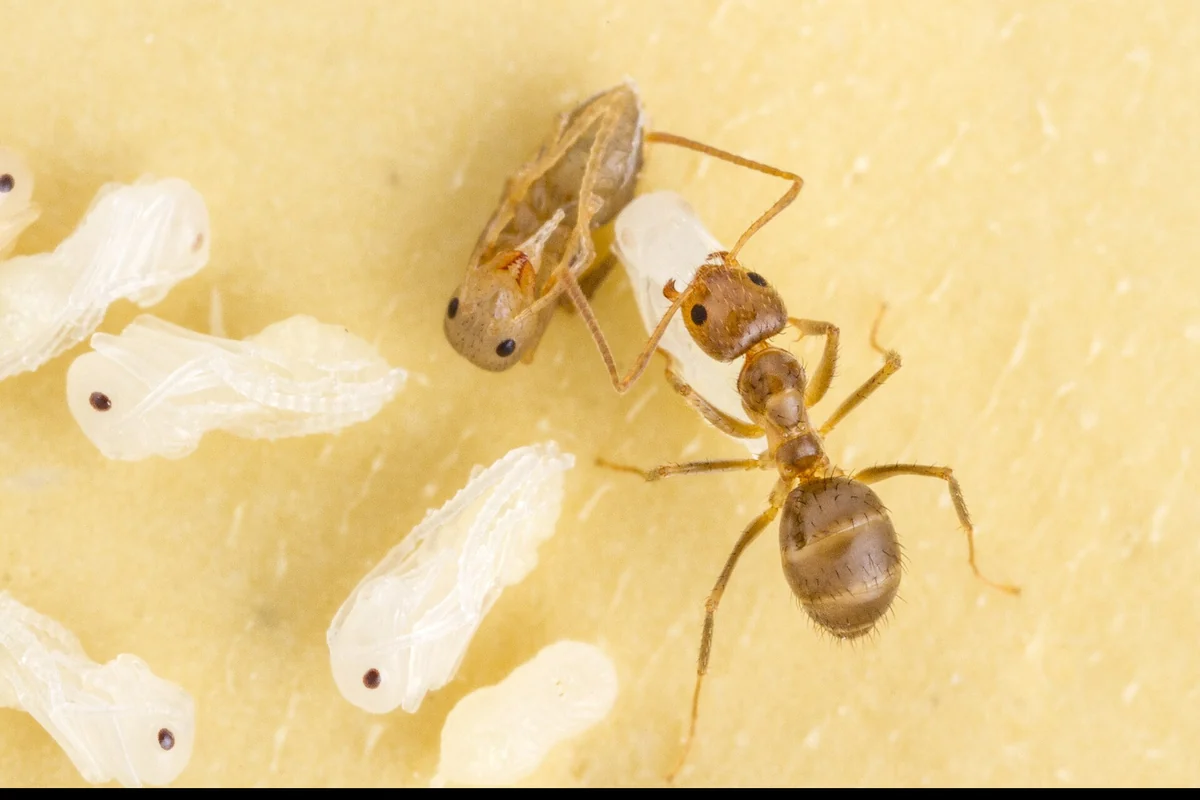
Ants pouring out of the A/C disconnect and shorting the pool pump? That’s a tawny crazy ant problem.
One call reaches a licensed, local exterminator who covers your address — and a real person answers, 24/7.
Talk to a licensed exterminator now
Call and we’ll connect you with a licensed, local exterminator who covers your address. It takes about two minutes, and a real person answers.
Free to call. Free to get matched. The licensed operator gives the quote.
24/7 line · A real person answers · Availability of same-day and emergency service depends on the provider.
How to know it’s a tawny crazy ant
Nylanderia fulva. Look, here’s the deal — if you’ve got tawny crazy ants, you generally know something is very wrong before you know what species it is. The sheer volume is the tell. People describe the ground “moving,” or a brown stain along the foundation that turns out to be ants.
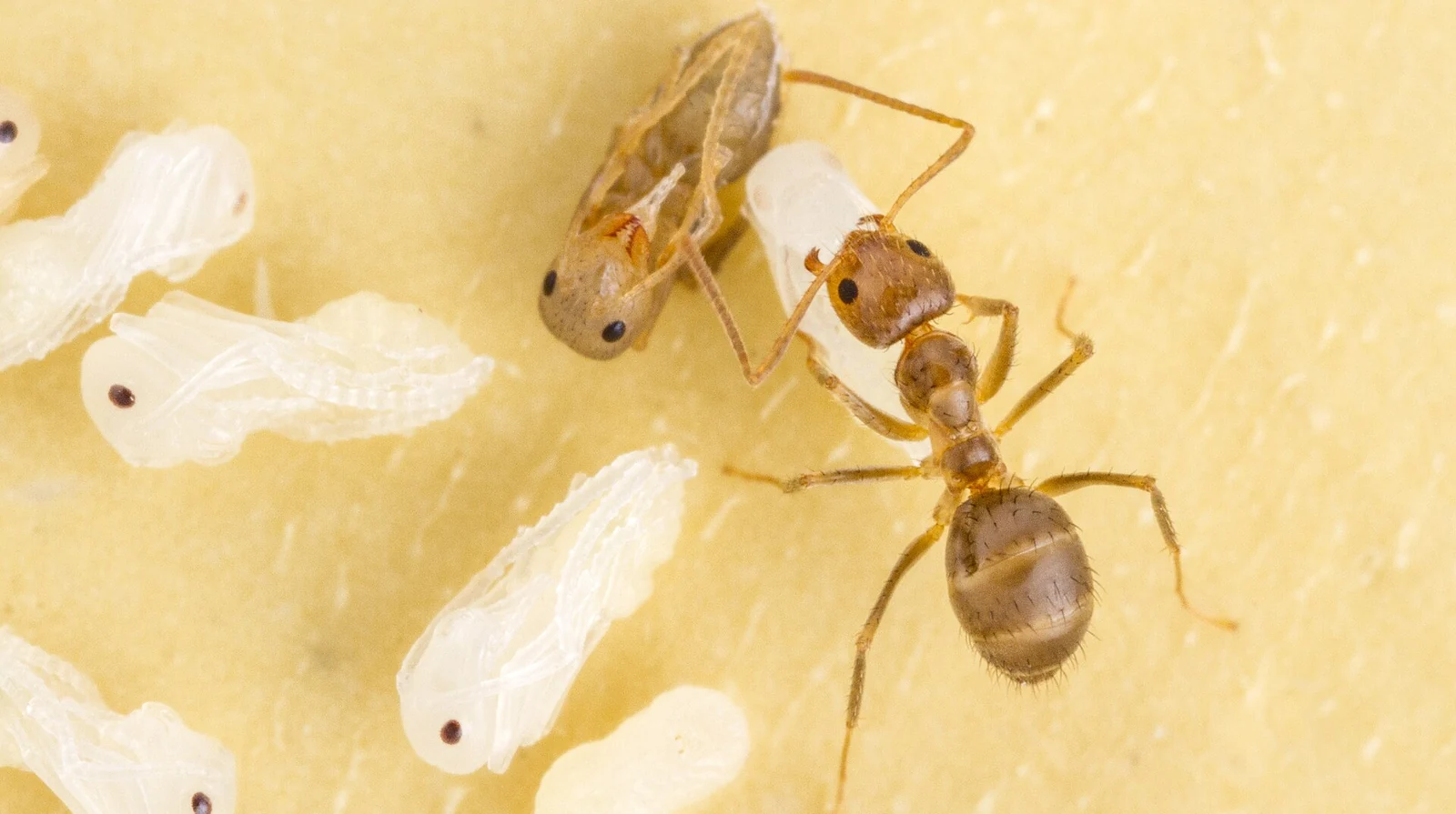
- Color and size. Uniformly reddish-brown, small — a bit bigger than a ghost ant, much smaller than a carpenter ant — and covered in fine hairs that give them a slightly fuzzy look under a hand lens.
- The movement. This is the giveaway. They don’t march. They dart, zigzag, reverse, and generally look like they’ve lost the plot. Hence “crazy.”
- No mound. No single nest. Unlike fire ants, they build nothing. They nest under whatever’s lying around — mulch, potted plants, landscape timbers, rocks, tarps, stacked pavers, the base of a utility box — and they’ll be under all of it at once.
- Numbers that don’t make sense. Populations get so dense that they displace fire ants entirely. If the fire ant mounds in your yard mysteriously disappeared and now there are ants everywhere, that’s not a win. That’s this.
- They don’t sting. They can bite and squirt formic acid, which stings briefly, but there’s no venom sting like a fire ant. The problem here is volume and electronics, not medicine.
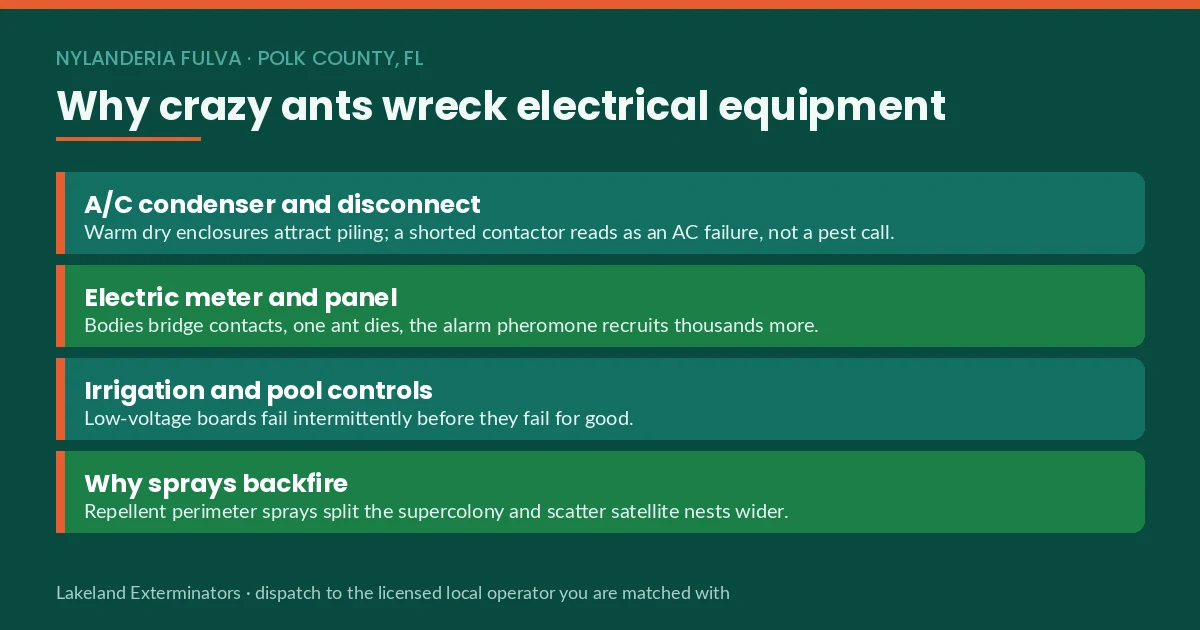
Why they wreck electrical equipment
This is the part that costs people real money, and it’s the reason a crazy ant call often comes in from a homeowner staring at a dead A/C unit rather than from someone bothered by bugs.
Crazy ants pile into warm, dry enclosed spaces — and in a Florida yard that means the A/C condenser and disconnect, the electric meter box, the breaker panel, irrigation controllers, pool pump housings, well pump boxes, landscape lighting transformers and outdoor outlets. When one ant bridges two contacts and gets electrocuted, it releases alarm pheromone as it dies. That pheromone summons more ants to the exact spot. They pile onto the corpse and the contact, more of them die, and the loop feeds itself until the mass of bodies shorts the connection or welds a relay shut.
So the failure looks bizarre from the outside — a perfectly good contactor packed solid with dead ants. It isn’t a fluke; it’s the documented behavior of this species, and it’s why they got attention across the Gulf Coast in the first place.
What that means for your house
- Don’t open a live panel to clean it out. That’s an electrician’s job, not a homeowner’s and not the pest operator’s.
- Tell the coordinator if equipment is already failing. A dead A/C in a Polk County July is a different priority than ants on the patio.
- Expect a two-trade fix. The licensed pest operator suppresses the population around the equipment. An electrician or HVAC tech deals with the hardware. Neither one does the other’s job.
Why the usual ant playbook fails
Baits underperform
Crazy ants feed heavily on honeydew from scale insects and aphids on your ornamentals — an unlimited free sugar buffet in the landscape. A bait station competes with an entire hedge. Bait acceptance is inconsistent, and control programs that lean on bait alone tend to disappoint.
Perimeter sprays knock down, then rebound
A non-repellent perimeter treatment kills what crosses it. But the supercolony next door keeps pushing new workers in, so knockdown is measured in weeks, not seasons. Repeat applications on a schedule are the norm, not an upsell.
There’s no queen to kill
These are polygyne supercolonies with countless queens spread across many nest sites, connected across property lines. There is no single nest to find and destroy. That’s why “we’ll get the queen” is not a thing anyone honest says about this ant.
You can move them yourself
They spread by budding and by hitchhiking — in potted plants, mulch, pavers, landscape debris, boats, trailers and moving loads. Polk County is a nursery and agriculture hub, and that’s exactly how they travel. Don’t haul mulch or plants from an infested property to a clean one.
The honest framing: this is ongoing suppression of a landscape-wide population, not a one-visit extermination. Any operator promising to wipe them out permanently from an open Florida yard is telling you what you want to hear.
The Polk County crazy ant calendar
| When | What’s happening | What you’ll see |
|---|---|---|
| Mar – May | Populations rebuild as it warms. Colonies expand under mulch, timbers, potted plants and debris. | Scattered activity, easy to dismiss. The right window to start a program — before the numbers get away from you. |
| Jun – Sep storm season | The explosion. Heat, humidity and daily storms drive population peaks and push ants indoors and into equipment. | Foundation lines crawling. Ants in the A/C disconnect, the meter box, the pool pump. Peak call volume, and the hardest time to get ahead of it. |
| Oct – Nov | Numbers begin to fall as temperatures ease. | Relief — and a good time to do the harborage work (pull mulch back, clear debris, trim honeydew-producing shrubs) that makes next summer easier. |
| Dec – Feb | Activity drops sharply. The colony is still there, tucked under cover. | Quiet. Do not mistake it for victory — they come back with the heat, and the pre-season treatment window is short. |
Ants in the breaker box is not a wait-and-see problem.
Get a licensed operator who’s actually treated this species in Polk County.
Talk to a licensed exterminator now
Call and we’ll connect you with a licensed, local exterminator who covers your address. It takes about two minutes, and a real person answers.
Free to call. Free to get matched. The licensed operator gives the quote.
What a realistic Polk County program looks like
Map the harborage
Mulch beds, potted plants, timbers, pavers, stacked material, the pool equipment pad, the fence line, the neighbor’s side of it. The population lives under objects, so the inventory of objects is the treatment map.
Non-repellent exterior treatment
A perimeter and harborage application the ants can’t detect and walk through, plus targeted work around equipment housings. This is the backbone.
Cut the honeydew
Treating scale and aphids on ornamentals removes the sugar supply that keeps the supercolony fed. Some operators do this; some coordinate with a lawn and ornamental license holder. Ask.
Repeat on a schedule
Because the pressure comes from beyond your property line, the program is recurring by design. The goal is a yard you can use, not a permanently ant-free parcel.
What the licensed operator will ask you
- Is any equipment failing? A/C, pool pump, irrigation controller, meter box. This shapes urgency and the treatment sequence.
- How far does it extend? Just your beds, or the whole street? Neighbor coordination genuinely matters with a supercolony species.
- What’s in the landscape? Mulch depth, potted plants, timbers, stacked pavers, brush piles, an old boat — all harborage.
- Any recent landscaping deliveries? New mulch or nursery plants are a classic introduction route in Polk County.
- What have you already applied? Repellent products push the population around and change what the operator can do next.
- Pets, pond, vegetable garden? Constrains the product list.
What crazy ant work costs in Polk County
We don’t set prices and never quote them. What we can tell you is how operators structure it, so nothing on the invoice surprises you:
- Initial exterior service. Perimeter plus harborage plus equipment-adjacent treatment. Priced by property size and how much landscape harborage there is.
- Recurring program. Expect the operator to recommend repeat visits on a set interval through the warm months. That’s the nature of the pest, not a padding tactic — a single visit will not hold through a Polk County summer.
- Ornamental / honeydew work. Sometimes a separate line item or a separate license holder.
- Non-pest costs. Electrician or HVAC repair for damaged equipment, and the landscape changes (mulch pull-back, debris removal) that reduce harborage. Not the pest operator’s scope.
See the Lakeland pest control cost breakdown for how recurring exterior programs are usually structured here. The number always comes from the licensed operator after they’ve walked the property.
Other ants we route in Polk County
All ant species
Not certain what you’re looking at? The hub covers every ant we dispatch for in Lakeland and Polk County.
Ant control in Lakeland →Fire ants
Mounds and stings. If your fire ants vanished and the ground started moving instead, read this page again.
Fire ant control →Argentine ants
The other supercolony species. Wide, orderly trails instead of frantic zigzags.
Argentine ants in Polk County →White-footed ants
Huge colonies, dark bodies, pale feet — and famously poor bait uptake.
White-footed ants →County-wide service
Winter Haven, Bartow, Auburndale, Haines City, Lake Wales — same dispatch, same licensed network.
Pest control in Polk County →Stop guessing. Get a licensed operator on it.
One ZIP. A real person on the line. No sales script about killing the queen.
Talk to a licensed exterminator now
Call and we’ll connect you with a licensed, local exterminator who covers your address. It takes about two minutes, and a real person answers.
Free to call. Free to get matched. The licensed operator gives the quote.
Tawny crazy ant questions, answered straight
How do I know these are tawny crazy ants and not something else?
Three cues. They’re uniformly reddish-brown and small. They move erratically — darting and zigzagging rather than following a clean trail. And there’s no mound and no single nest; they’re under mulch, pots, timbers, pavers and debris all at once, in numbers that don’t look reasonable. If the fire ant mounds in your yard disappeared around the same time, that’s another strong hint, because crazy ants displace them.
Why are they inside my A/C unit and breaker box?
They pile into warm, dry, enclosed spaces, and electrical equipment fits perfectly. When an ant contacts two terminals and is electrocuted, it releases alarm pheromone that recruits more ants to that exact spot. They pile in, more die, and the accumulation of bodies can short the connection or hold a contactor closed. It’s well-documented behavior for this species and it’s why crazy ant calls often start with failed equipment rather than with bugs.
Do tawny crazy ants sting or bite?
They don’t have a functional sting like a fire ant. They can bite and spray formic acid, which produces a brief burning sensation, but the real damage is economic and electrical, not medical. The problem is sheer volume: they get into everything, indoors and out.
Why doesn’t ant bait work on them?
Because they’re already eating. Crazy ants tend honeydew-producing scale insects and aphids on landscape plants, which gives them an enormous, renewable sugar supply. A bait placement has to out-compete an entire hedge. Bait acceptance is inconsistent with this species, which is why effective programs lean on non-repellent exterior treatments, harborage reduction and, often, controlling the honeydew producers.
Can they be eliminated from my property permanently?
Not in an open Florida landscape. These are polygyne supercolonies with many queens spread across many nest sites, and they extend across property lines. The realistic goal is ongoing suppression — keeping the numbers down enough that the yard is usable and the equipment survives — through a recurring exterior program. Anyone promising permanent eradication is overselling.
How did they get to my Polk County property?
Most often they hitchhike. Tawny crazy ants spread by budding rather than by mating flights, so they travel in things people move: potted plants, mulch and soil, pavers, landscape timbers, yard debris, boats, trailers and moving loads. Polk County’s nursery and agriculture traffic makes that route especially common here. If you’re bringing in fresh mulch or plants, look at what’s underneath before it goes in the bed.
When is the right time to treat them?
Start in spring, before the summer explosion. Populations rebuild from March through May and then peak from June through September with the heat, humidity and daily storms. Getting a program running early is far easier than trying to claw back control in August. Fall is the right time for harborage work — pulling mulch back, clearing debris, dealing with honeydew-producing plants — so next summer starts from a lower baseline.
Is the pest control company actually licensed?
Every operator in the network is a licensed Florida pest control business, and you never have to take our word for it. License status is public: search the company at the Florida Department of Agriculture and Consumer Services license lookup before anyone treats your property. Florida pest control is regulated under Chapter 482, Florida Statutes.
Disclosure
Lakeland Exterminators is a dispatch and matching service. We connect Polk County callers with FDACS-licensed pest control operators. We are not a licensed pest control operator. We do not perform treatment, set prices, issue warranties, hold bonds, or carry pest control trade insurance. All pricing, scheduling, treatment plans, warranties and service terms are determined by the FDACS-licensed operator dispatched to your address under Chapter 482, Florida Statutes.
Same-day and 24/7 emergency services are subject to provider participation, location, technician availability, and demand. Availability is not guaranteed and may vary by market and appointment capacity.
License status of any operator you connect with is publicly verifiable at the FDACS license search.
Electrical and HVAC repairs are outside the scope of pest control work and are performed by separately licensed trades.