Your lender wants a WDO report. Here is what that piece of paper actually says about your house.
One call reaches a licensed, local exterminator who covers your address — and a real person answers, 24/7.
Talk to a licensed exterminator now
Call and we’ll connect you with a licensed, local exterminator who covers your address. It takes about two minutes, and a real person answers.
Free to call. Free to get matched. The licensed operator gives the quote.
24/7 line · A real person answers · Availability of same-day and emergency service depends on the provider.
What a WDO report is — in plain English
Look, here is the deal. A WDO report is not a home inspection, it is not an appraisal, and it is not an opinion about whether your house is a good buy. It is a narrow, regulated document: an FDACS WDO-licensed inspector walks the accessible parts of the structure, writes down what wood-destroying organisms they can see evidence of, and signs the state form. In Florida that form is DACS-13645, the Wood-Destroying Organism Inspection Report.
Everything about the report follows from one word: visible. The inspector reports what is observable on the day of the inspection, in the areas they could actually reach. That is the whole scope. It is also why the “inaccessible areas” section matters far more than most buyers realize — more on that below.
What the report does
- States whether there is visible evidence of live activity, visible damage, or both — and these are separate findings. Old damage from a colony that was treated a decade ago is not live activity.
- Lists conducive conditions: wood-to-soil contact, moisture intrusion, faulty drainage, debris under the structure. These are not termites; they are the welcome mat.
- Names the areas that were not inspected because they were inaccessible.
- Notes previous treatment if a Notice of Treatment sticker is found on site — usually inside the electrical panel door, the water heater closet or a garage stud.
What the report does not do
- It does not opine on structural integrity beyond the WDO scope. “Damage noted” is not the same as “this beam is unsafe” — that call belongs to a structural engineer.
- It does not estimate repair cost. That is a separate conversation with a licensed operator and, often, a contractor.
- It does not promise the house is termite-free. It says nothing was visible where the inspector could look.
The five organisms a Florida WDO report covers
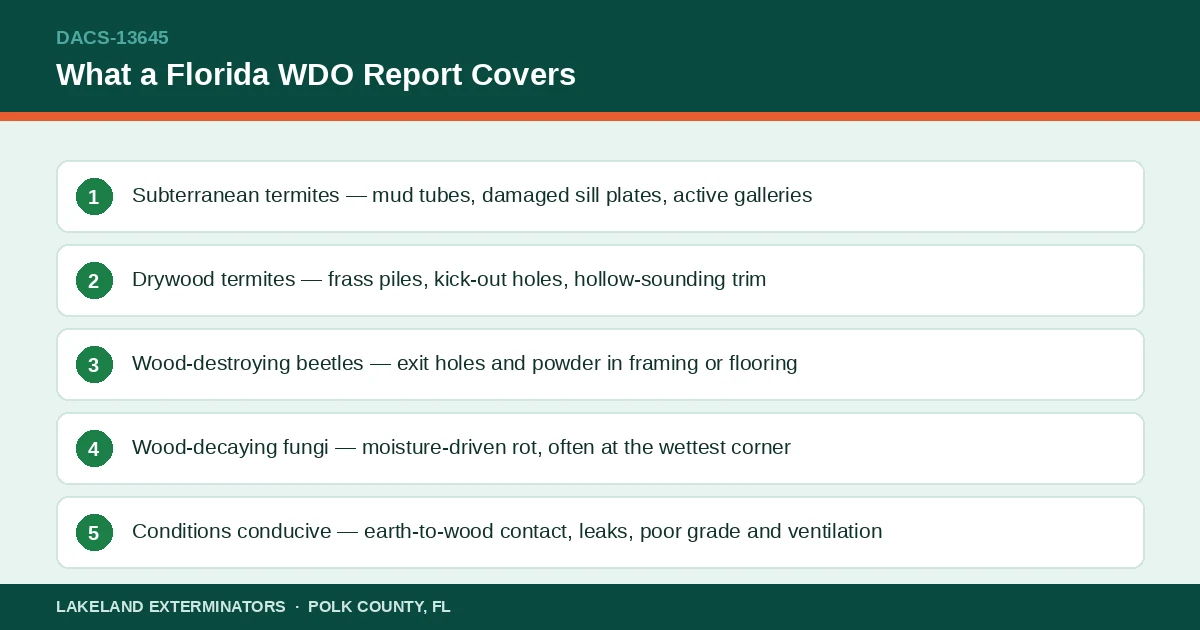
“WDO” is broader than termites, and Polk County produces all five categories. Buyers who only ask about termites miss half the form.
Subterranean termites
Reticulitermes flavipes (eastern) and Coptotermes formosanus (Formosan). Soil-dwelling, enter through slab joints and stem walls, leave pencil-width mud tubes. The most common finding on a Polk County report. Species guide →
Drywood termites
Cryptotermes brevis and Incisitermes snyderi. No soil contact needed — they colonize attic rafters, window framing and furniture, and leave six-sided frass pellets. Florida is one of the few states where these are an established structural pest. Species guide →
Old house borers
Wood-boring beetles whose larvae tunnel through softwood framing for years before emerging. Evidence is oval exit holes and a fine, powdery frass. Less common than termites here, but a real finding on the form.
Powderpost beetles
Small round exit holes, talc-fine frass, and a taste for hardwood — flooring, trim, cabinetry, furniture. Often ride into the house inside the lumber itself, which is why they turn up in renovations.
Wood-decay fungi
Commonly miscalled “dry rot,” and the quiet workhorse of Polk County WDO findings. Sustained moisture — a leaking hose bib, a sprinkler head hitting the stem wall, a June-through-September storm season that never dries out — softens wood until a probe sinks in. No insect required.
Why the distinction matters
Each organism carries a different treatment path and a different price tag. Subterranean means soil work. Drywood can mean a tent. Fungi means fixing water, not spraying chemicals. A report that just says “WDO evidence present” without an identification is a report worth asking questions about.

On a closing clock? Get the WDO inspection scheduled.
One call reaches a licensed, local exterminator who covers your address — and a real person answers, 24/7.
Free to call. Free to get matched. The licensed operator gives the quote.
How to read the report without panicking
Most people open the DACS-13645, see the word “termite” anywhere on it, and assume the deal is dead. Usually it is not. Here is the translation table.
| What the report says | What it actually means | What it usually does to the closing |
|---|---|---|
| No visible evidence | Nothing observable in the accessible areas on the day of inspection. Not a certificate of purity — read the inaccessible-areas list. | Clears the lender condition. Move on. |
| Visible damage, no live activity | Something ate here once. It may have been treated years ago — check for a Notice of Treatment sticker and prior records. | Often negotiable. Lenders may want a structural opinion if the damage is significant. |
| Live activity present | An active colony or infestation was observed. Species identification drives everything from here. | Treatment typically becomes a condition of closing, on a tight clock. |
| Conducive conditions noted | Wood-to-soil contact, moisture, drainage, debris. No organism found — but the conditions invite one. | Rarely blocks a closing. Fix them anyway; they are cheap now and expensive later. |
| Inaccessible areas listed | The inspector could not see behind the finished wall, under the addition, or into the sealed crawl. This is a disclosure, not a clean bill. | Worth reading twice before you waive anything. |
If your report names live subterranean activity, the termite treatment guide for Lakeland walks through the four paths a licensed operator will discuss — liquid barrier, bait system, tenting and no-tent localized work.
When Polk County closings need a WDO report
Not every transaction requires one by law — but in practice, on a Florida residential purchase, you should expect it.
- FHA loans. Commonly required, particularly when the appraiser flags any evidence or the property sits in a designated termite-pressure area — which, in Central Florida, effectively means everywhere.
- Conventional loans. Frequently required as a closing condition at the lender’s discretion.
- Buyer-driven. Plenty of Polk County contracts are simply written to require a clean WDO report, regardless of what the lender wants.
- Refinances. Sometimes required by the lender or the mortgage insurer.
How long the report stays good
Most Florida lenders want a report dated within roughly 30 days of closing; some files allow longer. Do not guess — the closing agent or loan officer will give you the exact window for your file, and that is the only answer that counts. If your closing slips, budget for a re-inspection rather than assuming the old form still flies.
The report came back with findings. Now what?
Take a breath. In Polk County, findings are common — warm soil, sandy drainage, a lot of pre-1980 wood framing and three termite species working year-round. Findings are a negotiation, not a verdict.
Get the species identified
Subterranean, drywood, beetle or fungus — they are four different problems with four different price tags. Insist the report names it.
Get a treatment proposal in writing
From an FDACS-licensed operator, after an inspection. The proposal is what turns an unknown into a number both sides can trade against.
Decide who pays
Standard Florida contract language often puts termite treatment on the seller, but it is negotiable and it depends on your contract. Read yours.
Ask about the bond that follows
A treatment paired with a transferable retreatment bond is worth more to a buyer than treatment alone. It is the paperwork that survives the closing.
Two guides worth reading before you negotiate: the termite treatment cost guide for what drives the number, and the termite bond guide for whether the coverage that comes with it is retreatment-only or includes damage repair. If the finding is drywood and the operator raises fumigation, the cost of termite tenting in Florida explains what moves that quote.
What the WDO report costs in Polk County
We do not set prices and we do not publish them — Lakeland Exterminators is a dispatch line, not a pest control company. The licensed inspector sets the fee, and they set it after they know what they are walking into.
What Polk County operators typically weigh when they quote a WDO inspection:
- Square footage and footprint complexity — a compact ranch and a two-story with a wrapped lanai are not the same walk.
- Structure type — slab, pier-and-beam with a crawl space, mobile or manufactured home, or an interior-only condo unit. Crawl spaces take time.
- Attic access — a floored, lit attic is a different job than a low-clearance truss attic in July.
- Turnaround — a report needed for a closing this week is a scheduling problem, and scheduling has a price.
- Re-inspection — if treatment happens and the lender wants the file re-cleared, that is usually a separate, smaller fee.
Full breakdown with the questions to ask: WDO inspection cost in Lakeland, and the WDO inspection guide for what actually happens during the visit.
What inspectors keep finding in Polk County houses
Local patterns, not national averages. If you are buying here, this is what the form tends to come back with.
The pre-1980 core: Dixieland, Lake Morton, Cleveland Heights
Cypress and pine framing, early slabs and pier-and-beam foundations, stucco applied straight over original wood, soffits with exposed end grain. Subterranean evidence at the stem wall is routine, and drywood frass in attic framing turns up often enough that a careful inspector always looks up.
The newer builds: South Lakeland, Christina, Grasslands, Highland City
Monolithic slabs and pre-construction soil treatment that ages out quietly. The findings here skew toward conducive conditions rather than active colonies — irrigation heads spraying the stem wall, mulch beds piled above the slab line, a lanai poured against the original foundation creating an untreated gap. Cheap to fix on inspection day; expensive to ignore.
Everywhere: water is the co-conspirator
Daily storms from June into September, sandy soil that drains fast but stays humid, and Chain of Lakes air that never really dries. Wood-decay fungi and moisture-related conducive conditions show up on Polk County reports constantly — and they are the findings most likely to be waved off as “minor” right before they turn into a soft sill plate.
How the dispatch works
Straight up: Lakeland Exterminators is a dispatch and matching service, not a licensed pest control operator. We do not write WDO reports. We connect you with the people who legally can.
Tell the line your timeline
Closing date, property type, whether the lender is VA, FHA or conventional. A real person answers around the clock.
Your address picks the inspector
The request routes to an FDACS WDO-licensed operator covering your part of Polk County — Lakeland, Winter Haven, Bartow, Lake Wales, Auburndale, the I-4 corridor.
Licensed inspection on site
They walk the accessible areas, probe suspect wood, photograph evidence and sign the DACS-13645. The fee is theirs to set, not ours.
The report is theirs, and so is the treatment
Findings, treatment proposals, bonds and warranties all sit with the licensed operator under Chapter 482, Florida Statutes.
Verify before you hire — confirm the inspector’s license status and categories yourself at the FDACS license search. WDO work requires the WDO category specifically. The good ones expect you to check.
Need the DACS-13645 signed before your closing date?
One call reaches a licensed, local exterminator who covers your address — and a real person answers, 24/7.
Free to call. Free to get matched. The licensed operator gives the quote.
WDO report questions, answered straight
What is a WDO termite report in Florida?
It is the Wood-Destroying Organism Inspection Report, Florida form DACS-13645, completed and signed by an FDACS WDO-licensed inspector. It records visible evidence of live activity, visible damage, conducive conditions, inaccessible areas and any previous treatment found on site. It covers five organism groups — subterranean termites, drywood termites, old house borers, powderpost beetles and wood-decay fungi — and it reports only what was visible in accessible areas on the day of the inspection.
How long is a Florida WDO report valid?
Most Florida lenders want a report dated within about 30 days of closing, and some files allow a longer window. There is no single universal number, so confirm the exact requirement with your closing agent or loan officer rather than assuming. If the closing date slips, expect to pay for a re-inspection instead of reusing an aging form.
Does a WDO report cover drywood termites too?
Yes. The DACS-13645 form covers both subterranean and drywood termites, plus old house borers, powderpost beetles and wood-decay fungi. This matters because the treatment paths are completely different — subterranean activity points toward soil work, while established drywood activity can point toward whole-house fumigation. Ask the inspector to name the organism, not just note that evidence exists.
Is a clean WDO report the same as a termite-free house?
No, and this is the single most misread thing on the form. The report states that no evidence was visible in the areas the inspector could access on the day of the inspection. Behind finished walls, under sealed additions and in low-clearance crawl spaces, nobody looked — that is exactly what the inaccessible-areas section discloses. Read that section before you waive anything.
Can the inspector who writes the report also do the treatment?
Yes. An FDACS-licensed operator holding the WDO category can both inspect and treat, and many Polk County companies write the inspection and the treatment proposal on the same visit. Some buyers prefer an inspector who does not sell treatment, to remove any incentive question. Both are legitimate choices — just make the choice deliberately, and verify the license either way at the FDACS license search.
Who pays for the WDO inspection in a Polk County sale?
It depends on the loan and the contract. On VA purchase loans in Florida the inspection cost generally falls to the seller. On conventional and FHA files it is commonly the buyer, unless the contract says otherwise. Because it is contract-driven rather than fixed by law, the answer lives in your purchase agreement — ask your agent to point at the clause.
How do I order a WDO inspection in Lakeland?
One call reaches a licensed, local exterminator who covers your address — and a real person answers, 24/7.
Disclosure
Lakeland Exterminators is a dispatch and matching service. We connect Polk County callers with FDACS-licensed pest control operators. We are not a licensed pest control operator. We do not perform inspections or treatment, write WDO reports, set prices, issue warranties, hold bonds, or carry pest control trade insurance. All pricing, scheduling, inspections, treatment plans, warranties and service terms are determined by the FDACS-licensed operator dispatched to your address under Chapter 482, Florida Statutes.
Same-day and 24/7 emergency services are subject to provider participation, location, technician availability, and demand. Availability is not guaranteed and may vary by market and appointment capacity.
License status of any operator you connect with is publicly verifiable at the FDACS license search.