A few roaches by the dishwasher can be thousands by fall. German roaches move fast.
One call reaches a licensed, local exterminator who covers your address — and a real person answers, 24/7.
Talk to a licensed exterminator now
Call and we’ll connect you with a licensed, local exterminator who covers your address. It takes about two minutes, and a real person answers.
Free to get matched. The licensed operator gives the quote.
24/7 line · A real person answers · Availability of same-day and emergency service depends on the provider.
Quick answer: is it a German cockroach?
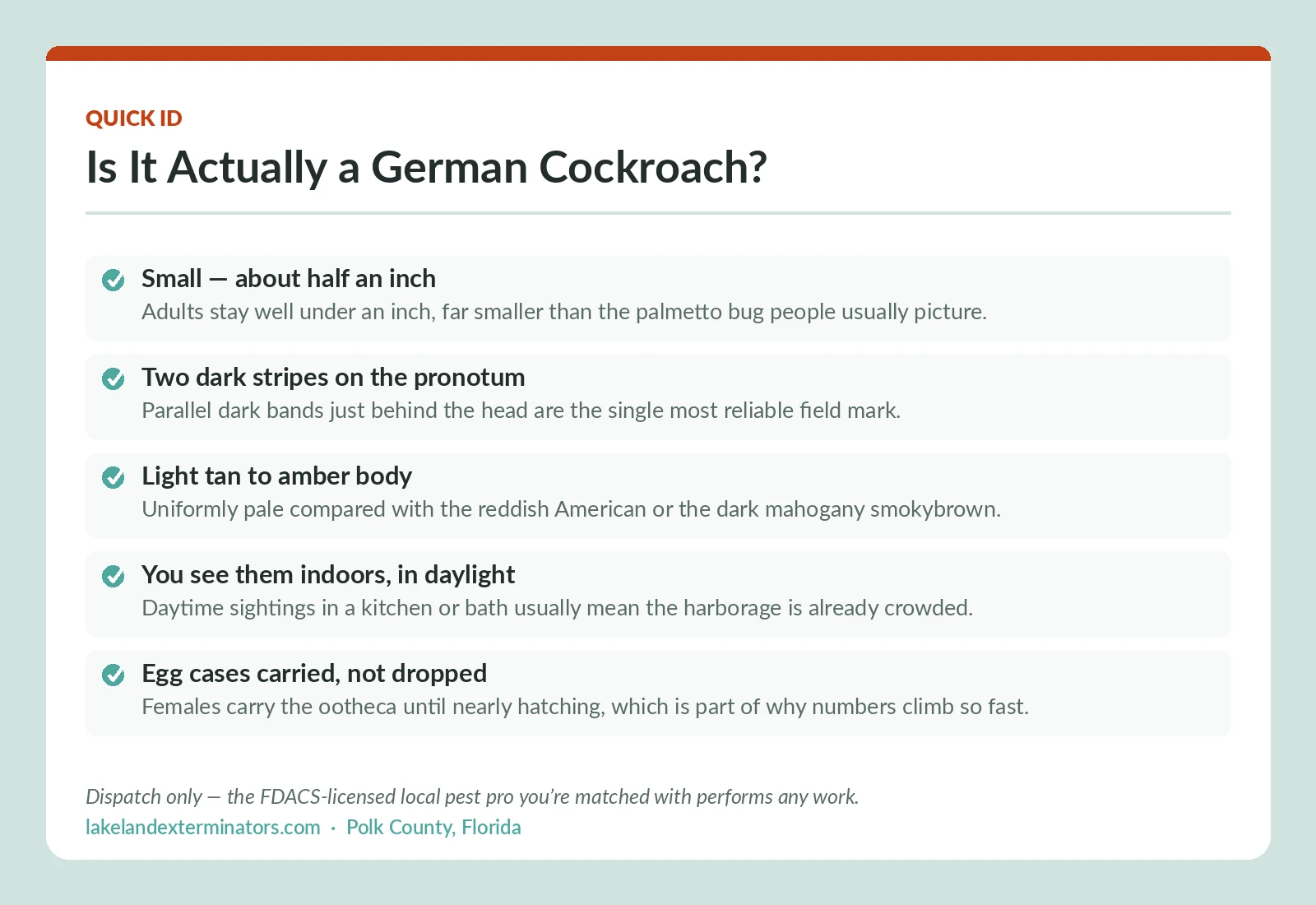
German cockroaches (Blattella germanica) are small — about half an inch — light tan to brown, with two dark parallel stripes running lengthwise on the pronotum (the shield behind the head). That’s the field mark. If you’re seeing small striped roaches scatter when you flip on the kitchen light, and the count climbs week over week, you have a German infestation, not a stray palmetto bug wandering in from the yard.
They are the most damaging structural cockroach in Polk County precisely because they don’t come from outside — they breed indoors, near food and water, and a single infestation can scale from a handful of visible adults to thousands within 90 days. It’s a frequent, fast-moving problem in Lakeland-area kitchens, multi-unit buildings, and HOA properties.
Why German cockroaches are so hard to eliminate
Four biological facts make this the roach that DIY consistently loses to:
- Pyrethroid resistance. Field populations across the southeastern US — Polk County included — are widely resistant to the retail pyrethroid sprays sold in every hardware store. Fogging them often makes it worse by scattering the population.
- Explosive reproduction. A female carries an egg capsule (ootheca) holding 30–40 eggs, matures in 6–8 weeks, and can produce 4–6 generations a year. The math compounds fast.
- Cryptic harborage. They wedge into cracks, motor housings, and electrical voids you can’t reach. Seeing them in daylight means the harborage is already full — a heavy-population signal.
- They eat anything. Grease, hair, paper, soap, glue, and even other roaches — so “just keep it clean” slows them but rarely starves them out on its own.
They also hitchhike in — grocery bags, cardboard boxes, secondhand appliances, and shared laundry areas are the classic introduction routes into an otherwise clean home.
Treatment that actually works
A licensed Polk County operator attacks a German infestation with a coordinated program, not a single spray:
Gel-bait rotation
Professional gel baits (rotating active ingredients — Advion, Maxforce, Vendetta — to defeat bait aversion) placed directly into harborage. Roaches feed, return to the harborage, and the bait transfers through the population.
Insect growth regulators
IGRs like hydroprene or pyriproxyfen stop nymphs from molting into breeding adults — breaking the egg-to-adult cycle so the population can’t rebuild.
Crack-and-crevice + sanitation
Targeted treatment of voids, plus a sanitation plan that removes the grease film, moisture, and clutter feeding the colony. This is the half that makes the chemistry last.
Multi-unit and HOA settings usually need adjacent units checked too — German roaches travel through shared wall voids and plumbing chases. For whole-property or recurring coverage, this pairs with roach extermination in Lakeland and a commercial program for food-service properties.
Roaches multiplying in the kitchen? Don’t wait for fall.
One call reaches a licensed, local exterminator who covers your address — and a real person answers, 24/7.
Free to get matched. The licensed operator gives the quote.
German cockroach FAQs
Why don’t store-bought sprays work on German roaches?
How fast can a German infestation grow?
Is it German roaches or palmetto bugs?
Will keeping the kitchen clean get rid of them?
Are you the pest control company?
Related Polk County pages
Disclosure
Lakeland Exterminators is a dispatch and matching service. We connect Polk County callers with FDACS-licensed structural pest control operators. We are not a licensed pest control operator. We do not perform treatment, set prices, issue warranties, or carry pest control trade insurance. All pricing, scheduling, treatment plans, and service terms are determined by the FDACS-licensed operator dispatched to your address under Chapter 482, Florida Statutes.
Same-day and 24/7 emergency services are subject to provider participation, location, technician availability, and demand. Availability is not guaranteed and may vary by market and appointment capacity.
License status of any operator you connect with is publicly verifiable at the FDACS license search.