Roaches in a Lakeland kitchen are not one problem — they are two. The fix starts with knowing which.
One call reaches a licensed, local exterminator who covers your address — and a real person answers, 24/7.
Talk to a licensed exterminator now
Call and we’ll connect you with a licensed, local exterminator who covers your address. It takes about two minutes, and a real person answers.
Free to get matched. No obligation. The licensed operator gives the quote.
24/7 line · A real person answers · Availability of same-day and emergency service depends on the provider.
The three roaches of Polk County — and why the difference decides everything
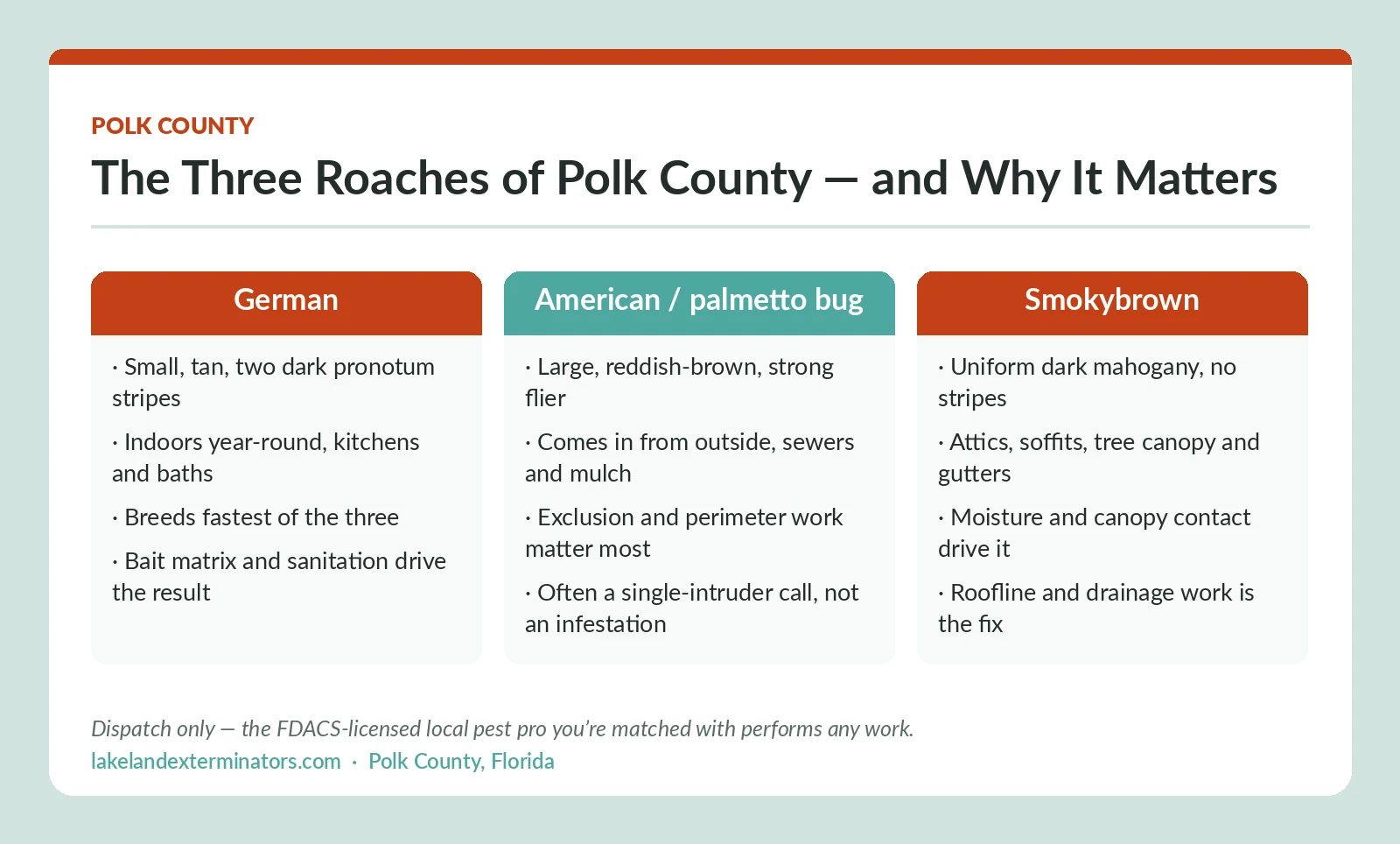
American cockroach (the palmetto bug)
Periplaneta americana. Big — up to two inches — reddish-brown, flies short distances, and lives OUTSIDE: palm boots, mulch, sewers, oak litter. It comes in through plumbing penetrations, door sweeps and the lanai, usually after heavy rain or during a dry spell. Seeing one occasionally means the outside is leaking in. Seeing them nightly means a harborage against the house.
German cockroach
Blattella germanica. Small — half inch — tan with two dark stripes behind the head. Lives INSIDE only: fridge motors, dishwasher voids, cabinet hinges, wall clocks. Reproduces fast enough that a visible daytime roach usually means a serious established population. This is the one that requires a real gel-bait program — spray-and-pray makes it worse by scattering the colony.
Smokybrown cockroach
Periplaneta fuliginosa. The oak-canopy roach — uniformly dark mahogany, strongly attracted to lights, thrives in Lakeland’s tree-heavy neighborhoods. Lives in tree holes, gutters, and attic soffits; drops onto roofs from overhanging limbs. Attic and gutter pressure is the tell that separates it from its American cousin.
Quick self-diagnosis before you call
- Size and place: big roach, bathroom or lanai, occasional — American. Small roach, kitchen, repeated — German. Dark roach, garage or attic edges, near oaks — smokybrown.
- Daylight sightings of German roaches signal heavy population pressure — crowding pushes them into the open. Move this call up your list.
- Pepper-like droppings and cast skins in cabinet corners and drawer slides confirm indoor breeding rather than walk-ins.
- After heavy summer rain, palmetto bug entries spike countywide as ground harborage floods — a Lakeland lake-district signature.
Saw one tonight? There is a reason it picked your kitchen.
One call reaches a licensed, local exterminator who covers your address — and a real person answers, 24/7.
Free to get matched. No obligation. The licensed operator gives the quote.
Why Lakeland grows roaches like it grows oranges
Zone 9b humidity is roach habitat
Roughly 51 inches of rain, sustained humidity around 75%, and 325 frost-free days — outdoor roach populations never crash here the way they do north of I-10. Every mulch bed, palm boot and irrigation box in Polk County is carrying capacity, and the summer rain bands push that population against your slab every June through September.
The lake districts leak indoors
Homes near Lake Hollingsworth, Lake Morton, Lake Parker and the rest of the named lakes sit on permanently moist ground with dense canopy — palmetto bug and smokybrown paradise. When a storm floods the ground harborage, the overflow walks up your plumbing penetrations. If the invasion repeats every wet season, the answer is exterior harborage and entry-point work on a schedule, not a can of spray in August.
Sewer-line connections
American cockroaches use sanitary lines as highways, surfacing through floor drains, dried-out P-traps in guest bathrooms, and AC condensate lines. The licensed operator checks these on inspection — one dried trap can explain months of mystery sightings. Run water in unused drains monthly — a simple no-cost habit that keeps the P-trap seal intact and that highway closed.
Multi-family and rental turnover spreads German roaches
German roaches move in furniture, appliance purchases and grocery boxes — not from the yard. Lakeland’s rental and multi-family stock keeps low-level movement constant, which is why an established German problem in one unit becomes the building’s problem. Landlords and property managers: the rental property guide covers unit-to-unit protocols.
What the licensed operator actually does (and why it beats the spray can)
Species ID and source inspection
Kitchen voids, appliance motors, plumbing penetrations, exterior harborage, attic edges. The species and the source decide the plan — which is why sight-unseen quotes are worthless.
Targeted treatment, not fog
German roaches: gel baits and insect growth regulators placed in the voids where they breed — repellent sprays scatter colonies deeper into walls and make it worse. Palmetto bugs and smokybrowns: exterior perimeter treatment, harborage reduction and entry-point sealing.
Follow-up on the biology’s schedule
German roach egg cases hatch in weeks — real programs include a follow-up visit timed to break the reproduction cycle, not a one-and-done spray that misses the next generation.
Prevention that sticks
Door sweeps, drain maintenance, mulch pullback, gutter cleaning near oak canopy — the operator leaves you a conducive-conditions list specific to your lot, not a generic flyer.
What decides the operator’s quote (we never set prices)
- Species and severity — an occasional palmetto walk-in and an established German infestation are different jobs entirely.
- Structure and units — single family vs. multi-family, kitchen count, crawl space access.
- Program vs. one-time — recurring quarterly or monthly service changes the economics; the quarterly vs. monthly guide explains when each makes sense.
Pricing is set by the FDACS-licensed operator after inspection — never by us. Free to get matched; you owe nothing until you accept the operator’s own quote. The cost guide covers every factor.
How the roach dispatch works
Full transparency: Lakeland Exterminators is a dispatch and matching service, not a licensed pest control operator. Your request routes by ZIP to an FDACS-licensed operator covering your part of Polk County; they own the inspection, the treatment plan, the pricing and any service warranty under Chapter 482, Florida Statutes. Verify any operator’s license at the FDACS license search — we encourage it, and honest companies expect it.
Lakeland roach questions, answered straight
Is a palmetto bug the same thing as a cockroach?
Yes — “palmetto bug” is Florida’s polite name for the American cockroach (and sometimes the smokybrown). The name matters less than the behavior: it lives outdoors and wanders in, which means control happens at the perimeter and the entry points, not by fogging your kitchen. Anyone quoting heavy indoor treatment for an occasional palmetto sighting is answering the wrong question.
I see one roach every few weeks. Do I actually need an exterminator?
An occasional big roach after rain is Florida being Florida — door sweeps, dry-trap maintenance and a tidy perimeter may genuinely be enough, and the DIY guide is honest about that. The call becomes worth making when sightings repeat weekly, when they are small tan roaches in the kitchen (German — that is an indoor breeding population), or when you find droppings and cast skins in cabinets. Those three findings do not resolve on their own.
Why did spraying make my German roach problem worse?
Repellent sprays scatter German roaches from their harborage into new wall voids and adjacent rooms — you traded one concentrated colony for several spread-out ones, and the egg cases (unaffected by contact spray) kept hatching on schedule. Licensed operators use non-repellent gel baits and growth regulators precisely because the colony feeds on them and collapses in place. It is the least intuitive fact in residential pest control and the most expensive one to learn by experiment.
How fast can someone come out?
The line answers around the clock and routes immediately by ZIP. On-site timing is set by the licensed operator — same-day and emergency availability is subject to provider participation, location, technician availability and demand. Describe what you are seeing (species, room, frequency) and the operator can triage honestly on the phone.
What does roach extermination cost in Lakeland?
Set entirely by the licensed operator after inspection. The variables that move it: species (German programs run longer than palmetto perimeter work), severity, structure size, and whether you want one-time treatment or a recurring plan. We do not set or publish prices — the Polk County cost guide explains each factor and the questions that keep any quote honest.
Are the treatments safe for kids and pets?
Ask the operator directly — that is genuinely the right protocol, because the answer depends on the products and placements your specific job needs. Licensed Florida operators apply EPA-registered products per label, and modern gel-bait placements go inside voids and hinges where children and pets cannot reach. Tell the operator about kids, dogs, cats, birds or aquariums when you talk; placement plans change accordingly, and a good operator walks you through re-entry timing room by room.
The colony is not waiting. The line answers now.
One call reaches a licensed, local exterminator who covers your address — and a real person answers, 24/7.
Free to get matched. No obligation. The licensed operator gives the quote.
Related Polk County roach reading
Why roach populations behave the way they do in Central Florida, and what to ask when a treatment stops working.
- German cockroach bait not working in your Lakeland kitchen? — glucose aversion, and the question that changes the bait matrix
- Why Florida homes get roaches year-round — the humidity and harborage cycle that removes the off-season
Disclosure
Lakeland Exterminators is a dispatch and matching service. We connect Polk County callers with FDACS-licensed structural pest control operators. We are not a licensed pest control operator. We do not perform roach treatment, set prices, issue warranties, or carry pest control trade insurance. All pricing, scheduling, treatment plans, warranties and service terms are determined by the FDACS-licensed operator dispatched to your address under Chapter 482, Florida Statutes.
Same-day and 24/7 emergency services are subject to provider participation, location, technician availability, and demand. Availability is not guaranteed and may vary by market and appointment capacity.
License status of any operator you connect with is publicly verifiable at the FDACS license search.