Nobody looks under the house — which is exactly why pests live there.
One call reaches a licensed, local exterminator who covers your address — and a real person answers, 24/7.
Talk to a licensed exterminator now
Call and we’ll connect you with a licensed, local exterminator who covers your address. It takes about two minutes, and a real person answers.
Free to call. Free to get matched. The licensed operator gives the quote.
24/7 line · A real person answers · Availability of same-day and emergency service depends on the provider.
Why the crawl space is the pest engine of an old Lakeland house
A crawl space stacks up everything a structural pest wants in one place: bare soil contact for subterranean termites, trapped humidity that never drops even in the dry season, total darkness, and — the decisive part — no human eyes, sometimes for a decade at a stretch. Problems that would be caught in a week inside a kitchen get years to compound under the floor.
This matters more in Lakeland than in most Florida cities because of the housing stock. The neighborhoods platted before slab-on-grade became standard — Dixieland, South Lake Morton, Cleveland Heights, Beacon Hill and the blocks around Lake Morton and Lake Hollingsworth — are full of 1920s-to-1950s bungalows and frame vernacular houses set on brick or block piers with a shallow crawl space beneath the floor joists. Heart pine floors above, sandy soil below, and thirty inches of humid air in between. It is beautiful architecture sitting on top of a pest habitat.
Polk County’s climate finishes the job. Zone 9b soil never gets cold enough to pause subterranean termite feeding, the June-through-September wet season pushes ground moisture up through the crawl space for a third of the year, and lake-adjacent lots in the historic districts carry a water table that keeps the soil under the house damp long after the rain stops.
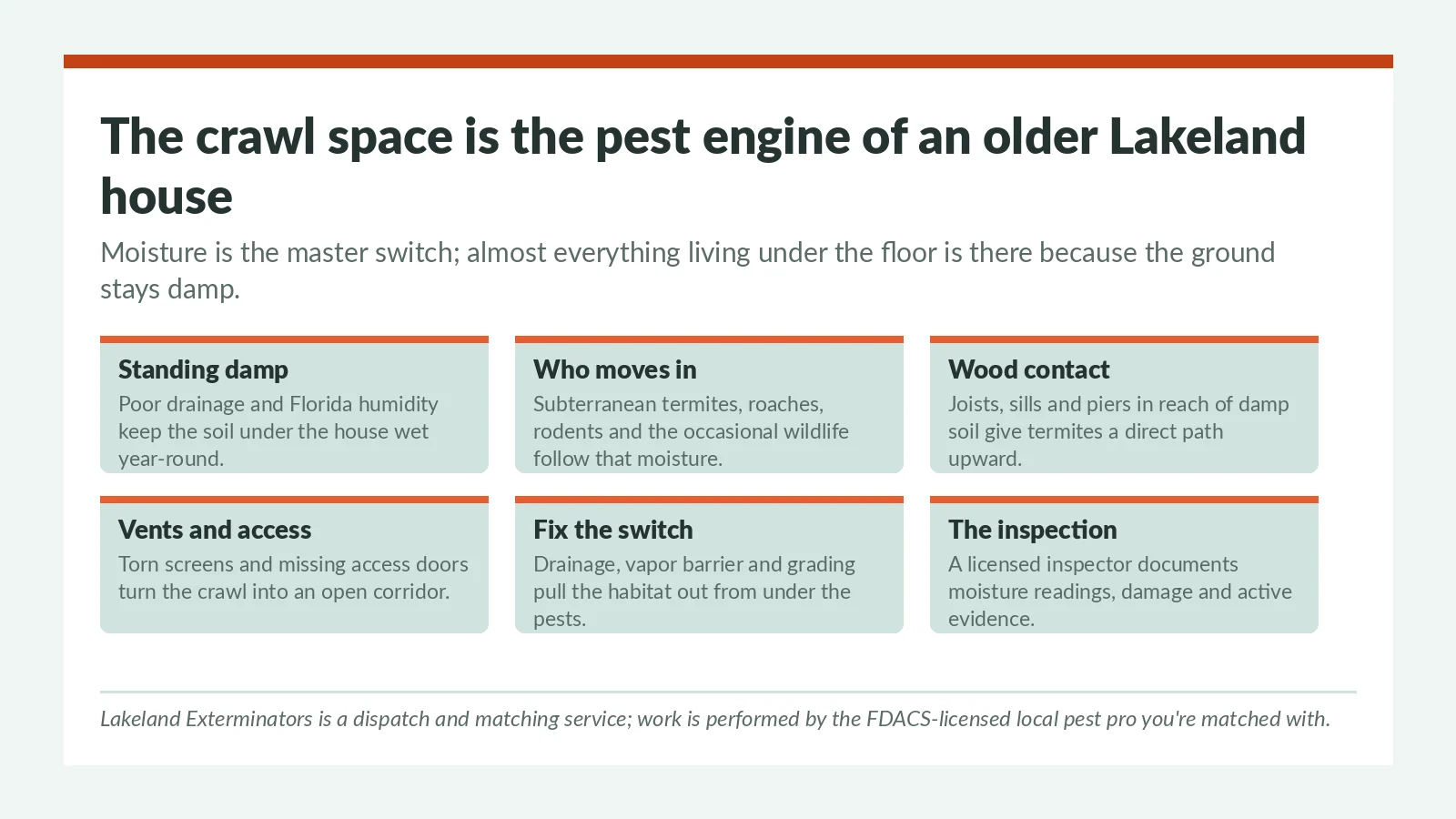
What actually lives under a Polk County house
Four problems account for nearly every crawl space call this line routes.
Subterranean termites
The crawl space is where eastern subterranean colonies — Polk County’s most common structural termite — do their most visible work: pencil-width mud tubes climbing the piers from soil to sill plate. Because nobody sees the piers, tubes under a Dixieland bungalow can run for years. Formosan colonies raise the stakes further with sheer size.
Subterranean termite guide →Rodents
Norway rats and house mice treat a crawl space as ground-floor housing: rusted-out vent screens and gaps at pier tops let them in, and from there plumbing penetrations lead up into wall voids and kitchens. Rodent evidence under the floor — burrows, droppings, gnawed sub-floor wiring — is a top finding on older-home inspections.
Rodent exclusion guide →Roaches and moisture insects
American cockroaches — the palmetto bugs every Lakeland homeowner knows — harbor in damp crawl spaces by the hundreds and follow plumbing chases up into bathrooms and kitchens at night. Camel crickets and earwigs ride the same moisture gradient in from mulched beds near the vents.
Wood-decay fungi
Not an insect, but the same moisture that feeds the pests feeds decay fungi that soften joists and sills — and soft, damp wood is easier for termites to work. Florida WDO inspections report wood-destroying fungi alongside termites for exactly this reason. Moisture control is pest control under a house.
Haven’t seen under your house in years? That is the reason to make the call.
One call reaches a licensed, local exterminator who covers your address — and a real person answers, 24/7.
Free to call. Free to get matched. The licensed operator gives the quote.
Moisture is the master switch — fix it and the pests lose their habitat
Every pest problem under a Lakeland house traces back to water. The durable fixes are physical, and a licensed operator will usually talk through some combination of these after the inspection:
- Vapor barrier on the soil. Polyethylene sheeting laid over the crawl space floor — 6-mil is the working minimum, 10-mil holds up better to inspection crawls — cuts the ground moisture that feeds fungi and keeps humidity high. It also makes future termite inspection dramatically easier, because tubes crossing clean plastic are obvious.
- Vent screening in metal. Original 1940s crawl vents rust out, and a torn vent screen is a rodent door. Replacement with galvanized hardware cloth backed by insect screen keeps the airflow and closes the entry. Foam and plastic patches do not survive a rat’s incisors.
- Grade and gutter discipline. Downspouts dumping at the foundation and beds graded toward the house pour water into the crawl space with every summer storm. Redirecting that water is unglamorous and does more than any spray treatment.
- Encapsulation, honestly assessed. Full encapsulation — sealed liner, closed vents, dehumidification — is a legitimate option for chronically wet crawl spaces, and the Florida Building Code now accommodates sealed-and-dehumidified designs. It is also more than many houses need. An operator who inspects first and scopes second is the one to listen to.
One thing no homeowner should do: seal a crawl space, in any fashion, before a licensed termite evaluation. Covering the soil and piers without checking them first can hide active tubes exactly where an inspector needs to see them.
What the licensed inspection covers under there
A proper crawl space inspection in Polk County is a flashlight-and-coveralls job, and it should come back to you as findings, not vibes. Expect the operator to check:
- Every pier, for mud tubes — the signature of subterranean termite travel from soil to sill, and the single most important sighting under a pre-1960 house. Full treatment paths are covered in the Lakeland termite guide.
- Sills, joists and sub-floor — probing for hollowed wood, decay-softened members and old repairs that hide history.
- Moisture readings — a moisture meter on the framing tells the story the eye misses; sustained readings above roughly 20 percent are where decay fungi and termite attraction start.
- Rodent and wildlife evidence — burrows, droppings, nesting, gnawed wiring and torn vent screens, plus the entry points that let it all in.
- Plumbing leaks and condensation — a slow drain leak under a bathroom is a private water fountain for every pest listed on this page.
the WDO inspection guide explains how crawl space findings land at the closing table.
The crawl space calendar in Polk County
| Season | What happens under the house | What to watch for |
|---|---|---|
| February – May | Subterranean termite swarm season | Wings at crawl vents and low windowsills; fresh mud tubes on piers. |
| June – September | Wet season saturates the soil | Standing water after storms, musty floor odors, roach activity climbing into the house at night. |
| October – January | Rodents push indoors as nights cool | Scratching under the floor, droppings at vents, gnawed screening. |
| Year-round | Feeding and decay never pause in zone 9b | There is no off-season under a Lakeland house — only uninspected months. |
How the crawl space dispatch works
Straight up: Lakeland Exterminators is a dispatch and matching service, not a licensed pest control operator. Here is the exact path your call takes.
Describe the house and the signs
Pier-and-beam or slab, what you have seen or smelled, how long since anyone was under there. A real person answers around the clock.
Your address picks the operator
The call routes to an FDACS-licensed operator covering your part of Polk County — Lakeland’s historic core, Winter Haven, Bartow, Lake Wales, all of it.
Licensed inspection under the house
The operator crawls it, documents termite, rodent, roach and moisture findings, and writes the quote. Pricing comes from them, never from us — it depends on square footage, access height, findings and the work scoped.
Treatment and follow-up stay with the pro
Termite treatment, exclusion work, vapor barrier, monitoring and any bond or warranty — all owned by the licensed operator under Chapter 482, Florida Statutes.
Verify before you hire — any Florida pest control company’s license status, categories and discipline history is public at the FDACS license search. Check the operator you are matched with; the good ones expect it.
Lakeland crawl space questions, answered straight
How do I know if my Lakeland house even has a crawl space?
If the house was built before roughly 1960 — most of Dixieland, South Lake Morton, Cleveland Heights and the Lake Morton blocks — and the floor sits a step or two above grade, it is very likely pier-and-beam with a crawl space. Look for foundation vents in the skirting or stem wall. Most Lakeland homes built after the 1960s are slab-on-grade and have no crawl space at all.
How often should a crawl space be inspected in Polk County?
Annually at minimum — that matches the standard termite bond inspection cycle — and many operators recommend a second look after the summer wet season on houses with known moisture issues. The practical rule: if nobody has been under the house since you bought it, the next inspection is overdue.
What are the mud tubes on my piers, and how urgent is that?
Pencil-width earthen tubes climbing a pier are subterranean termite highways connecting the soil colony to the wood above — active or historic. Either way it is a call-this-week finding: an inspector can tell fresh tubes from abandoned ones, and only a licensed operator can scope treatment. Do not knock the tubes off first; they are the evidence the inspection reads.
Can I lay a vapor barrier myself?
Physically, many homeowners can — spreading and overlapping poly sheeting is labor, not licensed work. The catch is sequencing: covering the soil before a licensed termite evaluation can hide the very evidence the inspector needs. Termite treatment and rodent work in a crawl space do require an FDACS-licensed operator. Inspect first, then improve.
Does a damp crawl space really affect the rest of the house?
Directly. Moist under-floor air migrates upward through gaps in the flooring (the stack effect), carrying humidity and musty odor into living space. Meanwhile the moisture softens framing for decay fungi, attracts termites and supports the roach population that shows up in the kitchen at night. Drying the crawl space cuts pest pressure through the whole structure.
What does crawl space pest work cost in Lakeland?
Pricing is set by the licensed operator after inspection — square footage, access height, findings, materials and whether a termite bond is involved all move the scope. We never set prices. What you should expect is an itemized, findings-based quote and a clear answer on what any bond covers.
The crawl space has waited years. Don’t give it another one.
One call reaches a licensed, local exterminator who covers your address — and a real person answers, 24/7.
Free to call. Free to get matched. The licensed operator gives the quote.
Disclosure
Lakeland Exterminators is a dispatch and matching service. We connect Polk County callers with FDACS-licensed structural pest control operators. We are not a licensed pest control operator. We do not perform pest control or crawl space work, set prices, issue warranties, hold retreatment bonds, or carry pest control trade insurance. All pricing, scheduling, treatment plans, warranties, bonds and service terms are determined by the FDACS-licensed operator dispatched to your address under Chapter 482, Florida Statutes.
Same-day and 24/7 emergency services are subject to provider participation, location, technician availability, and demand. Availability is not guaranteed and may vary by market and appointment capacity.
License status of any operator you connect with is publicly verifiable at the FDACS license search.