Think you’ve got termites in your Lakeland house? Here are the nine signs — and what each one is actually telling you.
Termites are quiet, they work inside the wood, and by the time anything is obvious they’ve usually been there a while. But they do leave evidence, and every piece of it points at a specific species and a specific treatment. Read the signs first, then drop your ZIP and we’ll route you to a licensed Polk County operator who can confirm it. Curious how much termite pressure your neighborhood carries? Check the Polk County, Florida Pest & Termite Pressure Report for the local risk data.
Talk to a licensed exterminator now
Call and we’ll connect you with a licensed, local exterminator who covers your address. It takes about two minutes, and a real person answers.
Free to call. Free to get matched. The licensed operator gives the quote.
24/7 line · A real person answers · Availability of same-day and emergency service depends on the provider.
Do the 60-second walk before you do anything else
Look, here’s the deal. You don’t need to be an entomologist to get a very good idea of what’s going on. You need a flashlight, a flathead screwdriver, and about ten minutes. Do this now, because whatever you find will make the licensed operator’s job dramatically faster — and it’ll stop you from buying the wrong treatment.
Outside: walk the whole foundation slowly, at knee height, with the flashlight held low and raking across the surface. Then do the inside of the garage block wall — the most-ignored surface in any Lakeland house.
Inside: windowsills, door frames, baseboards, the underside of the kitchen sink, the wall behind the toilet, and the attic hatch. Tap the trim with the screwdriver handle as you go.
Now here’s what you might find, and what it means.
The nine signs, and what each one is telling you
1. Mud tubes on the block, slab or pier
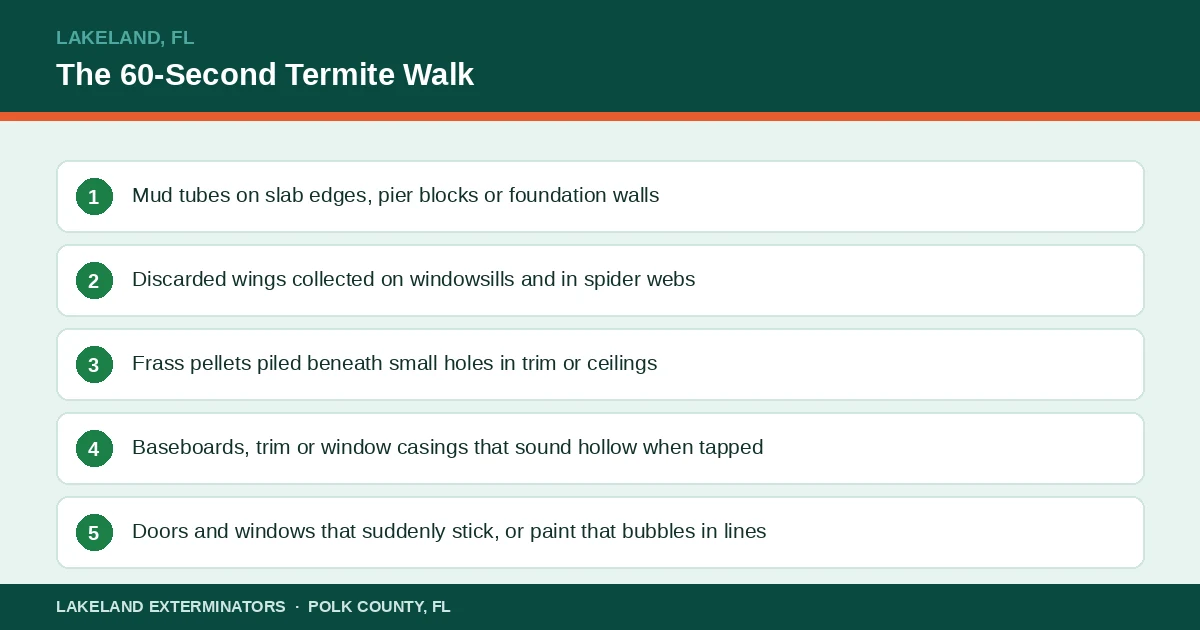
If you find one thing on this page, this is the one. A raised line of dried mud about the width of a pencil, running up concrete block, the slab edge, a pier, a plumbing stack, or across the inside of the garage wall.
What it means: subterranean termites, definitively. They live in the soil and cannot survive exposed to open air, so they build these covered highways to reach your wood. A tube is a commute in progress.
The test: break out a half-inch section with the screwdriver. Cream-coloured soft-bodied insects inside means active right now. No insects, but the gap sealed back up with fresh mud when you check in a few days — also active; they repaired the road. Dry, empty, and still broken open a week later usually means old activity, which is not a green light: whatever let them in is probably still there.
Don’t knock them all down. Intact tubes are a map that tells the inspector where the colony is coming from. Break one, leave the rest.
2. Little piles of hard pellets (frass)
Small heaps of what looks like coarse sand, sawdust or coffee grounds — classically on a windowsill, a bookshelf, the garage floor, or the top of a baseboard.
What it means: drywood termites. Get close, or zoom in with your phone. Drywood frass is hard, uniform, about a millimetre long, and six-sided with slightly concave faces. That geometry is the identification. Sawdust is fibrous and irregular; frass is granular and hard. Colour tells you nothing — it takes on the shade of whatever wood they’re eating, from pale tan to nearly black.
The test: sweep it up. If it’s back in a few days, the colony is active. And look directly above the pile for a pinhead-sized round kick-out hole — frass falls straight down, so the pile points at the source.
3. Discarded wings on a sill or in a light fixture
A little scatter of translucent wings, often in a windowsill, a spider web, a bathtub, or around a light. All four wings the same size, roughly twice the length of the body.
What it means: a swarm happened. Termite swarmers drop their wings almost immediately after flying — they only need them once. Wings inside your house are one of the most under-rated signs there is, because a swarm coming out of your structure means a colony that’s mature enough to reproduce, which takes years.
The test: note the month. February to May in daylight, after warm rain, points at eastern subterranean. Late spring on humid evenings, around lights, suggests Formosan. May to August on warm evenings points at drywood. The Polk County swarm calendar has the full breakdown, and our Polk County Termite Swarm Season & Pest Data Reference has the UF/IFAS-sourced data behind those dates.
4. Swarmers themselves — and how to tell them from flying ants
This trips up almost everyone, and it matters, because flying ants are a completely different problem. Here’s the three-second version — or skip straight to our free Pest Identifier & Urgency Check tool for an instant read.
| Look at… | Termite swarmer | Flying ant |
|---|---|---|
| The waist | Straight and broad. No pinch. Body looks like one continuous tube. | Sharply pinched, wasp-like waist. |
| The wings | All four the same size and shape, and much longer than the body. | Front wings noticeably larger than the hind wings. |
| The antennae | Straight, and slightly beaded like a tiny string of pearls. | Clearly elbowed — bent at a joint partway along. |
If it’s ants, you want ant control in Lakeland instead. If it’s termites, keep reading — and try to capture two or three specimens in a jar or a piece of tape. A real specimen makes the operator’s identification faster and firmer than any description you can give over the phone.
5. Wood that sounds hollow when you tap it
Run the handle of the screwdriver along baseboards, door frames, window frames, and any exposed structural timber. Solid wood gives a dull thud. Compromised wood gives a papery, drum-like knock.
What it means: termites eat the inside and leave the outer skin and the paint film intact. That’s exactly why a board can be structurally worthless and still look fine from three feet away. A hollow knock is one of the earliest signals available to you, and it costs nothing.
6. Blistered, rippled or sunken paint
Paint that bubbles, wrinkles or dips in a way that looks a bit like water damage — but there’s no leak anywhere near it.
What it means: the wood behind the paint film has been eaten out, and the film is all that’s left holding the shape. Common on window frames, door casings and baseboards. Press it gently — if it gives, there’s nothing behind it. Distinguishing this from genuine water damage matters, and the damage-identification guide covers exactly how to tell them apart.
7. Doors and windows that suddenly stick
A door that used to close cleanly and now catches. A window that’s become hard to open.
What it means: maybe nothing — Polk County humidity swells wood, and this is a genuinely common false alarm in the summer. But it can also mean termite galleries have weakened the frame and it’s shifting. The tell-tale: humidity affects everything at once and eases off when the weather changes; a termite-weakened frame sticks and stays stuck, and usually just one or two do it. Combine this sign with any other on the list and it becomes a lot more meaningful.
8. Floors that sag, buckle or feel spongy
Laminate lifting at a seam, tile cracking in a line, a floorboard with give in it, a soft spot near an exterior wall or a bathroom.
What it means: potentially a long-running subterranean infestation in the subfloor or the sill. This is a late-stage sign, not an early one, and it’s the one that should move you to act quickly — not because the house is going to fall down this week, but because damage this visible means years of quiet feeding.
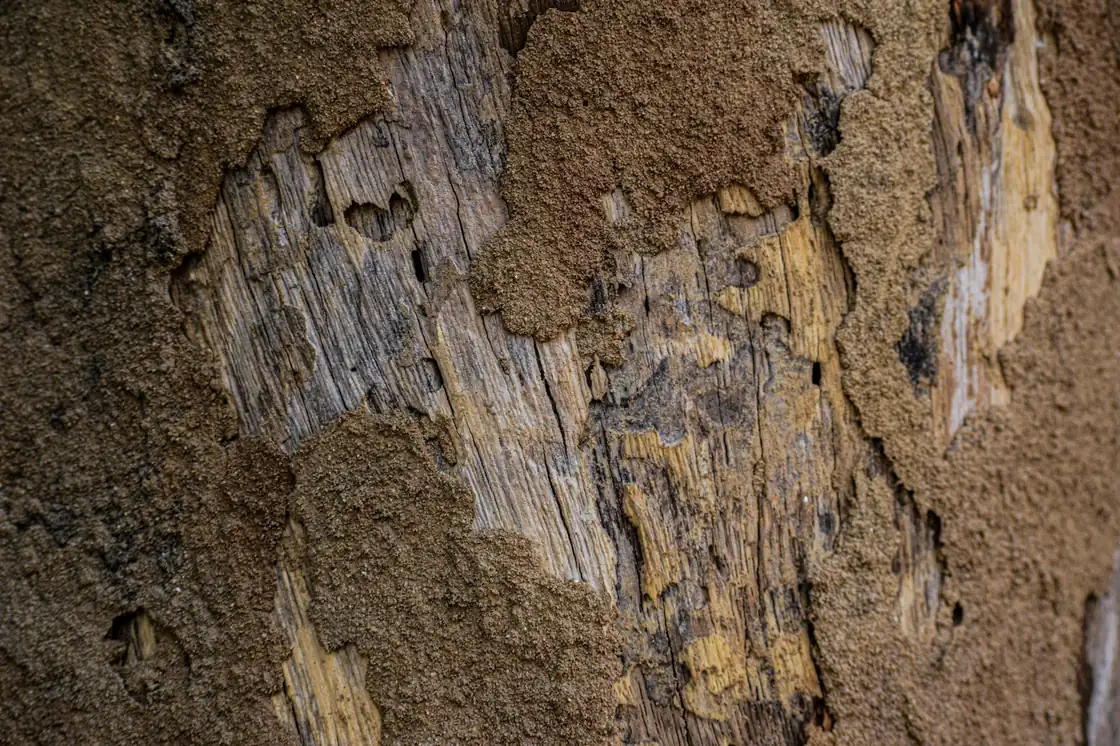
9. Live termites in the wood itself
You pry back a piece of soft trim, or lift a board, and there they are: pale, soft, roughly rice-grain sized, moving away from the light immediately.
What it means: exactly what it looks like. Take a photo, take a specimen if you can, put the board back, and stop excavating — disturbing a subterranean colony can push it to relocate deeper into the structure, which makes it harder for the operator to find and treat.
How the Lakeland dispatch line gets you to a licensed operator
Drop your ZIP
33801, 33803, 33809, 33810, 33813, 33815, 33880 — anywhere in Polk County. That’s all we need to start routing.
A coordinator calls you back
A real person. Tell them which of the nine signs you found and exactly where. That triage is what decides which kind of operator you need.
A licensed operator inspects
An independent, FDACS-licensed operator confirms the species and maps how far it’s spread. No inspection, no honest quote — anyone pricing termite work over the phone is guessing.
You get the quote and you decide
The operator sets the price, the method, the warranty and the schedule. Not us. Getting matched costs nothing and commits you to nothing.
Found one of the nine? Get it confirmed.
Every sign on this page points at a species — and the species decides the treatment.
Talk to a licensed exterminator now
Call and we’ll connect you with a licensed, local exterminator who covers your address. It takes about two minutes, and a real person answers.
Free to call. Free to get matched. The licensed operator gives the quote.
Match your sign to the termite — because the treatment follows the species
Mud → subterranean
Mud tubes, soil-packed galleries, daytime swarmers in February through May after warm rain. The colony lives in your yard, not your walls. Treatment goes in the ground: a liquid soil barrier or in-ground bait.
Pellets → drywood
Frass, kick-out holes, no mud anywhere, activity up high in attic, fascia, window frames or furniture. Swarms May through August. Nothing in the soil will help — treatment is fumigation or localized injection.
Clouds at the porch light → possibly Formosan
Heavy evening swarms in late spring, and carton nests that can survive above ground with no soil contact at all. That last part is why a plain soil barrier may not be the whole answer.
Once you know the species, the complete Lakeland termite treatment guide walks through what each treatment actually involves, and the termite control hub covers every service available locally.
Where to look, specifically, in a Polk County house
Termites go where it’s damp and where there’s a way in. In Lakeland, that means a handful of very predictable places.
- The bath trap. The void in the slab beneath the tub or shower where the plumbing comes through — often bare soil, dark, damp, and opening straight into your wall cavity. The most common hidden entry point in Florida slab construction.
- The garage block wall, from the inside. Nobody looks. Tubes turn up there constantly.
- Under the kitchen sink and behind the toilet. Any chronically damp cabinet base or wall.
- The attic hatch and the gable vents. Drywood swarmers get in through torn or missing vent screening. Look for frass on the joists and on top of the ceiling insulation.
- Fascia, soffit and exposed rafter tails. Especially on the older Dixieland, Garden District and Cleveland Heights bungalows, where there’s a lot of original decorative woodwork.
- Wherever the sprinkler hits the wall. Common in the newer South Lakeland, Christina, Grasslands and Highland City builds — irrigation aimed at stucco five mornings a week keeps the foundation permanently damp.
- Anywhere wood touches soil. Fence posts fixed to the house, deck supports, the firewood stack against the garage, wooden trellises. Direct road in.
And a note on age. Pre-1990s slabs — a lot of the housing stock around Lake Morton and Lake Hollingsworth — have had decades to settle and open hairline cracks at plumbing penetrations and expansion joints. A termite needs a gap about the width of a business card. Newer construction has better pre-treatment but usually more irrigation and denser foundation plantings. Different era, same physics. For the year-round checklist that keeps these signs from starting in the first place, see our free Polk County Home Pest Prevention Guide.
What to do — and not do — before the operator arrives
- Do photograph everything, with something for scale in the shot — a coin, a pen. Photos of tubes, frass, wings and damage give the inspector a head start.
- Do collect specimens if you can. A few swarmers in a jar or stuck to a piece of tape beats any verbal description.
- Do note the date and time you saw a swarm, and whether it was day or evening. That single detail often identifies the species on its own.
- Don’t knock down every mud tube. They’re the map.
- Don’t spray it with a hardware-store aerosol. With subterranean termites, repellent products can push the colony to route around the treated area and deeper into the structure, which makes the professional treatment harder and the infestation more expensive to solve.
- Don’t start demolishing trim to see how bad it is. You’ll disturb the colony and destroy evidence. Let the inspection happen first.
If you’re in the middle of a real-estate transaction, what you actually need is the formal, documented version of all of this — see WDO inspections in Lakeland.
Get a licensed operator to confirm what you found
One ZIP. One call back. You decide from there.
Talk to a licensed exterminator now
Call and we’ll connect you with a licensed, local exterminator who covers your address. It takes about two minutes, and a real person answers.
Free to call. Free to get matched. The licensed operator gives the quote.
Termite sign questions, answered straight
What is the very first sign of termites in a Lakeland home?
Usually mud tubes on the foundation, or a scatter of discarded wings on a windowsill after a swarm. Both are visible without tools and both are frequently walked past. The reason termites get missed for years is that the early damage happens entirely inside the wood, behind an intact paint film — so the first thing you can actually see is the evidence they leave outside the wood, not the wood itself.
How do I tell a termite swarmer from a flying ant?
Three things. The waist: a termite’s body is straight and broad with no pinch; a flying ant has a sharply pinched, wasp-like waist. The wings: a termite’s four wings are all the same size and much longer than the body; a flying ant’s front wings are clearly larger than the hind pair. The antennae: a termite’s are straight and slightly beaded; an ant’s are visibly elbowed. Capture a couple in a jar — a real specimen settles it immediately.
I found mud tubes but no live termites. Am I in the clear?
Not necessarily. Break a small section out of the tube and check back in a few days. If it’s been repaired with fresh mud, the colony is active and simply wasn’t in that stretch of tunnel when you looked. Even if the tube stays broken and dry, old activity still means something got in once, and the conditions that let it in — a crack, a damp spot, wood touching soil — are almost certainly still there.
Does a swarm mean the termites are coming from inside my house?
Not always, and this genuinely matters. Swarmers found inside your home — wings on interior sills, insects in the bathtub — strongly suggest a colony in or under your structure, mature enough to reproduce. Swarmers outside in the yard could be coming from a neighbour’s tree, a stump, or an old fence post. The operator can usually tell which is which by where the wings are and what else is present.
Should I spray the termites I found?
No. With subterranean termites in particular, a repellent hardware-store product can make things worse: the colony detects the treated zone, routes around it, and moves deeper into the structure where it’s harder to find. You haven’t killed anything, you’ve just scattered them and made the professional treatment more difficult. Leave the evidence in place and get it identified properly.
My doors are sticking. Is that termites?
Possibly, but Polk County humidity swells wood and that is the far more common explanation in the summer. The distinction: humidity affects lots of doors and windows at once and eases when the weather changes; a termite-weakened frame usually sticks, stays stuck, and affects one or two openings. If sticking doors are your only sign, don’t panic. If they come with hollow-sounding trim or blistered paint, that combination is worth an inspection.
How long do termites have to be there before I see signs?
Often years. Colonies take time to mature, and both subterranean and drywood termites work entirely inside the wood, leaving the surface intact. A colony generally has to reach a few years of maturity before it produces swarmers or enough frass to notice. That’s the uncomfortable part of finding your first sign: it’s rarely the beginning of the problem, it’s the point at which the problem became visible.
Disclosure
Lakeland Exterminators is a dispatch and matching service. We connect Polk County callers with FDACS-licensed pest control operators. We are not a licensed pest control operator. We do not perform treatment, set prices, issue warranties, hold bonds, or carry pest control trade insurance. All pricing, scheduling, treatment plans, warranties and service terms are determined by the FDACS-licensed operator dispatched to your address under Chapter 482, Florida Statutes.
Same-day and 24/7 emergency services are subject to provider participation, location, technician availability, and demand. Availability is not guaranteed and may vary by market and appointment capacity.
License status of any operator you connect with is publicly verifiable at the FDACS license search.