December in Polk County: the month you finally look in the attic.
One call reaches a licensed, local exterminator who covers your address — and a real person answers, 24/7.
Talk to a licensed exterminator now
Call and we’ll connect you with a licensed, local exterminator who covers your address. It takes about two minutes, and a real person answers.
Free to call. Free to get matched. The licensed operator gives the quote.
24/7 line · A real person answers · Availability of same-day and emergency service depends on the provider.
The December illusion: quiet outside, busy inside
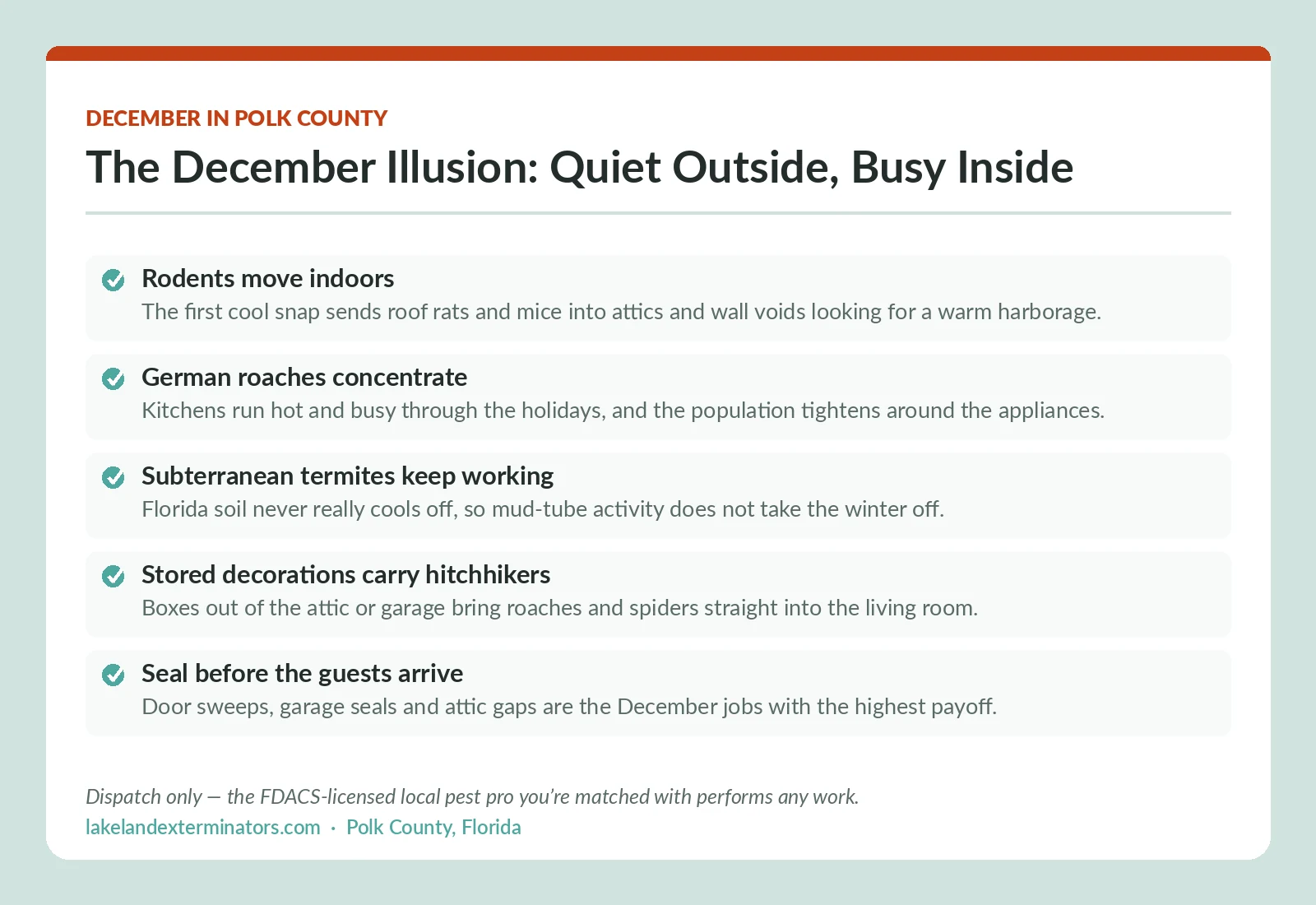
On paper, December is Polk County’s low month — cool nights, low humidity, no swarms, few mosquitoes. In practice it’s the month with the highest discovery rate of the year, for one simple reason: December is when people go into their own attics and deep storage. The decoration boxes come down and there are the droppings, the shredded nest, the gnawed wire insulation, the little cone of six-sided pellets under a rafter. Nothing about the infestation is new; the audience is.
The other December driver is the kitchen. Days of baking and hosting mean more food residue, more cardboard coming through the door, and more grocery traffic than any other month — exactly the inputs a German cockroach population and a pantry-moth problem need. And underneath it all, Zone 9b soil never gets cold enough to stop subterranean termites: colonies feed straight through the holidays, invisibly, ahead of a swarm season that starts as early as February.
The December priority list
Roof rats — climbing toward the winter peak
Ripening dooryard citrus is a roof-rat buffet, and December’s cool nights push the same rats toward attic warmth. Hollowed-out oranges on the ground and night scratching overhead are the December double-sign in Lakeland’s older neighborhoods.
Mice and Norway rats at ground level
Garage clutter season is mouse season — storage totes, gift wrap, pet food bags. A house mouse needs a dime-width gap and one unsealed door sweep; a Norway rat needs a quarter and a reason.
German cockroaches — the holiday kitchen spike
Grocery boxes, gift deliveries and days of cooking give Blattella germanica its strongest month of inputs. Seeing one at 2 p.m. — not 2 a.m. — means the nighttime population has outgrown its harborage.
Termites — feeding through the party
No December swarms, but no December pause either. If the decoration run into the attic turned up fresh frass pellets, or the porch repaint revealed soft wood, that’s active-colony evidence that should not wait for spring.
Pantry pests earn a December mention: Indian meal moths and flour beetles peak with holiday baking — webbing in the flour bag, small moths near the pantry at dusk. The fix starts with purging infested goods and airtight storage; a licensed operator handles what sanitation alone can’t. Mosquito programs, meanwhile, scale back naturally — area mosquito work belongs to the Polk County Mosquito Control District year-round, and December is its quiet season too.
Found droppings in the decoration boxes?
One call reaches a licensed, local exterminator who covers your address — and a real person answers, 24/7.
Free to call. Free to get matched. The licensed operator gives the quote.
December at a glance: the Polk County pest board
| Pest | December status | What you’ll see | The move |
|---|---|---|---|
| Roof rat | Climbing to winter peak | Night scratching, hollowed citrus, droppings in attic boxes | Inspection + exclusion before the January peak |
| House mouse / Norway rat | Rising indoors | Droppings along garage walls, chewed pet-food bags | Seal ground-level gaps; licensed trapping program |
| German cockroach | Holiday-kitchen spike | Roaches behind appliances; daytime sightings mean overflow | Gel bait + IGR program plus post-holiday deep clean |
| Pantry pests | Annual peak | Moths at dusk near the pantry, webbing in flour and meal | Purge, airtight containers, treat if it persists |
| Subterranean termite | Feeding, invisible | Mud tubes on slab edges — the only December tell | Foundation walk now; swarm season starts in February |
| Drywood termite | Frass discovery season | Six-sided pellets found during attic storage runs | Fresh frass = active colony; book the evaluation |
| Brown widow | Sheltering in storage | Egg sacs and webs in totes, grills, meter boxes | Gloves on for every storage box |
| Fire ant | Slow, warm-spell active | Mound activity on 75-degree afternoons | Licensed baiting works on warm December days |
The full-year picture lives on the Florida termite swarm calendar and the neighboring monthly pages: September and January.
The December homeowner checklist
Audit the attic while you’re up there
You’re making the decoration run anyway — bring a flashlight. Droppings, shredded insulation, gnawed wire jackets, frass cones under rafters: five extra minutes turns the errand into the year’s most valuable inspection.
Run the holiday pantry protocol
New flour, meal and baking goods go into airtight containers on arrival. Check existing dry goods for webbing before the big bake — one infested bag seeds the whole shelf.
Respect the firewood rule
Stack firewood off the ground and away from the house, and bring in only what burns tonight. A December log pile against the slab is a bridge for termites, ants and roaches — and indoor storage hatches whatever’s inside.
Seal before the cold snaps
Polk County’s few genuinely cold nights each winter are rodent-push nights. Garage door sweeps, weep-hole screens and the gap where the cable line enters — close them before the next front arrives.
What moves a December quote
We never set prices — the licensed operator quotes after seeing the property. In December, these are the levers:
- What the attic audit found — rodent evidence prices as exclusion scope plus trapping; frass prices as a termite evaluation with treatment paths that depend entirely on extent and species.
- Kitchen infestation maturity — a young German roach population and an established one with daytime activity are different programs with different visit cadences.
- Cleanup scope — contaminated insulation and nesting removal add remediation beyond removal.
- Program timing — starting a recurring program in December means the baseline is set before February swarms; the cadence guide and cost-factor guide explain the levers without pretending we set the number.
How the dispatch works through the holidays
Straight up: Lakeland Exterminators is a dispatch and matching service, not a licensed pest control operator. Here is the exact path your request takes.
Describe what you found
Droppings, frass, roaches, moths — tell the line what you’re seeing and where. A real person answers around the clock, holidays included.
Your address picks the operator
The request routes to an FDACS-licensed operator covering your part of Polk County — Lakeland, Winter Haven, Bartow, Lake Wales, the I-4 corridor, all of it.
Licensed inspection on site
The operator confirms the pest, maps the activity and writes the quote. Pricing comes from them, never from us.
Treatment stays with the pro
Trapping, exclusion, baiting, termite work — plus any warranty — all owned by the licensed operator under Chapter 482, Florida Statutes.
Verify before you hire — any Florida pest control company’s license status, categories and discipline history is public at the FDACS license search at aessearch.fdacs.gov. Check the operator you are matched with; the good ones expect it.
December pest questions, answered straight
I found droppings in the decoration boxes. Mouse, rat or roach?
Size sorts it: roach droppings look like coarse ground pepper, mouse droppings are rice-grain size with pointed ends, rat droppings run half an inch or longer and blunt. Location helps too — attic boxes point to roof rats, garage-floor boxes to mice. Bag a sample for the inspector; the ID sets the whole plan.
Will Polk County’s cold snaps kill the bugs?
No. Zone 9b cold snaps are measured in hours, not weeks — long enough to push rodents indoors, nowhere near long enough to kill soil-insulated termite colonies, indoor roach populations or sheltering spiders. In Polk County, winter relocates pests; it does not remove them.
Can firewood really bring pests inside?
Yes — a log is portable harborage. Termites, carpenter ants, roaches and spiders all overwinter in stacked wood, and a warm living room hatches them within days. Stack it off the ground, away from the slab, and carry in only what goes straight onto the fire.
Why do I suddenly have roaches at Christmas?
You almost certainly had them in November — December adds the inputs that make them visible: more food residue, more cardboard (the classic German roach vehicle), warmer appliance zones running longer. Daytime sightings during the holidays are the classic overflow sign that harborage is saturated — that’s a licensed-baiting situation, not a fogger situation.
Should I start a pest program now or wait for the new year?
If December handed you evidence — droppings, frass, daytime roaches — the answer is now, because every one of those problems compounds. If the house is genuinely clean, December and January are both sensible start months: the point is having the baseline in place before February swarm season and the spring ant surge.
Close out the year with the house actually yours.
One call reaches a licensed, local exterminator who covers your address — and a real person answers, 24/7.
Free to call. Free to get matched. The licensed operator gives the quote.
Disclosure
Lakeland Exterminators is a dispatch and matching service. We connect Polk County callers with FDACS-licensed structural pest control operators. We are not a licensed pest control operator. We do not perform pest control treatment, set prices, issue warranties, hold retreatment bonds, or carry pest control trade insurance. All pricing, scheduling, treatment plans, warranties, bonds and service terms are determined by the FDACS-licensed operator dispatched to your address under Chapter 482, Florida Statutes.
Same-day and 24/7 emergency services are subject to provider participation, location, technician availability, and demand. Availability is not guaranteed and may vary by market and appointment capacity.
License status of any operator you connect with is publicly verifiable at the FDACS license search: aessearch.fdacs.gov.