
Burrows along the foundation, a rat by the dumpster? That’s a Norway rat — and it works from the ground up.
One call reaches a licensed, local exterminator who covers your address — and a real person answers, 24/7.
Talk to a licensed exterminator now
Call and we’ll connect you with a licensed, local exterminator who covers your address. It takes about two minutes, and a real person answers.
Free to get matched. The licensed operator gives the quote.
24/7 line · A real person answers · Availability of same-day and emergency service depends on the provider.
Quick answer: is it a Norway rat?
The Norway rat (Rattus norvegicus) — also called the brown rat or sewer rat — is a bulky rodent with an 8–10 inch body, a tail shorter than its body, small ears, and a blunt snout. The behavior is the giveaway: Norway rats burrow in soft soil rather than climb. They build burrow systems along foundations, under sheds and porches, and in landscape beds, then enter structures at ground level.
They’re less common than roof rats in Polk County residential neighborhoods but dominate the commercial and dumpster-adjacent world — restaurants, warehouses, and multifamily trash areas. Control is a burrow-and-exclusion job: map the burrows, station the perimeter, seal the entries, and trap indoors.
Norway rat vs. roof rat
Both live in Polk County, but they occupy different vertical worlds — and the treatment follows the animal’s habits:
Norway rat
Bulky build, body 8–10 inches, tail shorter than body, small ears, blunt snout. Burrows in soil. Dominant at commercial and dumpster-adjacent sites.
Roof rat
Slim build, body 6–8 inches, tail longer than body, large ears, pointed snout. Climbs — attics, tile roofs, tree lines. Dominant in Polk County residential settings.
If the activity is in the attic, along the roofline, or in citrus trees, you’re likely dealing with the climber — see the roof rat page. Ground-level burrows and dumpster runs point to the Norway rat.
Burrows, entry, and the treatment workflow
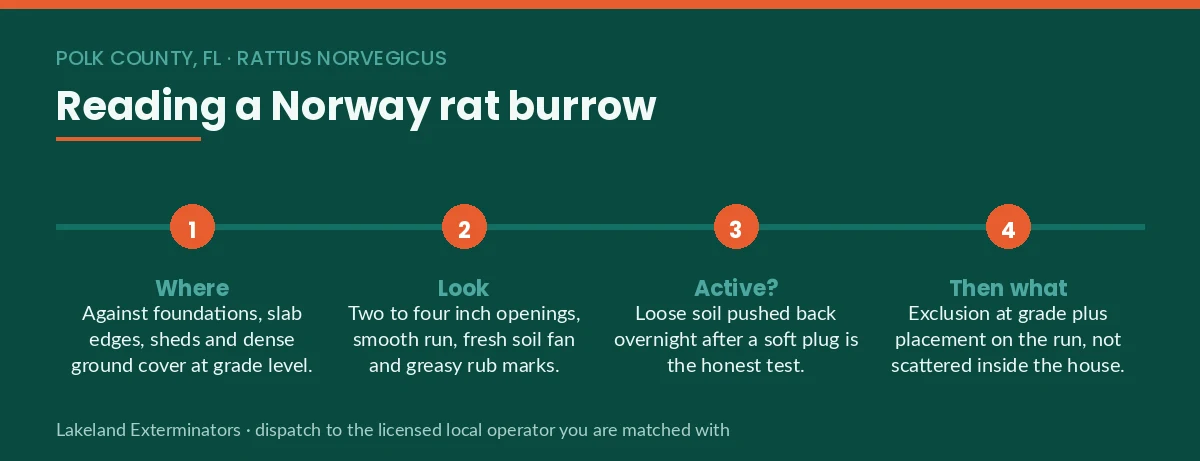
Norway rats dig burrow systems in soft soil — flower beds, landscape mulch, beneath sheds and porches, along foundation perimeters, and in irrigation valve-box voids. Entry into structures is at ground level: gaps around plumbing penetrations, slab cracks, doorway thresholds, and dryer-vent exits. A proper inspection identifies both the burrow system and the structural entry, because treating one without the other just relocates the problem.
The workflow a licensed operator runs:
- Map all burrow openings and structural entry points.
- Install exterior tamper-resistant bait stations at active burrow openings.
- Seal structural entries with hardware cloth and exclusion-rated materials.
- Trap out interior harborage with snap traps in identified runways.
- Run a sanitation review: dumpsters, pet-food storage, bird feeders, fallen citrus.
- Follow up at 14 and 30 days to confirm the burrows stay inactive.
For food-service and multifamily properties, this ties into an ongoing commercial pest program and full rodent exclusion.
Rats around the dumpster or foundation? Map it before it spreads.
One call reaches a licensed, local exterminator who covers your address — and a real person answers, 24/7.
Free to get matched. The licensed operator gives the quote.
Norway rat FAQs
How do I tell a Norway rat from a roof rat?
Why start with burrow mapping?
Are Norway rats mostly a commercial problem?
What sanitation changes actually help?
Are you the pest control company?
Related Polk County pages
Disclosure
Lakeland Exterminators is a dispatch and matching service. We connect Polk County callers with FDACS-licensed structural pest control operators. We are not a licensed pest control operator. We do not perform treatment, set prices, issue warranties, or carry pest control trade insurance. All pricing, scheduling, treatment plans, and service terms are determined by the FDACS-licensed operator dispatched to your address under Chapter 482, Florida Statutes.
Same-day and 24/7 emergency services are subject to provider participation, location, technician availability, and demand. Availability is not guaranteed and may vary by market and appointment capacity.
License status of any operator you connect with is publicly verifiable at the FDACS license search.