Pest complaints at every board meeting? Put one licensed operator on the whole community.
A community-wide pest program covers the clubhouse, pool deck, walking paths and shared landscaping under one master agreement — and gives every homeowner access to a negotiated per-home rate. Enter your community’s ZIP and the dispatch line matches your board with an FDACS-licensed operator who already runs HOA programs in Polk County.
Talk to a licensed exterminator now
Call and we’ll connect you with a licensed, local exterminator who covers your address. It takes about two minutes, and a real person answers.
Free to get matched. The licensed operator writes the proposal.
Board members, property managers and CAM licensees welcome · A real person answers · Availability of same-day and emergency service depends on the provider.
What a Polk County HOA pest program actually covers
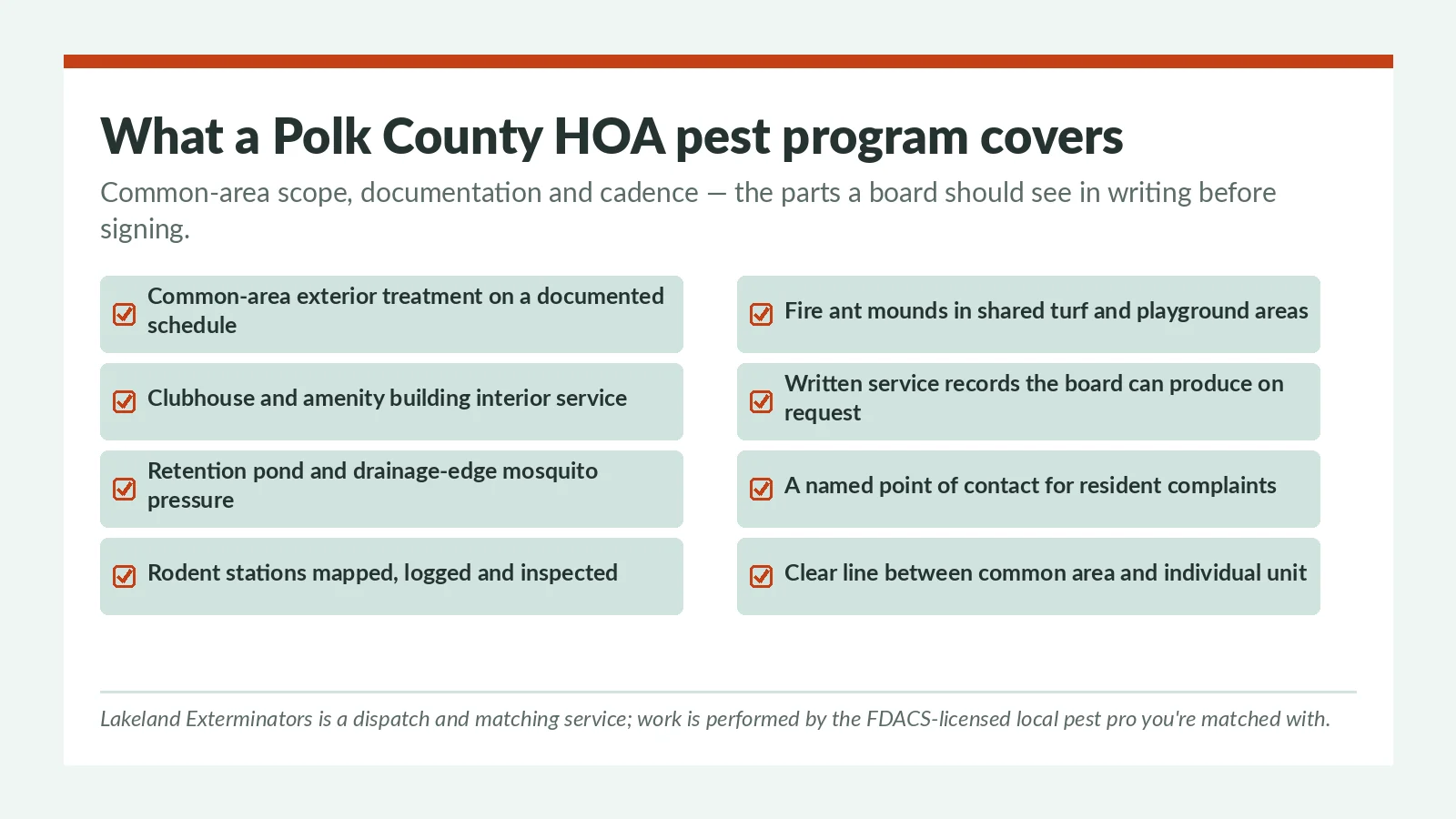
An HOA pest program is a master agreement between the association and one FDACS-licensed pest control operator. Instead of forty different trucks serving forty different homes on forty different schedules, the community gets one accountable vendor, one paper trail, and one program the board can actually audit. Here is what the licensed operator typically writes into the agreement.
Common-area treatment
Clubhouse, pool deck and cabana, mail kiosks, playgrounds, walking paths, entry monuments and shared landscaping — treated on a set cadence with documentation the board and the community’s insurer can review. Retention pond perimeters and golf course rough get addressed where fire ant and rodent pressure builds.
Per-home service at a community rate
The operator quotes a negotiated per-home rate for individual quarterly service that the HOA either bills back through assessments or lets homeowners opt into directly. Participation is opt-in in most Polk County communities; some CC&Rs make it mandatory — the association’s documents control.
Termite bond enrollment at portfolio scale
Communities with shared structures usually carry a community-level termite bond, and homeowners can often enroll individual homes under the same operator’s bond program. Whether that makes sense for your community is a real underwriting question — the termite bond guide covers what the fine print means.
Coordinated WDO inspections
Associations with steady resale turnover benefit from an operator who already knows the buildings when WDO inspections come up at closing. A stagger-scheduled annual sweep keeps findings from piling up in one budget quarter.
Board reviewing pest vendors? Start with a match, not a sales pitch.
One call reaches a licensed, local exterminator who covers your address — and a real person answers, 24/7.
Free to get matched. The licensed operator writes the proposal.
Why Polk County communities carry heavier pest pressure than the brochure admits
Tile roofs and mature canopy feed roof rat pressure
The barrel-tile roofs and established oak canopy that make communities like Eaglebrooke and Sandpiper Golf & Country Club attractive are the same features that make them roof rat highways. Tile gaps at the eave line are ready-made entry points, and connected tree canopy lets rodents travel the neighborhood without touching the ground. Communities that treat rodents home-by-home chase the same population in circles; a community program handles exclusion street by street, which is the only version that sticks.
Retention ponds and irrigation keep everything else active
Nearly every master-planned community in Polk County is built around retention ponds, and shared irrigation keeps turf and ornamental beds damp year-round. That combination supports fire ants along pond banks, palmetto bugs in mulched beds, and the general insect pressure that Zone 9b never turns off — there is no winter month where a Polk County pest program is coasting. Common-area mosquito concerns are a public-resource matter as well: the Polk County Mosquito Control District responds to service requests for standing-water issues on public and community land.
Communities running programs today
Carillon Lakes, Eaglebrooke, Highland Fairways, Cypress Point, Hampton Hills, Sandpiper Golf & Country Club and Highland Park are among the Polk County communities where association-level pest programs are standard practice, and most Disney-orbit communities north of I-4 run them as well. Newer associations often inherit the developer’s original vendor at turnover — boards typically re-bid that contract somewhere in year three to five, which is exactly the moment to get a competing proposal from a licensed operator instead of auto-renewing.
What a typical program year looks like
| Program element | What it covers | Typical cadence |
|---|---|---|
| Common-area general pest | Clubhouse, pool deck, kiosks, paths, entry features | Monthly or bi-monthly, documented per visit |
| Per-home perimeter service | Enrolled homes, exterior perimeter plus interior on request | Quarterly |
| Fire ant management | Pond banks, playgrounds, sports turf, common lawns | Broadcast or mound treatment on the operator’s schedule |
| Rodent monitoring & exclusion | Community buildings, dumpster corrals, enrolled homes | Ongoing stations plus exclusion work as findings dictate |
| WDO / termite sweep | Community structures and enrolled homes | Annual, stagger-scheduled across the calendar |
What drives the operator’s proposal (we never set prices)
- Home count and participation model — a 60-home opt-in program and a 400-door mandatory program are different jobs; per-home economics improve as enrollment climbs, which is the entire argument for community scale.
- Common-area footprint — acreage of shared landscaping, number of structures, pond perimeter footage, and whether the community carries amenities like sports courts or a golf course rough line.
- Scope of the termite component — whether the association wants monitoring only, a community-level bond on shared structures, or per-home bond enrollment, and what renewal terms the bond carries.
- Documentation requirements — some boards and community insurers require per-visit service records and annual summaries; that reporting layer is part of the scope, so name it in the bid.
Every one of those levers belongs to the FDACS-licensed operator who walks your property. The dispatch line’s job is the introduction — the proposal, pricing and terms come from the licensed company, never from us.
How the HOA dispatch works
Straight up: Lakeland Exterminators is a dispatch and matching service, not a licensed pest control operator. Here is the exact path a board inquiry takes.
Describe the community
Home count, common areas, current vendor situation, and what has the board’s attention — rodents, fire ants, termite bond renewal, or a full program re-bid.
Your address picks the operator
The inquiry routes to an FDACS-licensed operator with association-program experience covering your part of Polk County — Lakeland, Winter Haven, Bartow, Lake Wales and the I-4 corridor.
Property walk and written proposal
The operator walks the common areas, meets the board or CAM, and writes a scoped proposal. Pricing and terms come from them, never from us.
The contract stays with the pro
Service agreement, per-home rates, bond terms and all warranties are owned by the licensed operator under Chapter 482, Florida Statutes.
Verify before the board signs — any Florida pest control company’s license status, categories and discipline history is public at the FDACS license search. Run the check on any vendor you are matched with and any incumbent bidding against them; a board minute noting the verification is cheap governance.
Questions boards should ask before signing any pest contract
- Which FDACS categories does your license carry? General household pest and WDO (termite) work are separate categories — a vendor quoting a termite bond needs the WDO category on their license.
- What exactly is documented per visit? Ask for a sample service report before signing, not after the first complaint.
- How is per-home enrollment handled? Billing through the association vs. direct-to-homeowner changes the board’s administrative load and the collection risk.
- What happens at the renewal? Auto-renewal clauses with escalators are common; calendar the notice window the day the contract is signed.
- Who handles after-hours calls from residents? A program is judged on the week a resident finds rats in the soffit, not on the quiet months. The full question checklist goes deeper on all of these.
Polk County HOA pest control questions, answered straight
How does an HOA program benefit individual homeowners?
Three ways: the negotiated per-home rate that community scale makes possible, coordinated common-area treatment that lowers the background pressure on every individual lot, and clean documentation — which matters for community insurance and shows up as a selling point at resale. A community where the common areas are treated and the rodent exclusion is handled street-by-street is simply a harder target than forty homes fending for themselves.
Can the HOA require homeowners to use the contracted operator?
It depends entirely on the community’s governing documents. Some Polk County CC&Rs make participation in the pest program mandatory and bill it through assessments; most make per-home service opt-in while the association funds only the common areas. Review the CC&Rs and any board resolutions before assuming either way — and if the documents are silent, the board’s attorney should weigh in before a mandatory program is imposed.
Does an HOA pest program include termite coverage?
Common structures usually carry a community-level termite bond as part of the master agreement. Individual homes are typically a separate enrollment under the same operator’s bond program — a negotiated rate, but a distinct contract with its own renewal terms. Retreatment-only and damage-repair bonds are very different products, so ask which one is being proposed; the bond guide explains the difference.
How is HOA pest control billed?
The common-area portion is funded through the association budget and shows up in the assessment like landscaping or pool maintenance. Per-home service is billed either through the HOA (cleaner for the operator, more administration for the board) or directly to each enrolled homeowner (the reverse). Both models are common in Polk County; the operator’s proposal should price both so the board can choose.
What does an HOA pest program cost?
Pricing is set by the licensed operator after walking the property — home count, participation model, common-area footprint, termite scope and documentation requirements all move the number. We do not set or publish prices. What community scale reliably changes is the per-home economics relative to each homeowner contracting alone; how much is exactly what the competing proposals will tell the board.
What about mosquitoes on community property?
Mosquito concerns on community land are best routed two directions at once: the Polk County Mosquito Control District takes service requests for standing-water and breeding-site issues as a public resource, and the association’s landscaping practices (irrigation timing, pond bank maintenance, drainage) control most of what the district can’t. This dispatch line focuses on structural and general pest programs — household pests, rodents, ants and termites.
Our developer’s vendor came with the community. Should the board re-bid?
At turnover, most Polk County associations inherit the vendor the developer chose — often on terms nobody currently on the board negotiated. Re-bidding at the year-three-to-five mark is standard governance: it either confirms the incumbent is competitive or surfaces a better-scoped program. Either outcome, the board gets a paper trail showing it tested the market, which is worth having when an owner questions the assessment.
One agreement. One accountable operator. The whole community covered.
One call reaches a licensed, local exterminator who covers your address — and a real person answers, 24/7.
Free to get matched. The licensed operator writes the proposal.
Looking at the whole county picture first? Start with the Polk County pest control guide.
Disclosure
Lakeland Exterminators is a dispatch and matching service. We connect Polk County callers with FDACS-licensed structural pest control operators. We are not a licensed pest control operator. We do not perform pest control treatment, set prices, issue warranties, hold retreatment bonds, or carry pest control trade insurance. All pricing, scheduling, treatment plans, warranties, bonds and service terms are determined by the FDACS-licensed operator dispatched to your address under Chapter 482, Florida Statutes.
Same-day and 24/7 emergency services are subject to provider participation, location, technician availability, and demand. Availability is not guaranteed and may vary by market and appointment capacity.
License status of any operator you connect with is publicly verifiable at the FDACS license search.