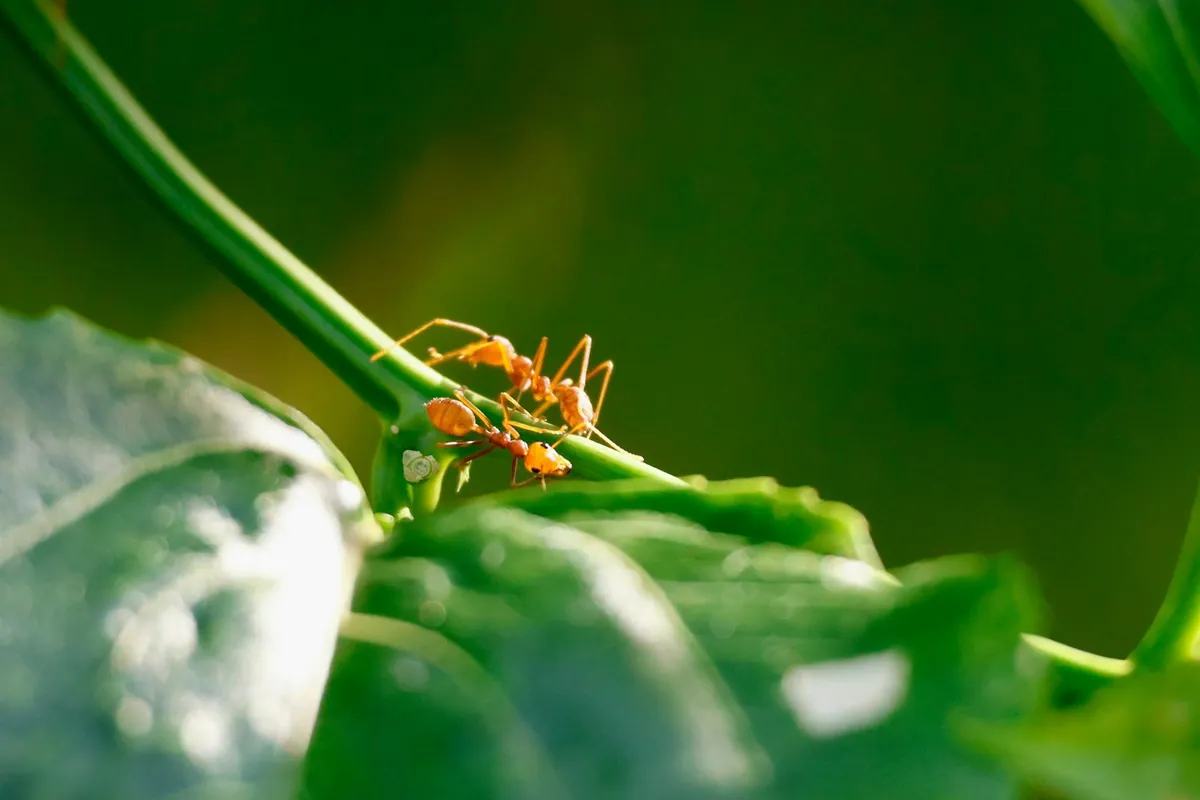
Tiny see-through ants on the counter? Spraying a ghost ant trail is what makes it spread.
One call reaches a licensed, local exterminator who covers your address — and a real person answers, 24/7.
Talk to a licensed exterminator now
Call and we’ll connect you with a licensed, local exterminator who covers your address. It takes about two minutes, and a real person answers.
Free to call. Free to get matched. The licensed operator gives the quote.
24/7 line · A real person answers · Availability of same-day and emergency service depends on the provider.
How to know it’s a ghost ant and not something else
Look, here’s the deal — almost every “tiny ants in the kitchen” call in Lakeland turns out to be one of three or four species, and the one homeowners describe as see-through is nearly always the ghost ant, Tapinoma melanocephalum. The name is literal. The head and thorax are dark brown to black, but the abdomen and legs are so pale and translucent that on a white countertop half the ant disappears and you just see a moving dot.
Here’s what to check before you assume:
- Size. Around 1.5 mm — smaller than the head of a pin. If you can clearly see body segments without leaning in, it’s a bigger species.
- Two-tone body. Dark front half, pale ghostly back half and legs. Nothing else common in Polk County looks like that.
- Erratic, fast trails. Ghost ants don’t march in a tidy line the way Argentine ants do. They scatter and re-form, which is why people say they “appear out of nowhere.”
- The smell. Crush one and you get a faint rotten-coconut odor. Ghost ants are in the same group as odorous house ants, and that smell is a real field ID cue — not folklore.
- Where they go. Sinks, dishwashers, coffee stations, bathroom vanities, the drip pan under the fridge. Moisture first, sugar second.
The species it gets confused with
White-footed ant
Bigger, uniformly dark body with pale feet. Enormous colonies, and notoriously hard to bait — a completely different treatment plan.
White-footed ants in Polk County →Argentine ant
Uniform light-to-medium brown, no pale gaster, and famous for wide, rope-like trails and supercolonies that span whole blocks.
Argentine ants in Polk County →Tawny crazy ant
Reddish-brown, hairy, moves in a jerky zigzag rather than a trail. Swarms electrical boxes and A/C units. Different bait, different expectations.
Tawny crazy ants in Polk County →Getting the ID right isn’t academic. Ghost ants and white-footed ants respond to almost opposite bait strategies, and a treatment tuned for fire ants outdoors does nothing for a colony living behind your backsplash. If you’re not sure which one you have, start at the Lakeland ant control hub — it walks every species we route in Polk County.
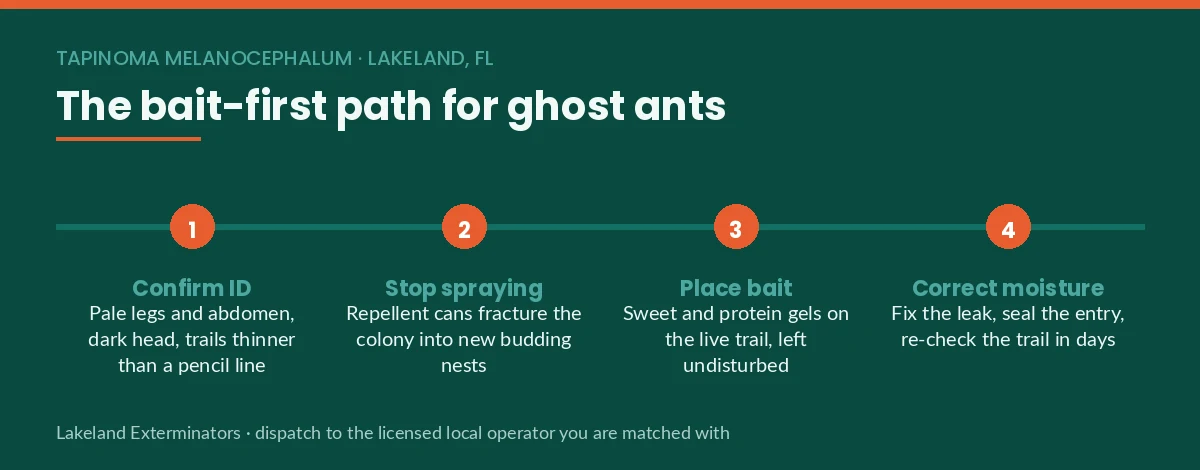
Why the can of spray under your sink makes it worse
This is the part that surprises people, so it’s worth being blunt about it. Ghost ant colonies are polygyne — they carry many egg-laying queens at once — and they reproduce by budding. Budding means a handful of workers simply pick up a queen and some brood and walk away to start a new nest. No mating flight required. No swarm on the window.
Repellent sprays (the pyrethroid aerosols on the hardware-store shelf) do exactly one thing well: they make ants avoid a surface. To a budding species, “avoid this surface” is a relocation order. You kill the fifty ants you can see, and the colony reads the chemical barrier as pressure and splits. Two weeks later you’ve got trails in the master bath and the laundry room, and now there are three nests instead of one.
What actually works is slow. Non-repellent products the ants can’t detect, plus sweet liquid or gel baits that foragers carry back and feed to nestmates and queens through trophallaxis — mouth-to-mouth food sharing. The colony poisons itself from the inside. It takes days to a few weeks, and during the first stretch you may see more ants, not fewer, because a good bait recruits them. That’s the bait working, not failing. Homeowners who panic at day three and grab the spray can undo the whole thing.
The three mistakes that keep Lakeland ghost ants coming back
- Spraying the trail. Covered above. Wipe it with soapy water instead — that erases the pheromone path without triggering a bud.
- Cleaning up the bait. People wipe away the gel dots because they look messy. That’s the food source you paid for. Leave placements alone until the operator says otherwise.
- Ignoring the water. Ghost ants are moisture ants first. A leaking angle stop under the sink, an A/C condensate line dumping against the slab, a bathroom exhaust fan that vents into the attic — those are the reasons they picked your house, and no bait program outruns a permanent water supply.
Where ghost ants get into Lakeland houses
Polk County construction gives ghost ants three or four highways, and which one you’ve got depends a lot on where you live.
The older core — Dixieland, Lake Morton and the Garden District, Cleveland Heights. Wood-frame bungalows from the 1920s through the 1950s, with pier foundations, original cast-iron or galvanized supply lines, and decades of small settling gaps. Ghost ants love the void behind a claw-foot tub and the chase around old plumbing stacks. In these homes the nest is almost always inside the structure, not the yard.
The 1980s slab belt — South Lakeland, Christina, Highland City. Monolithic slabs with block walls and stucco. Ghost ants come in through weep holes, at the slab-to-block cold joint, and along irrigation-soaked foundation beds. The mulch ring against the wall — that’s a nest site, not landscaping.
Newer subdivisions — Grasslands, north Lakeland along the I-4 corridor, out toward Kathleen. Tight envelopes, but builder landscaping puts a bed of moist mulch and a sprinkler head within eighteen inches of the wall, and ghost ants nest in that mulch year-round, then push in through the door sweep the first time it rains hard.
The Chain of Lakes doesn’t help. Lake Hollingsworth, Lake Morton, Lake Parker — anything within a few blocks of open water runs higher ambient humidity, and ghost ant pressure tracks moisture more reliably than it tracks food.
The Polk County ghost ant calendar
Ghost ants are active all twelve months here — Central Florida never gives them a hard freeze — but the reason they come inside changes with the season, and the fix changes with it.
| When | What’s happening outside | What you see indoors |
|---|---|---|
| Mar – May dry season | Polk’s driest stretch. Outdoor moisture disappears; landscape colonies get thirsty. | Trails to bathroom sinks, tub surrounds, pet water bowls, the condensate drip under the A/C handler. Water-seeking, not food-seeking. |
| Jun – Sep storm season | Near-daily afternoon convective storms flood mulch beds and saturate the soil against the slab. | The big indoor surge. Nests in mulch and potted plants get soaked and relocate straight into wall voids and cabinet toe-kicks. Peak call season. |
| Oct – Nov | Rain tapers, temperatures drop, honeydew from scale and aphids thins out. | Trails swing back toward sugar — pantries, coffee makers, spilled soda in the recycling bin. |
| Dec – Feb | Occasional cold snaps push foragers toward warm interior voids. | Quieter, but not gone. Activity concentrates near dishwashers, water heaters and other warm wet spots. A good window for bait work — less outdoor competition. |
If your problem started in July, it’s almost certainly storm-driven relocation, and the operator’s first move will be the exterior. If it started in April, look for a leak.
Ghost ants back for the third time this summer?
That’s the budding cycle, not bad luck. A licensed operator can bait the satellites you can’t see.
Talk to a licensed exterminator now
Call and we’ll connect you with a licensed, local exterminator who covers your address. It takes about two minutes, and a real person answers.
Free to call. Free to get matched. The licensed operator gives the quote.
How the dispatch works — four steps, no phone tag
You call the dispatch line
That’s the whole form. It tells us which corner of Polk County you’re in — 33801 downtown reads very differently from 33813 or 33880.
A coordinator reaches out
A real person, not a bot. They ask where you’re seeing trails, when it started, and what’s already been sprayed — that last one matters for the bait plan.
You’re matched to a licensed operator
An independent, FDACS-licensed pest control company that covers your address and handles ant work. You can verify their license yourself before anyone knocks.
The operator inspects and quotes
They set the price, the schedule, the products and any warranty — we don’t. Free to call, free to get matched, and the quote comes from the licensed pro.
What the licensed operator will ask you
Have these ready and the visit goes twice as fast:
- Which rooms, and in what order did they show up? Kitchen-then-bath tells a different story than bath-only.
- What have you already sprayed, and where? Residual repellent on a baseboard can push foragers off a bait placement for weeks. Be honest — nobody’s judging.
- Any known moisture issue? Slow drip, sweating pipe, A/C pan, roof leak, irrigation head hitting the wall.
- Potted plants indoors or on the lanai? Ghost ants nest in the root ball constantly. It’s one of the most-missed harborages in Florida homes.
- Kids, pets, aquariums? It changes where gel goes and which formulations are on the table.
- Roof and slab age? A 1948 Dixieland bungalow and a 2014 Grasslands slab get different entry-point plans.
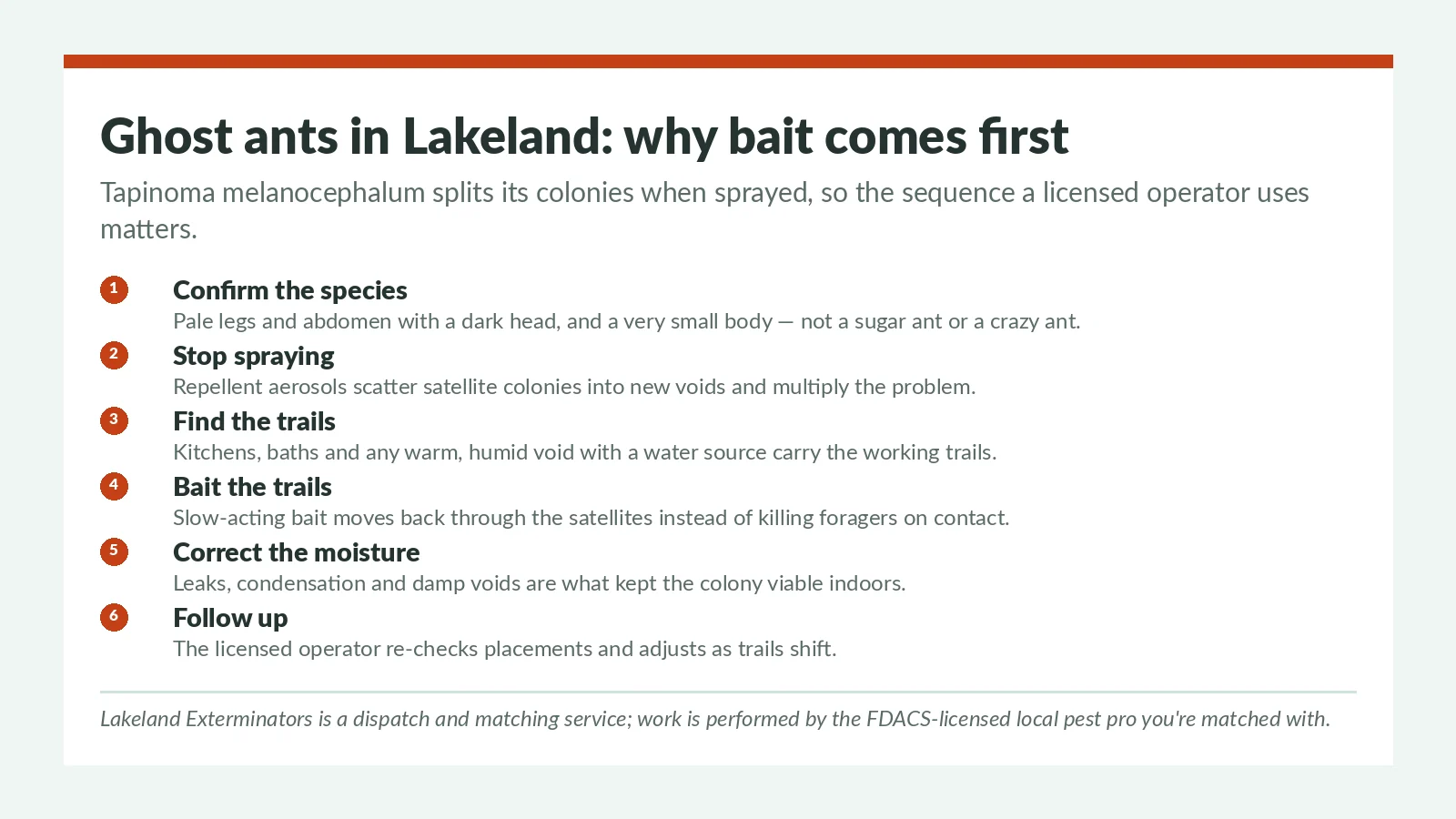
What you can do before the operator gets there
None of this replaces a licensed treatment, but it stops you from sabotaging one.
Do this
Wipe trails with soapy water to erase the pheromone path. Fix the drip under the sink. Seal the sugar — cereal, pet food, the honey bear. Rinse recyclables. Trim any branch or shrub touching the house — those are literal bridges over every barrier a pro will apply. Photograph the trails before you clean, so the operator can see the route.
Don’t do this
Don’t spray the trail. Don’t set out grocery-store bait stations next to a professional placement — competing baits split the recruitment and slow everything down. Don’t mop with strong citrus cleaner right before a scheduled bait service; residue repels foragers off the placement. Don’t bomb the house. Foggers are the single reliable way to turn one ghost ant nest into four.
What ghost ant work costs in Polk County
We don’t set prices and we won’t pretend to. What we can tell you is how Polk County operators usually structure a ghost ant job, so the number you hear makes sense.
- Initial ant service. A one-time interior bait placement plus an exterior non-repellent perimeter and harborage treatment. Priced by home size and how many interior zones are involved.
- Follow-up. Ghost ants almost always need at least one return visit to re-bait as the colony collapses and the satellites surface. Some operators fold this into the initial price; some bill it. Ask which, on the phone, before you book.
- Quarterly or bi-monthly program. The common Florida answer, because the outdoor pressure never stops. Sold as ongoing exterior maintenance with interior service as needed.
- Conducive-conditions work. Plumbing repairs, mulch pull-back, tree trimming. Usually not the pest operator’s job — and if they tell you the ants will come back until it’s done, they’re being straight with you.
For how ant work compares to termite, rodent and general pest pricing in this market, see the Lakeland pest control cost breakdown. Whatever the number, it comes from the licensed operator after they’ve looked at your house — not from us.
Other ants and pests we route in Polk County
All ant species
Start here if you’re not certain what you’ve got. The hub covers every ant we dispatch for across Lakeland and Polk County.
Ant control in Lakeland →Fire ants
Mounds in the yard, sting first and ask questions later. Entirely outdoor work — broadcast bait and mound treatment.
Fire ant control in Lakeland →Carpenter ants
Big black-and-red ants and coarse sawdust. Often mistaken for termites — and the difference matters a lot.
Carpenter ants in Lakeland →German cockroaches
The other kitchen pest that laughs at sprays and only bows to bait. Same building, same moisture, same story.
German cockroach control →Termites
Mud tubes on the slab or wings on the sill in spring? That’s a different animal and a different license class.
Termite control in Lakeland →County-wide service
Winter Haven, Bartow, Auburndale, Haines City, Lake Wales — the same dispatch, the same licensed network.
Pest control in Polk County →Ready to stop chasing trails?
One ZIP. A real person on the line. An FDACS-licensed operator who does this for a living.
Talk to a licensed exterminator now
Call and we’ll connect you with a licensed, local exterminator who covers your address. It takes about two minutes, and a real person answers.
Free to call. Free to get matched. The licensed operator gives the quote.
Ghost ant questions, answered straight
What are the tiny see-through ants in my Lakeland kitchen?
Almost certainly ghost ants, Tapinoma melanocephalum. They run about 1.5 mm with a dark head and thorax and a pale, translucent abdomen and legs, which is where the name comes from. They trail toward moisture first and sugar second, so kitchens, bathrooms and coffee stations are the usual hot spots. They are one of the most commonly reported indoor ants in Polk County homes.
Why do ghost ants come back worse after I spray them?
Because ghost ant colonies have many queens and reproduce by budding. A repellent aerosol kills the foragers you can see and signals the rest of the colony to split up and relocate. A single kitchen nest becomes nests in the kitchen, the master bath and the laundry room. Non-repellent products and slow-acting baits do the opposite: the ants keep foraging normally and carry the active ingredient back to the queens.
How long does ghost ant baiting take to work?
Usually days to a few weeks. Expect activity to increase for the first two or three days as the bait recruits foragers, then drop off as the queens are reached. That early surge is a sign the bait is being accepted. Homeowners who reach for a spray during that window typically reset the whole process.
Do ghost ants bite, sting, or damage my house?
No sting, no meaningful bite, and no structural damage — they don’t chew wood the way carpenter ants do. The real problem is food contamination and sheer persistence. Because they nest in wall voids and potted plants and forage across counters, they’re a sanitation nuisance more than a hazard.
Are ghost ants the same thing as white-footed or Argentine ants?
No, and the difference changes the treatment. White-footed ants are larger, uniformly dark with pale feet, build enormous colonies and are notoriously resistant to standard baiting. Argentine ants are uniformly brown and form wide supercolony trails. Ghost ants are the tiny two-tone ones. Misidentify the species and you’ll buy the wrong plan — which is a big part of why DIY ant control stalls out.
Why do ghost ants get worse in my bathroom every summer?
Polk County’s June-through-September storm pattern saturates mulch beds and the soil against the slab nearly every afternoon. Colonies nesting outdoors get flooded and relocate into wall voids and cabinet toe-kicks — which is why the indoor surge lines up with the rainy season. In the March-to-May dry stretch it’s the reverse: they come in looking for water at sinks, tubs and A/C condensate lines.
Is the pest control company actually licensed?
Every operator in the network is a licensed Florida pest control business, and you never have to take our word for it. License status is public: search the company at the Florida Department of Agriculture and Consumer Services license lookup before anyone treats your home. Pest control in Florida is regulated under Chapter 482, Florida Statutes.
What does ghost ant treatment cost in Lakeland?
We never set or quote prices — the licensed operator does that after inspecting your home. What you can expect structurally is an initial interior-and-exterior bait service, at least one follow-up as the colony collapses, and an optional ongoing exterior program, since outdoor ant pressure in Central Florida never really stops. Ask up front whether the follow-up visit is included or billed separately.
Disclosure
Lakeland Exterminators is a dispatch and matching service. We connect Polk County callers with FDACS-licensed pest control operators. We are not a licensed pest control operator. We do not perform treatment, set prices, issue warranties, hold bonds, or carry pest control trade insurance. All pricing, scheduling, treatment plans, warranties and service terms are determined by the FDACS-licensed operator dispatched to your address under Chapter 482, Florida Statutes.
Same-day and 24/7 emergency services are subject to provider participation, location, technician availability, and demand. Availability is not guaranteed and may vary by market and appointment capacity.
License status of any operator you connect with is publicly verifiable at the FDACS license search.