Hearing scratching in the attic of a Davenport home or short-term rental, or finding droppings in the garage? Davenport’s fast-growing subdivisions and vacation-rental density sit right in roof-rat country, and an empty rental between guests is exactly when rodents move in. Here’s how control works here and how to get matched with a licensed rodent pro.
Get matched with a Davenport rodent pro
One call reaches a licensed, local exterminator who covers your address — and a real person answers, 24/7.
Why Davenport’s growth and rentals draw rodents
Davenport sits in the northeast corner of Polk County at the edge of the Disney and ChampionsGate corridor, and over the last two decades it has gone from a small agricultural town to a belt of new subdivisions and vacation-rental communities. That combination — rapid new construction plus a high density of intermittently occupied homes — is unusually rodent-friendly, and it produces a pattern that is genuinely different from what an established Lakeland neighbourhood sees.
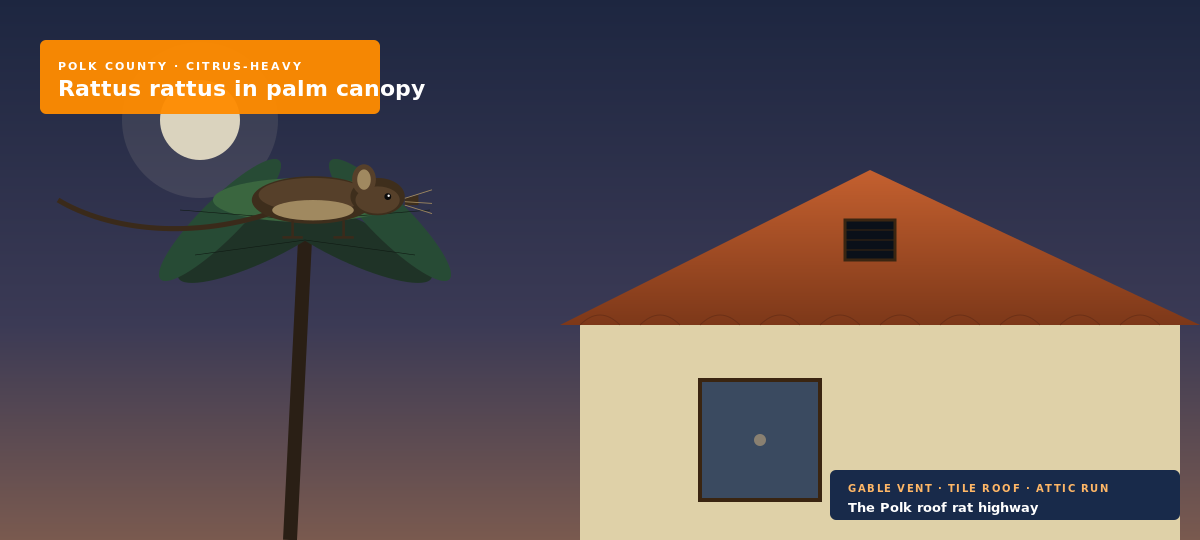
The dominant rodent here is the roof rat, an agile climber that nests high rather than burrowing. It travels rooflines, fence tops, utility lines, and tree canopy, and it enters at height: soffit returns, gable vents, roof-to-wall intersections at dormers, gaps where a chimney chase or plumbing stack passes through the roof deck, and the ridge where two roof planes meet. House mice turn up too, but they behave differently — garage door corners, pantry and utility spaces, and gaps at the slab edge.
New construction is not immune
Homeowners are frequently surprised that a house three years old has rats. New construction is often easier to enter, not harder. Builder-grade soffit and fascia assemblies leave gaps at returns and corners. Utility, AC line-set, and plumbing penetrations get foamed rather than sealed with a rodent-proof material, and foam is not a barrier — rodents chew through it readily. Weep holes in block construction are frequently unscreened. Garage door bottom seals and the corner gaps at each end are a standard entry point on almost every model. And a young subdivision has fresh landscaping, irrigation, and construction debris nearby, all of which support a population outdoors before it finds a way in.
The short-term-rental wrinkle
A vacation rental sitting empty between guests is a quiet, climate-controlled void with occasional food residue and no one home to notice a noise at 2 a.m. That is close to ideal. Several things specific to this corridor make it worse:
- Turnover cleaning is fast and surface-level. Crumbs under and behind appliances, in pantry corners, and in the seat cushions of the sofa bed routinely survive a same-day turn.
- Outdoor kitchens, grills, and pool cages hold grease and food residue and give cover right against the structure.
- Nobody hears the early signs. The scratching that would prompt an owner-occupier to call in week one goes unheard for months, so problems get discovered at the point of visible damage or a guest complaint.
- Garages get used as storage. Stacked bins, pool equipment, and bicycles create harborage in the one space with the most reliable entry points.
If you host in this corridor, a short pre-guest routine and a scheduled exterior inspection are worth far more than a reactive call. See short-term rental pest prep for Polk County hosts for the operational side of that.
Rat or mouse? It changes the plan
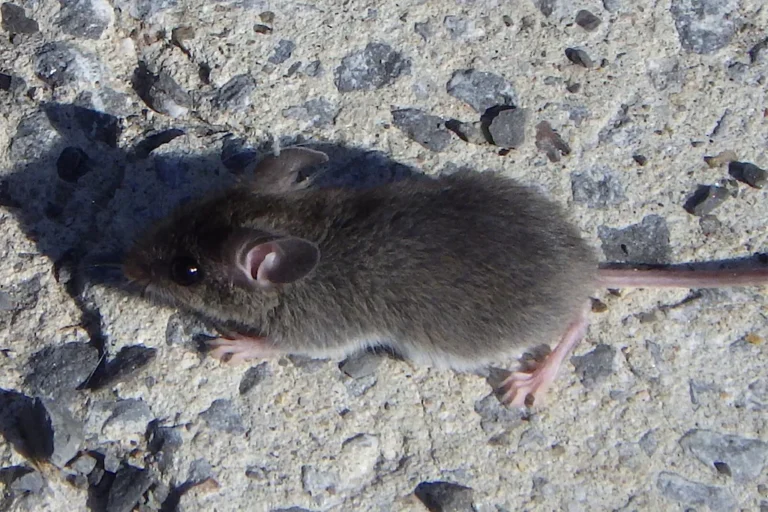
Droppings are the fastest tell: roof rat droppings are roughly half an inch long with pointed ends, house mouse droppings are about an eighth of an inch and rice-grain shaped. Location matters too — activity concentrated in the attic, along the tops of walls, and at roofline entry points is roof rat behaviour, while activity confined to the garage, pantry, and slab-edge is more typical of mice. It matters because the entry points, trap sizes, and placement heights are different, and a plan built for the wrong species tends to catch nothing.
What Davenport homeowners and hosts actually report
Noise
Scratching, scurrying, or a rolling sound overhead after dark. Roof rats are most active in the first hours after dusk and again before dawn. Noise directly above a ceiling usually means the attic; noise inside a wall usually means a vertical travel route from the soffit down a stud bay.
Droppings and rub marks
Droppings concentrated along attic joists, on top of ductwork, in the garage along the wall base, or behind the range and refrigerator. Established travel routes develop dark, greasy rub marks where fur repeatedly contacts an edge — along a truss chord, a pipe, or the top plate of a wall.
Damage
Gnawed food packaging, chewed irrigation and low-voltage wiring, shredded insulation gathered into nests, and damage to stored soft goods. Chewed electrical wiring is the reason this is not merely a nuisance problem — rodents gnaw insulation off conductors, and that is a genuine fire risk in an attic full of blown insulation.
Odour
Persistent ammonia smell from accumulated urine, or the distinct smell of a dead rodent in a wall or duct chase, which is a common way an unnoticed problem finally announces itself in a rental.
How licensed control works
Inspection
The whole job is decided here. A competent inspection covers the roofline and soffits, every roof penetration, gable and ridge vents, the garage door corners and seal, weep holes, AC line-set and plumbing penetrations, and the attic interior to find the actual travel routes and nesting areas. It should identify entry points specifically enough to be sealed, not just confirm that rodents exist.
Exclusion — the part that makes it permanent
Sealing entry points is the only step that produces a durable result, and it is the step most often skipped. Materials matter: quarter-inch hardware cloth, sheet metal, copper mesh packed into irregular gaps, and proper soffit and vent screening hold up. Expanding foam alone does not. This is also the step that requires physical access to a roofline and a willingness to do awkward work, which is why cheap rodent service so often means bait stations and nothing else. See rodent exclusion for the detail of how that work is scoped.
Population removal
Trapping inside the structure is the controlled approach: it removes animals where you can account for them and confirm the result, and it avoids leaving a rodent to die inside a wall. Where exterior rodenticide is used, Florida-licensed applicators work to the product label and use tamper-resistant stations; second-generation anticoagulants also carry real secondary-poisoning risk to owls, hawks, and pets, which is a legitimate reason to prefer trapping and exclusion over broadcast baiting near a residence.
Cleanup and monitoring
Contaminated insulation may need removal and replacement, and travel routes benefit from sanitation to remove the scent trails that attract the next animal. A follow-up visit confirms whether the sealing held and whether trapping has gone quiet.
Trim the highways
Roof rats reach a roof by travelling something. Tree limbs overhanging or touching the roofline, fence tops that run into the structure, trellises and lattice, and untrimmed palms with heavy frond skirts are all access routes. Cutting branches back several feet from the roof, skirting palms, and clearing dense vegetation off the exterior wall removes the approach before you ever get to sealing the building. On a new-subdivision lot this is easier than it sounds — the trees are still small enough to manage.
What you can do between now and the inspection
- Walk the exterior and photograph anything that looks like a gap at the soffit, roof edge, garage door corners, or where lines enter the wall
- Store pantry goods in rigid sealed containers rather than original packaging, particularly in a rental where stock sits between guests
- Clear the garage floor perimeter so the wall base is visible and not providing harborage
- Keep grills and outdoor kitchens clean, and secure bins with tight lids
- Pick up fallen fruit and pet food, and do not leave pet bowls out overnight
- Do not use glue boards in an attic; they are inhumane, and an animal caught and left in a void becomes an odour problem
- Do not put loose bait in an attic or wall void — it is a label violation in most cases and it produces exactly the dead-rodent-in-the-wall outcome you are trying to avoid
The same roofline-and-canopy pattern drives roof rat pressure across the county; see rodent control in Lakeland for the broader picture and pest control in Davenport for the other pests this corridor deals with.
Davenport rodent FAQs
Can a brand-new Davenport home really have rodents?
Yes, and new construction is often easier to enter than older housing. Builder soffit and fascia assemblies leave gaps at returns and corners, utility and AC line-set penetrations are commonly foamed rather than sealed with rodent-proof material, weep holes go unscreened, and garage door corner gaps are near-universal. A young subdivision also has fresh landscaping and construction debris supporting a population outdoors.
I host a short-term rental in Davenport. How do I keep rodents out between guests?
Treat it as an exterior problem first: get the roofline, soffits, penetrations, and garage door seal properly sealed, and keep tree limbs and fence lines from touching the structure. Then handle the interior routine — rigid sealed food storage, deep cleaning behind and under appliances rather than surface turnover cleaning, clean grills and outdoor kitchens, and a scheduled inspection rather than waiting for a guest complaint.
Is the rodent in my attic a rat or a mouse?
Check the droppings and the location. Roof rat droppings are roughly half an inch with pointed ends; house mouse droppings are about an eighth of an inch and rice-shaped. Activity in the attic, along wall tops, and at roofline entry points is roof rat behaviour; activity confined to the garage, pantry, and slab edge is more typical of mice. Entry points, trap sizes, and placement heights differ, so the identification drives the plan.
Why isn’t trapping alone enough?
Because trapping removes the animals currently inside without changing why they could get in. Roof rats have overlapping ranges and a structure with open soffit returns and unsealed penetrations gets re-entered. Exclusion — sealing entry points with hardware cloth, sheet metal, and copper mesh rather than foam — is the step that makes the result durable, and it is the step most often skipped.
How quickly can someone inspect in Davenport?
Tell us what you’re hearing and where, and we route it to licensed companies covering the Davenport and ChampionsGate corridor. Scheduling is set by that independent company and varies with season and demand, so the honest answer is that they will tell you when they confirm.
Are rodents in the attic actually a fire risk?
Yes, and it is the most underrated part of the problem. Rodents gnaw the insulation off electrical conductors, and an attic combines exposed wiring with blown insulation and nesting material. It is also why leaving a problem to run in a rental that nobody occupies for weeks at a time carries more risk than the nuisance itself suggests.
Should I put rodent bait in the attic?
No. Loose bait in an attic or wall void is generally contrary to the product label, and it produces the dead-rodent-in-the-wall outcome that is far harder to resolve than the original problem. Where exterior rodenticide is appropriate, licensed applicators use tamper-resistant stations, and second-generation anticoagulants carry secondary-poisoning risk to owls, hawks, and pets that argues for trapping and exclusion instead.
Do I need to replace the attic insulation?
Sometimes. Heavily contaminated or compacted insulation with accumulated droppings and urine may warrant removal and replacement, both for air quality and because the residual scent attracts the next animal. Light activity often does not. It is an inspection judgement the licensed company makes after seeing the extent, not something to decide in advance.
Seal them out for good
Tell us your address and where you’re hearing activity. We’ll match you with a licensed, insured Davenport company to schedule an inspection.
Last reviewed August 2026 · reviewed on a quarterly cycle. Lakeland Exterminators is a dispatch and matching service that connects Polk County homeowners with independent, FDACS-licensed pest-control companies; we are not a licensed pest control operator and do not perform treatments ourselves.
Disclaimer: Lakeland Exterminators is a local dispatch and referral service, not a licensed pest-control operator. We connect Polk County, Florida homeowners with independent, FDACS-licensed and insured pest-control companies. All inspections and treatments are performed by those independent providers, who set their own pricing, scheduling, and service terms.
Any reference to same-day, emergency, or 24/7 service describes the typical scheduling of matched independent providers and is not guaranteed; actual response times vary by provider, season, location, and demand.