Disney-area short-term rental pest prep is part of the operational baseline for any Polk County host running a vacation home along the I-4 / ChampionsGate / Loughman corridor. The combination of high guest turnover, swimming pools, frequent landscaping service visits, and the Florida pest pressure that doesn’t care whether a property is occupied creates a different pest management challenge than a permanent residence. This guide walks through the inspection cadence that experienced STR managers use, what an FDACS-licensed pest control program covers for an STR property, and how to read guest complaints when they arrive.
Dealing with a pest problem right now?
📞 Call now — get matched with a licensed local exterminator: (888) 295-0220When you call, stay on the line for a few seconds while we match you with the licensed local exterminator for your area. Have your address and a quick description of the problem ready.
Licensed local pros · Fast response, subject to availability · No obligation
Why STR Properties Need a Different Pest Approach
An STR property differs from an owner-occupied home in three pest-relevant ways:
- Vacancy gaps: some properties sit empty 5 to 15 days a month — long enough for German cockroach populations to establish behind appliances, for ants to find food sources, and for rodent entry points to go unnoticed
- Guest behavior: doors propped open, exterior lights left on, food trash in unsealed bins, and bedding moved around the property all create pest pressure that a permanent resident would self-correct
- Reputation risk: a single guest review mentioning “spiders,” “roaches,” or “ants” can durably affect a listing’s occupancy and pricing — pest issues have outsized downstream cost
For STR-focused service structure, see our Airbnb / short-term rental pest control program and our I-4 corridor hospitality pest control overview.
The Turnover-Day Inspection Checklist
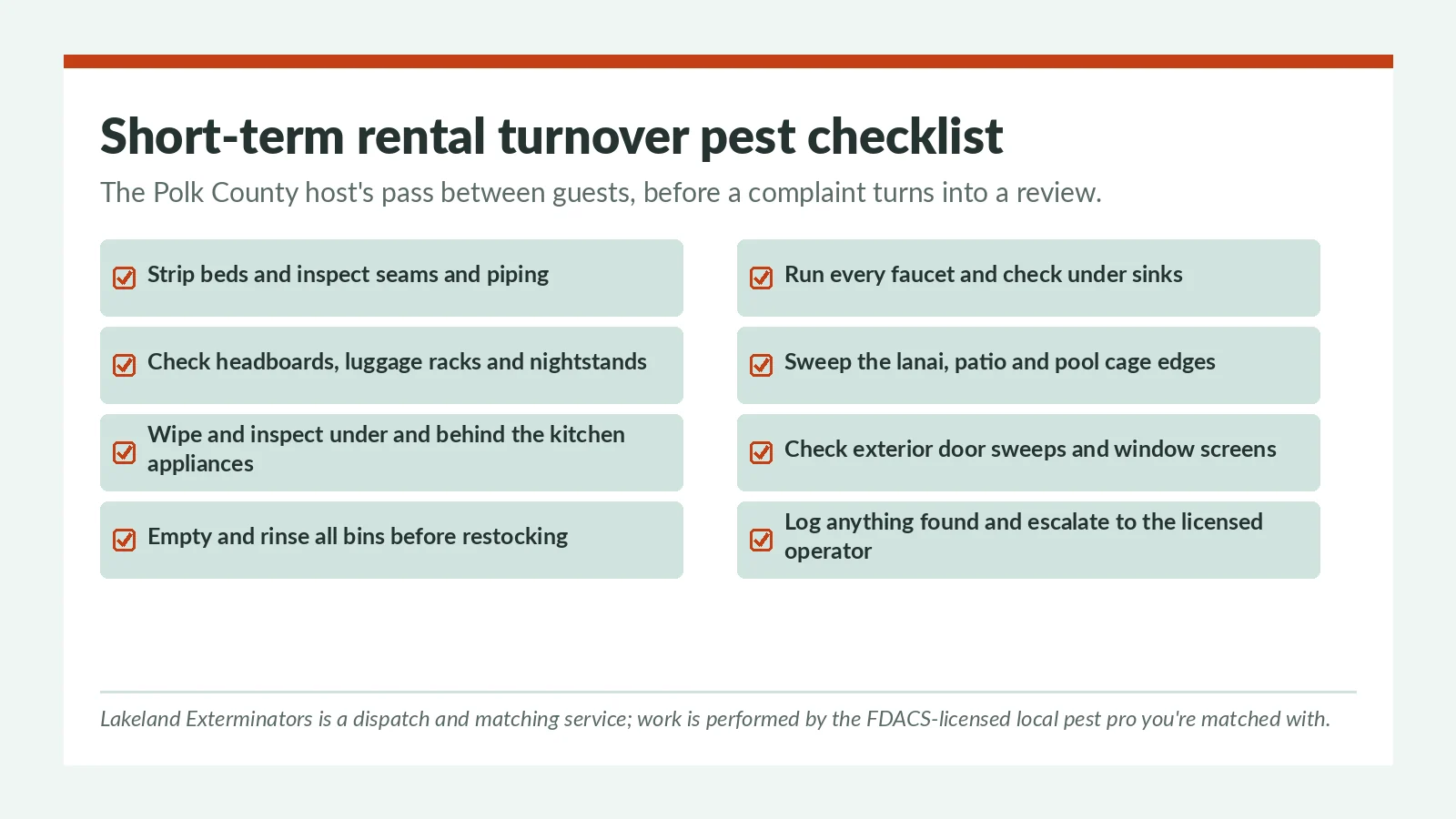
Cleaning crews are the first line of defense, but a structured five-minute pest check during turnover catches most issues before guests do:
- Kitchen counters and sink: any sugar, syrup, or sticky residue (ant attractant)
- Under sinks: standing water, leaks, or roach droppings around the pipe penetration
- Behind microwave, toaster, coffee maker: crumb accumulation and German cockroach traffic
- Pantry and food cabinets: open food packages, beverage bottles with sugar residue
- Pool deck and lanai: standing water in furniture cushions, screen damage at corner posts
- Master shower and guest bath: any insect activity around drains, especially small flies
- Garage door seal: any gap larger than ¼ inch (rodent entry)
- Pet-friendly listings: pet food residue, accidents that may attract ants
A handful of glue boards in low-visibility spots (behind kitchen baseboard, in laundry room corner, under refrigerator) gives you objective data on what’s actually moving through the property between guests.
What an FDACS-Licensed STR Pest Program Covers
STR-focused programs in Polk County typically run on a bi-monthly or monthly cadence rather than the standard quarterly schedule for owner-occupied homes. A typical STR program includes:
- Exterior perimeter spray and granular barrier: reduces ant, spider, and roach pressure before pests reach interior
- Interior crack-and-crevice in kitchen and baths: low-residue placements out of guest-visible areas
- Monitoring stations: tamper-resistant rodent stations on the perimeter; interior pheromone traps for stored-product pests
- Mosquito barrier spray: essential for pool decks and lanais — see our Polk County mosquito timing guide
- Pre-listing inspections: when a property changes ownership or management, a baseline WDO + general inspection (see our pre-listing inspection page) catches existing issues before they become guest complaints
The Pests That Drive STR Complaints in Polk County
Most pest-related guest reviews trace back to a short list:
- Ghost ants and white-footed ants in the kitchen: tiny ants on counters are the single most common Florida STR complaint. See our ghost ant control page.
- Palmetto bugs (American cockroaches) on the lanai: typically wander in from outside; barrier spray and screen integrity reduce them. See our palmetto bug profile.
- Mosquitoes around the pool: often a barrier-spray cadence issue or a standing-water source the cleaning crew is missing
- Spiders in corners and patio furniture: brown widows and orb weavers — see our spider control page
- Bed bug concerns: rare but high-stakes; many programs add a quarterly mattress-and-headboard inspection for STR properties
How to Read a Guest Pest Complaint
Not every complaint indicates an infestation — but the language often tells you what to investigate:
- “Small ants on the kitchen counter” → ghost ant or white-footed ant; check sugar sources and call for re-treatment
- “Spider in the bedroom” → usually a one-off harborage spider; check window screens and corner cobwebs
- “Roaches in the kitchen” → urgent; could be German cockroach establishment behind appliances. Inspect within 24 hours.
- “Bug bites on me / my child” → could be mosquito (often the case after pool use), but rule out bed bugs with a mattress-seam inspection
- “Something running across the floor at night” → likely a palmetto bug; less likely a rodent. Inspect attic and garage door seal.
Phone CTA
To schedule an STR-focused pest control program for a Polk County or ChampionsGate-corridor property, call Lakeland Exterminators at . FDACS-licensed pest control technicians will scope a program structured around your turnover cadence, occupancy patterns, and pool / lanai configuration.
Frequently Asked Questions
How often should an STR property be on pest service?
Monthly or bi-monthly is typical, vs. quarterly for owner-occupied homes. Turnover volume, pool presence, and pet-friendly status push toward the more frequent end.
Can you schedule treatments around guest stays?
Yes — most FDACS-licensed programs work with property managers on calendar-driven scheduling so treatments happen during turnover gaps.
What if I get a bed bug complaint from a guest?
Take it seriously and stop bookings until inspected. A mattress-seam, headboard, and box-spring inspection by a licensed technician is the first step. Confirmed cases typically require heat or chemical treatment before re-listing.
Are there pest control practices that void STR insurance or platform listings?
Generally no — FDACS-licensed treatments using EPA-registered products are accepted by major platforms and insurance carriers. Confirm specifics with your carrier and platform.
Do I need a separate inspection before listing a newly acquired property?
Strongly recommended. A baseline pre-listing pest inspection catches issues from prior ownership that would otherwise become a first-month guest complaint. See our pre-listing inspection page.
Disclaimer: Lakeland Exterminators is a local dispatch and referral service, not a licensed pest-control operator. We connect Polk County, Florida homeowners with independent, FDACS-licensed and insured pest-control companies. All inspections and treatments are performed by those independent providers, who set their own pricing, scheduling, and service terms.
Any reference to same-day, emergency, or 24/7 service describes the typical scheduling of matched independent providers and is not guaranteed; actual response times vary by provider, season, location, and demand.