FDACS pest control licensing in Florida is one of the most carefully structured regulatory frameworks in the United States, and it’s the right place for a Lakeland homeowner to start when evaluating a pest control company. The Florida Department of Agriculture and Consumer Services (FDACS) — through its Bureau of Entomology and Pest Control — licenses, certifies, and audits every pest control company and applicator operating in Polk County. Understanding what those licenses mean turns “what do I look for in a pest control company” from a marketing question into an objective one. Curious how Lakeland Exterminators itself screens the companies in its network before they’re ever matched to a homeowner? See how we vet pest control pros.
Dealing with a pest problem right now?
📞 Call now — get matched with a licensed local exterminator: (888) 295-0220When you call, stay on the line for a few seconds while we match you with the licensed local exterminator for your area. Have your address and a quick description of the problem ready.
Licensed local pros · Fast response, subject to availability · No obligation
The Three License Levels Every Lakeland Homeowner Should Know
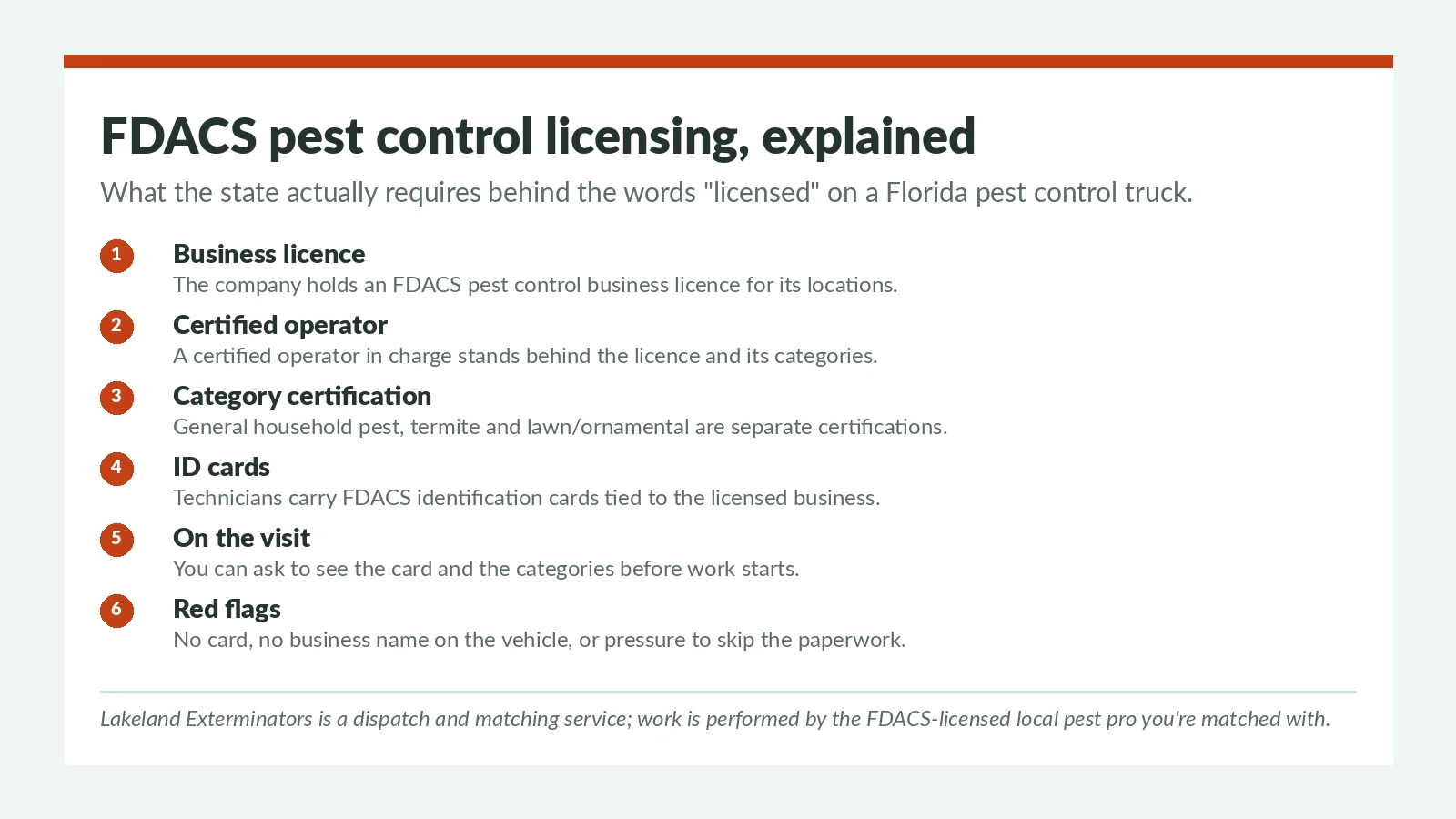
Florida’s structure has three levels you may see referenced:
- Pest Control Business License: issued to the company itself. Required before any pest control service can be offered for hire in Florida.
- Certified Pest Control Operator (CPCO): the certified individual responsible for the company’s pest control operations. Each licensed business must have at least one CPCO. CPCOs pass category-specific examinations (General Household Pest, Termite/WDO, Lawn & Ornamental, Fumigation) and complete continuing education.
- Identification Card Holder (ID Card): the field technician credential. Every employee performing pest control work in Florida must hold a current FDACS ID card in the relevant category. Cards require initial training, background check, and continuing education.
When you hire a Lakeland-area pest control company, the company should be able to provide its business license number, the name of its CPCO, and confirmation that the technician arriving at your home holds an FDACS ID card in the appropriate category.
FDACS Category Certifications
Florida licenses across multiple categories — and only certified categories may be offered as service. The categories most relevant to a Lakeland home:
- General Household Pest Control (GHP): ants, roaches, spiders, fleas, bedbugs, rodents inside structures
- Termite & Other Wood-Destroying Organisms (WDO): termites, wood-decay fungi, wood-destroying beetles. WDO inspection reports (the DACS-13645 form) can only be signed by WDO-certified inspectors. If you’re buying or selling a home, our page on home inspection vs. termite (WDO) check in Polk County explains why these are two separate reports.
- Lawn & Ornamental Pest Control: turf insects, fungal disease, ornamental landscape pests
- Fumigation: tent fumigation with sulfuryl fluoride and similar fumigants — a separately certified specialty
For a deeper look at the WDO inspection itself, see our Lakeland WDO inspection cost page, and for fumigation specifics, our termite tenting cost in Florida overview.
What FDACS Licensing Actually Requires Behind the Scenes
A licensed Florida pest control company carries obligations a homeowner doesn’t always see but benefits from:
- General liability and workers’ compensation insurance at state-prescribed minimums
- Public-disclosure record-keeping: chemical applications, target pests, locations, and applicator names recorded on each service
- Pesticide storage and transport compliance per Florida Administrative Code Chapter 5E-14
- Reporting and remediation requirements for any spill, misapplication, or worker exposure
- FDACS inspector audits on both office records and field operations
What “FDACS-Licensed” Means on the Service Visit Itself
When a technician arrives at a Lakeland home, the visit reflects the regulatory framework in concrete ways:
- Pre-treatment label review: EPA-registered product labels are legal documents — and Florida regulations require applicators to follow the label exactly. The technician will know what target pest, what concentration, what placement, and what re-entry interval the label specifies.
- Customer-side disclosure: on request, the company can provide the active ingredients, EPA registration numbers, and re-entry intervals for any products applied to your home
- Pet, child, and pollinator considerations: structured into product selection and application timing under Florida BMP guidance — see our pet-safe mosquito control page for one example
- Inspection-grade documentation: for WDO and pre-purchase inspections, the resulting report carries the certified inspector’s signature and license number
Red Flags When Vetting a Pest Control Company in Polk County
The FDACS framework gives homeowners a simple vetting structure. Any of the following is a red flag worth asking about:
- Company unwilling to provide business license or CPCO name on request
- Technician unable to produce an FDACS ID card
- Quoted pricing for termite or fumigation work from a company not certified in the WDO or Fumigation category
- Door-to-door sales pressure for “today only” pricing — legitimate Polk County operators don’t typically operate this way
- No written service agreement specifying scope, frequency, and products
For a deeper checklist, see our questions to ask a Lakeland pest control company page.
Getting Connected to an FDACS-Licensed Company
One call reaches a licensed, local exterminator who covers your address — and a real person answers, 24/7.
Frequently Asked Questions
Can I look up a Florida pest control company’s license myself?
Yes — FDACS maintains a public license search through its Bureau of Entomology and Pest Control. Search by company name or license number to confirm current status.
Is one CPCO enough for a company that serves all of Polk County?
A company must have at least one CPCO for its licensed categories, and additional CPCOs as company size grows. FDACS enforces minimum-supervision standards based on operational scale.
What’s the difference between a CPCO and an ID card holder?
A CPCO is the certified operator legally responsible for the company’s pest control work; an ID card holder is the field technician authorized to perform that work under CPCO supervision.
Does FDACS regulate organic or “natural” pest control too?
Yes. Any company offering pest control for hire — including organic or botanical-only programs — requires FDACS licensing regardless of product family.
How do I file a complaint about a pest control company in Florida?
FDACS Bureau of Entomology and Pest Control accepts written complaints from consumers. The agency investigates and can issue corrective actions, fines, or license revocation depending on findings.
Disclaimer: Lakeland Exterminators is a local dispatch and referral service, not a licensed pest-control operator. We connect Polk County, Florida homeowners with independent, FDACS-licensed and insured pest-control companies. All inspections and treatments are performed by those independent providers, who set their own pricing, scheduling, and service terms.
Any reference to same-day, emergency, or 24/7 service describes the typical scheduling of matched independent providers and is not guaranteed; actual response times vary by provider, season, location, and demand.