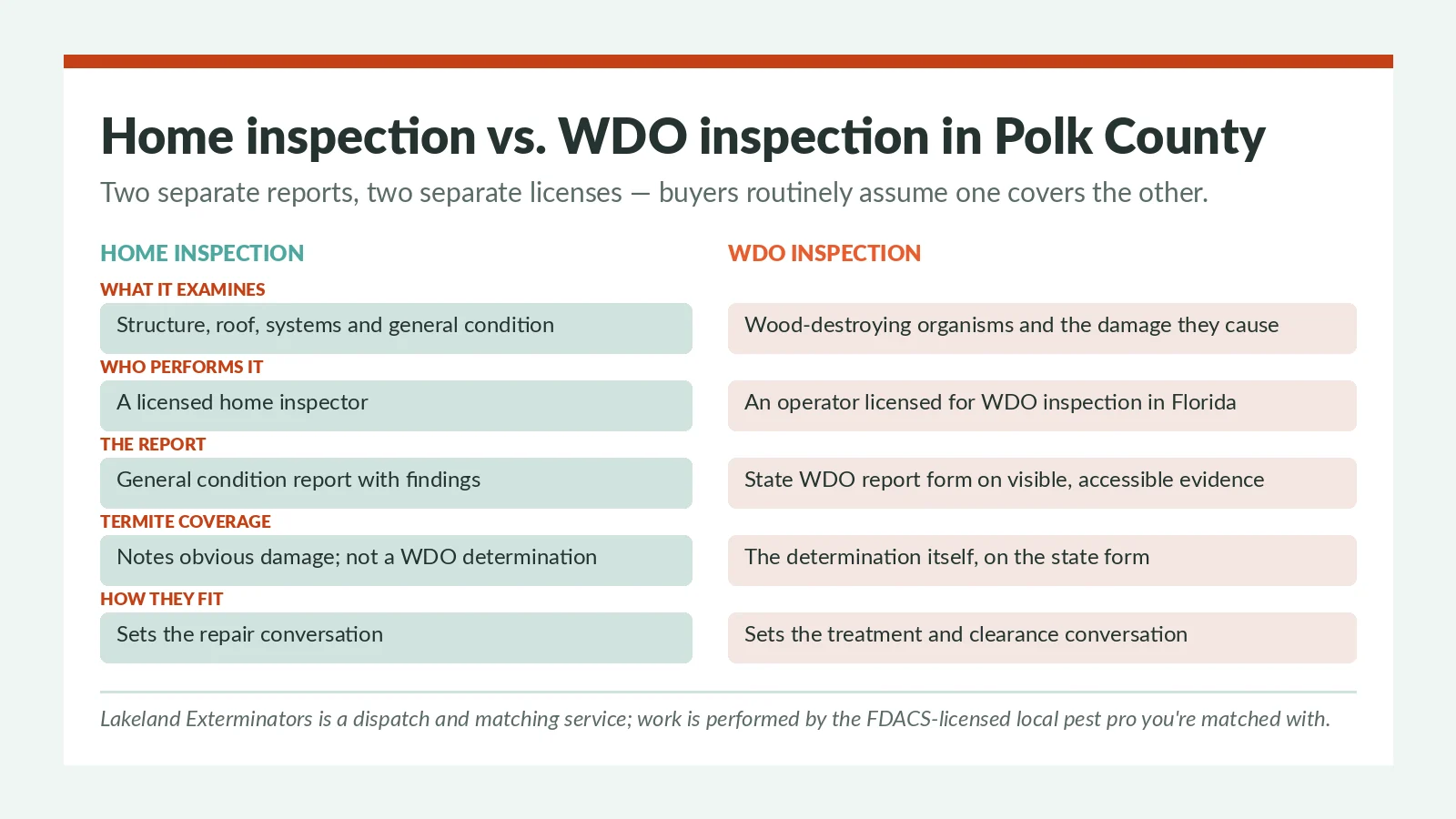
When you put a Lakeland home under contract, you are usually working against a short inspection window. Two evaluations get talked about in the same breath during that window, and buyers often assume they are the same report. They are not. A general home inspection and a wood-destroying-organism (WDO) inspection answer two different questions, and in Polk County you generally want both.
Dealing with a pest problem right now?
📞 Call now — get matched with a licensed local exterminator: (888) 295-0220When you call, stay on the line for a few seconds while we match you with the licensed local exterminator for your area. Have your address and a quick description of the problem ready.
Licensed local pros · Fast response, subject to availability · No obligation
What a general home inspection covers
A home inspection is a broad, visual assessment of the house as a system. A typical residential inspection looks at the roof and visible structure, the electrical and plumbing systems, HVAC, the water heater, attic and insulation, drainage and grading, windows and doors, and the general condition of major components. The inspector documents what is working, what is near the end of its service life, and what needs attention, then delivers a written report you can use to plan repairs or reopen negotiations.
What a general home inspection is not is a regulated pest report. Inspectors note obvious signs of an issue, but a general inspection is not the same document a lender or title company may ask for when wood-destroying organisms are the concern.
Why Florida adds a separate WDO (termite) inspection
Polk County sits in a warm, humid part of Florida where subterranean termites stay active year-round, and older slab-and-block construction around the Lakeland chain of lakes gives them plenty of ways in. That is why a WDO inspection is treated as its own regulated report in Florida, recorded on the state DACS-13645 form. It focuses specifically on termites, wood-decay fungi, and wood-boring beetles, and it is commonly required at closing. A clean home inspection does not replace it, and a clean WDO report does not replace a home inspection. The requirement applies the same way anywhere in the county, not just in Lakeland proper — see our page on a WDO inspection in Polk County for how the countywide process works.
For background on how the termite portion works locally, see our guides to WDO inspections in Lakeland and termite treatment in Lakeland.
Two different licenses, two different laws
The clearest way to understand why these are separate reports is that Florida regulates the two professions under different statutes entirely.
- Home inspectors are licensed under Chapter 468 of the Florida Statutes and regulated by the Department of Business and Professional Regulation. A home inspection is a broad, visual, non-invasive assessment of the structure and its systems.
- Wood-destroying-organism inspectors operate under Chapter 482 — the structural pest control law — administered by the Florida Department of Agriculture and Consumer Services (FDACS). WDO work requires a pest-control license in the appropriate category, and the inspection is documented on the state’s own form.
That is not a technicality: a home inspector who is not separately FDACS-licensed cannot issue a WDO report, no matter how experienced they are or how clearly they can see a mud tube. Conversely, a WDO inspector is not evaluating your electrical panel or your roof age. Both licenses are publicly verifiable, and checking them takes a couple of minutes — our page on FDACS pest control licensing in Florida explains how to look up the pest-control side.
What is actually on the WDO form
The WDO report is a standardized state document, the DACS-13645, and knowing its structure makes it far easier to read when it lands in your inbox at nine at night during a fifteen-day inspection period. It records:
- Which wood-destroying organisms were found — subterranean termites, drywood termites, wood-destroying beetles such as old-house borers and powderpost beetles, and wood-decay fungi. Note that wood-decay fungus is a covered organism; a WDO finding is not automatically a termite finding.
- Whether the evidence is live or from a previous infestation — an important distinction, since old, treated damage is a very different negotiation from active feeding.
- Visible damage — and here is the part buyers most often misread: the WDO inspector reports visible evidence of damage but is generally not qualified or engaged to assess the structural significance of it. A finding of damage may need a contractor or engineer to evaluate.
- Areas that were inaccessible or obstructed — a crawl space that could not be entered, an attic area blocked by ductwork or storage, a wall obscured by dense shrubs, furniture against a baseboard. This section deserves real attention, because it defines the limits of what the report actually establishes.
- Whether a treatment recommendation is being made, and by whom.
What each report will miss
Both inspections are visual and non-invasive, which sets a real ceiling on what either can tell you:
- Neither inspector opens walls, lifts flooring, or moves the seller’s stored belongings
- Concealed damage behind drywall, under tile, or inside a wall cavity will not be found unless it has produced a visible outward sign
- A blocked attic hatch or a crawl space with insufficient clearance limits the WDO report significantly, and that limitation appears in the obstructions section rather than as a warning at the top
- Neither report is a warranty or a prediction; both describe conditions observed on one day
The practical response is to read the obstructions section first, then ask whether anything on it can be cleared and re-inspected while you still have contingency time.
Why Polk County specifically raises the stakes
Central Florida is one of the highest-pressure termite environments in the country, and several features of Polk County’s housing stock compound it:
- Eastern subterranean termites are active year-round here, with heavy spring swarm activity, and Formosan subterranean termites are established in the region as well.
- Slab-on-grade block construction is the dominant local style, and it gives subterranean termites concealed routes — slab cracks, expansion joints, plumbing penetrations, and the bath trap — that are invisible from inside a finished house.
- Older neighborhoods around the downtown chain of lakes carry the additional variables of decades of settled grading, added mulch depth, mature trees close to structures, and in some cases original wood framing or additions built at different times to different standards.
- Newer subdivisions have their own signature issue: construction debris — form boards, stakes, scrap lumber — buried in the backfill during the build, which is a food source with a direct path to the foundation.
- The wet season, running roughly late May into early October, keeps soil moisture high and makes conducive conditions like a downspout discharging at the slab meaningfully worse than they would be in a drier climate.
A property may also already carry a termite bond from a previous treatment. That is genuinely useful information to ask the seller for, along with the treatment records, because bonds and their transferability vary and a transferable bond has real value at closing. Our page on whether an annual termite bond is worth it in Lakeland covers what those agreements typically include.
A workable inspection-period sequence
Florida residential contracts commonly run a short inspection period — frequently in the range of ten to fifteen days, though it is whatever your contract says — and the schedule below keeps both reports inside it:
- Days one to two. Book both inspections immediately on going under contract. Good inspectors book out, and this is the step that most often costs buyers their contingency window.
- Days three to six. Both inspections performed, ideally on the same day or back to back. Attend if you can — walking the property with the inspector produces context no written report conveys.
- Days five to eight. Reports delivered. Read the WDO obstructions section and the home inspection’s major-system findings first.
- Days six to ten. If either report flags something significant, get the specialist evaluation now — a contractor for structural damage, a licensed operator for a treatment scope. A repair request based on a specific scope is far stronger than one based on a line item in a report.
- Before expiry. Submit your repair or credit request, or exercise your contingency. Do not let the window lapse while waiting on a quote.
If you are on the selling side, the same logic runs in reverse: a pre-listing inspection removes the surprise and the leverage that comes with it. See pre-listing pest inspections in Lakeland.
Questions worth asking before you book the WDO
- Are you FDACS-licensed for WDO inspections, and what is the license number?
- Will the report be issued on the DACS-13645 form?
- Will you enter the attic and any crawl space, and what would prevent you from doing so?
- If you find evidence, does your company also perform treatment? — not disqualifying, but worth knowing when you read the recommendation
- Will you photograph findings and the areas you could not access?
- How quickly is the written report delivered, given my contingency deadline?
A local home inspector serving Polk County
One Polk County company we point buyers to for the general home-inspection side is Local Home Inspection LLC, led by Nasir Uddin, who holds the Certified Master Inspector (CMI) designation. They handle full residential home inspections across Lakeland and the surrounding Polk County area and provide the written report buyers use during their inspection period. Because they focus on the whole-house inspection, they pair naturally with an independent, FDACS-licensed company handling the separate WDO/termite report, so you are not leaning on one visit to answer both questions.
How the two reports fit together
The simplest way to think about it: the home inspection tells you about the house, and the WDO inspection tells you about what may be eating the house. Order the general home inspection early in your window so there is time to act on findings, schedule the WDO inspection in parallel, and read both reports side by side before your inspection contingency expires. If either report flags active issues, you still have room to ask for repairs, a treatment, or a price adjustment.
If you would like a step-by-step walkthrough before your own inspection day, our interactive WDO (Termite) Inspection guide for buying or selling a home covers what to expect at each stage.
Concerned about termites or other pests at a Polk County property?
One call reaches a licensed, local exterminator who covers your address — and a real person answers, 24/7.
Frequently asked questions
Does a home inspection include termites?
A general home inspection may note visible signs of pest activity, but it is not the regulated wood-destroying-organism report. In Florida the WDO inspection is a separate report on the DACS-13645 form, so most buyers schedule both.
Which inspection should I schedule first?
Schedule the general home inspection early in your inspection window so you have time to act on the findings, and book the WDO inspection in parallel so both reports are ready before your contingency expires.
Who performs these inspections in Lakeland?
General home inspections are performed by licensed home inspectors such as Local Home Inspection LLC, while WDO and pest inspections are performed by independent, FDACS-licensed Florida pest-control companies, each setting their own pricing and scheduling.
Can my home inspector also do the WDO inspection?
Only if they hold a separate FDACS pest-control license in the appropriate category. Home inspectors are licensed under Chapter 468 and regulated by DBPR, while WDO inspections fall under Chapter 482 and FDACS. Some individuals hold both, but the licenses are distinct and the reports are distinct.
What does a WDO report actually cover besides termites?
The DACS-13645 form covers wood-destroying organisms generally: subterranean and drywood termites, wood-destroying beetles such as powderpost and old-house borers, and wood-decay fungi. It records whether evidence is live or from a previous infestation, notes visible damage, and lists areas that were inaccessible or obstructed.
What is the most important section of a WDO report to read first?
The obstructions and inaccessible-areas section. It defines the limits of what the inspection established. A blocked attic, an unenterable crawl space, or a wall hidden behind dense shrubs means those areas were not evaluated, and clearing them and re-inspecting is often still possible inside the contingency window.
Does a clean WDO report mean the house has no termite damage?
No. Both inspections are visual and non-invasive. Concealed damage inside a wall cavity, under flooring, or in an obstructed area will not appear unless it has produced a visible outward sign. The report describes conditions observed on one day and is not a warranty.
Related Polk County reading
- WDO inspection — Lakeland
- WDO termite report — Lakeland
- WDO inspection cost — Lakeland
- Pre-listing pest inspection — Lakeland
- Signs of termites — Lakeland
- Is an annual termite bond worth it in Lakeland?
- FDACS pest control licensing in Florida
- Termite treatment — Lakeland
Disclaimer: Lakeland Exterminators is a local dispatch and referral service, not a licensed pest-control operator. We connect Polk County, Florida homeowners with independent, FDACS-licensed and insured pest-control companies. All treatments are performed by those independent providers, who set their own pricing, scheduling, and service terms. Local Home Inspection LLC is an independent company mentioned here as a local resource; we are not affiliated and receive no payment for the mention.
Any reference to same-day, emergency, or 24/7 service describes the typical scheduling of matched independent providers and is not guaranteed; actual response times vary by provider, season, location, and demand.