If you’re buying a home in Lakeland or anywhere in Polk County, somewhere between the offer and the closing table the term “WDO inspection” is going to come up. Maybe your lender mentioned it. Maybe your agent put it on a checklist. Maybe the words “termite letter” appeared in a closing document and you weren’t sure what it meant.
Dealing with a pest problem right now?
📞 Call now — get matched with a licensed local exterminator: (888) 295-0220When you call, stay on the line for a few seconds while we match you with the licensed local exterminator for your area. Have your address and a quick description of the problem ready.
Licensed local pros · Fast response, subject to availability · No obligation
Here’s the short version: a WDO inspection checks the home for wood-destroying organisms, and in a lot of Florida transactions it’s either required or strongly recommended. In Central Florida — where termite pressure is heavy year-round — it’s also genuinely useful, because the report tells you whether the house you’re about to buy has a problem hiding in the framing. This guide explains what the inspection covers, when it’s required, what the report says, what inspectors look for in our area, and how to time it so it doesn’t slow down your closing.
This is educational guidance, not legal advice. For what your specific deal requires, confirm with your lender and closing agent.
What a WDO inspection is (and what “wood-destroying organisms” covers in Florida)
WDO stands for wood-destroying organism. A WDO inspection is a visual inspection of a structure for organisms that damage wood — and in Florida, that’s a broader category than just termites.
A Florida WDO inspection covers:
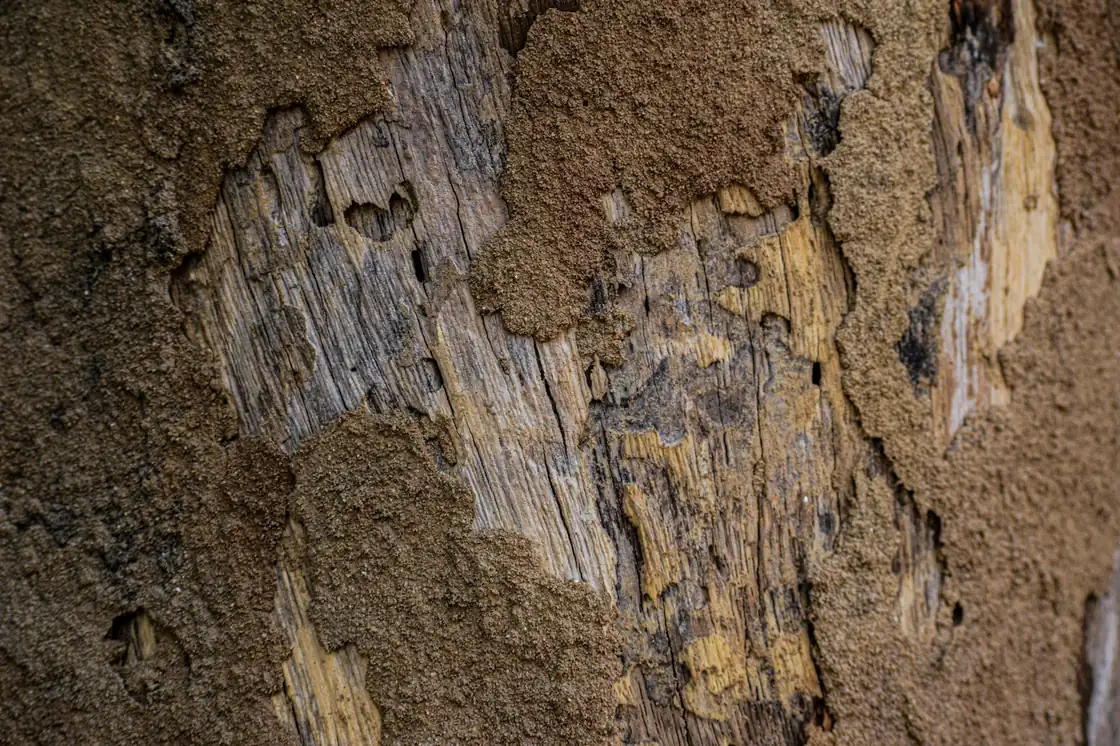
- Subterranean termites — the soil-dwelling termites that reach a home through mud tubes.
- Drywood termites — termites that live entirely inside the wood with no soil contact, common in Central Florida.
- Wood-decay fungi — the rot you get from moisture problems, which structurally weakens wood much like insects do.
- Other wood-destroying organisms — such as wood-boring beetles and, depending on the region, other pests covered under the WDO category.
So a WDO report is not only a “termite check.” It’s a snapshot of whether anything is actively eating or rotting the wood in the home, whether there’s evidence of past damage, and whether conditions around the property invite future problems. In Florida the inspection is performed by a licensed inspector and follows a standardized state form, which is part of why lenders trust it.
When a WDO inspection is required vs. strongly recommended
Whether you’re required to get a WDO report depends on your loan and your contract, but the patterns are consistent enough to plan around.
VA loans. If you’re a veteran buying in Polk County, assume it’s part of the process and confirm the specifics with your lender.
Other lenders.
Strongly recommended even when optional. Central Florida’s termite pressure is a real reason to get the inspection regardless of whether a lender demands it. A clean visual walk-through by a buyer or agent won’t catch drywood termites quietly working inside framing or fungal decay behind a wall. For what’s likely a six-figure purchase, the report is inexpensive insurance.
Bottom line: don’t assume.
One call reaches a licensed, local exterminator who covers your address — and a real person answers, 24/7.
What the report — the “termite letter” — actually says
The document a WDO inspection produces is officially the inspection report, but you’ll hear it called the “termite letter” in real-estate circles. In Florida it’s a standardized state form, and it tells the lender, buyer, and seller a few specific things:
- Visible evidence of active wood-destroying organisms — whether the inspector found live termites, fungi, or other WDOs at the time of inspection.
- Visible evidence of past or previous infestation — signs of damage or prior activity, even if nothing is active now.
- Visible damage — areas where wood has been compromised.
- Conditions conducive to infestation — moisture issues, wood-to-soil contact, or other situations that invite future problems.
- Any treatment present — whether the home already has a termite treatment or bond in place.
A key thing to understand: a WDO inspection is visual. The inspector reports what they can see and access. It is not an assurance that the home is clear of every possible problem in places no one can see. If the report flags active infestation or damage, that opens a conversation in your transaction — about treatment, repairs, or who pays for what. If treatment turns out to be needed, the no-tent termite treatment page for Lakeland explains the localized options that may apply.
What inspectors look for in Central Florida homes
A WDO inspector working a Polk County home pays attention to the conditions our climate and construction create. Common focus areas include:
- Foundation and slab edges for the mud tubes subterranean termites build to bridge soil and structure.
- Attics and framing for drywood termite frass (the pellet-like droppings) and damaged or hollow-sounding members.
- Crawl spaces and the area beneath the home where moisture, wood-to-soil contact, and hidden activity tend to concentrate.
- Bathrooms, kitchens, and water-adjacent areas where moisture intrusion can drive wood-decay fungi.
- Door and window frames, baseboards, and trim for frass, blistered paint, and small kick-out holes.
- Exterior wood — fascia, decks, fences, and landscaping timbers in contact with soil — where activity often starts before moving inward.
Because Central Florida carries both subterranean and drywood termites, a good inspection accounts for both signatures: the soil-connection evidence of one and the in-wood evidence of the other. For more on how local termite pressure shapes treatment decisions, see the broader Polk County pest control overview.
What a WDO inspection typically costs in Polk County
A WDO inspection is usually one of the lower-cost steps in a home purchase, especially set against the general home inspection, the appraisal, or the loan itself. As third-party industry context, a standalone WDO report in Florida commonly runs a modest flat fee — often somewhere in the low-to-mid hundreds, and sometimes less when it is bundled with other services. This page does not set that price; the figure is between you and the inspector you hire.
A few things affect the number:
- Who pays. On VA loans in Florida, the buyer generally does not pay for the WDO inspection. On other transactions the cost is negotiable between buyer and seller, so ask your closing agent how it is handled in your specific deal.
- Bundling. Some companies reduce the price of a WDO report when it is ordered alongside a general inspection or a treatment, while a formal standalone report tied to a closing may be priced on its own.
- Property size and complexity. A larger home, a crawl space, or multiple structures can take longer to inspect thoroughly, which can affect the fee.
The practical takeaway: a WDO report is inexpensive relative to the size of the purchase it protects. Treat the ranges here as general industry context rather than a quote — the inspector you are connected with provides the actual number after seeing the property.
Who’s qualified to perform a WDO inspection in Florida
A WDO inspection isn’t a job for a general handyman or a typical home inspector. In Florida, wood-destroying-organism inspections are performed by inspectors licensed through the Florida Department of Agriculture and Consumer Services (FDACS), working under a licensed pest control operator. The inspector completes a standardized state form — the same form statewide — which is part of why lenders and closing agents accept it with confidence.
That licensing matters in a real-estate transaction. A report from a properly licensed inspector carries professional and legal weight; an informal “I looked around and didn’t see anything” from an unlicensed party won’t satisfy a lender and won’t protect you if a problem surfaces after closing. When you order a WDO report, confirm the company holds the proper Florida license for this work.
The Florida DACS-licensed WDO inspectors in our network handle exactly this kind of standardized report. When you get connected, you can ask about licensing, the form they use, and how the findings will be documented for your closing.
Timing it so it doesn’t delay closing
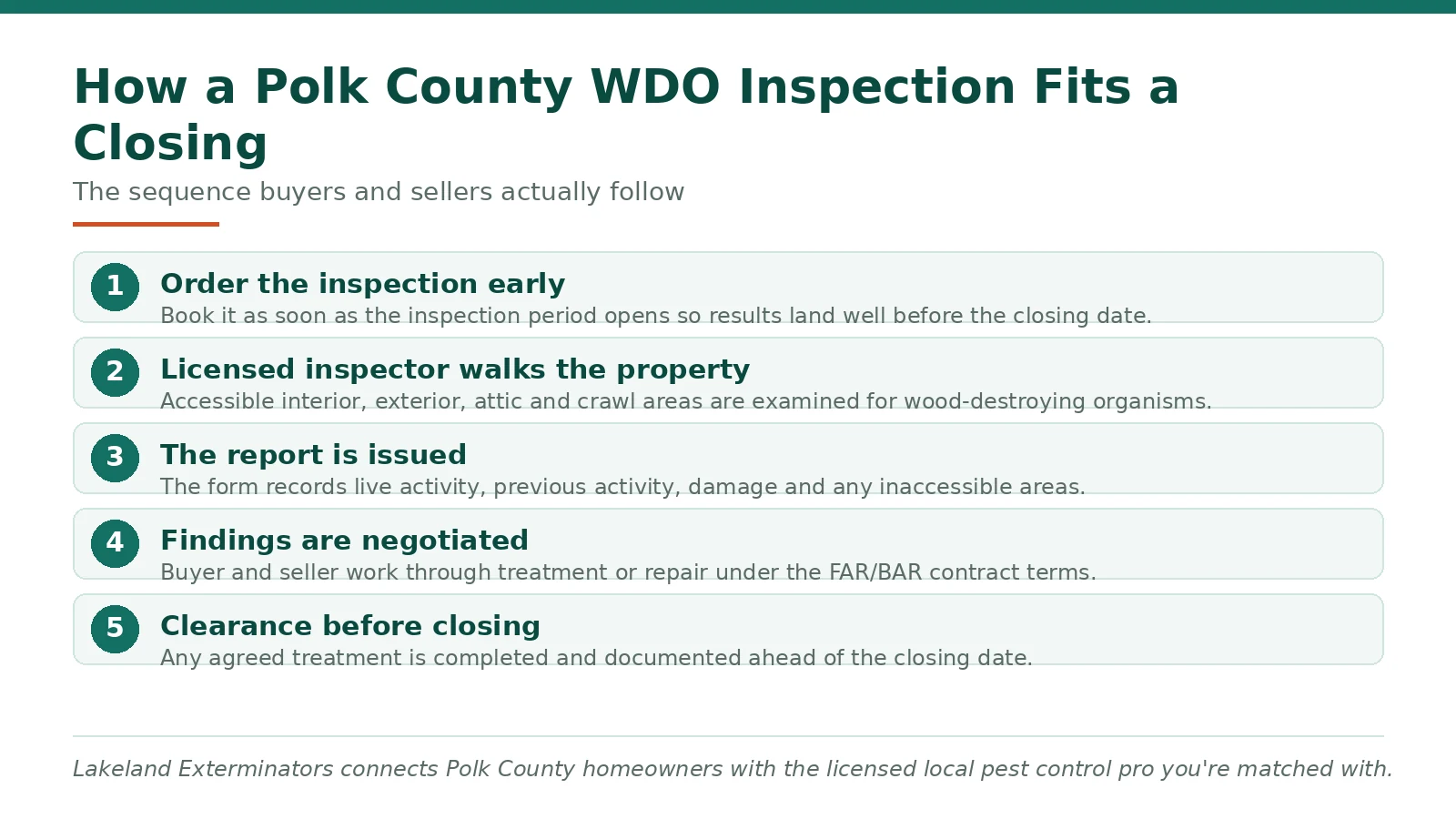
This is where buyers most often get caught. A WDO report is quick relative to the rest of a closing — but if you wait until the end of the process to order it, it can become the thing everyone is waiting on. And if the report flags an issue, you’ll want time to negotiate treatment or repairs before your closing date, not after.
A few practical pointers:
- Order it early in your inspection period, alongside your general home inspection, rather than at the last minute.
- Build in a buffer so that if the report turns up active WDOs, there’s room to arrange treatment and any re-inspection before closing.
- Coordinate with your closing agent on exactly what form and clearance your lender needs, so the right document is in hand on time.
- Don’t skip it to save a few days. A delayed or missing termite letter can hold up a closing far longer than scheduling the inspection on time would have cost you.
We can’t promise a turnaround — the timing is between you and the inspector you’re connected with — but ordering early is the single most reliable way to keep a WDO report from becoming a closing-day problem. A deeper walkthrough of the local report process is on the Polk County WDO reports page.
Selling instead of buying? Our interactive WDO Termite Inspection checklist for a home sale walks through what to expect at each stage, from pre-listing prep to the closing table.
One call reaches a licensed, local exterminator who covers your address — and a real person answers, 24/7.
FAQ
Do I need a WDO inspection to buy a house in Florida? Often, yes. Even when it’s not strictly required, buyers and agents frequently request it.
What does a WDO inspection cover in Florida? It covers wood-destroying organisms: subterranean and drywood termites, wood-decay fungi, and other wood-destroying organisms such as wood-boring beetles. It’s a visual inspection that reports active and past evidence, visible damage, and conditions that invite infestation.
What is a “termite letter”? “Termite letter” is the common real-estate name for the WDO inspection report. In Florida it’s a standardized state form documenting whether the inspector found evidence of wood-destroying organisms, damage, prior treatment, and conducive conditions.
Is a WDO inspection the same as a home inspection? No. A general home inspection looks at the overall condition of the home — roof, systems, structure. A WDO inspection is a specialized, licensed inspection focused specifically on wood-destroying organisms. Many buyers schedule both during the inspection period.
Who pays for the WDO inspection? On VA loans in Florida, the buyer generally does not pay for it. On other transactions it’s negotiable between buyer and seller. Your closing agent can tell you how it’s handled in your deal.
How long is a WDO report good for? A WDO report reflects the property’s condition on the inspection date, and lenders generally want a recent one for closing. Because conditions can change, an older report may not be accepted. Ask your lender how recent the report needs to be for your closing.
What happens if the report finds termites? A finding of active wood-destroying organisms opens a conversation in your transaction — about treatment, repairs, and who covers the cost. Depending on the type and extent, a localized no-tent treatment or a broader approach may be appropriate. It’s a reason to order the inspection early, so there’s time to address it before closing.
One call reaches a licensed, local exterminator who covers your address — and a real person answers, 24/7.
LakelandExterminators.com is a dispatch and matching service. We connect callers with independent, licensed Florida exterminators and inspectors; we are not a licensed pest control company ourselves. Any reference to prompt or same-day response describes typical scheduling of matched independent providers and is not guaranteed — actual response times vary by provider, season, location, and demand. See our full disclaimer in the site footer.