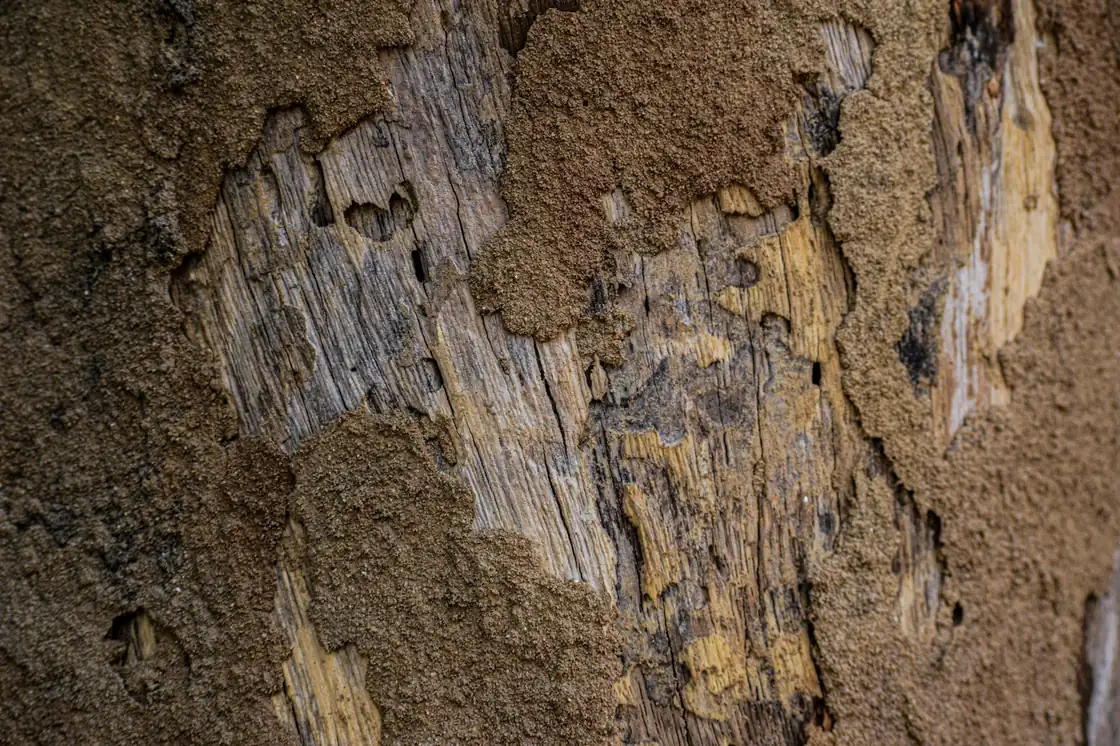
If you’re buying, selling, or representing a property in Lakeland, Winter Haven, Bartow, Plant City, Lake Wales, or anywhere else in Polk County, you’ll need a Wood Destroying Organism (WDO) inspection report — often called a “termite letter” or simply “the WDO” — to close. A WDO report in Polk County is completed by an FDACS-licensed inspector, and licensed pest control technicians can diagnose and treat anything the inspection turns up.
Dealing with a pest problem right now?
📞 Call now — get matched with a licensed local exterminator: (888) 295-0220When you call, stay on the line for a few seconds while we match you with the licensed local exterminator for your area. Have your address and a quick description of the problem ready.
Licensed local pros · Fast response, subject to availability · No obligation
This guide walks through what to expect — for buyers, for sellers, and for real estate professionals.
What a WDO Report Is
The inspection covers all readily visible and accessible portions of the structure for evidence of past or current infestation by:
- Subterranean termites (Reticulitermes flavipes, Eastern subterranean — the dominant Polk County subterranean species)
- Drywood termites (Cryptotermes brevis and Incisitermes snyderi — Florida’s drywood species)
- Wood-decay fungus (wood rot, brown rot, soft rot)
- Powderpost beetles and other wood-boring insects
The report itself is a one-page form documenting the inspection findings.S. residential lenders — and is the standard documentation for Polk County real estate transactions.
Florida Legal Framework —
Most Polk County residential real estate transactions use the (the Florida Realtors / The Florida Bar standard form). The contract contains a WDO inspection addendum — currently referenced as the WDO addendum (paragraph 17 in current versions). The addendum:
- Gives the buyer the right to obtain a WDO inspection during the inspection period
- Specifies who pays for the inspection (typically the buyer)
- Specifies the seller’s repair or treatment obligation if active infestation or damage is identified
- Provides remedies if the inspection reveals issues (treatment, credit, or contract cancellation)
The WDO inspection itself is governed by Chapter 482, Florida Statutes (Structural Pest Control) and Chapter 5E-14, Florida Administrative Code, administered by the Florida Department of Agriculture and Consumer Services (FDACS), Bureau of Entomology and Pest Control.
When the WDO Report Is Required in Polk County
- Conventional loans — Lender’s discretion. Most Polk County conventional loans request the report, particularly for older properties.
Contract-required: Practically:
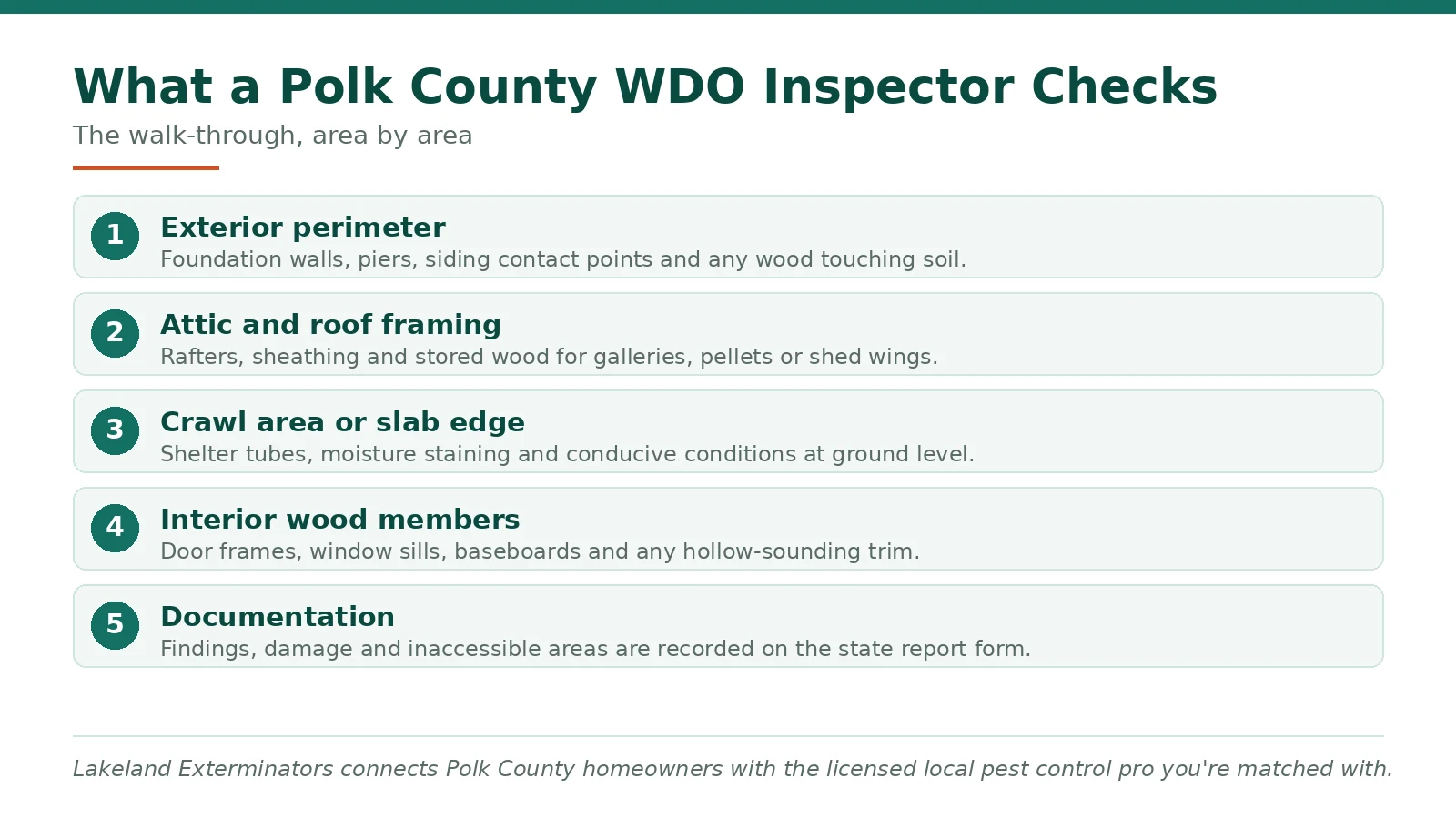
What the Inspector Will Check
An FDACS-licensed WDO inspector typically performs a 30–60 minute inspection covering:
Exterior: foundation perimeter (mud tubes, slab edge evidence), wood-to-soil contact points (deck-to-house, porch posts, fence-to-house), plumbing penetrations, bath traps (slab cutouts behind tubs and showers), eaves, soffits and fascia (drywood evidence), and trim, siding and exterior wood elements.
Interior: baseboards, window sills and door frames, plumbing walls in bathrooms and the kitchen (subterranean entry), closets (where drywood evidence often hides), the floor perimeter (drywood frass collections), wood ceiling beams, and hardwood floors.
Attic: structural members, decking and ridge beams, the insulation surface (drywood frass accumulation), eaves and roof line, and stored items.
Crawl space (if accessible): piers, beams and floor joists, sub-floor framing, moisture conditions, and mud tube evidence.
Areas not typically covered include sealed crawl spaces, areas obstructed by furniture or storage, finished basement framing, and anything behind drywall (the inspection is visual, not invasive).
Three Possible Report Outcomes
1. Clear report — no evidence of infestation. The ideal outcome; the report is submitted to the lender and closing proceeds normally.
2. Past infestation, treated, no current activity. The most common Polk County outcome given how prevalent termite activity is. The form notes “evidence of previous infestation” with details. If a treatment receipt is available, this typically isn’t a barrier to closing, and the treatment receipt and any existing termite bond should be transferred to the buyer.
3. Active infestation. The form notes “evidence of active infestation. Most Polk County transactions resolve by the seller arranging treatment and providing a treatment certificate.
4. Visible damage even without current activity. The form notes structural damage; repair scope and responsibility is then negotiated between buyer and seller.
For Buyers — Practical Tips
Order the WDO inspection early in your inspection period. Polk County WDO inspectors can typically schedule within 24–48 hours and deliver the report within 24 hours of the inspection — but during peak season (March–July) or after major storms, scheduling can extend.
Use an independent operator. If the seller’s existing pest control company performs the inspection, there may be a conflict of interest.
Ask about transferable termite bonds. If the property has an existing termite bond (often the case in Polk County), it can typically be transferred to you at closing for a modest transfer fee. That provides ongoing coverage at the cost of the transfer fee rather than starting fresh.
Understand what “clearance” means. A clear report doesn’t mean termites are absent forever — it means none were detected on the inspection day. Annual re-inspection is reasonable for any Polk County home.
Validity window: If your closing is delayed beyond 30 days, re-inspection may be required.
For Sellers — Practical Tips
Consider ordering an inspection before listing. Surfacing termite issues on your own timeline rather than during negotiation gives you treatment options and avoids price-negotiation pressure.
Maintain documentation of all past treatments. Treatment receipts, termite bond records and repair invoices all support a smoother closing if the report shows past activity.
If the report shows active activity, you can treat before closing (your cost) or offer a credit at closing (the buyer arranges treatment). Most Polk County sellers choose to treat — it gives you control over the operator and treatment quality.
Don’t wait until the closing crunch. If you list in May and a July inspection reveals active drywood termite, fumigation lead time (1–3 weeks scheduling, 1–2 day tenting, 1 day aeration) can push closing back significantly.
For Real Estate Professionals
For buyers: get the WDO inspection done within the first week of the inspection period — don’t wait. For sellers: a pre-listing inspection is increasingly common in Polk County, particularly for properties more than 10–15 years old. For new construction: For investor portfolios: annual WDO inspection of rental properties catches issues early and preserves termite bond coverage.
WDO Inspection Cost in Polk County
| Scope | Relative Cost Level |
|---|---|
| Larger home (3,000+ sq ft) | Moderate-to-high |
| Condo | Lowest |
| Commercial property | Highest |
For a deeper walkthrough, see the full WDO inspection guide for Lakeland or compare options for termite treatment cost in Lakeland.
When to Call
- You’re under contract on a Polk County home
- You’re listing a Polk County home
- Your termite bond is expiring and renewal requires a fresh inspection
- You’re refinancing and the lender requested a WDO report
- You’re an agent or attorney coordinating a closing
Frequently Asked Questions
Who pays for the WDO report in Polk County?
How long is a WDO report valid?
Is a WDO inspection required for every loan?
Conventional loans are at the lender’s discretion, but nearly every local closing includes one regardless.
How much does a WDO report cost in Polk County?
What happens if the report finds active termites?
Related Pages
- WDO Inspection in Lakeland
- Termite Treatment in Lakeland
- Drywood Termite Treatment
- Subterranean Termite in Polk County
- Termite Treatment Cost in Lakeland
Disclaimer: Lakeland Exterminators is a local dispatch and referral service, not a licensed pest-control operator. We connect Polk County, Florida homeowners with independent, FDACS-licensed and insured pest-control companies. All inspections and treatments are performed by those independent providers, who set their own pricing, scheduling, and service terms.
Any reference to same-day, emergency, or 24/7 service describes the typical scheduling of matched independent providers and is not guaranteed; actual response times vary by provider, season, location, and demand.