WDO (Termite) Inspection: What to Expect When You’re Buying or Selling a Home in Lakeland, FL
Almost every financed Florida home sale runs through a wood-destroying organism (WDO) inspection. This interactive guide walks Polk County buyers and sellers through the process step by step — what gets checked, what the report actually means, and how to get ready before the inspector shows up.
Polk County housing stock
Talk to a licensed exterminator now
Call and we’ll connect you with a licensed, local exterminator who covers your address. It takes about two minutes, and a real person answers.
Free to get matched. The licensed inspector or exterminator gives the quote.
Start here: are you buying or selling?
Pick one and the tip boxes throughout this guide adjust to your side of the transaction. Every step still applies to both.
No selection yet — both buyer and seller tips are shown below until you pick one.
Step 1 of 6
What a WDO Inspection Is — and When You Need One
A WDO (Wood-Destroying Organism) inspection is a visual, non-invasive inspection of a structure’s accessible areas — crawlspace, attic, exterior siding and foundation, garage, and interior areas where wood is exposed — looking for evidence of termites and other wood-destroying pests, plus “conducive conditions” that tend to invite them. In Florida the findings are documented on the state-standard form, sometimes called the WDO report.
When a WDO inspection typically comes up
- Selling: sellers often order their own WDO inspection before listing — a “pre-listing” inspection — so any findings get addressed on their own timeline instead of a buyer’s closing deadline.
Step 2 of 6
What the Inspector Actually Checks
A WDO inspection is systematic, not a quick walk-around. The inspector is looking for specific, well-defined signs in the areas they can safely access.
- Wood-to-soil contact: fascia boards, siding, deck posts, stair stringers, or stored firewood and lumber touching the ground and the structure — a direct highway for subterranean termites.
- Moisture readings: crawlspaces, under-sink and bath-trap areas, AC drip lines, and any spot with a history of roof or plumbing leaks. Elevated moisture is checked with a meter, not just eyeballed.
- Mud tubes: the pencil-width shelter tubes subterranean termites build over foundations, piers, and slab edges to travel between soil and wood while staying hidden from light and air.
- Evidence of prior treatment: drill-and-fill patches in slabs, old bait stations in the yard, treatment tags or stickers from previous pest control companies, and any paperwork the inspector can cross-reference.
- Conducive conditions: irrigation heads spraying the foundation, mulch stacked against siding, gutters dumping water at the slab, poor crawlspace ventilation, or debris piles against the exterior — nothing active yet, but the kind of setup that invites it.
Step 3 of 6
Active Infestation vs. Old Damage vs. “Conducive Conditions”
- Active or recent evidence of wood-destroying organisms: live insects, fresh mud tubes with moisture, or frass currently being produced. This is the finding most likely to need treatment before closing.
- Old damage, no current activity: galleries or damaged wood from a past infestation that has already been treated or has stopped on its own. Often this means disclosure and possibly a repair estimate — not necessarily a new pest treatment.
- Conducive conditions only: nothing has happened yet, but the setup invites it — wood-to-soil contact, excess moisture, or debris against the structure. Usually the cheapest and fastest category to resolve, often with a repair rather than a pest treatment at all.
Knowing which category a finding falls into helps everyone plan the closing timeline realistically instead of assuming the worst from the word “termite” on a report.
Step 4 of 6
Termite Bonds & Warranties: Why Buyers Ask About Them
A termite bond — sometimes called a service agreement or warranty — is an ongoing contract with a licensed pest control company. It typically covers periodic reinspection and, while the bond stays active and renewed, retreatment if termites return, with some bonds also covering a level of damage repair.
- Why it matters in a sale: an active, transferable bond signals the home already has ongoing termite monitoring in place, which buyers and lenders in a high-pressure county like Polk tend to view favorably.
- Transferability: bonds are usually tied to both the property and the issuing company. Confirm whether the existing bond transfers to a new owner and whether that company is still active and licensed.
- Terms vary: coverage, renewal requirements, and what triggers a claim differ by company and by bond. Get the actual paperwork and confirm current terms directly with the company that issued it or with the inspector reviewing the file — don’t assume based on the name on the yard sign.
Step 5 of 6
If Something Gets Flagged: Treatment, Re-Inspection, and the Report
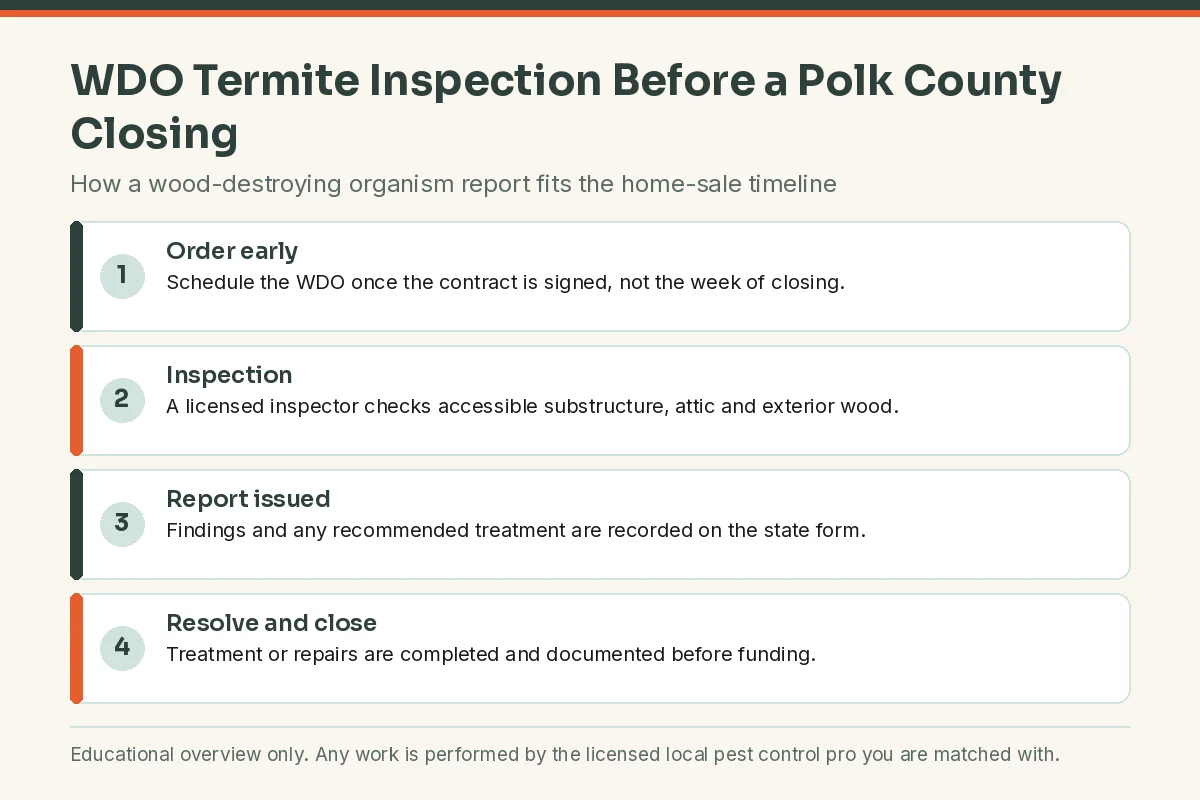
Here is the typical sequence once a finding shows up on the WDO report, from initial finding to a cleared file the lender can accept:
- For active infestation, a licensed local exterminator proposes a treatment plan matched to the species involved — subterranean termite treatments and drywood termite treatments are handled very differently.
- Treatment is performed by the licensed operator.
- A re-inspection or clearance letter confirms no current activity remains.
- The cleared report goes back to the buyer, seller, both agents, and the lender so closing can proceed.
Conducive conditions alone usually skip straight to a repair — regrading soil, trimming wood contact, redirecting a downspout — with a follow-up note added to the file rather than a full pest treatment.
Step 6 of 6
Get Ready for Your Inspection
Whether you’re the buyer or the seller arranging access, these steps clear the way for an accurate, efficient inspection. Check off what applies — your progress is saved on this device.
0 of 8 ready
Why Polk County WDO Inspections Look the Way They Do
Subterranean pressure, year-round
Eastern subterranean and established Formosan colonies stay active in Polk County soil twelve months a year — there is no off-season for the inspection to time around.
Sandy soil, humid air
Ridge sand drains fast on the surface, but sustained Central Florida humidity keeps crawlspaces and slab edges wetter than the ground looks — exactly what moisture meters are checking for.
Lakefront moisture
Lakeland sits on 38 named lakes inside city limits. Homes near Lake Hollingsworth, Lake Mirror, Lake Morton and Lake Parker typically carry higher ambient moisture than the county baseline.
Older housing stock
Pre-1960 neighborhoods like Dixieland, Cleveland Heights and the Garden District were framed in cypress and pine on pier-and-beam foundations — original construction that termites still treat as an easy target decades later.
WDO Inspection Questions, Answered Straight
What is a termite bond?
A termite bond is an ongoing service agreement with a licensed pest control company that provides periodic reinspection and, typically, retreatment coverage if termites return, for as long as the bond is kept active and renewed. Terms and coverage vary by company, so review the actual paperwork rather than assuming.
What’s the difference between active termite damage and old damage on a WDO report?
Active evidence means live insects, fresh mud tubes with moisture, or frass currently being produced at the time of inspection. Old damage means the wood shows galleries or damage from a past infestation, but the inspector found no current activity. The distinction changes what usually needs to happen next — treatment versus disclosure and repair.
Does a WDO inspection cover the whole property?
Typically it covers the accessible areas of the main dwelling. Detached structures — sheds, guest houses, detached garages — are sometimes inspected separately or noted as excluded from the report, so confirm the scope with whoever schedules the inspection before it happens.
Ready for your WDO inspection? Get matched by ZIP.
Free to get matched. The licensed local inspector or exterminator gives the quote.
Free to get matched. The licensed inspector or exterminator gives the quote.
Related reading: WDO Inspection in Lakeland, FL · WDO Termite Report Guide · Is an Annual Termite Bond Worth It? · Polk County Home Pest Prevention Guide · Polk County Termite Swarm Season & Pest Data Reference
General guidance, not a professional inspection. This guide provides general educational information about how the WDO (termite) inspection process typically works for a Polk County, Florida home sale. It is not a substitute for a professional WDO inspection, a real estate contract review, or legal advice, and it does not guarantee any particular finding, timeline, or outcome for your property or transaction.
One call reaches a licensed, local exterminator who covers your address — and a real person answers, 24/7.