Dealing with a pest problem right now?
📞 Call now — get matched with a licensed local exterminator: (888) 295-0220When you call, stay on the line for a few seconds while we match you with the licensed local exterminator for your area. Have your address and a quick description of the problem ready.
Licensed local pros · Fast response, subject to availability · No obligation
June 1 marked the official start of the 2026 Atlantic hurricane season, and Polk County is squarely inside the central Florida corridor that takes the worst of inland storm impacts. While coastal counties focus on wind and surge, Lakeland and the rest of Polk deal with something different — extended power outages, prolonged standing water across the citrus belt and Green Swamp watershed, and the predictable pest migration that follows. If you’ve lived through Charley, Irma, or Ian here, you already know: the pests show up about 48 hours after the wind dies down, and they don’t ask for permission.
For pre-season inspections or post-storm response, call the dispatch line to be connected with an FDACS-licensed pest control operator covering Polk County.
Why hurricane season changes everything for Polk County pests
Three things happen during and after a storm that drive pest pressure:
- Standing water expands — Pools that didn’t exist in dry season become Culex breeding sites in days. Lake margins flood inland and don’t recede for weeks. Citrus groves and the Green Swamp hold water far longer than residential drainage allows.
- Habitat is destroyed — Rats and roaches lose attic, garage, and outdoor harborage when trees blow down and structures are damaged. They migrate inward, into homes that previously had no problem. This same pre-storm migration pattern is well-documented for rodents specifically — see why Polk County rodent activity migrates indoors before storms for the barometric-pressure and habitat mechanics behind it.
- Power outages disable AC — Florida humidity inside an un-air-conditioned home creates ideal conditions for German cockroaches, mold, and the silverfish-and-booklice secondary pests that follow.
The result is predictable: termite swarm activity spikes 7-14 days after a major storm because saturated soil drives subterranean colonies surfaceward; rodent intrusion calls double in the two weeks after a storm; mosquito pressure stays elevated for 3-6 weeks; and roach activity can persist for months in homes that had no prior issue.
Pre-storm pest prep (do these BEFORE the first named storm)
This checklist is most useful done in the calm of June or early July, before a system is in the forecast cone. Once a storm is 72 hours out, do what you can — but the prep below works well when you have a week.
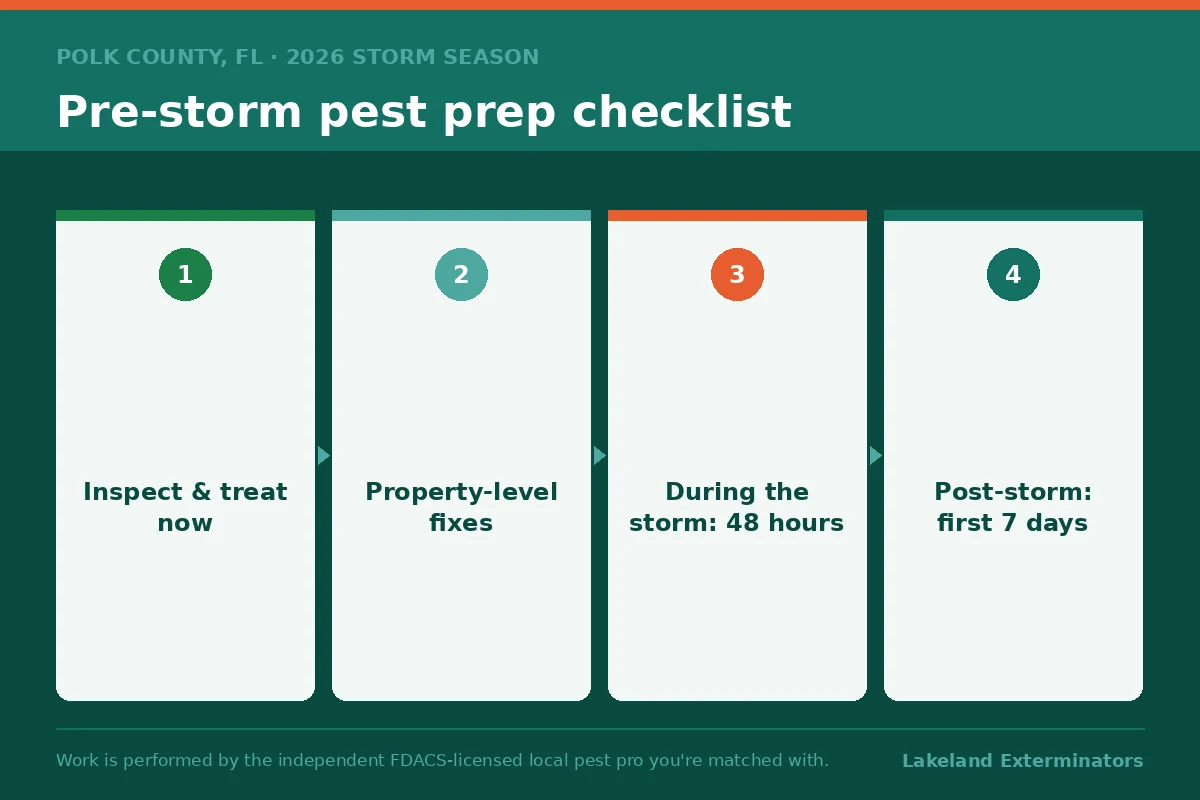
Inspect & treat now
- Termite bond confirmation — If you have a Sentricon or Termidor bond, verify it’s current and your annual inspection is recent. Post-storm is when termite swarms hit, and you’ll want documentation of the bond if damage occurs. Annual termite bond cost-benefit.
- WDO inspection if not done in 12 months — Catch active termite activity before water pushes colonies further. WDO inspection — Lakeland.
- Quarterly perimeter treatment scheduled — If you’re on quarterly, time the next visit for the late-June or early-July slot so residual is fresh going into peak storm season.
- Mosquito perimeter active by Memorial Day — Storm-water mosquito populations build on top of whatever’s already there. A monthly perimeter starting in May means you start the storm threshold with low population, not high. Mosquito control — Lakeland.
Property-level fixes
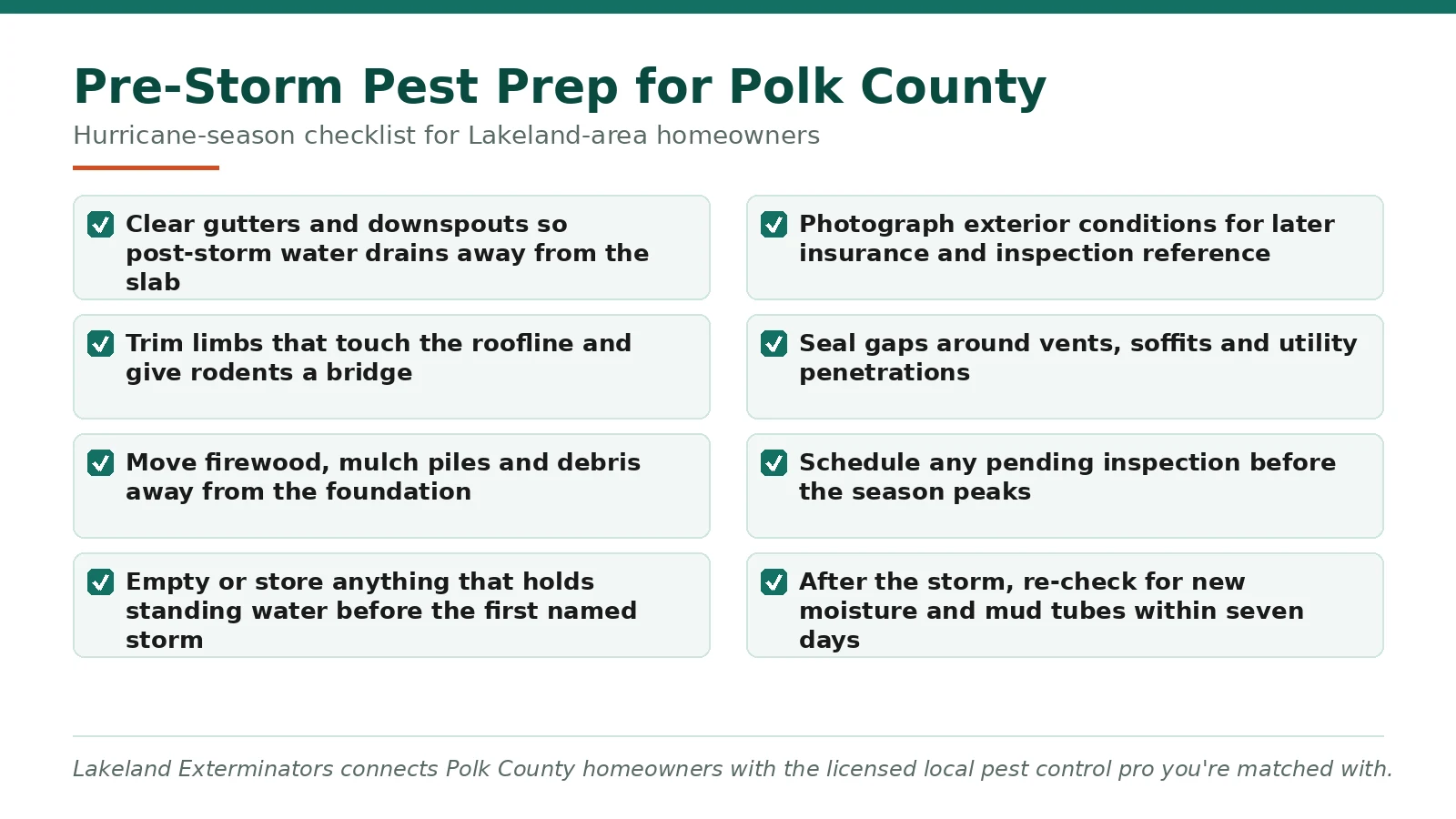
- Walk the perimeter and identify mulch within 18 inches of slab — Replace with lava rock or river stone. Wet organic mulch against a Florida slab post-storm is termite and roach paradise.
- Trim trees touching or within 6 feet of roof — Tile roofs in Polk County are especially vulnerable to roof rats using overhanging branches as entry. Storm damage opens new entry points. Roof rats — Polk County.
- Clean gutters — Clogged gutters become mosquito habitat the second they hold water. They also overflow during heavy rain and saturate the soil at the foundation.
- Check garage door bottom seal — Storm wind drives water and pests through worn seals. Replace if light is visible.
- Verify weep holes are clear — Block construction in Lakeland uses weep holes for moisture release. If they’re caulked or blocked, post-storm humidity has nowhere to escape.
Inside the house
- Check water-supply line penetrations under sinks — Caulk any visible gaps. These are highway routes for German cockroaches after a power outage.
- Verify attic vents are screened — 1/4″ hardware cloth, not standard window screen. Post-storm bat and rodent entry happens here.
- Inventory non-perishable food storage in airtight containers — Pantry moth and weevil pressure increases dramatically in unconditioned post-storm homes.
- Locate your power-outage food plan — Coolers staged with ice; non-perishable shelf elevated and sealed.
During the storm (48-hour window)
There’s not much pest-related work to do during the storm itself — focus on safety and water management. But if conditions allow:
- Move outdoor trash to a sealed location (storm-driven garbage scatter is a 72-hour pest magnet).
- Bring potted plants inside if possible (bromeliads and any plant saucers are mosquito incubators when refilled by storm water).
- Cover pool with the pool cover if you have one (otherwise refilling pool water becomes peak mosquito habitat).
Post-storm checklist (the first 7 days)
Most pest issues triggered by a storm show up in this window. Run through this list in the first week after the wind dies.
Day 1-2 (as soon as safe)
- Walk the entire structure perimeter — Look for new entry points: roof tiles missing, soffit damage, fence-line tree damage opening migration paths.
- Empty every standing-water container — Pots, buckets, tarps, kiddie pools, wheelbarrows. Anything refilled by the storm becomes Aedes breeding habitat in 4-6 days.
- Check the attic — Storm winds drive rodents and bats in through any damaged vent or eave. Hearing scratching at night = inspect now.
- Check crawlspaces — Water intrusion creates roach and silverfish bloom conditions.
Day 3-7
- Inspect for termite swarmers indoors — Saturated soil drives subterranean termites to surface. Swarms within 7-14 days post-storm are common in Polk County. White wings on windowsills = call immediately. Termite treatment — Lakeland.
- Mosquito perimeter retreat if last service was 21+ days ago — Storm-water population takes 7-10 days to mature. Retreat the perimeter before the new generation emerges.
- Bait gel renewal in kitchen and bath if roach activity visible — Power outage roach populations build fast.
- Rodent exclusion check — Any new structural damage = new rodent access. Rodent exclusion — Lakeland.
Day 7-30
- Schedule full WDO inspection if you saw any swarmers — Even one wing is worth a follow-up.
- Resume normal pest control rotation — Don’t let the storm disruption push you off your schedule. Quarterly vs monthly.
- Document damage with photos — For insurance and for pest professionals diagnosing entry points.
Pricing during hurricane season
Pre-storm pest service in Polk County runs the normal monthly/quarterly rates. Post-storm specialty calls — debris-driven WDO follow-up, emergency rodent exclusion, restaurant compliance work after a power outage — typically run 10-25% higher than off-season pricing because demand surges and companies work extended hours. Pre-storm pricing locked in via a quarterly contract avoids the post-storm premium.
Realistic Polk County 2026 ranges for storm-related pest service:
| Service | Relative Cost Level | Notes |
|---|---|---|
| Pre-storm perimeter treatment | Lowest | Standard quarterly visit |
| Post-storm mosquito retreat | Lowest | Above scheduled service |
| Post-storm rodent exclusion | Highest (damage-dependent) | Depends on damage |
| Termite swarm follow-up inspection | Lowest | Standalone WDO |
| Emergency German roach reset | Moderate | Multi-visit program |
| Restaurant emergency compliance | Moderate-to-high | Documentation included |
See the pest control complete guide and the hurricane recovery pest checklist for more.
Frequently asked questions
Do termites really swarm after hurricanes? Yes. Saturated soil drives subterranean termite colonies surfaceward, and the warm humid post-storm air mirrors the conditions that normally trigger spring swarms. Post-storm swarms within 7-14 days are documented in Polk County, especially after slow-moving systems that drop 4+ inches of rain.
Should I cancel pest control before a hurricane? No. Pre-storm treatment with active residual is more valuable than waiting until after the storm. Skipping the late-June or early-July perimeter visit leaves you with no residual when peak storm activity hits in August-September.
How long do post-storm mosquito problems last in Polk County? 3-6 weeks for the initial wave, longer if Polk receives a second storm in the same window. Areas adjacent to the Green Swamp and the citrus corridor typically see longer-tail pressure because those watersheds hold water far longer than residential drainage.
Is hurricane prep work covered by my termite bond? Most bonds cover the inspection and retreatment for subterranean termite activity, including post-storm activity. They do not typically cover storm-damaged wood or drywood termite activity. Review your bond document for specifics or ask the operator to walk you through it.
Should I evacuate roaches with a fogger before a hurricane? No. Foggers push roaches into wall voids where they can’t be reached for treatment. If you have a roach problem heading into hurricane season, get a proper IGR + bait gel program in place by mid-June. See roach extermination — Lakeland.
Next steps
One call reaches a licensed, local exterminator who covers your address — and a real person answers, 24/7.
Related Polk County storm + pest reading:
- Hurricane pest prep — Polk County
- Hurricane recovery pest checklist — Polk County
- Polk County pest pressure overview
- WDO inspection — Lakeland
- Mosquito control — Lakeland
- Pest control complete guide — Lakeland
One call reaches a licensed, local exterminator who covers your address — and a real person answers, 24/7.
Disclaimer: Lakeland Exterminators is a local dispatch and referral service, not a licensed pest-control operator. We connect Polk County, Florida homeowners with independent, FDACS-licensed and insured pest-control companies. All inspections and treatments are performed by those independent providers, who set their own pricing, scheduling, and service terms.
Any reference to same-day, emergency, or 24/7 service describes the typical scheduling of matched independent providers and is not guaranteed; actual response times vary by provider, season, location, and demand.