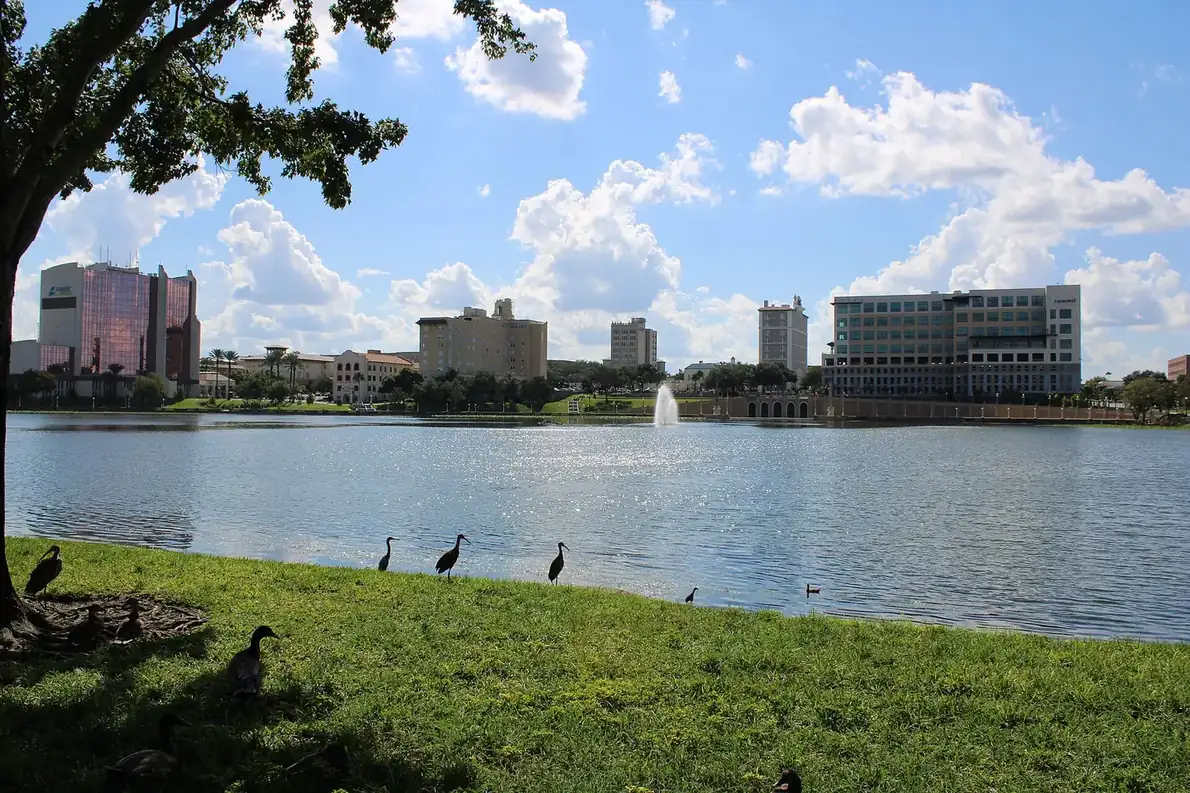
Ants on the counter, roaches at the slider, mud tubes on the slab? Get matched with a licensed Lakeland pest pro.
Look, here’s the deal: Lakeland doesn’t really get an off-season. Between the sand ridge under our feet, the Chain of Lakes humidity, and eight months of afternoon storms, something is always looking for a way inside. This guide tells you what you’re actually dealing with — and one ZIP routes you to a licensed Polk County operator who can handle it.
Talk to a licensed exterminator now
Call and we’ll connect you with a licensed, local exterminator who covers your address. It takes about two minutes, and a real person answers.
Free to call. Free to get matched. The licensed operator gives the quote.
24/7 line · A real person answers · Availability of same-day and emergency service depends on the provider.
Start here: name what you’re seeing, and we’ll point you at the right pro
Most people land on a page like this after a specific, unpleasant moment. A trail of ants behind the coffee maker. Something the size of a matchbox skittering across the lanai at 10pm. A pile of what looks like sawdust that isn’t sawdust. Skip the guesswork — find your symptom below and go straight to the guide that covers it.
Discarded wings or mud tubes
Pencil-width dirt tunnels running up a block wall, or a little pile of translucent wings on a windowsill after a warm rain. That’s subterranean termite behavior, and it’s the one thing on this page that eats your equity while you sleep.
Termite control in Lakeland →Ant trails that come back
Kill the trail, it reappears in two days three feet to the left. That usually means a satellite colony, not a stray forager — and Florida carpenter ants in particular nest in damp wood you can’t see.
Ant control in Lakeland →Roaches after dark
Big, glossy, flies-at-your-head roaches are usually palmetto bugs coming in from the mulch. Small tan ones on the counter at 2am are German cockroaches — a completely different problem with a completely different fix.
Roach extermination →Scratching overhead at dusk
Roof rats run the palm fronds and oak limbs into the soffit line. If the noise starts right around sunset and tracks across the ceiling, it’s rodents, and trapping alone won’t end it.
Rodent control in Lakeland →Webs in every corner
Spiders are a symptom as much as a pest — they show up where there’s something to eat. Heavy webbing around the garage and porch lights usually means the insect population outside got ahead of you.
Spider control in Lakeland →Not sure which bucket you’re in? That’s normal, and it’s fine. Put your ZIP in and describe what you’re seeing — sorting it out is the coordinator’s job, not yours.
Why Lakeland runs hot for pests all twelve months
Plenty of Florida cities are humid. Lakeland stacks a few things on top of that, and the combination is why neighbors who moved here from Jacksonville or the Panhandle swear it’s worse. It kind of is.
Sandy, well-drained ridge soil
Lakeland sits on the western shoulder of the Lake Wales Ridge. The soil is sandy and drains fast, which is exactly the substrate Eastern subterranean termites like to tunnel through. Sand is easy to move, holds moisture at depth, and lets a colony forage a long way from the nest without ever surfacing where you’d notice.
Water on every side
Lake Hollingsworth, Lake Morton, Lake Parker, Lake Bonny, Scott Lake — you’re rarely more than a few minutes from open water, and the Green Swamp sits just north of town feeding groundwater year-round. That means relative humidity stays high enough, long enough, that moisture-loving pests never get knocked back the way they do in a cold, dry climate.
June through September, it rains almost every afternoon
The daily storm cycle is the single most reliable predictor of a summer pest call. Heavy rain floods the top few inches of soil, and everything living in it — ants, roaches, crickets, millipedes — moves uphill and inward. Your slab is uphill. That’s the whole mechanism.
Grove edges and old fence lines
Drive ten minutes east or south of the city and you hit citrus. Plenty of subdivisions in Highland City, Mulberry, and out toward Auburndale share a fence line with an active or long-abandoned grove. Those edges are reservoirs — undisturbed ground cover, rotting wood, deep leaf litter — and pressure bleeds off them into the nearest yard.
A lot of Lakeland housing stock is 1970s–1980s slab
Slab-on-grade construction from that era typically means plumbing penetrations that were never properly sealed, expansion joints that have opened up, and stucco that stops short of grade. Each of those is a doorway. Newer builds in South Lakeland and Christina are tighter, but they get pressure from freshly disturbed soil and new landscaping instead. Nobody gets a free pass.
The Polk County pest calendar — what’s moving, and when
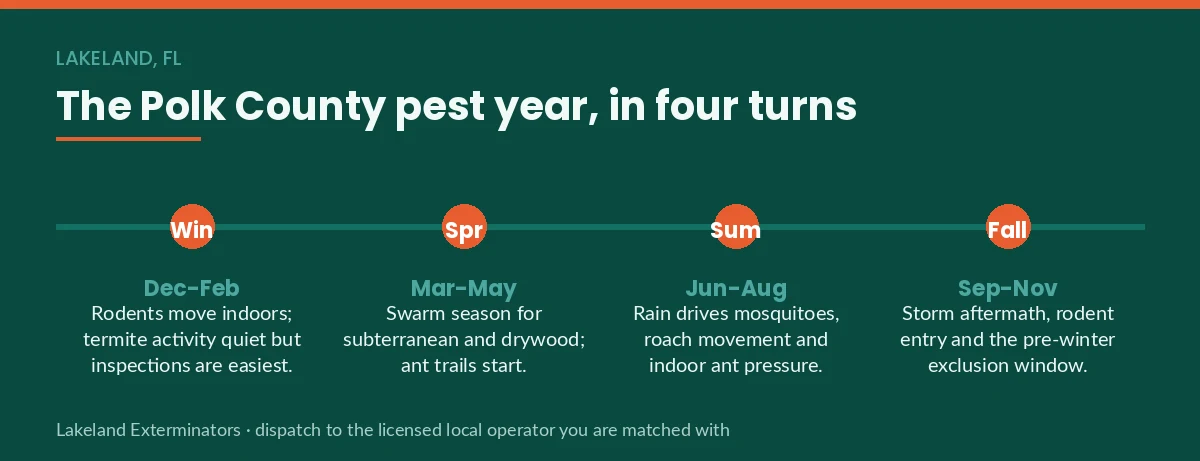
Pest pressure here is seasonal, but it’s never zero. Knowing what’s active this month tells you whether what you’re seeing is normal-for-February or genuinely a problem.
| Window | What’s moving | Why, in Lakeland terms | Smart move |
|---|---|---|---|
| Feb–May | Eastern subterranean termite swarms | The classic trigger is a warm afternoon a day or two after rain. Winged swarmers pour out, fly badly, drop their wings, and die on your windowsills. | Wings indoors mean a mature colony is already established nearby. Get a licensed inspector on it, not a can of spray. |
| Late spring | Formosan subterranean termites | These swarm on humid evenings and are drawn to porch and landscape lighting. Bigger colonies, faster damage than natives. | If your swarm happened at night around lights, say so — it changes the treatment conversation. |
| May–Aug | Drywood termites | They don’t need soil contact at all. They fly straight into attic vents, fascia, and window frames, and the first sign is usually tiny pellets on a sill. | Pellets that look like coarse pepper or sawdust are frass. Bag a sample — it helps identification. |
| Jun–Sep | Ants and roaches, indoors, constantly | Every afternoon storm pushes ground-dwelling insects out of saturated soil and toward dry structure. | This is the season a maintained perimeter earns its keep. Reactive spraying loses to the rain cycle. |
| Jul–Sep | Palmetto bugs on the lanai | Mulch beds, irrigation, and leaf litter against the foundation are a five-star hotel. They come in under thresholds and through weep holes. | Pull mulch back from the slab. It’s free and it works better than most people expect. |
| Oct–Feb | Roof rats and mice | First cool nights send rodents looking for a warm void. Oak limbs and palm fronds are the highway; the soffit gap is the front door. | Trim branches back from the roofline and get entry points sealed. Trapping without exclusion is a treadmill. |
| Year-round | Silverfish, earwigs, centipedes, millipedes, crickets | Humidity specialists. They live in the damp margin where your landscaping meets your foundation and wander in by accident. | Usually a moisture and harborage problem, not an infestation. Fix the damp, and they mostly go away. |
Want the month-by-month detail? The March, June, September, and December guides break down each season on its own. And if a storm has just come through, the hurricane recovery pest checklist is worth ten minutes — displaced rodent and roach populations relocate fast after flooding.
Not sure what you’re looking at?
Describe it to a coordinator. They’ll route you to a Polk County operator licensed for that specific category.
Talk to a licensed exterminator now
Call and we’ll connect you with a licensed, local exterminator who covers your address. It takes about two minutes, and a real person answers.
Free to call. Free to get matched. The licensed operator gives the quote.
The species that actually show up in Lakeland houses
Forget the generic pest list you’d get anywhere in America. Here’s what genuinely walks into Polk County homes, and what each one is really telling you.
Ants — the number-one call, all year
Lakeland gets several distinct nuisance ants and they behave nothing alike. Florida carpenter ants are the big ones you see at night, and they nest in wood that got wet — around a leaking window, under a rotted fascia board, in the wet framing behind a failed shower pan. Ghost ants are tiny with pale legs, love kitchens and bathrooms, and famously split their colony when you spray them, which is how one trail becomes six. White-footed ants ignore most baits entirely. Fire ants build mounds in every sunny lawn in Polk County and are a genuine hazard for kids and pets.
The practical point: correct identification changes the entire treatment. Baiting the wrong ant makes things worse. The ant control guide goes species by species.
Cockroaches — two totally different problems wearing the same name
The huge, shiny, occasionally-airborne roach on your lanai is almost certainly a palmetto bug — an American or Florida woods cockroach that lives outdoors in mulch, palm boots, and leaf litter, and comes inside by accident. Unpleasant, not a sanitation verdict.
The small tan roach with two dark stripes behind its head, running across the counter when you flip the light on, is a German cockroach. That one lives and breeds indoors, multiplies fast, and does not resolve on its own. Different species, different biology, different plan. Don’t let anyone treat them the same.
Termites — the expensive one
Polk County carries an unusual double burden: heavy Eastern subterranean pressure in the sandy western half, and steady drywood activity through the citrus corridor to the east. Subterraneans come up from the soil and build the mud tubes; drywoods fly in and colonize wood directly, no ground contact needed; Formosans are the aggressive subterranean cousin that swarms at night toward lights.
Each has its own guide: Eastern subterranean, Formosan, and Florida drywood. If you only skim one section on this page, make it this one — termites are the only pest here that quietly removes value from your house.
Rodents — roof rats first, mice second
In Lakeland, “rats in the attic” almost always means roof rats. They’re agile climbers, they travel the tree canopy, and they exploit the gap where the soffit meets the fascia. House mice turn up in garages, kitchen voids, and under dishwashers. Both leave droppings, gnaw wiring, and contaminate insulation.
Here’s the part most people learn the hard way: trapping is the easy half. Without exclusion work — physically sealing the entry points — you’re just harvesting an infinite supply. Full rodent control guide here.
Spiders — mostly a signal, not the disease
Spiders show up where there’s prey. Heavy webbing around the porch, garage, and soffit corners usually means the insect population outside is thriving. Most Lakeland spiders are harmless and genuinely useful. The two worth respecting are widows (glossy black, red hourglass, likes undisturbed garages, meter boxes, and patio furniture you haven’t moved in a while) and recluses, which are far rarer here than the internet suggests.
The quiet crew nobody warns you about
- Silverfish — teardrop-shaped, metallic, fast. They eat starch: book bindings, wallpaper paste, cardboard in a humid garage. A silverfish problem is a humidity problem.
- Earwigs — the pincers are harmless. They live in damp mulch and turn up in bathrooms and laundry rooms after heavy rain.
- Centipedes and millipedes — millipedes migrate in absurd numbers after the summer storms and die in your garage. Centipedes are predators and go where the other bugs are. Both are moisture stories.
- House crickets — loud, harmless, and a reliable sign that the garage door sweep has given up.
- Clothes moths — rare but real, and they do actual damage to wool and natural fibers stored in a hot, still closet.
None of these are emergencies. All of them are telling you something about moisture, harborage, or a gap in the building envelope.
How the dispatch actually works
We’ll be straight with you about what this site is, because a lot of pest sites aren’t. Lakeland Exterminators is a dispatch and matching service. We don’t treat houses. We connect you with FDACS-licensed operators who do.
You give us a ZIP
That’s the whole ask. No forms about your household income, no six-page questionnaire. The ZIP tells the coordinator which operators actually cover your address.
A coordinator calls you back
A real person, on a line that’s staffed around the clock. You describe what you’re seeing. They ask a few clarifying questions — wings or no wings, day or night, one room or the whole house.
You get routed to the right license category
Florida licenses pest work by category. A general household pest license does not cover termite work. Matching your problem to the right licensed operator is the entire point of the call.
The operator inspects and quotes
From there it’s between you and them. They inspect, they price it, they warranty it, they schedule it. We aren’t in that conversation, and we don’t take a cut of what you pay them.
Free to call. Free to get matched. The licensed operator gives the quote. Availability of same-day and emergency service depends on the provider.
Check the license before you let anyone in your house
This is the part of the process people skip, and it’s the part that protects you. Under Chapter 482, Florida Statutes, every business performing pest control in Florida must hold a license issued by the Florida Department of Agriculture and Consumer Services (FDACS). Not a preference. A legal requirement.
Licenses are issued by category, and the categories matter more than most homeowners realize:
- General Household Pest — ants, roaches, rodents, spiders, the everyday crawling stuff.
- Termite & Other Wood-Destroying Organisms — termites, wood-boring beetles, wood decay fungi. This is the category that can issue a WDO report.
- Lawn & Ornamental — turf and landscape plant pests. A different exam entirely.
- Fumigation — whole-structure tenting. Narrow, heavily regulated, and separately certified.
An operator can be perfectly legitimate in one category and completely unlicensed to do the work you actually need. So ask which category they hold for your job — then go check it yourself. Every license in Florida is public and searchable at the FDACS license search. It takes about ninety seconds.
If anyone gets cagey when you ask for a license number, that’s your answer. Walk. Our full FDACS licensing explainer covers the categories and what each one legally permits.
What Polk County operators typically quote — and what moves the number
We’re not going to print a price, because we don’t set one and anyone who quotes you a firm figure before seeing your house is guessing. What we can do is tell you honestly what drives the number, so you can read a proposal and know whether it’s reasonable.
What pushes a quote up
- Linear footage and square footage. Perimeter work is priced off the outside of the structure. A sprawling ranch costs more to treat than a compact two-story with the same interior space.
- How far it’s gone. A first-week German cockroach sighting and an established kitchen population are different jobs with different visit counts.
- Access. A tight crawl-height attic, a screened enclosure over the slab line, or dense landscaping against the foundation all add labor.
- Construction type. Slab-on-grade, stem wall, and pier-and-beam each demand different termite treatment approaches, and the material cost differs a lot.
- Warranty and bond terms. A renewable termite bond with a repair provision prices differently from a one-time treatment with no ongoing coverage. Both are legitimate. Know which one you’re buying.
What tends to bring it down
- Ongoing plans beat emergency calls. A maintained quarterly perimeter is generally less expensive over a year than three panic visits.
- Doing the free stuff yourself. Pulling mulch off the slab, fixing the leaking hose bibb, trimming the oak limb off the roofline, replacing the garage door sweep. None of that costs money, and all of it reduces the work the operator has to price for.
- Catching it early. Obvious, but worth saying: the least expensive termite job in Polk County is the one that starts the week you find the tubes, not the year you find the damage.
For the full breakdown of how Polk County pricing is structured, see the pest control cost guide and the termite treatment cost guide. If you’re weighing an annual bond, this one is worth reading before you sign. And whatever you do, run through the questions to ask before you hire anyone.
One more honest note: whether you go with a national brand or a local independent is a real tradeoff, not a slam dunk. We laid it out plainly in the national-versus-local comparison.
Pressure changes by neighborhood — here’s roughly how
Lakeland isn’t one pest environment. It’s several, and they’re maybe fifteen minutes apart.
Dixieland, Lake Morton & the Garden District
Older homes, mature oak canopy, plenty of original wood trim and crawl space. This is roof rat and termite country. The tree cover that makes these streets gorgeous is also a rodent highway straight to the roofline.
Lake Hollingsworth & Cleveland Heights
Water on one side, established landscaping everywhere else. Consistently damp margins around foundations mean steady palmetto bug, silverfish, and millipede pressure through the summer.
South Lakeland, Grasslands & Christina
Newer slab construction and irrigated turf. Tighter envelopes, but freshly disturbed sandy soil plus new landscaping is prime subterranean termite and fire ant territory.
North Lakeland & the I-4 corridor
A mix of older stock and new development, plus commercial and warehouse activity. Rodent pressure runs higher near distribution and food-service buildings than most homeowners expect.
Highland City & Kathleen
Grove edges, pasture, and larger lots. Ants, roaches, and rodents migrate off undisturbed ground cover the moment it’s cleared, mowed, or built on.
Beyond the city limits
The same operators cover the county. See South Lakeland, North Lakeland, Winter Haven, Bartow, Mulberry, Plant City, or the countywide Polk County hub.
Pest control questions Lakeland homeowners actually ask
Is Lakeland really worse for pests than the rest of Florida?
It’s a genuinely high-pressure zone, yes. Polk County carries heavy Eastern subterranean termite pressure in its sandy western half and steady drywood termite activity through the citrus corridor to the east — carrying both at once is not typical. Add year-round humidity from the Chain of Lakes and the Green Swamp, plus a summer storm cycle that drives ground insects indoors almost daily from June through September, and the year-round pressure is real. You’re not imagining it.
How do I know if it’s termites or just flying ants?
Look at three things. Termite swarmers have two pairs of wings the same length; flying ants have a longer front pair. Termites have a straight, thick waist; ants are pinched in the middle. Termite antennae are straight and beaded; ant antennae are elbowed. Easiest tell of all: termite swarmers shed their wings almost immediately, so a pile of loose wings on a windowsill is a strong signal. If you find wings, bag a few and show the inspector.
Are those giant roaches on my lanai a sign my house is dirty?
No. Big glossy roaches in Lakeland are typically palmetto bugs — American or Florida woods cockroaches that live outdoors in mulch, palm boots, and leaf litter and wander in through a gap. They’re a landscaping-and-thresholds issue, not a sanitation verdict. Small tan German cockroaches on your kitchen counter are the ones that indicate an indoor breeding population, and those do need a real plan.
Why does trapping never seem to end my rat problem?
Because trapping removes the rats that are already inside; it doesn’t remove the way in. Roof rats travel the tree canopy and enter at the soffit-fascia gap, around roof penetrations, or through a torn vent screen. Until those openings are physically sealed — that’s the exclusion work — you’re just making room for the next one. Trim limbs back from the roofline and seal the envelope, then trap.
How do I verify a pest control company is licensed in Florida?
Ask for the license number, then check it yourself in the public FDACS database at aessearch.fdacs.gov. Confirm two things: that the license is active, and that it covers the right category for your job. A General Household Pest license does not authorize termite work. Under Chapter 482, Florida Statutes, licensure isn’t optional — if someone won’t give you a number, that tells you what you need to know.
What does pest control cost in Lakeland?
We don’t set prices and we won’t pretend to. The licensed operator quotes the job after inspecting your property, because the number depends on your square footage, construction type, how far the problem has progressed, access, and whether you want an ongoing plan or a one-time treatment. What we can tell you is what drives the figure up and down — that’s covered in the Lakeland pest control cost guide. Getting matched costs nothing.
Can I just handle this myself with store-bought products?
For some things, honestly, yes — a few crickets, the occasional millipede after a storm, silverfish in a humid garage. Fix the moisture and seal the gaps and you’re usually done. For others, DIY actively backfires: spraying ghost ants can split the colony into several, and no consumer product on a shelf addresses a subterranean termite colony living in the soil under your slab. We drew the line honestly in DIY vs. professional pest control.
Is there anything I should do before the operator arrives?
Three things help a lot. Take photos of what you saw, especially if it’s gone by the time they arrive. Save a physical sample — wings, pellets, a dead specimen in a ziplock — because identification drives everything. And clear access to the areas that matter: the attic hatch, the water heater closet, under the sinks, and the perimeter of the slab. Ten minutes of prep can save an entire follow-up visit.
One ZIP. One call back. A licensed Polk County operator.
You don’t have to diagnose it yourself. That’s the whole point of the call.
Talk to a licensed exterminator now
Call and we’ll connect you with a licensed, local exterminator who covers your address. It takes about two minutes, and a real person answers.
Free to call. Free to get matched. The licensed operator gives the quote.
Disclosure
Lakeland Exterminators is a dispatch and matching service. We connect Polk County callers with FDACS-licensed pest control operators. We are not a licensed pest control operator. We do not perform treatment, set prices, issue warranties, hold bonds, or carry pest control trade insurance. All pricing, scheduling, treatment plans, warranties and service terms are determined by the FDACS-licensed operator dispatched to your address under Chapter 482, Florida Statutes.
Same-day and 24/7 emergency services are subject to provider participation, location, technician availability, and demand. Availability is not guaranteed and may vary by market and appointment capacity.
License status of any operator you connect with is publicly verifiable at the FDACS license search.