Raised ridges snaking across the St. Augustine? That’s a mole — and the lawn is losing.
One call reaches a licensed, local exterminator who covers your address — and a real person answers, 24/7.
Talk to a licensed exterminator now
Call and we’ll connect you with a licensed, local exterminator who covers your address. It takes about two minutes, and a real person answers.
Note: this line is for mole and lawn-wildlife issues specifically. If your issue is ants, roaches, termites, rodents indoors, or other general household pests, use our main pest match instead.
Free to get matched. The licensed operator gives the quote.
A real person answers · Availability of same-day service depends on the provider.
Why a St. Augustine lawn is prime mole territory in Polk County
If you have walked out to a Lakeland yard after a few days of rain and found raised, spongy ridges snaking across the St. Augustine, or a scattering of small volcano-shaped mounds near the flower beds, you are most likely looking at eastern mole activity — not a rodent problem. Moles are insectivores, not rodents. They are not after your grass, your bulbs, or anything in your pantry. They are tunneling through Polk County’s sandy topsoil hunting earthworms, grubs and other soil insects, and the well-irrigated, grub-supporting lawns common across Lakeland subdivisions make excellent hunting ground.
The damage homeowners see is a side effect of that hunting, not intentional destruction — but it is real damage all the same. Raised tunnel ridges lift turf roots out of contact with the soil, the grass above dies in lines, and repeated tunneling through Central Florida’s long growing season can leave a yard looking like it has been through a series of small earthquakes.
Three local facts working against your lawn
- Sandy soil. The Astatula, Candler and Tavares soil series that underlie much of Lakeland and the Ridge move like sugar compared to the clay soils further north — a mole can push a surface run through it fast, which is why fresh ridge lines seem to appear overnight.
- Irrigation plus a long growing season. Frequent watering keeps earthworms and white grubs active near the surface nearly year-round. There is no hard winter to knock the food supply back, so there is no off-season for mole pressure either.
- St. Augustine sod. The dominant turf across Polk County subdivisions supports a healthy insect population in its root zone — exactly the buffet that draws a mole to hunt just under the surface where the damage shows.
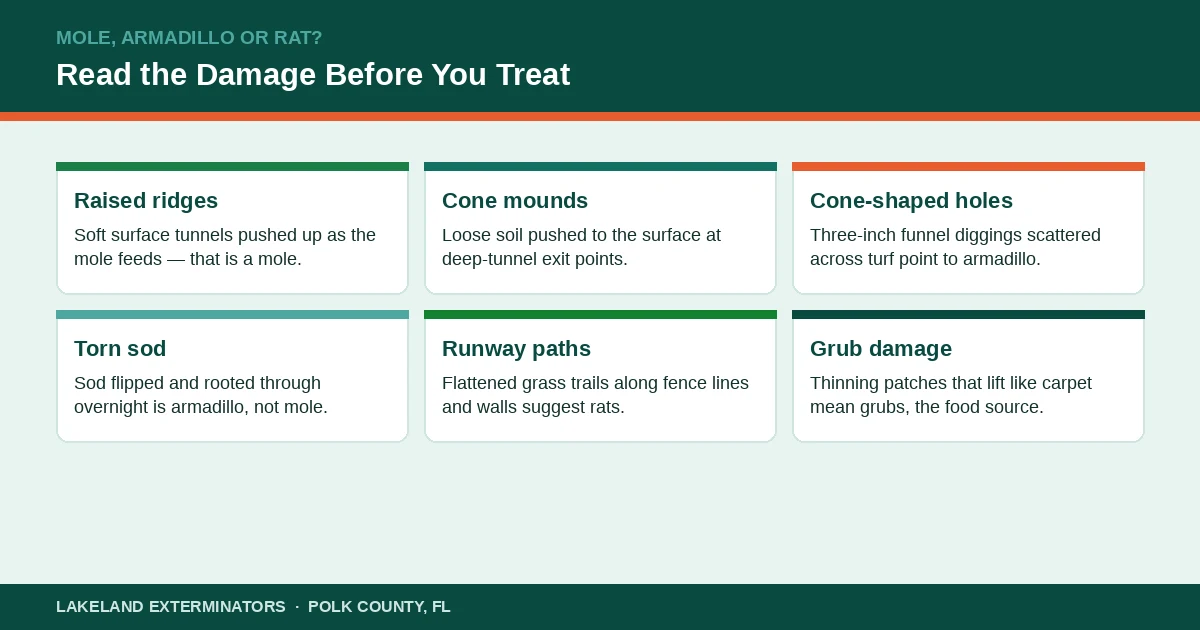
Mole, armadillo or rat? Read the damage before treating anything
Polk County yards take damage from several different animals, the fixes barely overlap, and treating for the wrong one wastes a season. Here is the field guide.
| What you see | What it is | What the fix looks like |
|---|---|---|
| Long raised ridges, spongy underfoot, occasional volcano-shaped mounds | Eastern mole — surface feeding runs with deep tunnels below | Grub control plus professional trap placement on active runs |
| Scattered cone-shaped holes and rooted-up patches, no connected lines | Armadillo rooting for grubs at night | Different animal, different rules — see the armadillo removal guide |
| No turf damage, but noise in the attic or droppings at the soffit line | Roof rats — they do not tunnel lawns at all | Structural work — see rodent exclusion |
| Ridges tracking flower beds, sprinkler lines or the driveway edge | Classic mole signature — easier digging along those edges | Same as mole above; those runs are where traps go |
One more identity check worth making: moles hunt alone. What looks like an invasion is usually one animal working a network of runs — which is why correctly placed traps resolve most yards faster than homeowners expect, and why a whole season of repellent granules resolves nothing.
Fresh ridges this week? That is exactly when trapping succeeds.
One call reaches a licensed, local exterminator who covers your address — and a real person answers, 24/7.
Free to get matched. The licensed operator gives the quote.
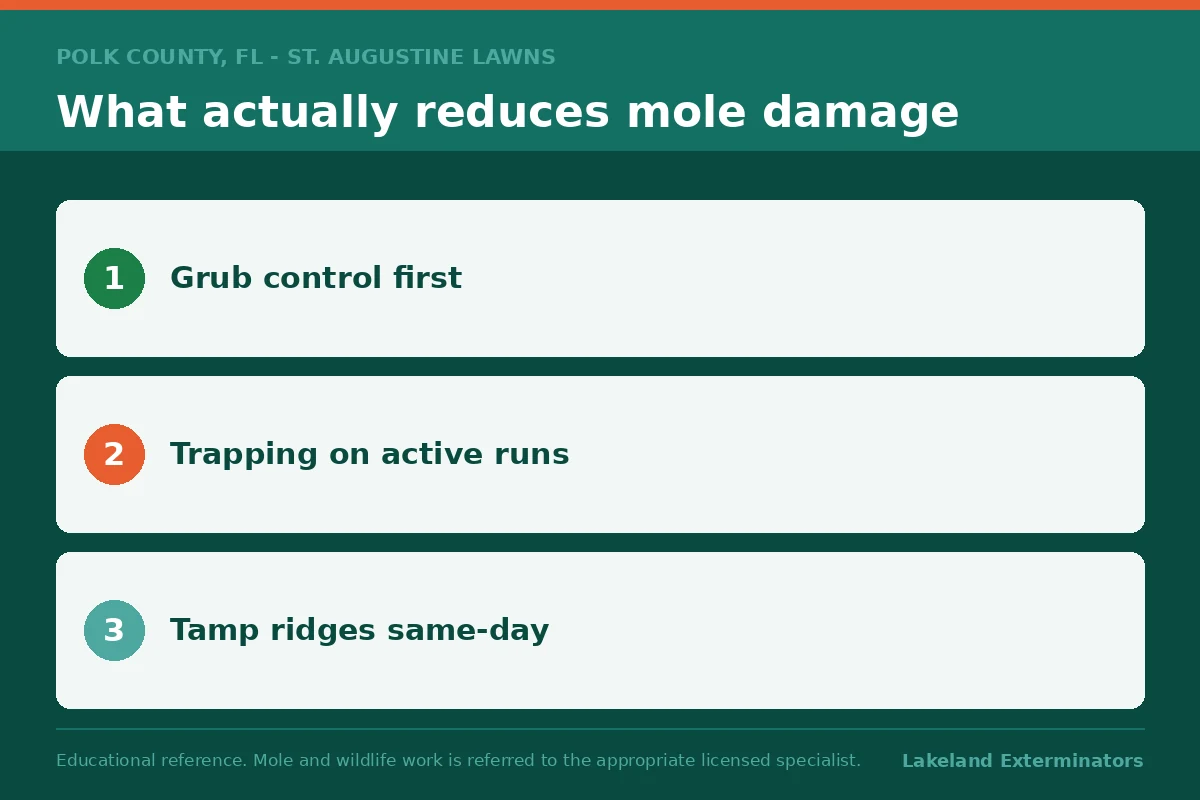
What actually reduces mole damage — and what just moves it around
Because moles are after the food under the lawn rather than the lawn itself, the durable fix addresses what is under the turf. The licensed operator’s playbook has four working parts.
Grub control first
Reducing the white grub population with a properly timed lawn treatment removes much of the incentive for a mole to work your yard at all. In Polk County that timing matters — the operator schedules against the local beetle cycle, not a Midwest calendar.
Trapping on active runs
Trapping is the most reliable direct-removal method for an established mole, and placement is the whole craft: traps go on confirmed active runs, which the operator identifies by flattening a section and seeing what gets re-raised within a day.
Tamp ridges same-day
Pressing fresh ridges back down the day they appear protects turf roots that have not died yet, discourages re-use of the run, and — most usefully — shows the operator exactly which runs are active when they arrive.
Fix the watering pattern
Consistently saturated ground is easier to tunnel and holds more earthworms near the surface. Backing overwatered zones down to what St. Augustine actually needs makes the whole yard a worse hunting ground.
The honest word on repellents
Castor oil granules, vibrating stakes, chewing gum in the runs — University of Florida extension testing puts results for all of them between inconsistent and nil. The common outcome is that activity shifts to an adjacent, untreated stretch of the same yard, which feels like progress for about a week. If a product promises to drive moles out of a lawn without touching the food supply or the animal, Polk County’s soil and grub pressure will win that bet.
What drives the operator’s quote (we never set prices)
- Scope of the grub program — lawn size and whether grub treatment folds into an existing lawn-care schedule or stands alone.
- Trapping effort — number of active runs, return visits to check and reset traps, and how established the animal is.
- Bundling — mole work is usually a lawn/wildlife line item separate from general household pest service; ask the operator how it pairs with any program you already run.
How the dispatch works
Straight up: Lakeland Exterminators is a dispatch and matching service, not a licensed pest control operator. Here is the exact path your request takes.
Describe the damage
Ridges, mounds, how long it has been going on, and how much of the yard is affected. A real person answers.
Your address picks the operator
The request routes to a licensed operator covering your part of Polk County — Lakeland, Winter Haven, Bartow, Lake Wales, the whole county.
On-site inspection
The operator confirms mole vs. armadillo vs. anything else, maps active runs, checks the grub picture and writes the quote. Pricing comes from them, never from us.
Treatment stays with the pro
Grub program, trap placement, return visits and any service terms are owned by the licensed operator.
Verify before you hire — structural pest control in Florida requires an FDACS license under Chapter 482, Florida Statutes, and any company’s license status and history is public at the FDACS license search. Check the operator you are matched with; the good ones expect it.
Lakeland mole questions, answered straight
Are moles rodents? Are they eating my grass or garden plants?
No on both counts. Moles are insectivores — they tunnel through soil hunting earthworms, grubs and soil insects, and they do not eat grass, roots or bulbs. The visible damage is mechanical: the tunneling lifts turf roots away from soil contact, and the grass above the run dies of dehydration. That distinction matters because it is why the durable fix targets the food supply and the animal, not the plants.
How do I tell mole tunnels apart from armadillo digging?
Moles leave long, continuous raised ridges just under the surface, sometimes with a volcano-shaped mound where a run goes deep. Armadillos leave scattered cone-shaped holes and rooted-up patches with no connecting lines, usually overnight. A snaking raised line is a mole; a field of little craters is an armadillo — and the armadillo guide covers that animal’s very different rulebook.
Will getting rid of grubs get rid of the moles?
It removes most of the reason a mole chose your yard, which makes it the strongest long-term move — but it will not guarantee an animal already working the lawn leaves immediately. That is why the standard Polk County approach pairs grub control (removes the draw) with trapping on active runs (removes the animal). Either one alone leaves half the problem in place.
Do castor oil granules or vibrating stakes actually work?
University of Florida extension testing and local field experience both say: inconsistently at best. The typical result is mole activity shifting to a nearby untreated section of the yard rather than leaving it. Money spent on repellents is usually better spent on the grub treatment that changes what the lawn offers a mole in the first place.
Is mole work covered by a standard pest control program?
Usually not — lawn and wildlife services are typically a separate line item from general household pest control, because mole work is grub treatment plus trapping rather than structural or interior treatment. When you are matched, ask the operator whether mole and lawn service bundles with their standard program or is quoted separately. Broader wildlife issues route the same way — the wildlife removal guide covers what licensed operators handle.
Why did the ridges show up right after it rained?
Two reasons stack: saturated sandy soil is easier to push through, and rain drives earthworms and grubs up toward the surface, so the mole follows its food into the top few inches — exactly where tunneling shows as ridges. A day or two after a heavy Polk County rain is the most common time for a yard to “suddenly” look invaded, and also the best window for an operator to read which runs are active.
Will the mole just go away on its own?
Sometimes — a single animal passing through after rain often moves on within days. The signals that it will not: recurring ridges across the same stretches of lawn, multiple active runs at once, or damage spreading section by section. At that point the yard is a established hunting territory, and waiting costs turf you will be re-sodding. That is the moment to make the call.
Every week of tunneling is more sod to replace.
One call reaches a licensed, local exterminator who covers your address — and a real person answers, 24/7.
Free to get matched. The licensed operator gives the quote.
Dealing with animals bigger than a mole? Start with the wildlife removal guide.
Disclosure
Lakeland Exterminators is a dispatch and matching service. We connect Polk County callers with FDACS-licensed structural pest control operators. We are not a licensed pest control operator. We do not perform pest control treatment, set prices, issue warranties, hold retreatment bonds, or carry pest control trade insurance. All pricing, scheduling, treatment plans, warranties, bonds and service terms are determined by the FDACS-licensed operator dispatched to your address under Chapter 482, Florida Statutes.
Same-day and 24/7 emergency services are subject to provider participation, location, technician availability, and demand. Availability is not guaranteed and may vary by market and appointment capacity.
License status of any operator you connect with is publicly verifiable at the FDACS license search.