Two look-alike pests, two very different bugs
Centipedes and millipedes get lumped together constantly in Lakeland homes, mostly because both are long, segmented, many-legged, and show up in the exact same damp corners of a house. But they’re different animals with different habits, and telling them apart actually matters for figuring out what’s driving them indoors.
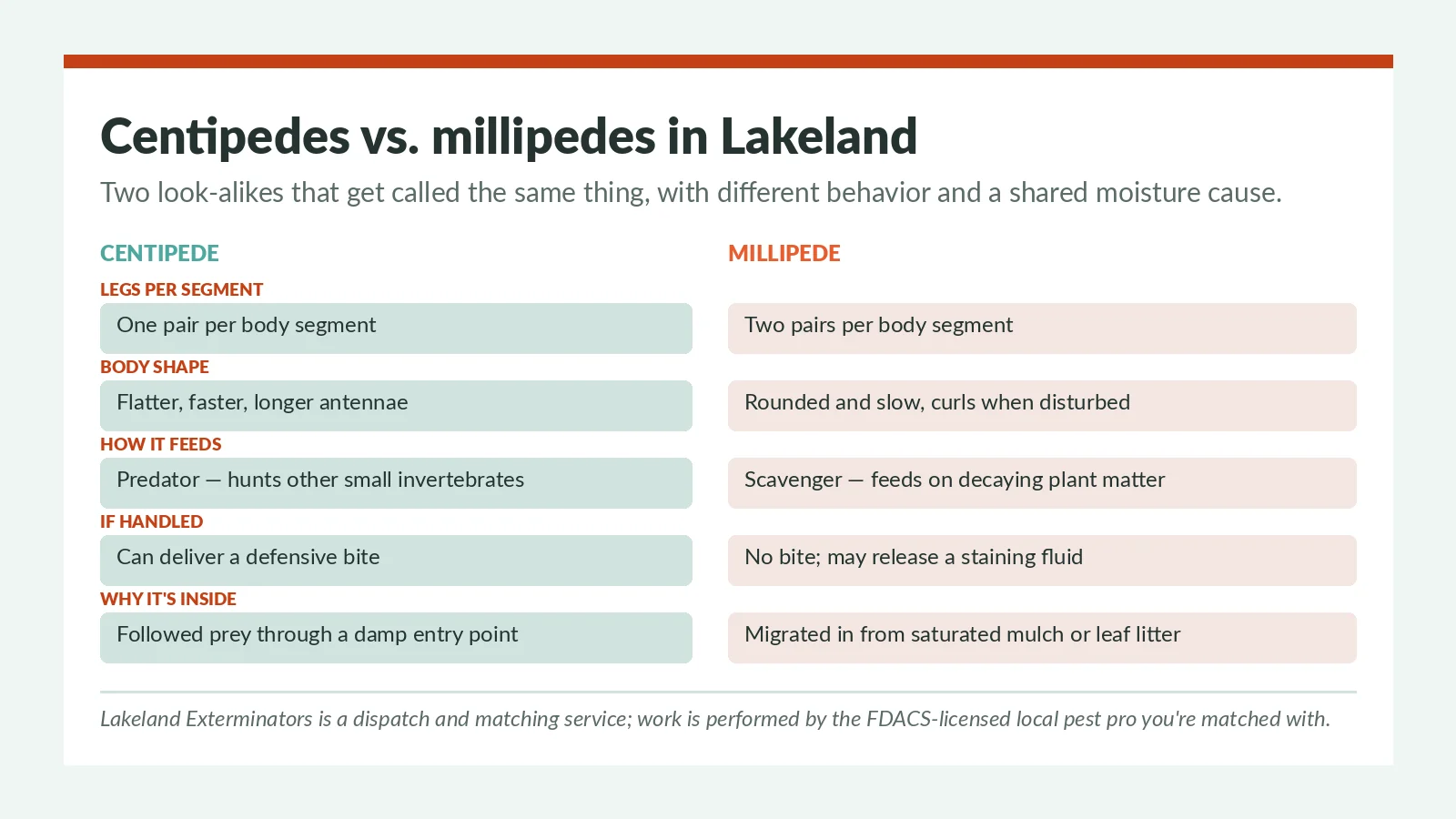
Centipedes are flattened, fast-moving, and have one pair of long legs per body segment — they look like they’re built for speed, because they are. They’re active hunters that feed on other insects, spiders, and small pests. A centipede in the house is often a sign there’s something else for it to eat.
Millipedes are rounded, slow, and have two pairs of shorter legs per segment, giving them a much denser, “many-legged” look as they crawl. They don’t hunt — they feed on decaying plant matter, mulch, leaf litter, and damp organic debris. Millipedes curl into a tight coil when disturbed instead of running.
Both are far more of a nuisance than a threat. Neither bites people in any meaningful way (centipedes technically can pinch with their front pincers, which may sting briefly like a minor bee sting, but it’s rare and not dangerous to most people), and neither damages structures, wiring, or wood the way termites or carpenter ants do.
Why Lakeland’s climate produces so many of them
Central Florida’s humidity is the common thread behind both pests. Polk County’s sandy soil drains fast on the surface but holds moisture in mulch beds, leaf litter, and shaded foundation perimeters for days after rain — exactly the microclimate centipedes and millipedes need to survive, since both lose moisture quickly through their exoskeletons and dry out in open sun.
Neighborhoods with heavy landscaping mulch, dense shrub lines, or homes backing up to wooded lots — common through South Lakeland, Christina, and the Grasslands area — tend to see more activity simply because there’s more damp organic cover right up against the foundation. Homes near the Chain of Lakes and Lake Hollingsworth also see elevated humidity levels that keep mulch beds and crawlspace vents damp well after a storm front clears.
Millipede populations in particular can spike into what’s sometimes called a “millipede migration” after heavy, sustained rain — large numbers moving out of saturated soil and mulch toward drier ground, which often means toward a house foundation and, eventually, indoors through slab gaps, door thresholds, and weep holes.
Signs you’re dealing with a moisture problem, not just bugs
Because both pests are moisture-dependent, repeated indoor sightings are frequently a signal pointing at something bigger than the bugs themselves:
- Mulch or leaf litter piled directly against the foundation, holding moisture against the slab or crawlspace vents.
- Gutters or downspouts draining next to the house rather than away from it, keeping soil saturated along one wall.
- Crawlspace humidity that never fully dries out between rain events, common in older Lakeland homes without a vapor barrier.
- Recurring activity in the same room, such as a bathroom, laundry room, or garage — usually the room closest to an exterior moisture source or a foundation crack.
- Increased activity after heavy rain or irrigation cycles, since both pests are pushed toward drier ground when their outdoor habitat floods.
What professional control typically involves
- Inspection of the foundation perimeter, mulch beds, gutter drainage, and crawlspace conditions to identify the moisture source drawing pests toward the house.
- Perimeter treatment targeting entry points — door thresholds, weep holes, slab expansion joints, and foundation cracks.
- Moisture-source correction recommendations, such as pulling mulch back from the foundation, redirecting downspouts, or addressing standing water.
- Interior spot treatment in rooms with recurring sightings, focused on baseboards and areas near plumbing penetrations.
- Seasonal follow-up, since both pests track rainfall patterns and a single treatment rarely holds through Florida’s full wet season without a check-back.
Why DIY treatments usually underperform
Store-bought sprays applied only where centipedes or millipedes are seen indoors treat the symptom, not the source. Because these pests are constantly moving in from outdoor mulch and soil, indoor-only treatment gets overrun again within days, especially during Polk County’s heavier rain months. A licensed pest control operator treats the perimeter and the moisture conditions driving the activity, not just the bugs that have already made it inside.
When to call a pro
If centipede or millipede sightings are frequent, appear right after rain, or keep returning to the same interior room no matter how often they’re swept up, it’s worth getting a professional inspection. A licensed Lakeland-area operator can confirm whether the issue is isolated or tied to a bigger moisture or landscaping problem around the foundation.
Get matched with a licensed Lakeland-area pest pro
One call reaches a licensed, local exterminator who covers your address — and a real person answers, 24/7.
Free to call. Free to get matched. The licensed operator gives the quote.
Related Lakeland Exterminators pages
- Silverfish Control in Lakeland, FL
- Crawl Space Pest Control in Lakeland, FL
- Lawn Pest Control in Lakeland, FL
Verify before you sign: structural pest control in Florida requires an FDACS license under Chapter 482, Florida Statutes. Every operator this line matches is independent, licensed and insured — and you can check any company yourself in thirty seconds at the FDACS license search.
Frequently asked questions
What’s the easiest way to tell a centipede from a millipede?
Leg count and speed are the fastest tells. Centipedes have one pair of long legs per segment and move quickly, since they’re active hunters. Millipedes have two pairs of shorter legs per segment, move slowly, and curl into a tight coil when disturbed rather than running.
Are centipedes or millipedes dangerous to people or pets?
Both are generally harmless. Millipedes don’t bite at all, though some species can secrete a mild irritant if handled roughly. Centipedes can pinch with front pincers, which may cause brief, minor stinging similar to a small insect bite, but serious reactions are rare.
Why do I keep finding millipedes in my house after it rains?
Heavy or sustained rain saturates the soil and mulch millipedes normally live in, pushing large numbers toward drier ground — which often means toward and into a house foundation. This is sometimes called a millipede migration and tends to follow Polk County’s heaviest rain events.
Will pulling mulch back from my foundation actually help?
Yes, in most cases. Mulch piled against the foundation holds moisture right where these pests thrive and gives them a direct bridge to slab gaps and weep holes. Keeping a few inches of clearance between mulch and the foundation, along with proper gutter drainage, reduces the moisture bridge significantly.
Do centipedes indoors mean I have another insect problem?
Possibly. Centipedes are predators that feed on other small insects and spiders, so consistent indoor centipede activity can be a sign there’s a food source — other pests — supporting them. A broader pest inspection can confirm whether that’s the case.
Can I just vacuum up millipedes and centipedes instead of calling someone?
Vacuuming handles what’s already inside, but it doesn’t address the outdoor moisture and mulch conditions producing new arrivals. If sightings keep recurring despite regular cleanup, the underlying source likely needs professional attention.
How much does centipede and millipede control cost in Lakeland?
Pricing is set independently by the licensed pest control operator based on the size of the property, the extent of the moisture issue, and whether follow-up visits are needed. Call to get matched with an operator and ask for a quote based on your home.