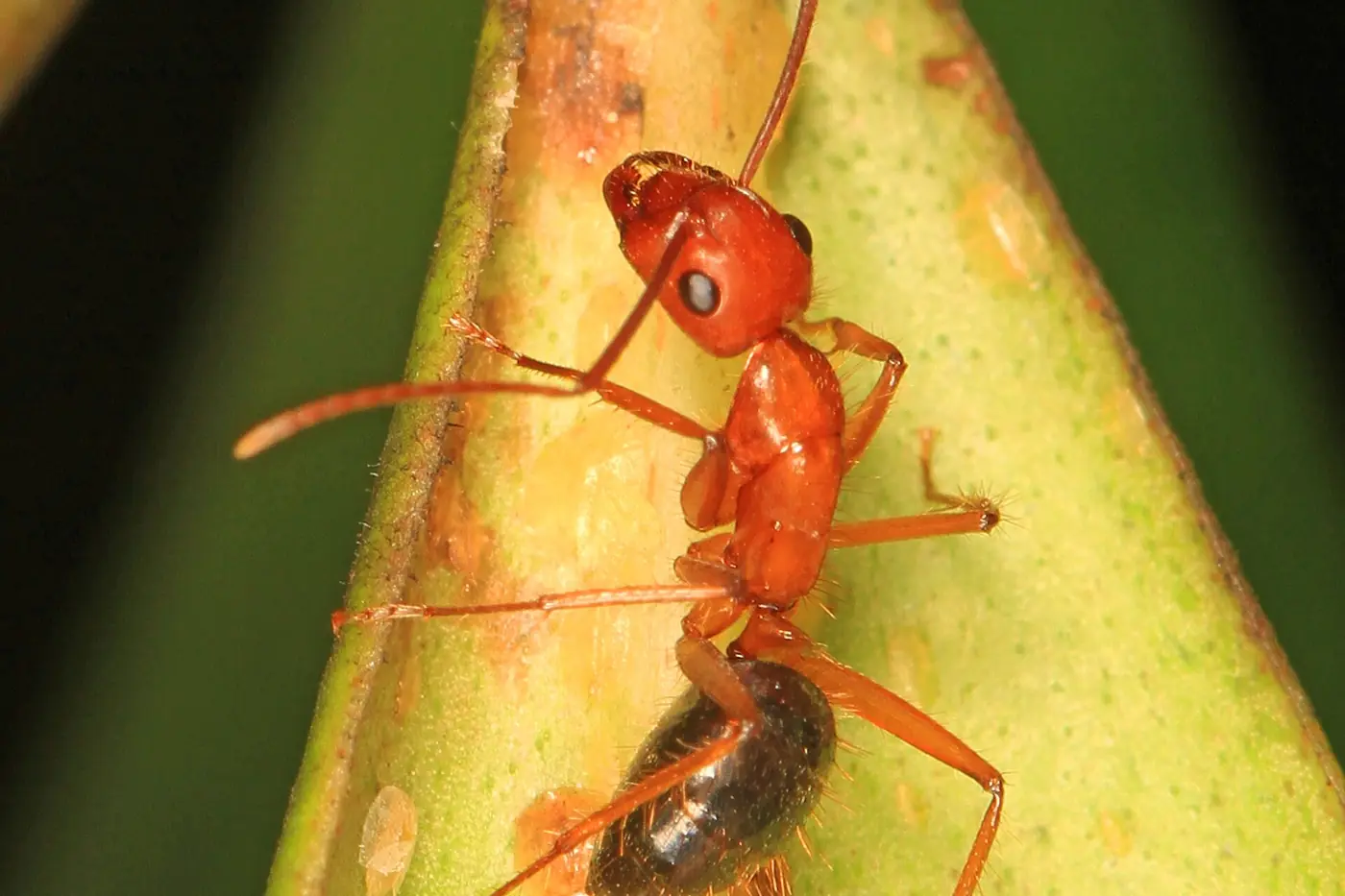
Broad ant trails on the soffit that a spray only makes worse? That’s the white-footed ant.
One call reaches a licensed, local exterminator who covers your address — and a real person answers, 24/7.
Talk to a licensed exterminator now
Call and we’ll connect you with a licensed, local exterminator who covers your address. It takes about two minutes, and a real person answers.
Free to get matched. The licensed operator gives the quote.
24/7 line · A real person answers · Availability of same-day and emergency service depends on the provider.
Quick answer: is it a white-footed ant?
The white-footed ant (Technomyrmex difficilis) is an invasive species that has become one of central and south Florida’s most common nuisance ants over the last 20 years, including throughout Polk County from Lakeland to Winter Haven. Workers are about 1/8 inch, dark brown to black, with distinctively pale yellowish feet, and they travel in broad foraging patterns rather than the tight defined trails of an Argentine ant. Colonies are multi-queen and enormous — often more than a million individuals.
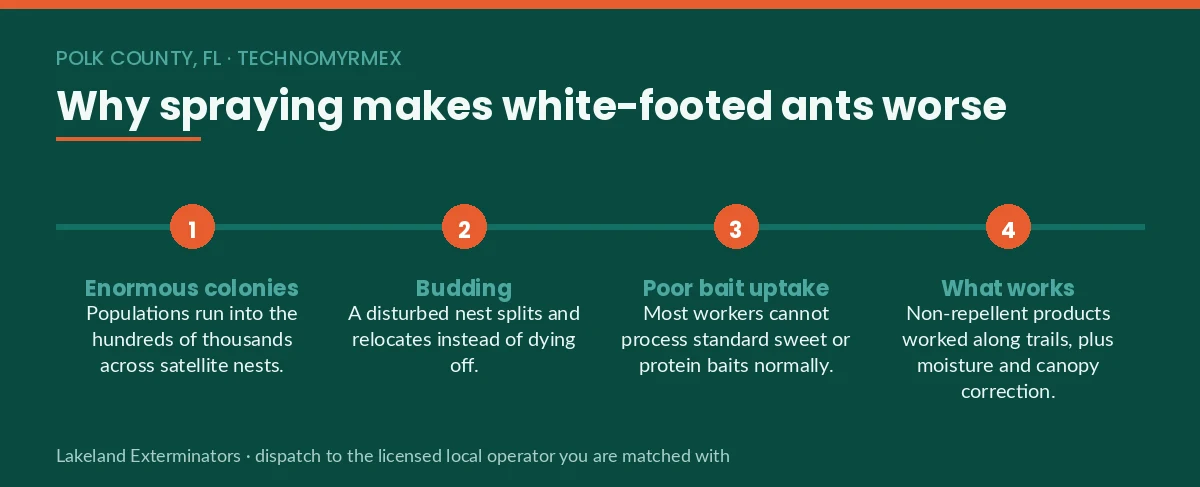
The key control fact: retail sprays trigger budding. Hit a white-footed ant colony with a repellent product and it splinters into multiple satellite colonies, turning one problem into several. Effective treatment uses slow-acting bait and non-repellent perimeter chemistry — which is why this is a species where DIY reliably backfires.
How to identify white-footed ants
- About 1/8 inch; dark brown to black body with distinctly pale yellow feet — the namesake field mark.
- Single petiole, hidden under the abdomen.
- Broad foraging bands rather than the tight single-file trails of Argentine ants.
- Heavy presence on soffits, fascia, gutters, and roof edges, often via tree-to-roof branches.
- Reproductive females mate inside the colony and stay — there are no dramatic swarming flights, which is part of why they spread quietly.
If the ants are forming tight trails or you’re seeing winged swarmers, you may be dealing with a different species — see ant control in Lakeland and the Argentine ant page to compare.
Why white-footed ants are so hard to control
They combine every trait that defeats consumer products. Like Argentine ants they’re multi-queen and prone to repellent-triggered budding. But they add a distinct challenge: white-footed ants don’t share food broadly through trophallaxis (mouth-to-mouth food transfer). That means traditional protein and sugar baits move through the colony slowly and unevenly, so a bait that wipes out an Argentine colony can barely dent a white-footed one.
Effective treatment relies on slow-acting, non-repellent chemistry that builds up at the food source and on individual ants over time, eventually reaching the queens via cuticular (body-to-body) contact rather than food-sharing. It’s a patience-and-precision job — the exact opposite of a fast knockdown spray, and precisely why a licensed operator’s protocol succeeds where the hardware-store can fails.
How a licensed operator treats them
Non-repellent perimeter
A non-repellent residual (that ants can’t detect and therefore walk through) around entry zones and trails — so foragers carry it back rather than avoiding a treated band.
Slow-acting bait
Baits chosen and placed for a species that shares food poorly — building lethal dose over time and relying on ant-to-ant contact to reach the queens.
Trail & harborage work
Trimming tree-to-roof branches, sealing soffit and fascia access, and disrupting the elevated trails white-footed ants favor — cutting off the highways into the structure.
Because colonies are so large and satellite-prone, resolution usually takes a sequence of visits rather than one. This is best handled inside an ongoing Polk County pest program so the operator can monitor and adjust.
Ant ribbons on the soffits getting worse? Stop spraying — get the right protocol.
One call reaches a licensed, local exterminator who covers your address — and a real person answers, 24/7.
Free to get matched. The licensed operator gives the quote.
White-footed ant FAQs
Why did spraying make my ant problem worse?
Are white-footed ants dangerous?
How do I tell them from Argentine ants?
How long does treatment take to work?
Are you the pest control company?
Related Polk County pages
Disclosure
Lakeland Exterminators is a dispatch and matching service. We connect Polk County callers with FDACS-licensed structural pest control operators. We are not a licensed pest control operator. We do not perform treatment, set prices, issue warranties, or carry pest control trade insurance. All pricing, scheduling, treatment plans, and service terms are determined by the FDACS-licensed operator dispatched to your address under Chapter 482, Florida Statutes.
Same-day and 24/7 emergency services are subject to provider participation, location, technician availability, and demand. Availability is not guaranteed and may vary by market and appointment capacity.
License status of any operator you connect with is publicly verifiable at the FDACS license search.