Droppings in the pantry, scratching in the wall? A house mouse only needs a dime-sized gap.
One call reaches a licensed, local exterminator who covers your address — and a real person answers, 24/7.
Talk to a licensed exterminator now
Call and we’ll connect you with a licensed, local exterminator who covers your address. It takes about two minutes, and a real person answers.
Free to get matched. The licensed operator gives the quote.
24/7 line · A real person answers · Availability of same-day and emergency service depends on the provider.
Quick answer: is it a house mouse?
The house mouse (Mus musculus) is 3–4 inches of body plus a 3–4 inch tail, gray to brown, with large ears and small dark eyes relative to its head. It’s the dominant small rodent in Polk County, in homes and food-service settings alike, from Lakeland to Bartow. The reason it becomes a structural problem so fast is simple biology: continuous breeding in the warm climate, and a body that squeezes through a gap as small as a quarter-inch — dime-sized.
Effective control is a three-part job: structural exclusion (seal every dime-sized gap), interior snap-trap removal, and exterior bait stations. For homes, trapping beats interior bait, because a mouse that dies inside a wall void from bait becomes an odor problem you can’t reach.
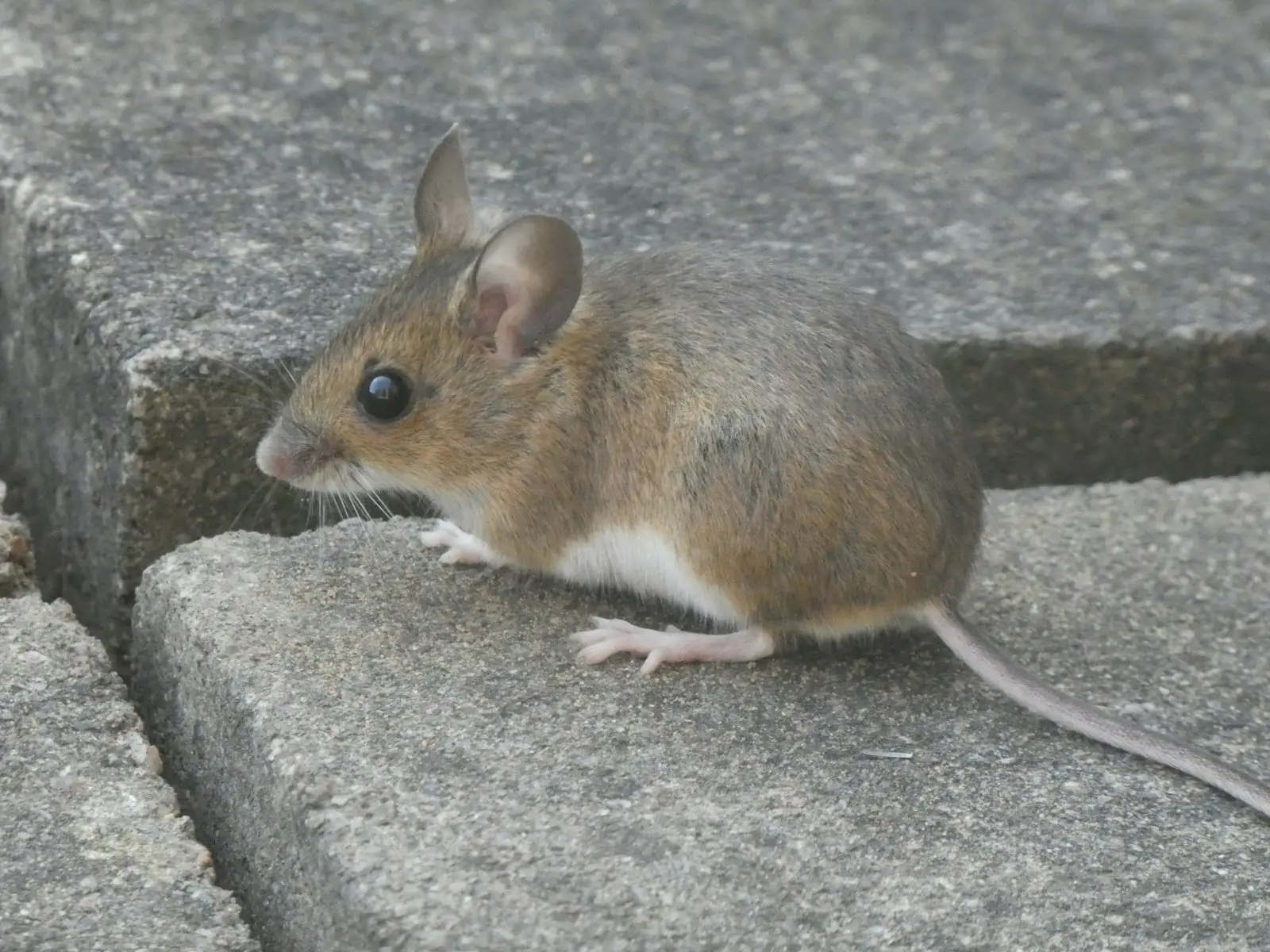
House mouse vs. a juvenile rat
This is the most common ID mistake, because a young rat looks a lot like an adult mouse. Three tells settle it:
Head size
Adult mice have a proportionally large head for the body. A juvenile rat has a smaller head on a chunkier body.
Feet
Juvenile rats have oversized hind feet — a preview of the adult size they’re growing into. A mouse’s feet stay proportional.
Droppings
Mouse droppings are 1/8–1/4 inch with pointed ends. Rat droppings are 1/2–3/4 inch with blunt ends — the fastest field ID of all.
Getting this right matters because the exclusion gap sizes and trap placements differ. If it turns out to be a rat, see the roof rat and Norway rat pages.
Where mice get into Polk County homes
The inspection follows the utilities and the ground line — mice enter low and near penetrations:
- Gaps around plumbing under kitchen, bathroom, and utility sinks.
- Dryer-vent exits with a missing or broken damper.
- Garage-door bottom-seal gaps — the single most common entry into attached garages.
- HVAC line-set penetrations through exterior walls.
- Weep holes in masonry and block construction.
- Gaps under exterior doors and thresholds.
- From the garage into the attic via cross-bracing and wall voids.
Sealing these with rodent-rated materials (hardware cloth, exclusion foam, door sweeps) is the part that turns a one-time trap-out into a lasting fix. This is the core of a proper rodent exclusion job.
Hearing them in the walls? Get an inspection.
One call reaches a licensed, local exterminator who covers your address — and a real person answers, 24/7.
Free to get matched. The licensed operator gives the quote.
House mouse FAQs
How do I know if it’s mice or rats?
Do retail snap traps work for mice?
Why does exclusion matter more than bait indoors?
How fast do mice multiply here?
Are you the pest control company?
Related Polk County pages
Disclosure
Lakeland Exterminators is a dispatch and matching service. We connect Polk County callers with FDACS-licensed structural pest control operators. We are not a licensed pest control operator. We do not perform treatment, set prices, issue warranties, or carry pest control trade insurance. All pricing, scheduling, treatment plans, and service terms are determined by the FDACS-licensed operator dispatched to your address under Chapter 482, Florida Statutes.
Same-day and 24/7 emergency services are subject to provider participation, location, technician availability, and demand. Availability is not guaranteed and may vary by market and appointment capacity.
License status of any operator you connect with is publicly verifiable at the FDACS license search.