January in Polk County: the pests don’t leave. They move in with you.
One call reaches a licensed, local exterminator who covers your address — and a real person answers, 24/7.
Talk to a licensed exterminator now
Call and we’ll connect you with a licensed, local exterminator who covers your address. It takes about two minutes, and a real person answers.
Free to call. Free to get matched. The licensed operator gives the quote.
24/7 line · A real person answers · Availability of same-day and emergency service depends on the provider.
What January actually changes in Polk County — and what it doesn’t
Lakeland sits in USDA Zone 9b. January nights dip into the 40s and low 50s, daytime highs still touch the 70s, and a hard killing freeze is rare. That matters for one simple reason: almost nothing that eats your house dies in a Polk County winter. The soil a foot down stays warm enough for subterranean termites to feed every single day of January — there is no off-season, only a no-swarm season. What the cool, dry weather does change is where the pressure shows up. Outdoor food and water get scarce, so the traffic comes indoors: attics, garages, wall voids, kitchen plumbing chases.
January is also the month Polk County homeowners find what the holidays left behind — pantry moths in the baking cupboard, German cockroaches that rode in with cardboard boxes, and brown widow egg sacs in the storage totes the decorations came out of.
The January priority list
Four pressures dominate the dispatch line’s January calls, in this order.
Roof rats — peak attic season
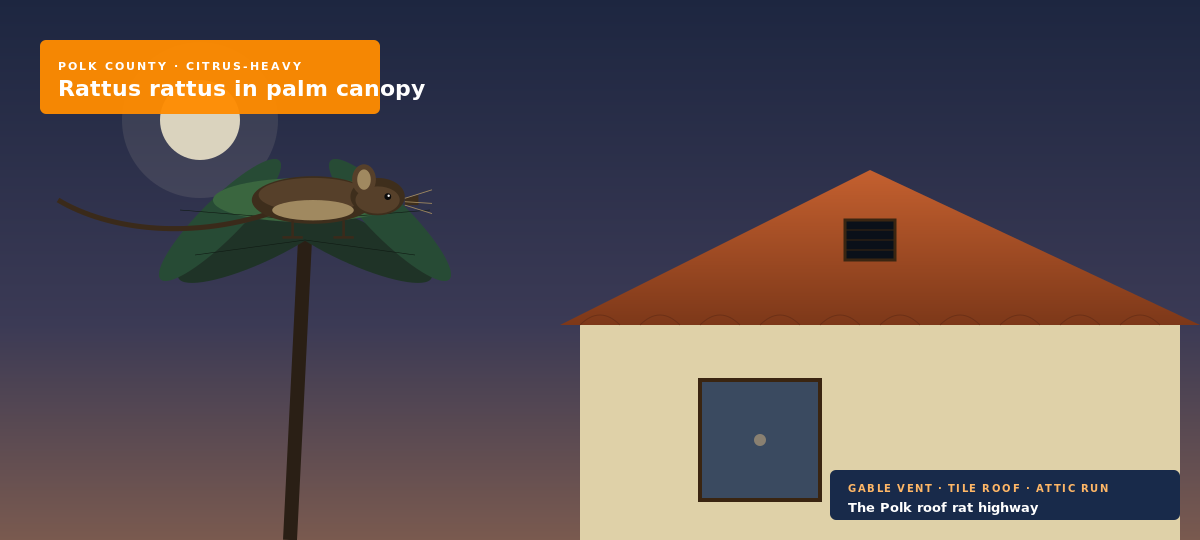
Rattus rattus is Polk County’s dominant rat, and January is its strongest indoor month. Citrus trees, palm canopies and utility lines are the highways; a gap the width of a quarter at the fascia is the front door. Scratching in the ceiling between dusk and midnight is the classic tell.
Norway rats and house mice
Norway rats work the ground level — crawl spaces, garage corners, ground-floor voids — while house mice squeeze through dime-sized gaps around garage doors and pipe penetrations. Both breed indoors all winter once they’re in.
German cockroaches — no winter indoors
Your kitchen is 74°F with water in the P-traps year-round, so German cockroach breeding never slows. January sightings usually mean a population that built up quietly through the holidays — droppings like coffee grounds in hinge corners are the confirmation.
Subterranean termites — the pre-swarm month
Eastern subterranean colonies feed all January and swarm February through May. January is the quietest month to catch them early: check the slab edge, stem wall and garage expansion joints for pencil-width mud tubes before swarm season announces the colony for you.
A note on winter mosquitoes: overwintering Culex females do hole up in Polk County culverts and sheds in January, but area mosquito management is county-funded public work handled by the Polk County Mosquito Control District — not something a structural pest operator treats house-by-house. Structural operators focus January work on rodents, roaches, termites and ants.
Scratching in the ceiling? Droppings in the kitchen drawer?
One call reaches a licensed, local exterminator who covers your address — and a real person answers, 24/7.
Free to call. Free to get matched. The licensed operator gives the quote.
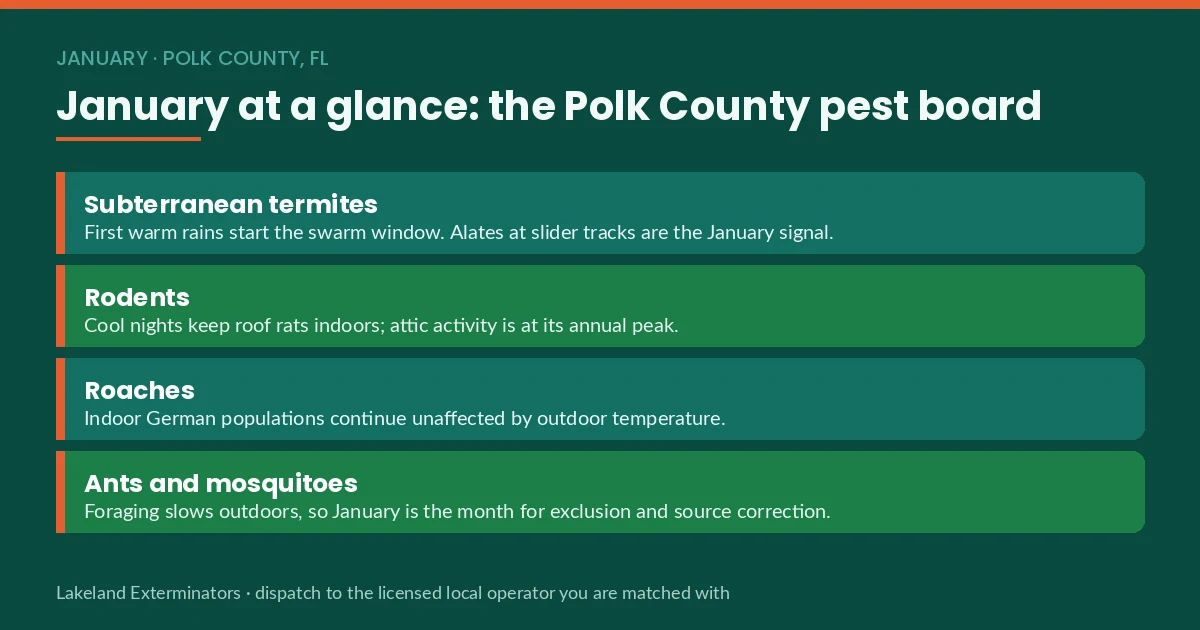
January at a glance: the Polk County pest board
| Pest | January status | What you’ll see | The move |
|---|---|---|---|
| Roof rat | Peak indoor pressure | Night scratching overhead, gnawed citrus in the yard, greasy rub marks on rafters | Inspection + exclusion now — trapping alone doesn’t close the door |
| House mouse / Norway rat | Peak indoor pressure | Droppings along garage walls, shredded paper nests, chewed pantry packaging | Seal ground-level gaps; licensed trapping program |
| German cockroach | Steady — fully indoor | Roaches near the dishwasher at night, pepper-like droppings in hinge corners | Gel bait + IGR program from a licensed operator, not fogging |
| Subterranean termite | Feeding, pre-swarm | Mud tubes on slab or stem wall — swarms start as early as February | Walk the foundation this month; book a WDO inspection if you find tubes |
| Drywood termite | Quiet, still feeding | Fresh six-sided frass pellets under attic framing or window sills | Frass in January means an active colony — get it evaluated |
| Brown widow | Low, sheltering | Spiky egg sacs in storage boxes, meter boxes, patio furniture folds | Wear gloves unpacking storage; knock down sacs |
| Pantry pests | Post-holiday spike | Indian meal moths near the flour and baking shelf, webbing in dry goods | Purge infested goods; airtight containers |
The full-year picture lives on the Florida termite swarm calendar and the neighboring monthly pages: December and March.
The January homeowner checklist
Walk the roofline
Trim branches and palm fronds back off the roof, then look for gaps at fascia boards, soffit returns, gable vents and where utility lines enter. Anything a quarter fits through, a roof rat fits through.
Walk the slab
Circle the foundation and garage expansion joints looking for pencil-width mud tubes. Ten minutes in January beats discovering the colony when it swarms your living room in March.
Reset the kitchen
Pull the stove and fridge, degrease, and get dry goods into sealed containers. German cockroach control is sanitation plus licensed baiting — half of that is yours to do.
Inspect the storage boxes
Holiday bins coming down from the attic are January’s spider-bite scenario. Wear gloves, check folds and lids for brown widow egg sacs, and vacuum corners before re-stacking.
What moves a January quote
We never set prices — the licensed operator quotes after seeing the property. These are the levers that move the number in January:
- Exclusion scope — rodent work is priced by the entry points: linear feet of roofline gap, number of vent and pipe penetrations, crawl-space access. A one-story block home and a two-story frame house with a wraparound soffit are different jobs.
- Attic condition — contaminated insulation, nesting cleanup and sanitizing add scope beyond trapping.
- Program vs. one-time — most operators price recurring quarterly service differently than a single knockdown; January is a natural month to start a program before the spring surge. The cadence guide compares the two.
- Termite findings — if the winter walk turns up tubes, treatment pricing depends on species, spread and foundation type. The cost-factor guide breaks down every lever without pretending we set the number.
How the dispatch works in January (and every month)
Straight up: Lakeland Exterminators is a dispatch and matching service, not a licensed pest control operator. Here is the exact path your request takes.
Describe what you found
Scratching, droppings, tubes, roaches — tell the line what you’re seeing and where. A real person answers around the clock.
Your address picks the operator
The request routes to an FDACS-licensed operator covering your part of Polk County — Lakeland, Winter Haven, Bartow, Lake Wales, the I-4 corridor, all of it.
Licensed inspection on site
The operator confirms the pest, maps the activity and writes the quote. Pricing comes from them, never from us.
Treatment stays with the pro
Trapping, exclusion, baiting, termite work — plus any warranty — all owned by the licensed operator under Chapter 482, Florida Statutes.
Verify before you hire — any Florida pest control company’s license status, categories and discipline history is public at the FDACS license search at aessearch.fdacs.gov. Check the operator you are matched with; the good ones expect it.
January pest questions, answered straight
What’s the worst pest in Polk County in January?
Roof rats, by call volume. January is the coldest, driest stretch of the Polk County year, and that pushes rodents hard toward attics and garages. The runner-up is the German cockroach, which never slowed down — it just went unnoticed through the holidays.
Do termites die off in a Polk County winter?
No. Soil temperatures in Zone 9b stay warm enough for subterranean termites to feed year-round, and drywood colonies live inside your framing where it never gets cold. Winter only pauses the swarming, not the eating — a colony you find in January has been feeding all winter.
Is January a good month to start a pest control program?
Yes — and January has a real edge. Pressure is at its annual low, so an operator can establish a clean baseline — exclusion, baiting, barrier — before the February termite swarms and the spring ant surge. Starting in January means the program is already working when the pressure arrives.
Why am I still seeing mosquitoes in January?
Warm January afternoons can wake overwintering Culex females sheltering in culverts, sheds and bromeliads. Area mosquito control in Polk County is public work handled by the Polk County Mosquito Control District; a structural pest operator’s January focus is rodents, roaches, termites and ants. Dumping standing water in plant saucers and bromeliads is the useful homeowner move.
Can I just set rodent traps myself?
You can, and snap traps do catch rats. But trapping without exclusion is a treadmill: the population outside replaces what you remove. Licensed rodent work pairs trapping with sealing the actual entry points — and in Polk County, roof rat entry points are usually at the roofline where most homeowners never look. The DIY guide is honest about which jobs are DIY-able.
Start the year with an empty attic and a quiet kitchen.
One call reaches a licensed, local exterminator who covers your address — and a real person answers, 24/7.
Free to call. Free to get matched. The licensed operator gives the quote.
Disclosure
Lakeland Exterminators is a dispatch and matching service. We connect Polk County callers with FDACS-licensed structural pest control operators. We are not a licensed pest control operator. We do not perform pest control treatment, set prices, issue warranties, hold retreatment bonds, or carry pest control trade insurance. All pricing, scheduling, treatment plans, warranties, bonds and service terms are determined by the FDACS-licensed operator dispatched to your address under Chapter 482, Florida Statutes.
Same-day and 24/7 emergency services are subject to provider participation, location, technician availability, and demand. Availability is not guaranteed and may vary by market and appointment capacity.
License status of any operator you connect with is publicly verifiable at the FDACS license search: aessearch.fdacs.gov.