Orlando’s roof rats love two things: palm trees and vacation homes that sit empty three weeks a month.
The noise over the ceiling is a roof rat — the climbing species that owns Central Florida attics. Orlando hands it two gifts most cities don’t. First, landscaping: mature palms whose untrimmed boot skirts are ready-made nests, plus oak canopy in College Park and Winter Park-edge streets that turns limbs into highways. Second, vacancy: tens of thousands of short-term rentals and seasonal homes around the tourist corridor sit quiet for days or weeks — and an undisturbed attic is a rat nursery. A bait box on the fence line doesn’t answer either problem. The dispatch line matches you with FDACS-licensed operators who work Orlando rodent jobs in the durable order: trap out, seal every entry, cut the routes.
Talk to a live dispatch coordinator now
Scratching overhead, droppings in the garage, chewed pool-cage screen, insulation tunnels — describe it and get routed to a licensed Orlando rodent operator.
(863) 445-9190Tap to call — 24/7 dispatch
Free to call. Free to get matched. The licensed operator you’re matched with gives the quote.
24/7 line · A real person answers · Availability of same-day and emergency service depends on the provider.
Need rodent control in Orlando, FL? Call (863) 445-9190 and a dispatch coordinator matches you with an FDACS-licensed operator serving your Orlando ZIP — attic inspections, trap-out programs, entry-point sealing and follow-up monitoring for roof rats and mice, including vacation-rental turnaround work. Lakeland Exterminators is a dispatch service: the licensed local operator inspects, maps the entries, and quotes the work.
Why do Orlando attics fill with rats faster than most?
Because the city’s two signature features — themed landscaping and part-time occupancy — are both rodent accelerants. Palms are the big one. A roof rat nesting in an untrimmed palm skirt lives fifteen feet from your soffit; when summer storms strip the skirt or food runs thin, the attic next door is the obvious upgrade. Tile roofs on newer HOA communities in Hunter’s Creek, Lake Nona and the Dr. Phillips corridor add the entry: barrel and flat-tile eave courses leave arched gaps at every row unless they were mudded or bird-stopped, and builders rarely do it to rodent standard.
Occupancy is the quieter accelerant. A rat colony in a full-time home gets discovered in weeks — noise, droppings, chewed food. In a vacation home near the parks that hosts guests eight nights a month, nobody hears the attic. Colonies establish, breed, and chew undisturbed; the discovery event is a guest review mentioning “scratching sounds,” or an AC tech finding tunneled insulation. That’s also the wiring risk: rats gnaw constantly, attic runs are the casualty, and chewed conductors are a genuine fire hazard. Orlando operators sequence accordingly — inspect every eave and ridge, trap inside (never poison in an attic; a dead rat in a wall void of a rental is a cancelled-bookings problem), seal with rodent-rated materials, and verify zero activity before closing the file.
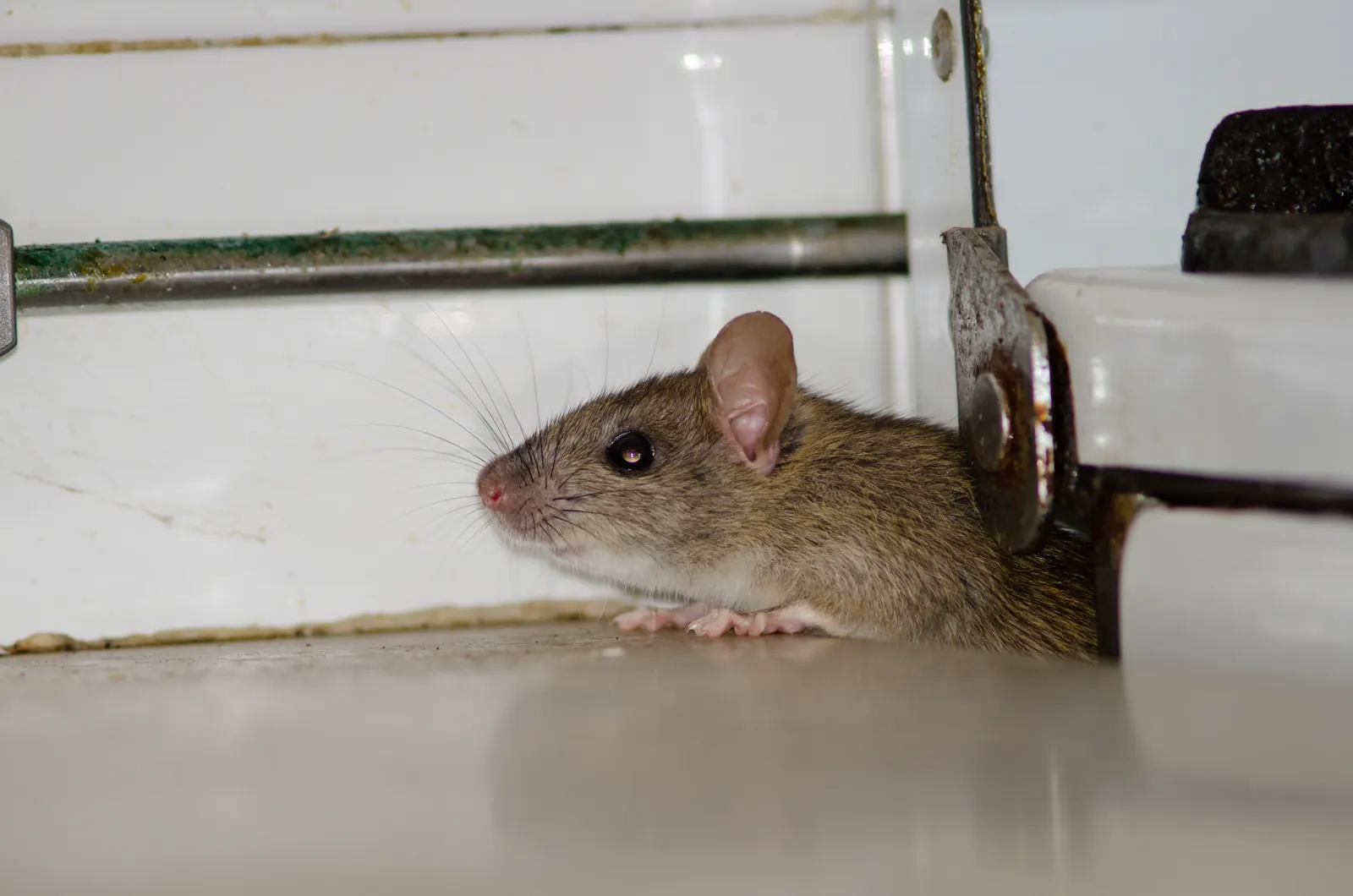
Where does rodent pressure concentrate in Orlando?
- College Park & Audubon Park (32803, 32804): oak canopy plus 1920s-50s housing stock — fascia returns and ridge gaps that predate any rodent-proofing standard.
- Dr. Phillips & Bay Hill (32819, 32836): mature palm landscaping, tile roofs and lakefront lots — classic skirt-to-soffit pressure.
- Tourist corridor & vacation-home zones (32821, 32830, 32836): part-time occupancy lets colonies establish undetected between stays.
- Lake Nona & Southeast Orlando (32827, 32832): new construction abutting conservation land — displaced field rodents test every new roofline each fall.
- MetroWest & Pine Hills (32808, 32811, 32835): dense multifamily with shared attic runs — one untreated building seeds its neighbors.
- Colonialtown & Milk District (32801, 32803): restaurant density feeding alley and dumpster populations at ground level.
What should a vacation-rental owner do differently?
Run rodent control like turnover maintenance, not emergency response. That means a standing inspection rhythm — attic and eave check each quarter, palm skirts trimmed on schedule, garage-door sweeps replaced the moment daylight shows at the corners — and an exclusion job done once, properly, with materials rats can’t chew: quarter-inch hardware cloth over gable vents, sheet-metal closures at roof-to-wall junctions, mortar at tile arches. Guest-facing stakes are higher than in a residence: a single sighting in a review does more damage than the repair bill, and poison placed by a handyman produces the worst possible outcome — an odor in a booked unit. Licensed operators who work the corridor understand documentation too: dated inspection reports and a monitoring log are what a management company wants on file.
Call the line
Tap (863) 445-9190 any hour. Describe what you’re hearing or finding, and your Orlando ZIP.
Get matched by job type
Attic trap-out and exclusion calls route to operators who do sealing work; vacation-rental and multifamily calls route to providers who run monitoring programs.
A licensed operator takes over
An independent, FDACS-licensed and insured Orlando operator inspects, maps entries, and quotes. No obligation — the dispatch call costs nothing.
Scratching over the bedroom? Droppings in the cabana bath?
The line answers 24/7 and matches you with a licensed Orlando rodent operator.
One tap. One call. Matched.
(863) 445-9190Tap to call — 24/7 dispatch
Free to call. The licensed operator gives the quote.
Orlando rodent control questions, answered straight
Rats or squirrels in my Orlando attic — how do I tell?
Do palm trees really cause rat problems?
Why not just drop poison blocks in the attic?
What does rodent control cost in Orlando?
Disclosure
Lakeland Exterminators is a pest control dispatch and referral service, not a licensed pest control operator. All rodent inspections, quotes, trapping and exclusion work in Orlando are performed by independent pest control operators licensed by the Florida Department of Agriculture and Consumer Services (FDACS) and insured in their own name. Calling the dispatch line is free and creates no obligation; the licensed local operator you’re matched with sets their own pricing and terms.
More Orlando help: Pest control in Orlando, Roach control in Orlando, Termite treatment in Orlando · Rodent dispatch guide · All pest control services