The Indian River splits Melbourne’s termite problem in two: drywood colonies own the beachside, subterranean colonies own the mainland, and the causeways carry buyers between them daily.
On the Space Coast, geography is termite destiny. East of the lagoon — Indialantic, Melbourne Beach, the beachside condo stacks — salt-weathered cottages and elevated stock feed the drywood economy: colonies living entirely inside window casings, rafter tails and roof framing, discovered by pellet piles and dusk swarms. West of the lagoon, mainland Melbourne, Eau Gallie and the vast expansion tracts of Palm Bay run the subterranean script: slab-on-grade subdivisions built in waves from the 1960s through last year, each riding a builder pretreat that expired 5–10 years after the certificate was signed. Two termite economies, two treatment logics — and enough aerospace-driven relocation churn that many owners are learning which side of the line they bought on only when the evidence shows up. The dispatch line matches both shores with FDACS-licensed operators who treat to the geography.
Talk to a live dispatch coordinator now
Pellets in a beachside condo, mud tubes in a Palm Bay garage, wings after a spring evening — describe it and get matched with a licensed Melbourne termite operator.
(904) 943-3349Tap to call — 24/7 dispatch
Free to call. Free to get matched. The licensed operator you’re matched with gives the quote.
24/7 line · A real person answers · Availability of same-day and emergency service depends on the provider.
Need termite treatment in Melbourne, FL? Call (904) 943-3349 and a dispatch coordinator matches you with an FDACS-licensed operator serving your Brevard ZIP — tent fumigation and no-tent drywood options beachside, liquid barriers and bait systems for mainland subdivisions, and WDO-documented close-out. Lakeland Exterminators is a dispatch service: the licensed operator inspects, prescribes and quotes.
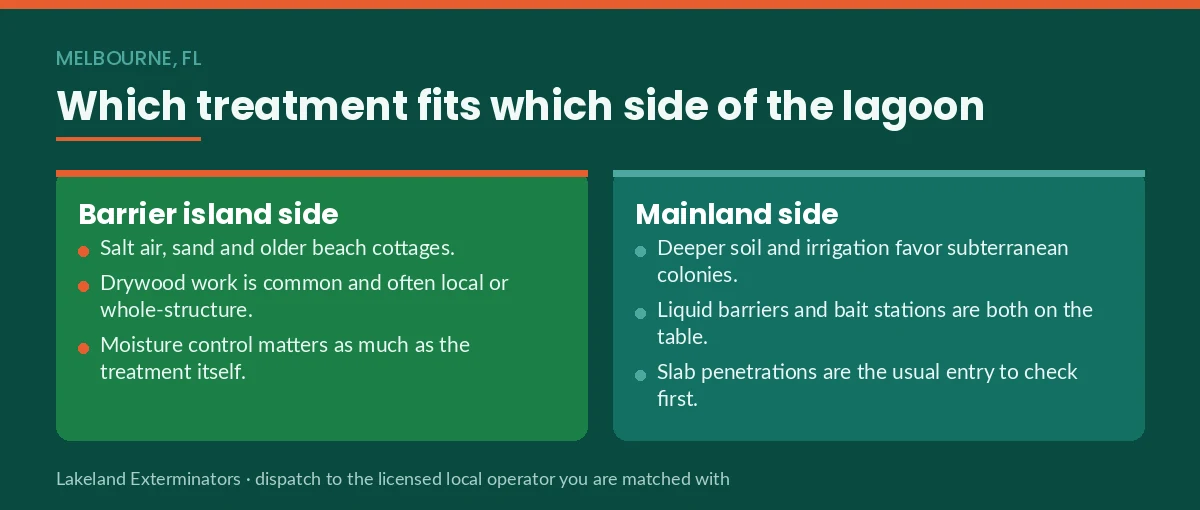
Which treatment fits which side of the lagoon?
Beachside, the drywood decision tree rules. Multi-room pellet evidence or roof-framing activity means whole-structure fumigation — the only method reaching every colony in the envelope at once — while single-gallery finds in accessible framing can justify targeted wood injection without the tent. Condo buildings add governance: drywood colonies live in the shared envelope, so a unit owner’s pellets often become an association agenda item, and buildings with a maintained tent-and-bond history are simply better places to own. Mainland, the subterranean toolkit applies: liquid soil barriers trenched at the perimeter for fast knockdown, or monitored bait systems that eliminate the colony itself — the choice steered by hardscape, pool decks and how much drilling a homeowner will tolerate.
The mainland’s real story is the expiry ledger. Palm Bay alone platted tens of thousands of slab homes across five decades of building waves, and every wave’s builder pretreat aged out on schedule; the region’s barrier-renewal backlog is enormous and mostly invisible until February-to-May swarm season converts it into phone calls. A house in its second decade or later without a renewal record should be treated as unprotected until a licensed inspection says otherwise — and the cheap time to renew is before the tubes, not after.
Where does termite treatment pressure concentrate around Melbourne?
- Indialantic & Melbourne Beach (32903, 32951): the drywood core — salt-weathered cottages and casings; tent scheduling and no-tent triage are the local craft.
- Beachside condo stacks (32903, 32937): shared-envelope colonies and association governance — tent history and bond status matter as much as unit evidence.
- Eau Gallie & historic Melbourne (32901, 32935): the oldest mainland stock — both-species layering, prior-treatment reading, and crawl-space pockets in the pre-slab blocks.
- Palm Bay expansion tracts (32905, 32907, 32908, 32909): the barrier-expiry engine — wave-built slabs, irrigation against stem walls, and renewal decisions overdue by the calendar.
- Suntree & Viera (32940): 1990s–2020s planned stock — newer pretreats aging out on schedule; hardscape-heavy lots steer renewals toward bait systems.
- West Melbourne (32904): growth-corridor builds with pretreat paperwork questions — first-resale buyers should ask for the original certificate before waiving anything.
What should relocating aerospace families check before buying?
Three documents and one date. The WDO report — ordered early in the inspection period, since VA and FHA timelines need runway if findings surface. The previous-treatment record — drill holes and bait-station caps tell an inspector a house was defended; paper tells a buyer when, by whom and whether a bond survives the sale. The pretreat certificate on newer builds — because “new construction” is a protection status with an expiry date, not a permanent attribute. And the build date itself, which predicts the default risk posture: pre-1990 mainland stock is past all original protection; beachside anything has been catching drywood swarms since it was framed. None of this should scare a buyer off the Space Coast — it should just move the termite questions from after closing to before it, where they are negotiating leverage instead of repair bills.
Call the line
Tap (904) 943-3349 any hour. Describe the evidence — pellets, tubes, wings, damage — which side of the lagoon, and your Melbourne-area ZIP.
Get matched to the geography
Beachside drywood jobs route to tent-and-injection operators; mainland subterranean work routes to liquid-and-bait providers; condo evidence routes to association-fluent operators.
A licensed operator takes over
An independent, FDACS-licensed and insured Melbourne operator inspects, prescribes the method and quotes it. No obligation — the dispatch call costs nothing.
Wings on the lanai this spring — or pellets in the condo?
The line answers 24/7 and matches you with a licensed Space Coast termite operator for your side of the lagoon.
One tap. One call. Matched.
(904) 943-3349Tap to call — 24/7 dispatch
Free to call. The licensed operator gives the quote.
Melbourne termite questions, answered straight
How do I know if my evidence is drywood or subterranean?
Our Palm Bay home is 15 years old with no termite history — are we fine?
Can our condo unit be treated without tenting the whole building?
What does termite treatment cost in Melbourne?
Disclosure
Lakeland Exterminators is a pest control dispatch and referral service, not a licensed pest control operator. All termite inspections, treatments and quotes in Melbourne are performed by independent pest control operators licensed by the Florida Department of Agriculture and Consumer Services (FDACS) and insured in their own name. Calling the dispatch line is free and creates no obligation; the licensed local operator you’re matched with sets their own pricing and terms.
More Melbourne help: Pest control in Melbourne, Daytona termite treatment, Port St. Lucie termite treatment · Termite dispatch guide · All pest control services