Brick streets, century-old bungalows, mature oaks — Dixieland’s charm comes with a specific pest profile.
Dixieland is Lakeland’s oldest platted neighborhood, its craftsman bungalows dating back to the early 1900s citrus boom. Original wood construction, brick streets, and a heavy oak canopy create pest pressure that looks different from a newer Lakeland subdivision. One call gets you matched with a licensed operator who reads a century-old house correctly.
Talk to a licensed exterminator now
Call and we’ll connect you with a licensed, local exterminator who covers your address. It takes about two minutes, and a real person answers.
Free to call. Free to get matched. The licensed operator gives the quote.
Before you call: have your address ready, plus what pest you’re seeing and where. Staying on the line about two minutes helps your local operator confirm details and get you scheduled.
A real person answers · Availability of same-day and emergency service depends on the provider.
Why Dixieland’s housing stock changes the pest conversation
Most Dixieland homes predate modern soil-treatment standards and slab construction entirely — many sit on pier-and-beam foundations with a crawlspace underneath, original wood siding, and single-pane wood windows with decades of settling around the frames. That combination gives several pests an easier path in than a 1990s-or-newer Lakeland home would offer.
Drywood termites are the standout risk: they need no ground contact at all, and original attic framing, exposed rafter tails, and wood trim on a century-old bungalow are exactly the kind of undisturbed wood they colonize for years before a swarm gives them away. Subterranean termites still matter too, working up through pier foundations and old expansion joints. A licensed inspector treats the two very differently, so getting the species right at the start saves a wasted treatment.
The oak canopy’s effect on rodent and ant pressure
Dixieland’s mature live oak canopy is part of its character — and it’s also a direct highway for roof rats (Rattus rattus), which use overhanging limbs to bridge straight onto older rooflines with original vent screening that may be decades past its useful life. Carpenter ants and Florida carpenter ants also favor the moisture-softened wood common in older eaves and porch columns, and their large size and wood-excavating behavior get them confused with termites more often than any other species — worth a proper identification before assuming the worst.
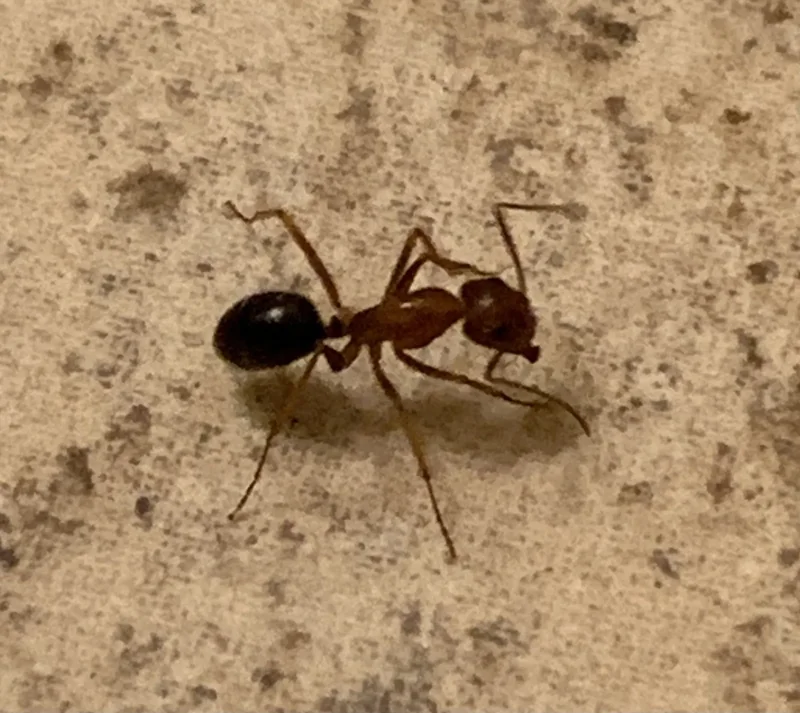
Carpenter ants favor moisture-softened wood common in Dixieland’s original porch columns and eaves.
What to have inspected on an older Dixieland home
Crawlspace & pier foundation
Ground moisture and old expansion joints under pier-and-beam construction are a classic subterranean termite entry point.
Attic framing & trim
Original rafters, fascia, and window trim are where drywood termite colonies typically establish undisturbed for years.
Roofline & vent screening
Original gable vents and soffit returns are common roof rat entry points once screening degrades.
Porch columns & eaves
Moisture-softened wood in original porch construction is prime carpenter ant territory.
Kitchen & bath plumbing chases
Original plumbing routes offer German cockroaches an easy path between wall voids.
Foundation perimeter
A full WDO inspection documents both current activity and decades of prior damage separately.
Renovation and historic-preservation considerations
Many Dixieland homes fall under local historic-district guidelines that affect what exterior treatment methods and repairs are allowed — worth mentioning to the licensed operator up front, since it can shape the treatment plan for a confirmed termite or wood-decay issue. A pre-renovation inspection is also worth scheduling before any interior demolition on an older Dixieland home, since opening up original walls is the easiest time to spot and address hidden damage.
Ready when you are.
One call gets you matched with a licensed local operator.
Talk to a licensed exterminator now
Call and we’ll connect you with a licensed, local exterminator who covers your address. It takes about two minutes, and a real person answers.
Free to call. Free to get matched. The licensed operator gives the quote.
Before you call: have your address ready, plus what pest you’re seeing and where. Staying on the line about two minutes helps your local operator confirm details and get you scheduled.
Availability of same-day and emergency service depends on the provider.
Questions, answered straight
Are Dixieland’s historic homes more likely to have termites?
Often yes. Original pier-and-beam construction, decades-old wood trim, and undisturbed attic framing all give termites — both subterranean and drywood — more opportunity than a newer slab-built home.
How do I tell carpenter ants from termites in an old house?
Carpenter ants have a pinched waist, bent antennae, and excavate clean, smooth-walled galleries without eating the wood; termites have a straight waist, straight antennae, and leave mud-packed or damaged wood behind. A licensed inspector can confirm on-site.
Does a historic district designation affect pest treatment options?
It can affect exterior repair and replacement methods after a termite or wood-decay finding. Mention any historic-district guidelines to the operator before treatment begins.
Should I get an inspection before renovating an older Dixieland home?
Yes — opening up original walls or attic space during a renovation is the easiest time to spot hidden termite or moisture damage before it’s covered up again.
Do roof rats really use tree canopy to get onto the roof?
Yes. Roof rats are agile climbers and routinely use overhanging oak limbs as a direct bridge onto a roofline, especially where vent screening has degraded.
What does it cost to get matched with an operator?
Nothing. Free to call and free to get matched. The licensed operator inspects the home and quotes the job.
One call. A real person. Straight answers.
Get matched with an FDACS-licensed operator who covers your address.
Talk to a licensed exterminator now
Call and we’ll connect you with a licensed, local exterminator who covers your address. It takes about two minutes, and a real person answers.
Free to call. Free to get matched. The licensed operator gives the quote.
Before you call: have your address ready, plus what pest you’re seeing and where. Staying on the line about two minutes helps your local operator confirm details and get you scheduled.
Availability of same-day and emergency service depends on the provider.
Disclosure
Lakeland Exterminators is a dispatch and matching service. We connect Polk County callers with FDACS-licensed pest control operators. We are not a licensed pest control operator. We do not perform treatment, set prices, issue warranties, hold bonds, or carry pest control trade insurance. All pricing, scheduling, treatment plans, warranties and service terms are determined by the FDACS-licensed operator dispatched to your address under Chapter 482, Florida Statutes.
Same-day and 24/7 emergency services are subject to provider participation, location, technician availability, and demand. Availability is not guaranteed and may vary by market and appointment capacity.
License status of any operator you connect with is publicly verifiable at the FDACS license search.