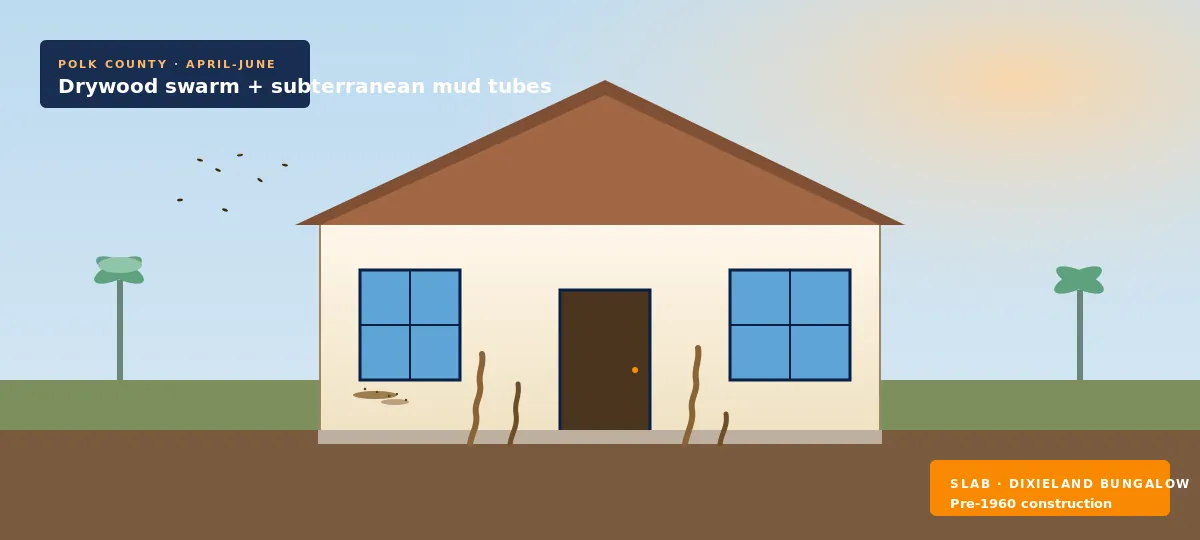
Mud tubes on the block? There’s a termite colony in your yard, and it’s been commuting into your house.
Subterranean termites live in Polk County soil and build mud highways up to your wood. Here’s how to read the tubes, why our sandy old grove land is such good habitat, and how a licensed operator decides between a liquid barrier and a bait system. Then drop your ZIP and we’ll route you to one.
Talk to a licensed exterminator now
Call and we’ll connect you with a licensed, local exterminator who covers your address. It takes about two minutes, and a real person answers.
Free to call. Free to get matched. The licensed operator gives the quote.
24/7 line · A real person answers · Availability of same-day and emergency service depends on the provider.
Why Polk County soil is such good subterranean termite country
Look, here’s the deal. Subterranean termites aren’t a sign you keep a dirty house. They’re a sign you live in Central Florida. A few things about this specific patch of ground make Polk County genuinely hospitable to them, and it’s worth understanding why, because the “why” is what a good operator is reading when they walk your property.
We don’t get a real freeze. There’s no winter shutdown here. A colony that would go dormant in Georgia just keeps working through January in Lakeland. Nothing resets, so colonies get old, and old colonies get big.
The old grove land is full of buried food. Enormous stretches of Polk County were citrus grove or pine scrub before they were subdivisions. When that land got cleared and graded, stumps, roots, landscape timbers and scrap construction lumber went under, not away. A subterranean colony feeding on a buried stump twenty feet from your footer is a colony that already lives on your property — it just hasn’t found the house yet. This is a real pattern in the North Lakeland and I-4 corridor stock, out toward Kathleen, and along the old grove edges.
Sandy soil moves water and moves termites. Central Florida sand drains fast, which is great for your slab and neutral for termites — they tunnel through it easily either way. What matters more is where the soil stays damp: under the AC condensate line, at the leaky hose bib, in the bed where the irrigation head sprays the stucco five mornings a week, in the mulch piled up over the weep screed. Termites need moisture. You are almost certainly providing some, and most of it is fixable for free this weekend.
The Chain of Lakes keeps everything humid. Add June-through-September storms dumping water at the foundation daily, and wood in Polk County rarely gets a proper chance to dry out.
How to read a mud tube — the diagnostic that costs you nothing
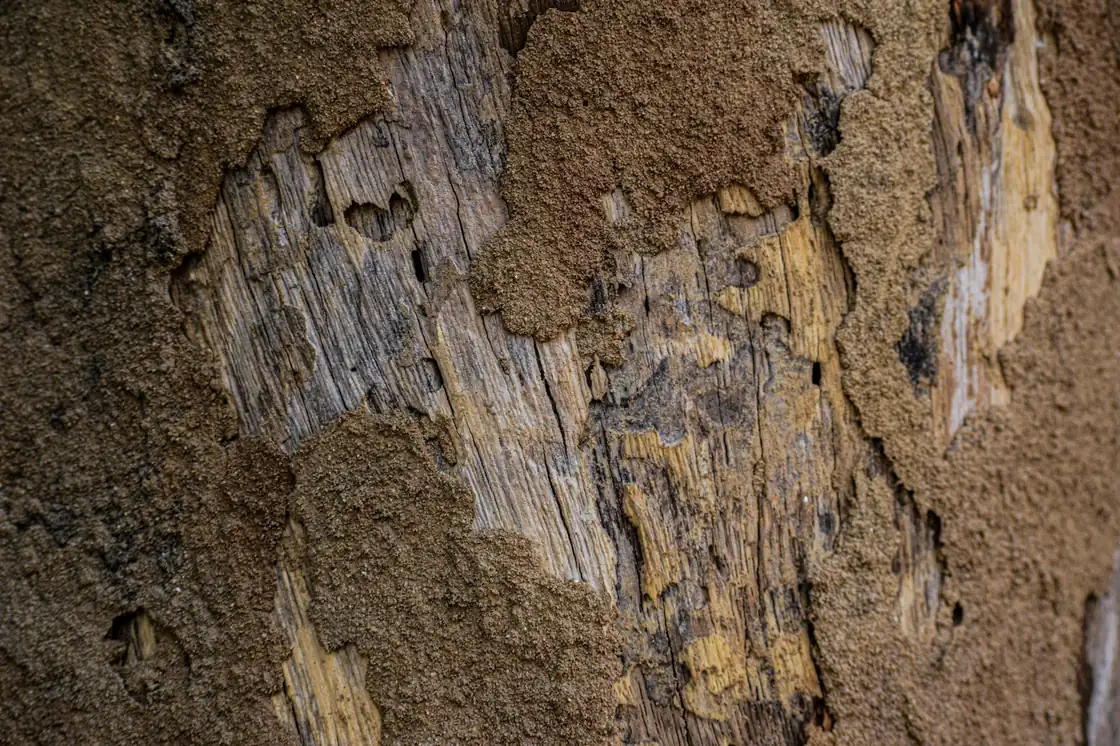
Subterranean termites have a fatal flaw: they desiccate. Open air kills them. So they never travel exposed — they build shelter tubes out of soil, wood and saliva, and every trip between the colony and your joist happens inside one. That’s bad news for your house and very good news for you as a diagnostician, because the tubes are visible and they tell you things.
Go outside with a flashlight. Walk the entire perimeter of the foundation, slowly, at knee height. Then do the garage interior, and then the inside of any crawlspace or utility area. You’re looking for a raised line of dried mud, roughly the width of a pencil, running vertically up concrete block, up the slab edge, up a pier, up a plumbing stack, or across the inside of the block in the garage.
The four kinds of tube, and what each one is telling you
- Working tubes — the ones running from soil straight up to wood. This is the commute. It means there is an active connection between a colony and your structure right now.
- Exploratory tubes — tubes that go up and just stop in mid-air, having found nothing. They look like a failed experiment because they are one. They still mean a colony is actively foraging on your property.
- Drop tubes — tubes hanging down from wood toward the soil. These are re-supply lines back to the ground, and they usually mean an infestation that’s well established above.
- Swarm castles — small bulbous mud structures with exit holes, built for swarmers to launch from. Rare, and a sign of a mature colony.
The break test
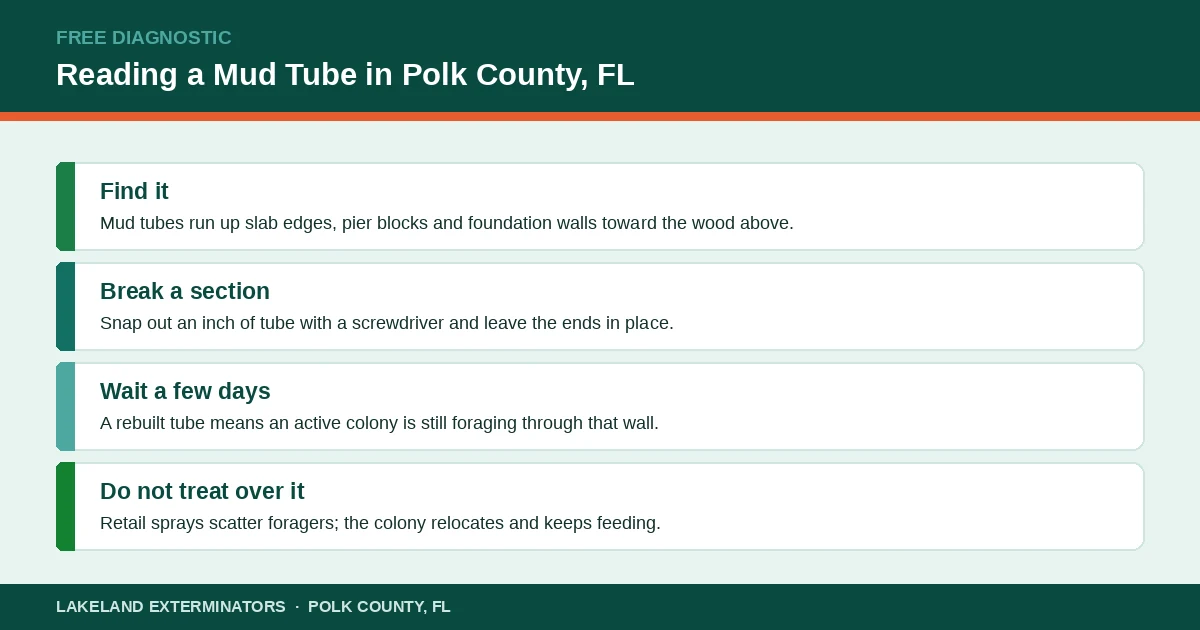
Snap a small section out of a tube with a screwdriver or your fingernail — half an inch is plenty. Then look inside, and then leave it alone and come back in a few days.
Cream-coloured, soft-bodied insects moving around in there means active. No insects, but the gap has been sealed back up with fresh mud when you return, also means active — they repaired the highway. A dry, crumbly, empty tube that stays broken open probably means the colony has moved on or was treated at some point. That last case isn’t a green light, though: it means somebody got in once, and whatever let them in is likely still there.
One warning worth stating plainly. Do not knock down every tube you find before the operator arrives. Those tubes are a map. An inspector reading them can tell where the colony is approaching from and where it’s getting in. Break one to test it if you want, then leave the rest alone.
Two subterranean species, two different problems
Eastern subterranean
The workhorse of Polk County termite calls. Colonies live in the soil and must maintain contact with it — that constraint is precisely what liquid barriers and in-ground bait exploit. Swarms February through May, in daylight, usually within a day or two of a warm rain. If you’re seeing daytime swarmers in March, this is almost certainly your insect.
Eastern subterranean termite guide →Formosan subterranean
The one that changes the treatment plan. Colonies are far larger and more aggressive, and Formosans build carton nests — chewed wood cemented with soil and saliva — that hold their own moisture. Which means a Formosan nest can survive above ground with no soil contact at all. A soil-only barrier can leave that nest untouched. Swarms late spring, humid evenings, in clouds around porch and street lights.
Formosan termite guide →Not seeing mud at all, but finding little piles of hard pellets on a windowsill? That’s a different animal entirely — go read drywood termites in Lakeland instead, because nothing on this page will help you. For the visual checklist that separates them, see signs of termites in a Lakeland home.
How the Polk County dispatch line gets you to a licensed operator
Drop your ZIP
Lakeland, Winter Haven, Bartow, Auburndale, Plant City, Haines City, Lake Wales, Mulberry — anywhere in Polk County.
A coordinator calls you back
A real person. Tell them what you found: where the tubes are, how many, whether they’re on the outside block or inside the garage, and whether you saw swarmers.
A licensed operator inspects
An independent, FDACS-licensed operator walks the foundation, maps the activity, checks the plumbing penetrations and the bath trap, and works out where the colony is coming from. Nobody can quote termite work honestly without doing this.
You get the quote and you decide
The operator sets the price, the method, the warranty and the schedule. Not us. Getting matched costs nothing, and you’re never obligated to accept.
Found a tube? The colony is already here.
Subterranean damage is cumulative and quiet. It doesn’t pause while you think about it.
Talk to a licensed exterminator now
Call and we’ll connect you with a licensed, local exterminator who covers your address. It takes about two minutes, and a real person answers.
Free to call. Free to get matched. The licensed operator gives the quote.
Liquid barrier or bait system? What the operator weighs
Both are legitimate. Both are used constantly across Polk County. They solve the same problem from opposite directions, and the honest answer to “which is right” depends on your house, not on which one the salesman likes.
Liquid soil barrier (trench and treat)
The operator trenches the soil around the foundation and drills through any concrete abutting it — the driveway seam, the patio pour, the garage floor, the front porch — injecting termiticide to create a continuous treated zone in the soil.
The reason this works as well as it does is the chemistry. Modern non-repellent termiticides are undetectable to termites. They don’t avoid the treated soil because they can’t tell. They walk through, pick up the active ingredient on their bodies, and carry it back into the colony where it transfers to nestmates through grooming and feeding. The colony poisons itself.
Good for: fast action, established infestations, slab-on-grade homes, which is most of Lakeland. Trade-offs: it’s invasive — expect a trench, a crew and drilled holes in your concrete that get plugged and patched. Ask to see the patch before they start, especially on stamped or stained hardscape. And afterward, do not re-grade, dig, or trench along that foundation. You’d be cutting a doorway through the barrier you just paid for.
In-ground bait stations
Rather than treating the soil, you weaponize the food. Stations go into the ground in a ring around the structure. Foraging termites find them, feed, and carry the bait back to the colony — and because termites feed each other mouth-to-mouth, the bait spreads through the nest. The active ingredient blocks molting, so the colony cannot replace workers as they die.
Good for: homes with extensive hardscape where drilling is impractical or ugly, owners who want continuous monitoring, and situations where a trench would tear up landscaping you care about. Trade-offs: bait is a campaign, not a strike — it works on colony time, over months. And it is entirely dependent on somebody actually servicing the stations on schedule. An unserviced bait station is a piece of plastic in your yard. Get the monitoring interval in writing and put it on your own calendar.
A note on Formosans. If the operator suspects Formosan rather than eastern subterranean, the conversation should change — because an above-ground carton nest doesn’t care about your soil barrier at all. Ask directly whether they’ve ruled out above-ground nesting, and what they looked at to do it. For the full method-by-method comparison including drywood options, see the complete Lakeland termite treatment guide.
The specific places subterraneans get into a Polk County slab home
Almost everything in Lakeland is slab-on-grade, and slabs have predictable weak points. A licensed operator will go to these first, and you can go look at most of them yourself right now.
- The bath trap. The open void in the slab beneath a tub or shower, where the plumbing comes through. It’s often bare soil, it’s dark, it’s damp, and it opens directly into your wall cavity. It is the single most common hidden entry point in Florida slab construction, and it’s where an experienced inspector wants to look.
- Plumbing and utility penetrations. Every pipe through the slab is a gap, and gaps settle open over decades.
- Expansion joints and settlement cracks. A termite needs a crack about the width of a business card. Your 1985 slab has several.
- The garage–house junction and the porch pour. Where two slabs meet at different times and cure at different rates, there’s a seam. Go look at the inside of your garage block wall — it’s the most-often-ignored surface in the house and it’s where tubes turn up.
- Stucco or siding run down to grade. If you can’t see the weep screed and the slab edge, neither can the inspector, and termites can travel up behind the cladding completely unseen.
- Mulch, soil and plantings piled against the wall. Free bridge over the barrier. Pull it back a few inches. Costs nothing.
- Wood touching soil. Fence posts bolted to the house, deck supports, that stack of firewood against the garage wall, the wooden trellis. It’s a direct road in.
Build era changes the picture. The pre-1990s stock — Dixieland, Cleveland Heights, the streets around Lake Morton and Lake Hollingsworth — predates tighter soil pre-treatment practice and has had forty years to settle and crack. The newer builds in South Lakeland, Christina, Grasslands and Highland City got better pre-treats but often came with irrigation aimed straight at the foundation and dense plantings hard against the stucco. Different eras, same lesson: termites go where it’s wet and where there’s a gap.
When you’ll actually see them: the Polk County swarm window
| Species | Swarm window in Polk County | What it tells you |
|---|---|---|
| Eastern subterranean | February through May, in daylight, typically within a day or two of a warm rain | Swarmers indoors mean a mature colony with an established connection to your structure. This is not an early warning — it’s a late one. |
| Formosan subterranean | Late spring, humid evenings, swarming heavily around porch lights and street lights | Larger colonies and possible above-ground carton nests. The operator should be actively ruling out nesting that a soil barrier wouldn’t reach. |
| Both, all year | No swarm — just continuous feeding, because Polk County never freezes | The absence of swarmers proves nothing at all. Mud tubes, hollow-sounding baseboards and buckling floors are the signals that don’t wait for spring. |
If you want the month-by-month version across all three local termite species, the Florida termite swarming season calendar lays it out. And if you’re buying or selling in Polk County, a WDO inspection is the formal, documented version of everything on this page.
What to ask before you sign
- “What’s your FDACS license number?” Florida pest control operators are licensed under Chapter 482, Florida Statutes, and status is public. Verification link is in the disclosure below. It takes a minute.
- “Eastern or Formosan — and how do you know?” The answer changes the treatment plan. It should reference something they actually saw.
- “Did you check the bath trap and the plumbing penetrations?” If the answer is vague, that tells you what kind of inspection you got.
- “Repellent or non-repellent product — and which one?” A licensed operator will name the product without hesitating. The label is public record.
- “Is the warranty repair or retreat, and what voids it?” Retreat means they come back and treat again. Repair means they pay to fix the joist. Ask what re-grading, adding a deck, or letting mulch pile up does to your coverage — because it can void it.
- “If it’s bait: who services the stations, how often, and what does renewal cost?”
On price: we don’t set it and won’t guess. What Polk County operators typically quote is driven by linear footage of foundation, how much concrete needs drilling, the method, and the warranty you buy. The licensed operator sets the price after inspection — see termite treatment cost in Lakeland for how those variables move the number, or the termite control hub for the overview of every service available locally.
Have a licensed operator read the tubes for you
One ZIP. One call back. You decide from there.
Talk to a licensed exterminator now
Call and we’ll connect you with a licensed, local exterminator who covers your address. It takes about two minutes, and a real person answers.
Free to call. Free to get matched. The licensed operator gives the quote.
Subterranean termite questions, answered straight
Should I knock the mud tubes down?
Break one small section to test whether it’s active — look for living insects inside, or check in a few days to see whether the gap has been sealed back up with fresh mud. Then leave the rest alone. Intact tubes are a map: they tell the inspector where the colony is approaching from and where it’s entering. Destroying all of them before the inspection throws away the most useful evidence you have, and it doesn’t harm the colony in any lasting way.
Can subterranean termites get into a concrete slab house?
Yes, routinely — and slab-on-grade is most of Lakeland. They don’t go through concrete, they go through the gaps in it: plumbing penetrations, expansion joints, settlement cracks, the seam where the garage or porch slab meets the house, and the bath trap void under the tub. A crack about the width of a business card is enough. That’s exactly why treatment targets the soil, not the concrete.
Which works better in Polk County — a liquid barrier or bait stations?
Neither is universally superior; they suit different houses. A liquid barrier acts fast and creates a treated soil zone, but requires trenching and drilling through abutting concrete. Bait is minimally invasive, gives ongoing monitoring, and suits homes with a lot of hardscape — but it works over months rather than weeks and only if the stations are genuinely serviced on schedule. Let the licensed operator inspect and recommend, then make them explain the trade-off in those terms.
How long before the colony dies after treatment?
Weeks rather than days for a non-repellent liquid barrier — the product works by transfer through the colony, not by instant kill, so the decline is gradual by design. Bait typically works over a longer period still, because it interrupts molting. Seeing a few stragglers shortly after treatment is not automatically a failure. Seeing brand-new mud tubes months later is a reason to call the operator back under the warranty.
Do I need to keep paying after the treatment is done?
Usually, yes, if you want to keep the warranty. Termite warranties in Florida generally carry an annual renewal, and a bait system carries an ongoing monitoring cost because the stations have to be serviced to work. Ask what the renewal costs, whether it can increase, and exactly what lapsing does to your coverage — before you sign, not in year three.
Is there anything I can do myself to lower the risk?
Quite a lot, and it’s all free. Pull mulch and soil back from the foundation so the slab edge and weep screed are visible. Fix the dripping hose bib. Aim irrigation heads away from the wall. Move the firewood stack off the side of the house. Get the downspouts discharging away from the footer. Termites need moisture and a bridge — take away both and you’ve genuinely reduced your risk without buying anything.
What does subterranean termite treatment cost in Polk County?
We don’t set prices and won’t quote one. What Polk County operators typically quote depends on the linear footage of your foundation, how much concrete has to be drilled, whether you’re going liquid or bait, and the warranty you choose. The licensed operator sets the price after inspecting. See termite treatment cost in Lakeland for how those variables move the number.
Disclosure
Lakeland Exterminators is a dispatch and matching service. We connect Polk County callers with FDACS-licensed pest control operators. We are not a licensed pest control operator. We do not perform treatment, set prices, issue warranties, hold bonds, or carry pest control trade insurance. All pricing, scheduling, treatment plans, warranties and service terms are determined by the FDACS-licensed operator dispatched to your address under Chapter 482, Florida Statutes.
Same-day and 24/7 emergency services are subject to provider participation, location, technician availability, and demand. Availability is not guaranteed and may vary by market and appointment capacity.
License status of any operator you connect with is publicly verifiable at the FDACS license search.