Termites in one window frame? You may not need a tent over your whole Lakeland house.
Look, here’s the deal: when people search no-tent termite treatment in Lakeland, they’re usually picturing the worst version of this — a circus tent on the roof, three nights in a hotel, the neighbors watching. Sometimes that’s genuinely the call. A lot of the time, for a contained drywood infestation, it isn’t. A licensed operator inspects the wood first and tells you which situation you actually have.
Talk to a licensed exterminator now
Call and we’ll connect you with a licensed, local exterminator who covers your address. It takes about two minutes, and a real person answers.
Free to call. Free to get matched. The licensed operator gives the quote.
24/7 line · A real person answers · Availability of same-day and emergency service depends on the provider.
What “no-tent” actually means — and what it doesn’t
No-tent termite treatment is the industry shorthand for localized drywood termite work. Instead of sealing the entire structure and filling it with fumigant gas, a licensed operator treats the specific pieces of wood that are infested: the fascia board, the window buck, the attic rafter, the door jamb, the piece of trim in the Florida room that’s been dropping pellets on the sill.
That distinction matters more than any price tag, so let’s be blunt about it. Localized treatment reaches the galleries the operator can find and access. It does not reach a colony hiding in a wall cavity two rooms over. Fumigation reaches everything inside the envelope at once because gas doesn’t care about drywall. Neither method is “the right one” in the abstract — the right one is whichever matches the infestation the inspection actually finds.
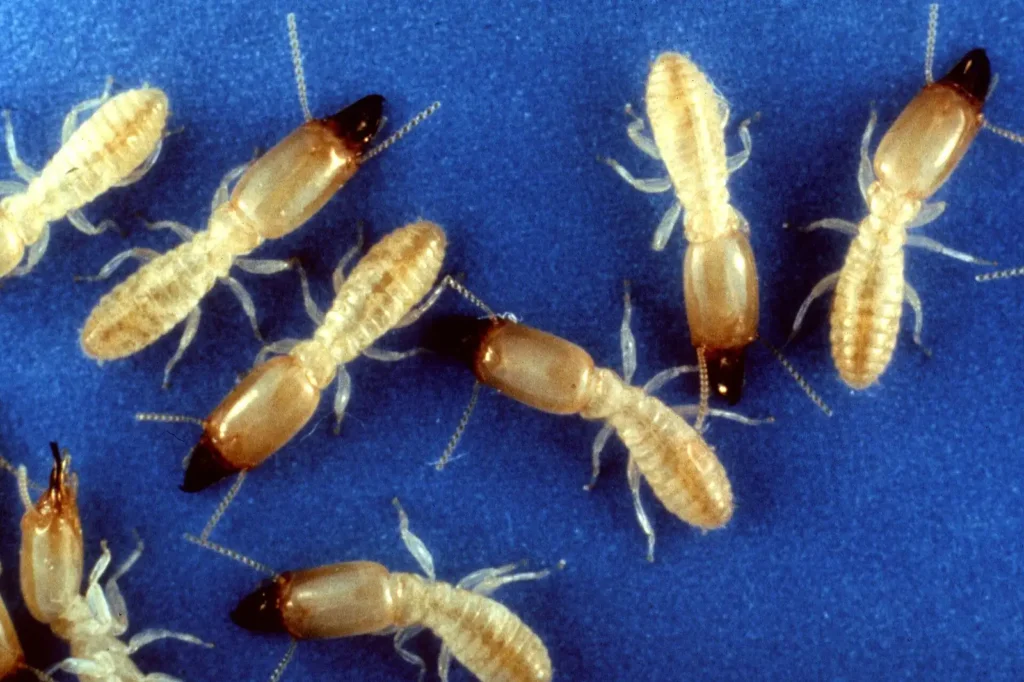
In Polk County the species driving nearly all of this is the Florida drywood termite, Cryptotermes brevis. Unlike the subterranean termites that build mud tubes up your slab from the soil, drywood termites live their entire lives inside the wood, with no ground contact at all. That’s precisely why injecting the wood can work — the colony is right there in the board. And it’s also why they can be so easy to miss: no mud tubes on the foundation, no soil connection, nothing to see from the yard. Just a small drift of pellets that looks like coarse pepper or sawdust under a window.
One more thing worth saying plainly: the word “no-tent” gets used in advertising to mean anything from a genuine borate injection to a spray-the-baseboards visit that does nothing to a drywood colony. If you’re shopping this, ask the operator to name the method, the product, and the specific members being treated. A real answer sounds like “we’re drilling and foaming the two south-facing window bucks and the adjacent header.” A vague answer is a signal.
The no-tent methods a licensed operator may put on the table
These are the approaches you’ll hear discussed during an inspection. We don’t perform any of them — we route you to the FDACS-licensed operator who does, and they decide what’s appropriate for your wood.
Drill-and-inject foam or termiticide
The infested member is drilled at intervals and a foaming termiticide or borate solution is pushed into the galleries, where it travels along the tunnels the termites cut. This is the workhorse of localized drywood work. It requires the operator to be able to reach the wood — which is why an accessible window frame is a candidate and a hidden wall stud usually isn’t.
Borate wood treatment
A borate solution applied to bare or replaced wood soaks into the surface layers and stays there. It’s most useful when trim, fascia or sheathing is being replaced anyway after damage — the new wood goes back up already treated. It’s a preventive layer on exposed wood, not a rescue for a deep active colony behind paint.
Void and gallery dusts
A dust formulation blown into open galleries or voids can collapse a small, tightly localized pocket. Operators typically pair it with injection rather than leaning on it alone, and it depends entirely on having real access to the tunnels.
Localized heat
Targeted thermal treatment raises the temperature of a defined area — a section of attic, a piece of furniture, a bay of framing — past what drywood termites survive. It’s chemical-free, which some Lakeland homeowners specifically ask for, and it’s bounded by whatever area the equipment can actually bring up to temperature and hold.
Two things every one of these methods has in common. First, they only cover what was treated — the warranty language, if any, follows the treated members, not the house. Second, they all assume an inspection happened first. Skipping the inspection and picking a method off a menu is how people end up paying twice. If you want the full picture of what a licensed operator looks for, our termite control in Lakeland hub walks through the inspection and every treatment route, subterranean included.
When tenting is still the honest answer
Here’s where a lot of sites get squishy, and we won’t. Whole-structure fumigation is the only method that reaches drywood termites everywhere at once: inside the wall cavities, up in the attic sheathing you can’t see, in the furniture, in the piano. If pellets are showing up in more than one room, if you’re seeing kick-out holes in several areas, or if a real-estate WDO report flags multiple locations, localized treatment is a coin flip — and the colony you miss is the one that keeps eating.
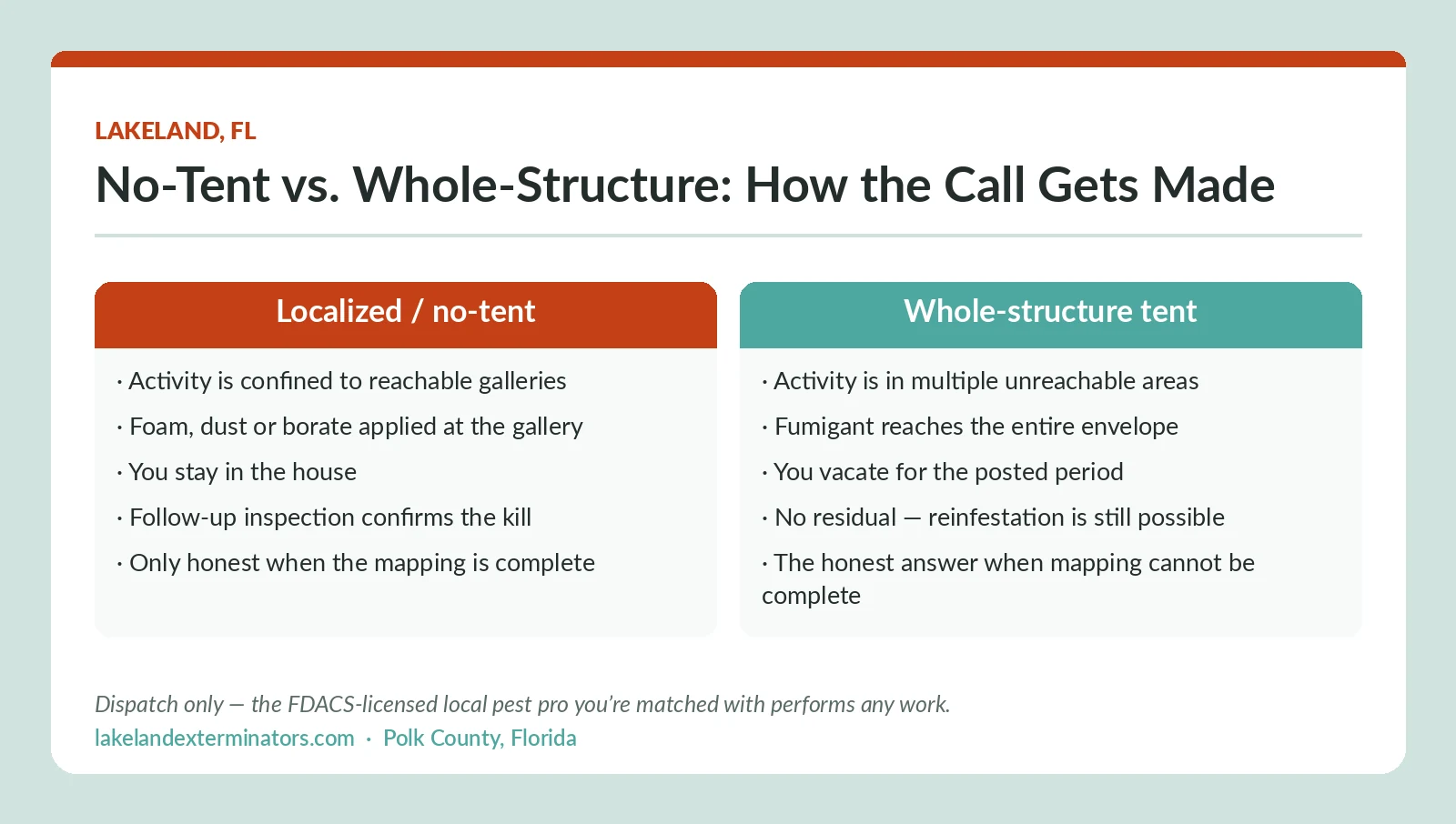
Tenting is also what typically comes with a renewable structural warranty from the operator, because the operator can stand behind treating everything. Localized work usually can’t offer that, for the obvious reason: nobody warranties wood they never touched. If the warranty matters to you — and it often does when you’re selling — that’s part of the math.
| No-tent (localized) | Tent fumigation | |
|---|---|---|
| Fits when | Activity confined to accessible members you can point at | Activity in several rooms, hidden areas, or unknown extent |
| Move out? | No — usually a same-visit job | Yes — typically two to three nights |
| Reaches hidden galleries | Only what’s accessed | Whole structure inside the seal |
| Warranty | Limited, and only on treated members | Operator often offers a renewable structural warranty |
| Relative cost | Lower | Higher |
If you land on the tenting side of that table, don’t guess at the logistics — read how to prepare for termite tenting in Florida and the cost of termite tenting in Florida before you sign anything, and see drywood termite tenting in Lakeland for what the fumigation process actually involves.
Not sure whether your infestation is contained?
One call reaches a licensed, local exterminator who covers your address — and a real person answers, 24/7.
Talk to a licensed exterminator now
Call and we’ll connect you with a licensed, local exterminator who covers your address. It takes about two minutes, and a real person answers.
Free to call. Free to get matched. The licensed operator gives the quote.
First, make sure you’re even chasing the right termite
No-tent treatment is a drywood conversation. If what you’ve actually got is a subterranean colony coming up from the sandy soil under the slab, tenting was never on the table in the first place — and neither is drill-and-foam. Different animal, different playbook. Here’s the field guide, minus the jargon:
- Six-sided pellets (frass). Tiny, hard, gritty, roughly the color of the wood, piling up under a window sill or in a neat cone on the floor. That’s drywood. Sweep it up; if it comes back, they’re active.
- Mud tubes on the foundation or slab edge. Pencil-width dirt highways running up block or stucco. That’s subterranean, and it means soil contact — a soil termiticide barrier or a Sentricon bait station system is the conversation, not a tent.
- Swarmers indoors. Timing is the tell in Polk County. Subterranean swarms cluster February through May, usually in the day or two after a warm rain. Florida drywood swarms run later — roughly May into August, often at dusk, and they tend to show up as discarded wings on a windowsill rather than a cloud in the yard.
- Blistered or rippled paint on trim. Drywood termites eat right up to the paint film and leave it as a thin skin. Press it — if it gives like a bruise, there’s a gallery under there.
- Hollow-sounding wood. Tap along a fascia board or door jamb with a screwdriver handle. The change in tone where the sound goes papery is the map.
Still not sure? The species pages break the biology down: Florida drywood termite in Polk County and eastern subterranean termite in Polk County. Getting this right before you call is worth ten minutes of your evening.
Why localized treatment works more often in Lakeland than you’d expect
Housing stock is the reason. A huge share of Lakeland’s older neighborhoods — Dixieland, the Garden District around Lake Morton, Cleveland Heights, the streets ringing Lake Hollingsworth — are full of homes with exposed wood trim, deep eaves, wood-framed windows and real fascia boards. That’s exactly the kind of accessible, visible wood where a drywood pocket announces itself early with a pellet pile and where an operator can get a drill bit on it.
Meanwhile the 1980s-and-newer slab-on-grade construction across South Lakeland, Highland City, Christina and the Grasslands tends to shift the risk profile: less exposed wood, more slab, more subterranean pressure through sandy Central Florida soils and expansion joints. Different house, different termite, different fix. Homes along the I-4 corridor in North Lakeland and out toward Kathleen sit near old citrus-grove edges and tree lines, which keeps swarmer pressure up on both fronts.
And the Chain of Lakes humidity ties it all together. Wood that stays damp — a fascia under a clogged gutter, trim behind a sprinkler head that hits the wall every morning, a window sill under a leaky flashing — is wood that gets found. If an operator does localized work on your house and you don’t fix the moisture that made that board attractive, you’re renting the solution, not buying it.
How the dispatch works — four steps, no phone tag
You call the dispatch line
That’s the whole ask. No forms with fourteen fields, no “a specialist will email you a brochure.” Your address tells us which Polk County operators cover your address.
We match you to a licensed operator
We route you to an independent, FDACS-licensed and insured pest control operator working your area. We’re a dispatch service — we don’t treat, and we don’t take a cut of your quote.
They inspect the wood
The operator looks at the members you’re worried about, probes for galleries, and determines whether the activity is contained enough for localized treatment or extensive enough to need fumigation.
They quote, you decide
Pricing, method, warranty terms and scheduling all come from the operator, in writing. You’re free to get a second inspection. Nothing on this page obligates you to anything.
What Polk County operators typically quote — and what moves the number
We never set prices and we never quote them. What we can tell you is what actually drives the figure the licensed operator writes down, because knowing that is how you read a proposal instead of just reacting to it.
- How many members are being treated. One window buck is one price. Six locations across the attic, the lanai and two bedrooms is a different conversation — and at some point the math stops favoring localized work and starts favoring fumigation.
- Access. A fascia board you can reach off a six-foot ladder is cheap access. A second-story soffit, a tight attic run, or trim behind cabinetry is not.
- Method. Foam injection, borate application, dusting and localized heat all carry different labor and equipment loads.
- Whether wood needs replacing. Treatment kills the colony; it doesn’t restore a board that’s been hollowed out. Carpentry is usually separate, and sometimes it’s a separate contractor entirely.
- Warranty and follow-up. A limited warranty on treated members, with a re-inspection, generally prices differently than a one-and-done visit.
For the fuller cost picture on both sides of the tent question, see termite treatment cost in Lakeland, and if you’re weighing ongoing protection afterward, whether an annual termite bond is worth it in Lakeland is the companion read. Whatever the number ends up being, it’s the operator’s number — set after they’ve seen your wood, not before.
Questions worth asking before you sign anything
You’re allowed to interview the person treating your house. The good ones expect it.
- “What’s your FDACS license number?” — then check it yourself at the FDACS license search. Every operator licensed under Chapter 482, Florida Statutes, is in that public database. It takes about thirty seconds.
- “Exactly which members are you treating, and what product goes in them?”
- “What happens if activity shows up in a wall I’m not treating today?”
- “Does anything you’re proposing carry a warranty, and does it cover the structure or only the treated wood?”
- “Do you re-inspect, and when?”
- “If you were selling this house next year, would you do it this way?” — that one gets honest answers surprisingly often.
If a real-estate transaction is driving this, a WDO inspection in Lakeland is the document the lender or buyer will actually want, and it’s a different scope than a treatment sales visit. Know which one you’re booking.
Get a licensed operator to look at the wood
One call reaches a licensed, local exterminator who covers your address — and a real person answers, 24/7.
Talk to a licensed exterminator now
Call and we’ll connect you with a licensed, local exterminator who covers your address. It takes about two minutes, and a real person answers.
Free to call. Free to get matched. The licensed operator gives the quote.
No-tent termite treatment questions, answered straight
Can drywood termites really be treated without tenting?
Yes — when the infestation is localized and the operator can physically reach the infested wood. Drill-and-inject foam, borate treatment, gallery dusts and localized heat all work on contained pockets. What they can’t do is reach a colony inside a wall cavity or an attic bay nobody found. That’s the honest limit, and it’s why the inspection comes before the method.
How do I know if I can avoid tenting?
An inspection decides it, not a phone call and not a web page. Broadly: if frass is showing up in exactly one accessible spot and probing confirms the damage stops there, localized treatment is a reasonable route. If pellets appear in several rooms, if kick-out holes are scattered, or if a WDO report flags multiple areas, fumigation is the method that doesn’t leave a colony behind.
Is no-tent treatment cheaper than fumigation?
Generally yes, and that’s the appeal — but it’s cheaper because it covers less. You’re paying to treat specific members, not the structure. We don’t set or quote prices; the licensed operator does that after inspecting. What we’ll say is that if the number of locations keeps climbing, the cost advantage narrows fast and the coverage gap doesn’t.
Does localized treatment come with a warranty?
Sometimes, and when it does the warranty typically follows the treated members only — not the whole house. Whole-structure fumigation is what usually carries a renewable structural warranty, because the operator treated everything inside the seal. Warranty terms are entirely the operator’s to set; read them before you sign.
Do I have to move out for no-tent treatment?
Typically no. Localized drill-and-inject or dust work is usually done in a single visit with the household staying put, though the operator will give you specific re-entry guidance for the treated rooms based on the product used. Fumigation is the one that requires vacating the structure, generally for two to three nights.
Will no-tent treatment work on subterranean termites?
No — different problem entirely. Subterranean termites live in the soil and travel up through mud tubes and slab expansion joints. They’re handled with a soil termiticide barrier or a bait station system, not wood injection. If you’re seeing mud tubes rather than pellets, start with termite control in Lakeland and skip the tent-vs-no-tent question altogether.
How do I verify the operator is actually licensed?
Ask for the license number and look it up at the FDACS license search. Pest control in Florida is regulated under Chapter 482, Florida Statutes, and licensing is public record. We route only to FDACS-licensed operators, and we’d still tell you to check — verification costs you nothing.
How fast can someone get out here?
Depends on the operator, your ZIP, and how booked the week is — especially during spring swarm season when everyone in Polk County calls at once. The dispatch line runs 24/7 and a real person answers. Availability of same-day and emergency service depends on the provider. Availability is not guaranteed and may vary by market and appointment capacity.
Disclosure
Lakeland Exterminators is a dispatch and matching service. We connect Polk County callers with FDACS-licensed pest control operators. We are not a licensed pest control operator. We do not perform treatment, set prices, issue warranties, hold bonds, or carry pest control trade insurance. All pricing, scheduling, treatment plans, warranties and service terms are determined by the FDACS-licensed operator dispatched to your address under Chapter 482, Florida Statutes.
Same-day and 24/7 emergency services are subject to provider participation, location, technician availability, and demand. Availability is not guaranteed and may vary by market and appointment capacity.
License status of any operator you connect with is publicly verifiable at the FDACS license search.