Termite tenting is not priced by square foot. It is priced by the air inside your house.
One call reaches a licensed, local exterminator who covers your address — and a real person answers, 24/7.
Talk to a licensed exterminator now
Call and we’ll connect you with a licensed, local exterminator who covers your address. It takes about two minutes, and a real person answers.
Free to call. Free to get matched. The licensed operator gives the quote.
24/7 line · A real person answers · Availability of same-day and emergency service depends on the provider.
Why fumigation is priced by cubic foot, not square foot
Look, here is the deal. Every other termite treatment you will price in Florida is measured across a surface — linear feet of foundation to trench, square feet of slab to drill. Fumigation is different, because the product is a gas. Sulfuryl fluoride has to fill the entire volume under the tarp and hold a target concentration long enough to penetrate the wood where drywood termites are living.
So the operator is not really pricing your floor plan. They are pricing the volume of air they have to fill and hold. That is why:
- A two-story home costs meaningfully more than a single-story of the same square footage — roughly double the volume, plus a bigger, more complicated tarp.
- Vaulted and cathedral ceilings raise the quote on a house that looks modest from the street.
- A tall attic volume matters even though nobody lives up there — the gas has to fill it, because that is exactly where the drywood colonies are.
It also explains the thing homeowners find maddening: no honest fumigator will quote you a firm number over the phone. They have to measure. Anyone who names a price before seeing the structure is either padding heavily or about to revise it on the day.
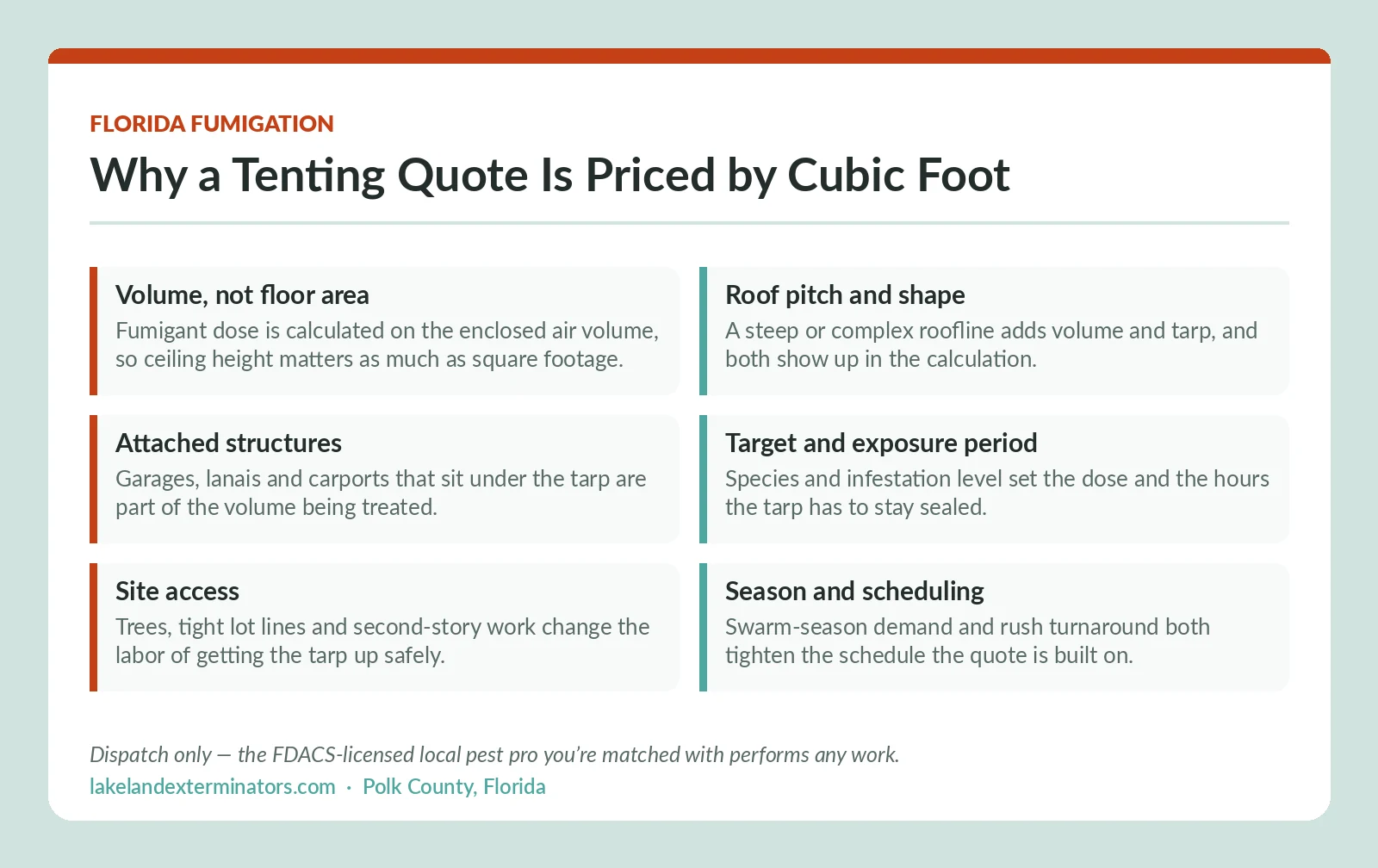
The six factors that move a Florida tenting quote
| Factor | What it does to the number |
|---|---|
| Cubic footage of the structure | The dominant driver. Height counts as much as floor area — two stories, vaulted ceilings and a deep attic all add volume that has to be filled and held. |
| Gas dose rate | Set by the target organism, the thickness of the wood being penetrated, and the required exposure time. A dense old-growth beam is a different penetration problem than modern framing. The licensed fumigator calculates this — it is not a menu item. |
| Tarp size and seal complexity | Complex rooflines, attached carports, lanais, pool screen enclosures and tight lot lines all make the seal harder. A simple gable roof on an open lot is the easy day; a Lakeland ranch with a wrapped lanai and a screen cage is not. |
| Preparation scope | Gas shutoff coordination, bagging food and medication, relocating pets and plants. Most operators fold this into the quote; a few price it separately. Ask which. |
| Aeration and clearance testing | Standard on every legitimate job, and normally included: the structure is aerated and then tested with a monitoring instrument until it is safe to re-enter. If a quote is silent about clearance testing, that is a question, not a saving. |
| Access and logistics | Tight driveways, overhanging oaks, second-story balconies and neighbors sharing a lot line all add crew time on tarp day. |
Notice what is not on that list: how badly infested you are. Fumigation fills the whole structure regardless. A modest drywood pocket and a house riddled with them cost about the same to tent — which is precisely why catching it early does not save you money on the tent, but does save you the repair bill underneath it.
Get the structure measured and the tenting quoted properly.
One call reaches a licensed, local exterminator who covers your address — and a real person answers, 24/7.
Free to call. Free to get matched. The licensed operator gives the quote.
What is in the quote — and what is not
Normally included
Tarp installation and removal, the fumigant itself, monitoring during exposure, aeration, clearance testing before re-entry, and filing the required Notice of Treatment. A secured re-entry process is part of a legitimate job, not an upsell.
Normally NOT included
Structural repair of damaged wood — fumigation kills the colony, it does not replace a joist. Also excluded: your lodging during the vacate window, putting your kitchen back together afterward, and in some cases landscaping protection or damage to plantings from tarp handling.
The repair trap worth understanding
A tent solves the biology and nothing else. If drywood termites have been working through your window framing for years, the fumigation ends the colony on Thursday and the carpentry bill starts on Friday. That is a separate scope, a separate contractor, and a separate number — and it is the single most common surprise on a Florida tenting job. Ask the inspector to document the damage extent, not just the activity.
The part that costs you time instead of money
Tenting takes the house away from you for a stretch — commonly a couple of days, sometimes closer to three, depending on the dose, the structure and the aeration. The operator sets the exact window. Budget for it honestly:
- Everything edible or ingestible goes. Food, medication, pet food, even some cosmetics — either out of the house or double-bagged in the fumigation-grade bags the operator supplies. Sealed cans and unopened bottles usually stay; ask about anything you are unsure of.
- Pets, people and plants leave. All of them. Potted plants generally come outside the tarp line; landscaping close to the wall may need protection.
- Gas gets shut off and re-lit. Coordinated with the utility — the operator handles the scheduling, but somebody has to be reachable for the relight.
- Access and keys. The operator secures the structure during the exposure. Lock boxes, alarm codes and gate access all need sorting before tarp day.
- Nobody re-enters until clearance. Not for a phone charger, not for ten minutes. The clearance test is the whole safety system.
Detailed walk-through: how to prepare for termite tenting in Florida.
Do you actually need the tent?
Honest answer: sometimes yes, sometimes no — and it depends entirely on what the inspection finds. This is the question to press hardest on, because it is the difference between the largest termite invoice most Florida homeowners ever see and a much smaller one.
The tent is the honest answer when…
Drywood activity is spread through framing in ways nobody can fully map — multiple rooms, attic rafters, hidden voids. Gas reaches wood that no injection can. When the extent is genuinely unknown, fumigation is the treatment that does not rely on a guess.
No-tent work is legitimate when…
The colony is bounded to accessible wood and the operator can verify the extent — a single window frame, a run of accessible trim. Direct wood injection and foam are real treatments, not shortcuts. No-tent guide →
Be wary of anyone who commits to either path before inspecting. An operator who sells tents will find reasons to tent; an operator who never tents will find reasons not to. The right answer comes out of the inspection, and it is worth getting a second licensed opinion when the number is this large. Related: drywood termite tenting in Lakeland and the full termite treatment guide.
Tenting in Polk County specifically
Why the drywood problem is a Central Florida problem
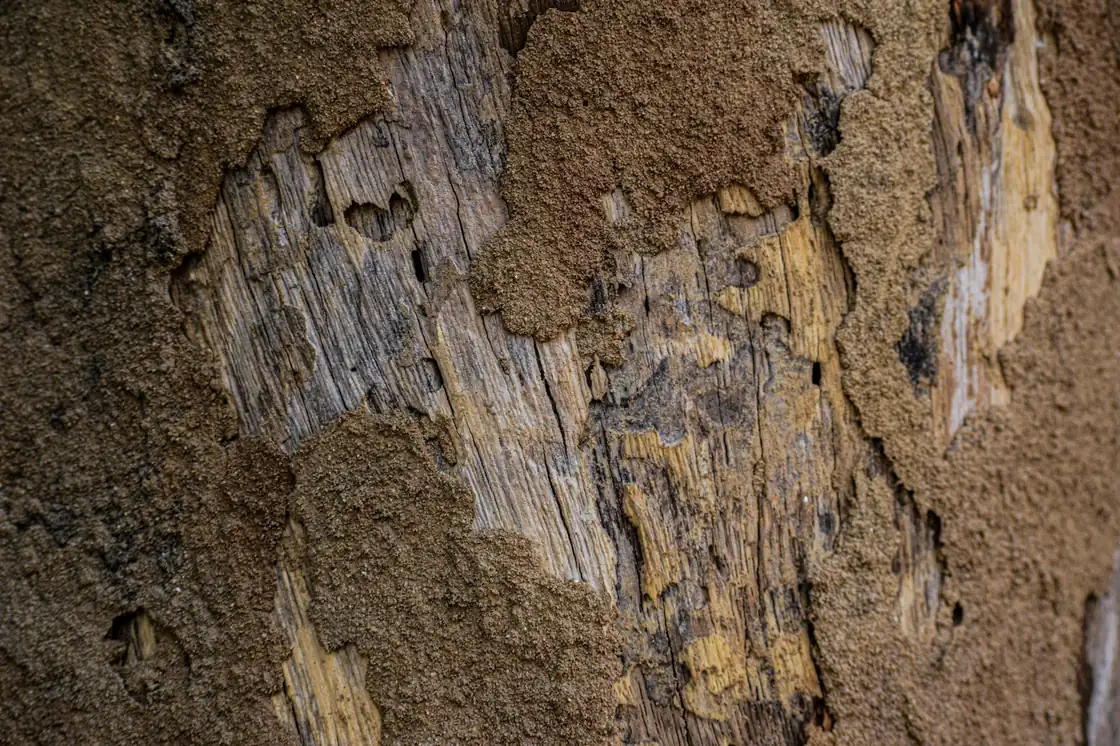
Florida drywood termites need no soil contact at all. Swarmers drift in through soffit and gable vents from roughly May into August, settle in attic rafters, window framing and furniture, and the first thing most homeowners notice is a small pile of six-sided frass pellets months later. That biology is why tenting exists here and barely registers in most of the country — and why a subterranean termite bond usually does not cover the pest that puts a tarp on your roof.
Local structures that complicate the seal
Lakeland housing stock throws real tarp problems at a fumigator: screen-enclosed pools in South Lakeland and Grasslands, wrapped lanais poured against the original slab, deep live-oak canopy over the older Dixieland and Lake Morton streets, and tight lot lines in Cleveland Heights. None of it is a dealbreaker. All of it is crew time, and crew time is the quote.
Storm season is a scheduling factor
From June into September, Polk County gets near-daily afternoon storms and the wind that comes with them. Tarp work is weather-sensitive, and operators will move a job rather than fight a squall line. If you are trying to land a fumigation inside a real estate closing window during summer, build in slack — availability depends entirely on the provider.
How the dispatch works
Straight up: Lakeland Exterminators is a dispatch and matching service, not a licensed pest control operator. We do not fumigate, we do not measure and we do not price. Fumigation in Florida requires a specific FDACS license category, and we are not it.
Describe what was found
Frass pellets, kick-out holes, swarmers in the attic — or a WDO report that already names drywood. A real person answers around the clock.
Your address picks the operator
The call routes to an FDACS-licensed operator covering your part of Polk County who holds the fumigation category the job requires.
They measure, then they quote
Cubic footage, tarp complexity, dose and exposure time — calculated on site. The number is theirs. We never set it.
The job and the warranty stay with the pro
Fumigation, aeration, clearance testing and any warranty are all owned by the licensed operator under Chapter 482, Florida Statutes.
Verify before you hire. Fumigation requires a fumigation-specific FDACS license category — not just a general pest license. Confirm it yourself at the FDACS license search before anyone puts a tarp on your house. On a job this size, thirty seconds of checking is the highest-value thing you will do all week.
Drywood termites confirmed? Get the tenting quoted properly.
One call reaches a licensed, local exterminator who covers your address — and a real person answers, 24/7.
Free to call. Free to get matched. The licensed operator gives the quote.
Termite tenting cost questions, answered straight
What does termite tenting cost in Florida?
The FDACS-licensed fumigation operator sets the price after measuring the structure — we are a dispatch line and we do not publish prices. The reason no honest operator quotes a firm number by phone is that fumigation is priced by the cubic footage of the structure, not the square footage. Volume, tarp complexity, gas dose rate and exposure time all feed the calculation, and they cannot be known from a street view. Expect an on-site measurement before any real number.
Why is fumigation priced by cubic foot instead of square foot?
Because the treatment is a gas. Sulfuryl fluoride has to fill the entire volume under the tarp and hold a target concentration long enough to penetrate the wood where the drywood colonies live. The operator is pricing the air they have to fill and hold, which is why ceiling height, attic volume and a second story move the number as much as floor area does.
Why does a two-story cost so much more to tent than a ranch?
Volume roughly doubles for the same footprint, and the tarp gets larger and far harder to seal — more surface, more edges, more crew time on tarp day. Add a vaulted ceiling or a deep attic and the volume climbs again. It is not a markup for the second floor; it is genuinely more gas, more tarp and more labor.
How long do I have to be out of the house?
Commonly a couple of days, sometimes closer to three — the exposure period plus aeration and clearance testing. The licensed operator sets the exact window based on the dose and the structure, and nobody re-enters until the clearance test passes. Not for a phone charger, not for ten minutes. That test is the entire safety system, and availability of any particular schedule depends on the provider.
Does the tenting quote include repairing the damaged wood?
No, and this is the most common surprise on a Florida fumigation job. The tent ends the colony; it does not replace a joist, a rafter or a window frame. Structural repair is a separate scope with a separate contractor and a separate number. Ask the inspector to document the extent of the damage, not just the presence of activity, so you can budget for both.
Does my termite bond cover fumigation?
Often it does not. Most subterranean termite bonds name subterranean termites only — and drywood termites are the pest that puts the tent on your roof. Two different organisms, frequently two different contracts. Check which species your bond actually names before you assume you are covered. The termite bond guide explains the distinction.
Can I avoid tenting with a spot treatment?
Sometimes, legitimately. No-tent localized treatment — direct wood injection, foam — works when the colony is bounded to accessible wood and the operator can verify the extent. It is not a shortcut when activity is spread through framing nobody can map; in that case gas reaches wood injection cannot. Be skeptical of anyone who commits to either path before inspecting, and consider a second licensed opinion when the number is large.
Is tenting safe for my house and belongings?
The fumigant is a gas that dissipates during aeration and leaves no meaningful residue on surfaces, which is why furniture and most household goods stay put. What must be bagged or removed is anything ingestible — food, medication, pet food. Plants and pets leave entirely. The operator supplies the fumigation-grade bags and the preparation list; follow it exactly, and ask about anything you are unsure of rather than guessing.
Disclosure
Lakeland Exterminators is a dispatch and matching service. We connect Polk County callers with FDACS-licensed pest control operators. We are not a licensed pest control operator and we do not perform fumigation. We do not perform treatment, set prices, issue warranties, hold bonds, or carry pest control trade insurance. All pricing, scheduling, treatment plans, warranties and service terms are determined by the FDACS-licensed operator dispatched to your address under Chapter 482, Florida Statutes. Fumigation requires a separate FDACS license category held by the operator performing the work.
Same-day and 24/7 emergency services are subject to provider participation, location, technician availability, and demand. Availability is not guaranteed and may vary by market and appointment capacity.
License status of any operator you connect with is publicly verifiable at the FDACS license search.