How long does termite treatment actually take? It depends entirely on the method.
One call reaches a licensed, local exterminator who covers your address — and a real person answers, 24/7.
Talk to a licensed exterminator now
Call and we’ll connect you with a licensed, local exterminator who covers your address. It takes about two minutes, and a real person answers.
Free to get matched. The licensed operator gives the quote.
24/7 line · A real person answers · Availability of same-day and emergency service depends on the provider.
Quick answer: treatment time by method
The single biggest variable is which treatment your inspection calls for. Here’s the honest range for a typical Polk County single-family home:
| Method | On-site time | Time to effective control |
|---|---|---|
| Liquid soil barrier (subterranean) | 4–8 hours | Days to a few weeks as foragers contact the treated zone |
| Bait system install (e.g. Sentricon) | 1–2 hours | Weeks to months — the colony is eliminated through the bait over time |
| Whole-house fumigation (drywood) | 48–72 hours of tent time | Complete within the exposure window; aeration and clearance follow |
| No-tent localized (drywood, bounded) | 1–3 hours | Days, when the colony is accessible and fully mapped |
Notice the split between on-site time and time to elimination. A bait install is quick to set up but works slowly by design; a liquid barrier takes a full workday but starts protecting immediately. Neither is “better” in the abstract — the right one depends on the species and how the infestation is situated.
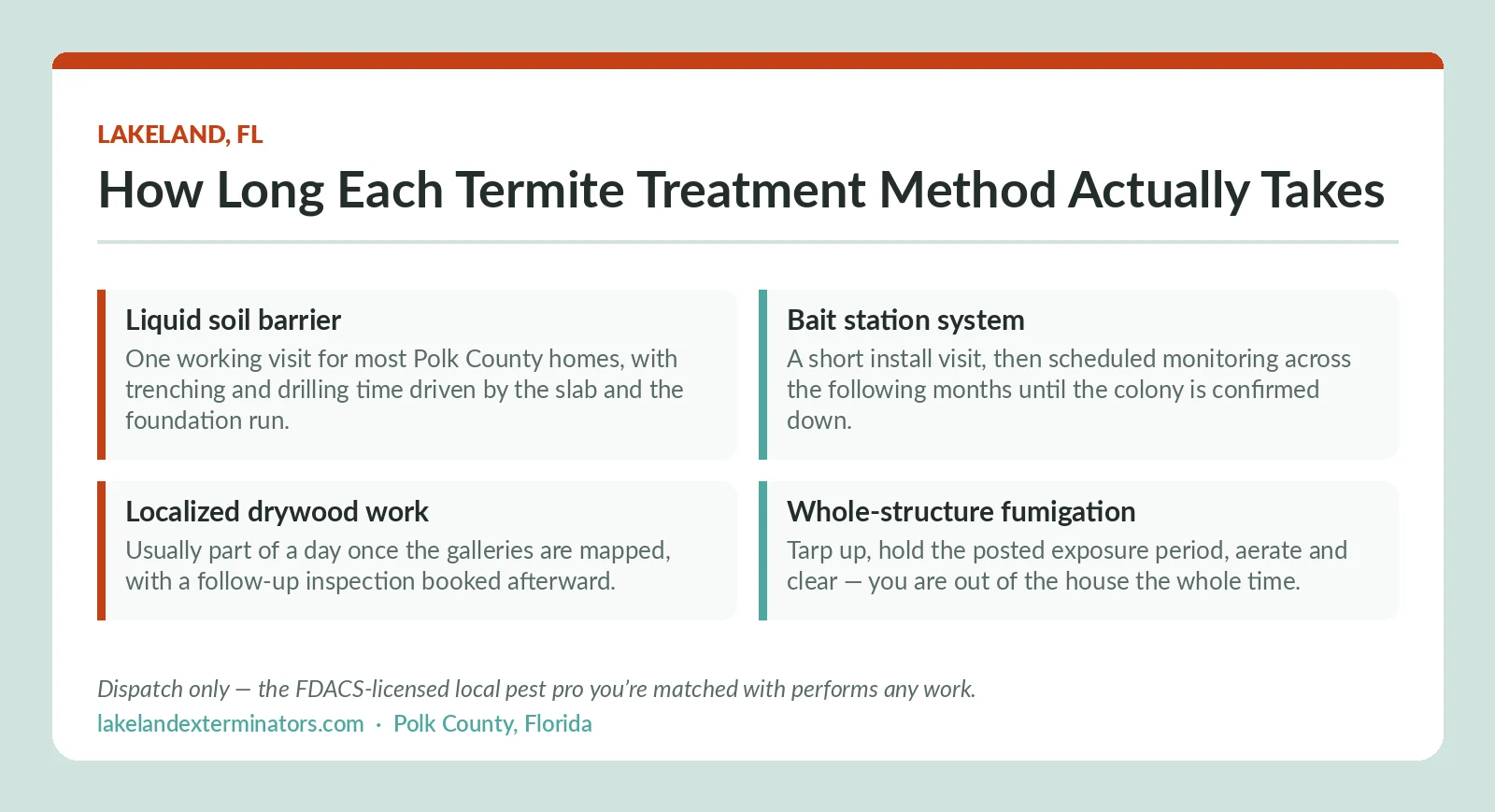
What each treatment involves
Liquid soil barrier
A non-repellent termiticide (Termidor-class) is trenched and injected around the foundation, creating a treated zone subterranean termites carry back to the colony. One working day on site for most homes; protection builds over the following days to weeks. Pairs with an annual bond for ongoing coverage.
Bait system
In-ground stations (Sentricon and similar) are installed around the structure and monitored. The colony feeds and shares the active ingredient, collapsing over weeks to months. Fast to install, slow and thorough to work — and low-disruption to the household.
Whole-house fumigation
The structure is tented and gassed for drywood termites that live inside the wood itself. Total time is 48–72 hours including tarp setup, gas exposure, aeration, and clearance testing before re-entry. You’ll need to arrange to be out of the home for that window.
No-tent localized drywood
When drywood activity is confined to accessible, verifiable wood, spot treatments (foams, dusts, or localized fumigants) can resolve it in 1–3 hours without tenting. Legitimate only when the extent is fully mapped — which is why the inspection matters.
Which path applies is a question the licensed inspector answers after identifying the species and mapping the spread. For the species behind each, see subterranean, Formosan, and drywood termites.
What changes the timeline for your home
- Species. Subterranean vs. drywood is the fork in the road — it decides between soil barrier/bait and fumigation/spot work.
- How far it has spread. A bounded drywood colony may qualify for a 1–3 hour no-tent job; widespread activity through the framing points to fumigation.
- Home size and construction. Square footage, foundation type, and linear footage of foundation all affect trenching and station counts.
- Prep and clearance. Fumigation adds prep time (bagging food, arranging to vacate) and mandatory clearance testing before re-entry — built into the 48–72 hour window.
- Bond and monitoring. Bait and bonded liquid programs add periodic monitoring visits after the initial job — short, but ongoing.
None of this is quoted sight-unseen. The FDACS-licensed operator confirms the species and scope on inspection, then gives you both the on-site schedule and the realistic time to control.
Need a treatment timeline for your specific home?
One call reaches a licensed, local exterminator who covers your address — and a real person answers, 24/7.
Free to get matched. The licensed operator gives the quote.
Termite treatment time FAQs
How long does a liquid termite treatment take?
How long do I have to be out of the house for fumigation?
Why does a bait system take so long to work?
Can drywood termites be treated without tenting?
Are you the pest control company?
Related Polk County pages
Disclosure
Lakeland Exterminators is a dispatch and matching service. We connect Polk County callers with FDACS-licensed structural pest control operators. We are not a licensed pest control operator. We do not perform treatment, set prices, issue warranties, or carry pest control trade insurance. All pricing, scheduling, treatment plans, and service terms are determined by the FDACS-licensed operator dispatched to your address under Chapter 482, Florida Statutes.
Same-day and 24/7 emergency services are subject to provider participation, location, technician availability, and demand. Availability is not guaranteed and may vary by market and appointment capacity.
License status of any operator you connect with is publicly verifiable at the FDACS license search.