The tent goes up Tuesday. Here’s everything you should have already done by Sunday.
Prep is the part of termite tenting that homeowners underestimate and then pay for — in a delayed start, a lost half-day, or a pantry full of food you have to throw out. Your licensed fumigator gives you a written prep sheet and that sheet governs. This page is the honest preview, so nothing on it surprises you at 9pm the night before.
Talk to a licensed exterminator now
Call and we’ll connect you with a licensed, local exterminator who covers your address. It takes about two minutes, and a real person answers.
Free to call. Free to get matched. The licensed operator gives the quote.
24/7 line · A real person answers · Availability of same-day and emergency service depends on the provider.
Why prep is the thing that blows up the schedule
Look, here’s the deal. A fumigation is a tightly sequenced job: the tarp crew has a window, the gas has a window, the utility has a window, and the clearance tech has a window. Everything downstream depends on the tarp sealing on time. And the two things that most often stop that from happening are both prep failures — a gas shut-off that never got requested, and shrubbery growing so tight against the block that the tarp can’t seat at grade.
Do it right and it’s a smooth two-to-three nights out of the house. Do it sloppy and you’re rescheduling, re-bagging, or throwing away a fridge full of groceries you didn’t seal. The good news: it’s all knowable, it’s all boring, and none of it is hard once you know it’s coming.
One framing note before the lists: we don’t fumigate anything. Lakeland Exterminators is a dispatch service. The FDACS-licensed operator on your job sets the prep requirements, supplies the bags, coordinates the utility and signs the clearance. Everything below is what they will typically ask of you — follow their sheet, not ours, where the two differ.
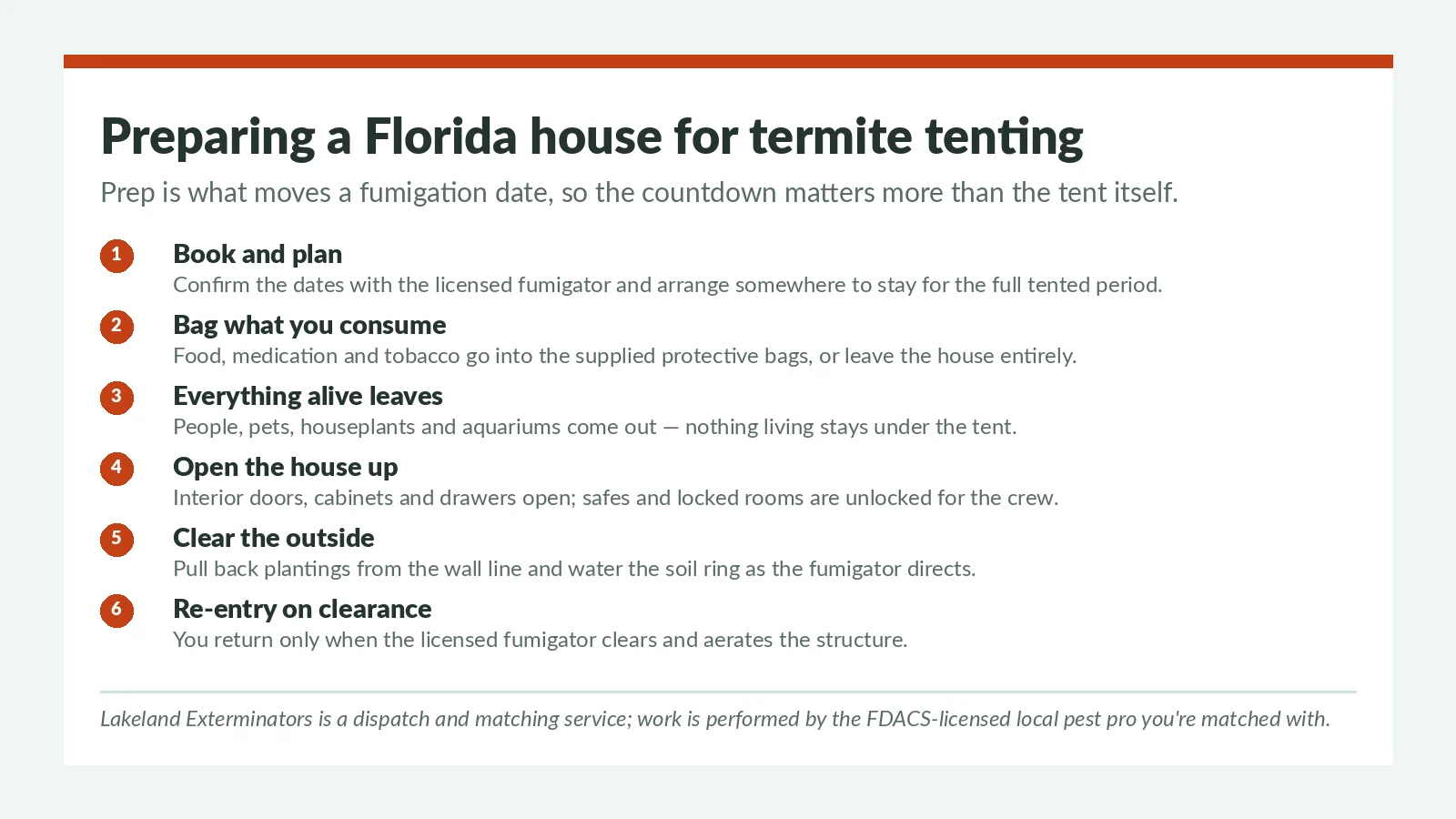
The countdown — what happens when
| When | What’s happening | Your job |
|---|---|---|
| 7–10 days out | Operator confirms the date and submits the gas shut-off request to your utility. Most give you a printed prep checklist around now. | Book your lodging. Read the sheet the day you get it, not the day before. |
| 2–3 days out | Bags (commonly Nylofume or equivalent) are supplied or picked up. | Trim the landscaping. Stop buying groceries. Start eating the fridge down. |
| Night before | Nothing on their end — everything on yours. | Bag food and medications. Pack for the household. Open interior doors, cabinets, drawers, closets, attic access. |
| Tenting day | Crew arrives, tarps go up, perimeter is sandbagged, vents sealed, gas released. | Be out. Everyone and everything living, out. Hand over keys per the operator’s instructions. |
| Re-entry | Tarps removed, structure aerated, clearance device confirms the reading is below the label’s re-entry threshold. | Wait for the operator to release the home in writing. Do not go in early for a phone charger. |
End to end, plan on roughly 48 to 72 hours away. If you want the mechanical detail of what’s happening under the tarp during those hours, that’s on drywood termite tenting in Lakeland, and the full method timing comparison lives on how long termite treatment takes in Lakeland.
Not tented yet — and not sure you should be?
One call reaches a licensed, local exterminator who covers your address — and a real person answers, 24/7.
Talk to a licensed exterminator now
Call and we’ll connect you with a licensed, local exterminator who covers your address. It takes about two minutes, and a real person answers.
Free to call. Free to get matched. The licensed operator gives the quote.
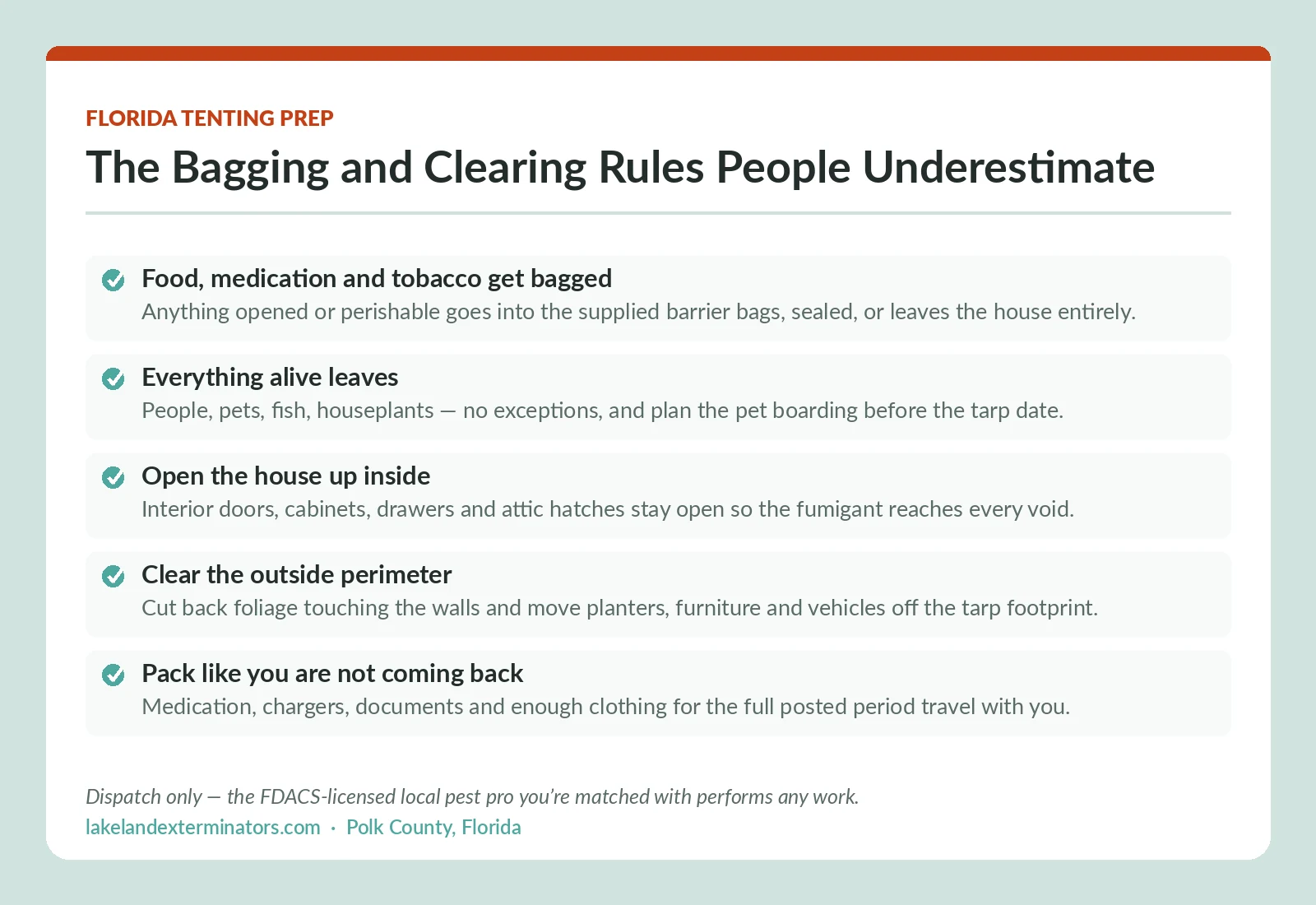
Food, medication and tobacco: the bagging rules
This is where most of the labor is, and where most of the mistakes happen. The rule people get wrong: it isn’t about whether something is edible. It’s about whether the packaging is unopened and impermeable.
Safe to leave in place, untouched
- Factory-sealed metal cans that have never been opened.
- Glass jars with unopened screw-on metal lids.
- Unopened mylar, foil or polyethylene pouches with a factory seal intact.
Must be bagged in the fumigant-resistant bags — or leave the house
- Anything opened. The cereal box, the half bag of chips, the coffee, the flour, the sugar, the open box of pasta.
- Everything in the refrigerator and freezer that isn’t in the sealed-container list above. The fridge is not a barrier. Bag it or lose it.
- Fresh produce, bread, eggs, anything in a paper or cardboard package.
- Medications — prescription and over-the-counter — unless still in unopened factory packaging. Honestly, just take your prescriptions with you; you’ll want them anyway.
- Tobacco products of any kind.
- Pet food and treats. The bag in the laundry room counts.
- Vitamins, supplements, protein powder — the stuff people forget because it lives in a bathroom cabinet, not the pantry.
The fumigator supplies the bags (Nylofume is the common brand) and will show you how to seal them — usually a twist-and-fold-and-tape, not a knot. Ask them to demonstrate on one, then do the rest the same way. And a piece of practical Lakeland advice: start eating the fridge down a week out. The single easiest way to cut this job in half is to simply have less food in the house.
Everything alive leaves. All of it.
This is the non-negotiable one, and it’s broader than people expect.
- People. The whole household, for the full window. No sleeping in the RV in the driveway — the driveway is inside the work zone.
- Pets. Dogs, cats, birds, hamsters, the kid’s bearded dragon. All of them.
- Fish and aquariums. You cannot cover a tank and call it sealed. The tank goes, or the fish go.
- Houseplants. Every one, including the ones in the garage and the lanai if the lanai is under the tarp.
Also worth saying plainly: tender plants and turf directly under the tarp footprint outside can take temporary damage even when the crew does everything right. A good fumigator will tell you that upfront and shield or relocate what they reasonably can. Ask, before the tarp goes up, who’s responsible if a plant dies or a roof tile cracks — the answer should be in writing.
Opening the house, and clearing the outside
Inside: open everything
Interior doors unlocked and open. Cabinets, drawers, closets and the attic hatch open. Safes and locked rooms opened or the key left per the operator’s instructions. Gas needs to reach every enclosed volume — a locked closet is a pocket the fumigant may not fully penetrate.
Beds and floors
Remove mattress and pillow covers if your operator asks (plastic covers in particular). Roll back area rugs and lift heavy furniture off carpet so wood floor seams are exposed. It’s about giving the gas a path, not about tidiness.
Outside: cut it back
Shrubs, vines, hedges and low limbs touching the structure get trimmed back — commonly around 18 inches — so the tarp seats against the ground. In older Lakeland neighborhoods with forty-year-old foundation plantings, budget real time for this or hire it out.
Gas and utilities
The fumigator submits the gas shut-off request to the utility, typically five to ten days ahead, and coordinates the reconnect after clearance. Confirm they’ve done it. An unscheduled shut-off is one of the most common reasons a tenting date slips.
Pack like you’re not coming back for anything
Because you’re not. Once the tarp is on, the house is sealed and nobody — including you — goes in until clearance. Pack accordingly:
- All prescriptions and daily medications.
- Chargers, laptop, work equipment, school gear.
- Enough clothes for three days plus one.
- Pet food, pet meds, the crate, the leash, the litter box.
- Anything with a deadline attached — passports, tax paperwork, the closing documents.
- The kids’ one non-negotiable comfort item. Do not learn this lesson the hard way at 11pm in a hotel.
Book the lodging early. In Polk County, tenting season overlaps with drywood swarm season — roughly May into August — and that’s also when hotel demand runs high across the I-4 corridor. Waiting until the week of is how people end up in Plant City.
Coming home: what you do and don’t have to do
Here’s the good news, and it’s genuinely good news. Sulfuryl fluoride — the fumigant licensed operators typically use, sold under the Vikane brand — is a true gas, and it leaves no chemical residue. It doesn’t settle onto your counters. It doesn’t soak into your couch. Once the structure is aerated and the clearance device reads below the label’s re-entry threshold, the operator releases the home.
- You do not need to wash the dishes. Sealed or not, surfaces are clean — there’s nothing on them to wash off.
- You do not need to launder all the clothes. Same reason.
- Electronics, furniture, books, instruments come through fine.
- You do need the clearance in writing. Ask for it, and don’t re-enter until it exists. That’s not paranoia; that’s the process working.
- You do need to re-open the gas. Confirm the utility reconnect happened before you’re standing in a cold shower.
And the uncomfortable truth to keep in your back pocket: fumigation leaves no residual protection. It eliminates what’s in the wood today. A drywood swarmer can fly in next May and start over in a fascia board. That’s why operators often recommend a borate treatment on exposed or replaced wood, and why annual inspection still matters. If you’re weighing ongoing coverage, is an annual termite bond worth it in Lakeland is the follow-on read.
How the dispatch works — four steps, no phone tag
You call the dispatch line
That’s the whole ask. Your address tells us which FDACS-licensed operators cover your address.
We match you to a licensed operator
Independent, licensed and insured. Fumigation requires a certified operator in the fumigation category and a licensed fumigation business. We’re a dispatch service — we don’t treat and we take no cut of your quote.
They inspect and scope the job
They confirm whether tenting is warranted at all, measure the structure, and issue the prep sheet and schedule. Plenty of drywood infestations turn out to be contained enough for localized work.
They quote, prep and schedule
Price, method, warranty, prep requirements and dates all come from the operator, in writing. You can always get a second inspection.
Get a licensed Polk County fumigator on the schedule
One call reaches a licensed, local exterminator who covers your address — and a real person answers, 24/7.
Talk to a licensed exterminator now
Call and we’ll connect you with a licensed, local exterminator who covers your address. It takes about two minutes, and a real person answers.
Free to call. Free to get matched. The licensed operator gives the quote.
Termite tenting prep questions, answered straight
Do I have to wash my dishes after fumigation?
No. Sulfuryl fluoride is a true gas and leaves no residue on surfaces — counters, dishes, tableware and cookware are fine to use once the operator has aerated the structure and released it on a clearance reading. Same answer for clothing and bedding: no special laundering required.
What food can stay in the house?
Only unopened, factory-sealed items in impermeable packaging: sealed metal cans, glass jars with unopened screw-on metal lids, and unopened mylar/foil/poly pouches. Everything else — anything opened, anything in cardboard or paper, everything in the fridge and freezer, pet food, medications, tobacco — goes into the fumigant-resistant bags the operator supplies, or leaves with you.
Do fish tanks really have to leave?
Yes. Every living thing leaves the structure — people, pets, birds, reptiles, fish and houseplants. An aquarium can’t be sealed against a gas that penetrates wood. Arrange for the tank or the fish to be elsewhere; your fumigator has seen it done a hundred times and can point you in the right direction.
How far back do I have to cut my landscaping?
Enough for the tarp to seat cleanly against grade all the way around — operators commonly ask for about 18 inches of clearance from the structure, and low branches trimmed off the roofline. In older Lakeland neighborhoods where the shrubs have been there since the Carter administration, this is often the biggest single job on the prep sheet. Get your operator’s specific number and do it a few days early.
Who handles the gas shut-off?
The fumigator submits the request to your utility, typically five to ten days ahead, and coordinates the reconnect after clearance. It’s not on you to arrange — but it is worth confirming they’ve done it, because a missing shut-off is one of the most common reasons a tenting date slips.
Will fumigation damage my roof, electronics or furniture?
Properly executed fumigation doesn’t damage roofing materials, exterior paint, electronics, furniture, books or instruments — the gas dissipates and leaves nothing behind. Tender plants and turf under the tarp footprint can take temporary damage. Ask upfront, in writing, who is responsible if a tile cracks or a plant dies.
How long am I out of the house?
Plan on 48 to 72 hours. Tarping runs about half a day, gas exposure roughly 18 to 24 hours, aeration another 12 to 24, then clearance testing before the operator releases the home. Book lodging early — Polk County tenting demand peaks in the same May-to-August window as drywood swarm season.
Am I sure I even need a tent?
One call reaches a licensed, local exterminator who covers your address — and a real person answers, 24/7.
Disclosure
Lakeland Exterminators is a dispatch and matching service. We connect Polk County callers with FDACS-licensed pest control operators. We are not a licensed pest control operator. We do not perform treatment, set prices, issue warranties, hold bonds, or carry pest control trade insurance. All pricing, scheduling, treatment plans, prep requirements, warranties and service terms are determined by the FDACS-licensed operator dispatched to your address under Chapter 482, Florida Statutes. Where this page and your operator’s written prep sheet differ, follow your operator’s sheet.
Same-day and 24/7 emergency services are subject to provider participation, location, technician availability, and demand. Availability is not guaranteed and may vary by market and appointment capacity.
License status of any operator you connect with is publicly verifiable at the FDACS license search. Vikane is a registered trademark of Douglas Products and Nylofume is a registered trademark of its respective owner; both are referenced factually to describe materials licensed operators commonly use. We sell, endorse and apply nothing.