Orlando ants don’t die from spraying. Several species literally multiply because of it.
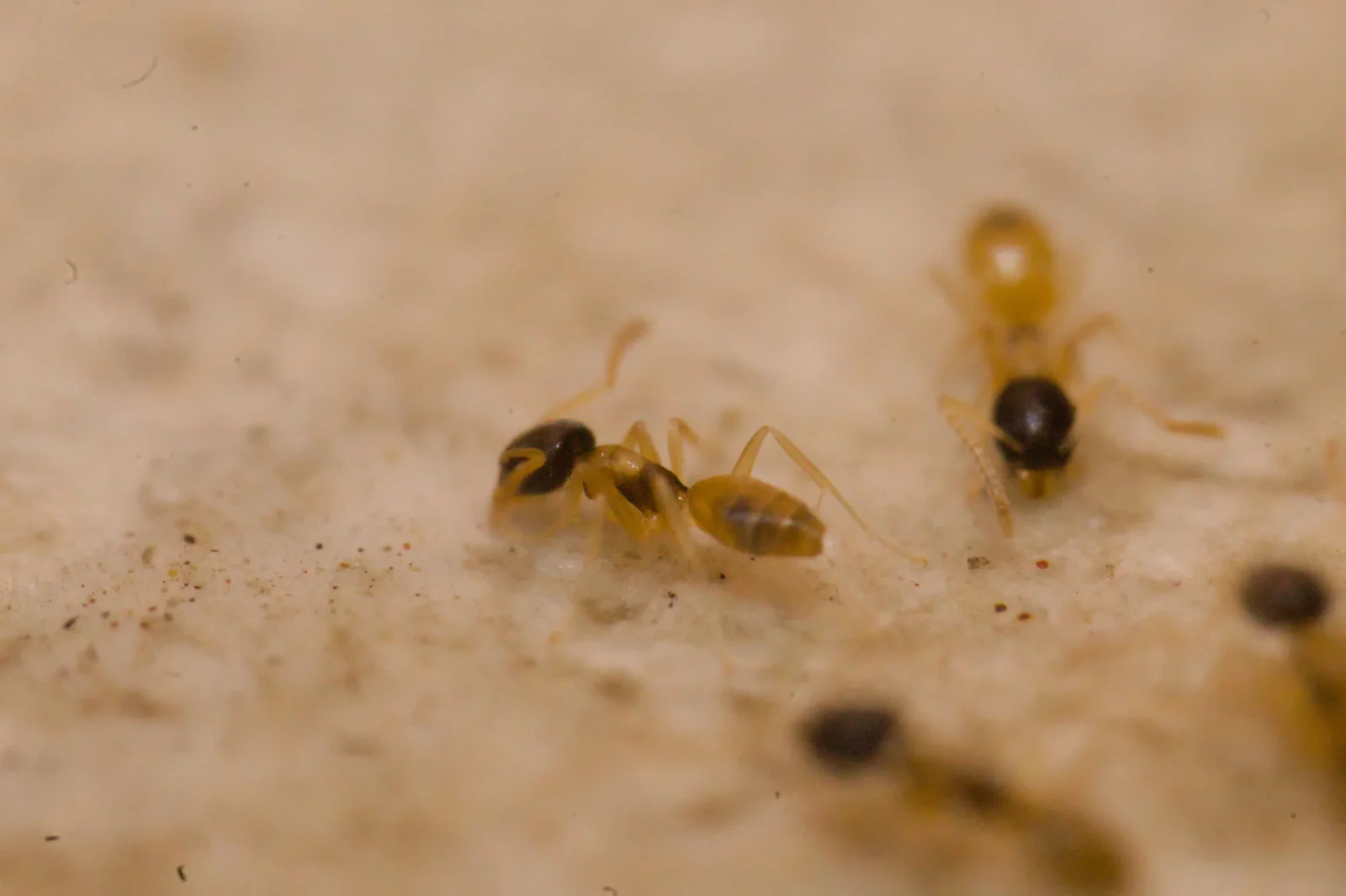
The tiny pale ants trailing across your Orlando kitchen counter are probably ghost ants — and they belong to a category that makes Central Florida ant control genuinely counterintuitive: budding species. Hit them with repellent spray and the colony doesn’t collapse; it splits into satellite colonies behind three different walls. Add big-headed ants throwing sand piles at every paver joint and stucco seam, fire ants claiming sunny turf, and white-footed ants mass-trailing along soffits after rain, and you get the metro’s standard story: a summer of spray cans that made everything worse. The dispatch line matches you with FDACS-licensed operators who start with species ID — because in Orlando, the ID is the treatment plan.
Talk to a live dispatch coordinator now
Trails over the sink, sand piles between pavers, mounds in the lawn, ants in the dishwasher seal — describe it and get routed to a licensed Orlando ant operator.
(863) 445-9190Tap to call — 24/7 dispatch
Free to call. Free to get matched. The licensed operator you’re matched with gives the quote.
24/7 line · A real person answers · Availability of same-day and emergency service depends on the provider.
Need ant control in Orlando, FL? Call (863) 445-9190 and a dispatch coordinator matches you with an FDACS-licensed operator serving your Orlando ZIP — non-repellent baiting for ghost and big-headed ants, broadcast fire ant programs for lawns, and entry-point work that holds. Lakeland Exterminators is a dispatch service: the licensed local operator inspects, identifies the species, and quotes the treatment.
Why does spraying make Orlando ant problems worse?
Because of how these species are built. A ghost ant colony isn’t one queen in one nest — it’s a diffuse network of nesting sites with multiple queens, connected by trails, living in wall voids, potted plants, and the gap behind the dishwasher. Repellent spray is a chemical alarm: workers detect it, the network fragments defensively, and each fragment with a queen becomes a new colony — the phenomenon operators call budding. You saw one trail; now you have four. The professional counter is patience-shaped: non-repellent baits the workers can’t detect, matched to the colony’s current appetite (sugar-heavy in Orlando’s wet months, protein-leaning at other points in the cycle), carried home along the trails and shared colony-deep. It takes days, and for a week it looks like nothing is happening — then the trails thin, then they’re gone.
Outdoors the cast changes. Big-headed ants — the species behind the endless sand piles at paver joints and expansion cracks across Orlando’s newer subdivisions — forage in mass trails along foundations and slip under stucco weep screeds; they take granular baits well when spray hasn’t poisoned the route. Fire ants own the sunny, irrigated turf of the metro’s lawns and parks; the fix that works is broadcast baiting on schedule, not the kettle-of-boiling-water folklore that relocates the mound six feet left. A yard program that names all three species and treats each by its biology is what “ant control” means here.
Where does ant pressure concentrate around Orlando?
- Newer stucco subdivisions — Lake Nona, Avalon Park, Horizon West edge (32827, 32828, 32832): big-headed ants in paver joints and weep screeds; ghost ants inside within the first sod year.
- College Park & Audubon Park (32803, 32804): mature-canopy yards — white-footed ant soffit trails after summer rain, ghost ants in bungalow kitchens.
- Dr. Phillips & Bay Hill (32819, 32836): irrigated landscaping and pool decks — year-round ghost ant interior pressure.
- Conway, Belle Isle & lake-adjacent streets (32806, 32809, 32812): moisture-loving species following plumbing lines into 1960s-70s ranches.
- Hunter’s Creek & Meadow Woods (32837, 32824): HOA-scale fire ant turf pressure — broadcast programs beat mound-by-mound whack-a-mole.
- UCF corridor (32816, 32817, 32826): multifamily ghost ant complaints that travel unit-to-unit like the roach problems do.
What does an ID-first ant program look like?
Visit one is diagnostic: the operator identifies the species (a hand lens and the ant’s node count settle it), maps the trails to entry points — window weep holes, slab expansion joints, the conduit penetration behind the water heater — and notes the conducive conditions: hedge branches bridging to stucco, mulch mounded against the slab, irrigation overspray keeping foundation soil damp. Treatment is then species-shaped: gel or liquid bait placements on active interior trails, granular bait or non-repellent perimeter applications outside, broadcast fire ant bait for turf, and no repellent spray anywhere a budding species is working. The honest part every Orlando homeowner should hear up front: baiting looks slow for the first week because it’s working — the workers are hauling the product home. Killing the trail on sight is the one satisfaction the program asks you to give up.
Call the line
Tap (863) 445-9190 any hour. Describe the ant — size, color, where it trails — and your Orlando ZIP.
Get matched by species
Interior trail calls route to baiting-fluent operators; lawn and fire ant calls route to providers running broadcast turf programs.
A licensed operator takes over
An independent, FDACS-licensed and insured Orlando operator confirms the species, treats by its biology, and quotes. No obligation — the dispatch call costs nothing.
Trails back on the counter every morning? Sand piles in the pavers again?
The line answers 24/7 and matches you with a licensed Orlando ant operator.
One tap. One call. Matched.
(863) 445-9190Tap to call — 24/7 dispatch
Free to call. The licensed operator gives the quote.
Orlando ant control questions, answered straight
What are the tiny see-through ants in my Orlando kitchen?
Are the winged ants in my house actually termites?
Why do the ants come back every time it rains?
What does ant control cost in Orlando?
Disclosure
Lakeland Exterminators is a pest control dispatch and referral service, not a licensed pest control operator. All ant inspections, quotes and treatments in Orlando are performed by independent pest control operators licensed by the Florida Department of Agriculture and Consumer Services (FDACS) and insured in their own name. Calling the dispatch line is free and creates no obligation; the licensed local operator you’re matched with sets their own pricing and terms.
More Orlando help: Pest control in Orlando, Termite treatment in Orlando, Roach control in Orlando · Ant dispatch guide · All pest control services