Spotting on the mattress seam after a move-in? Heat clears the whole room in a day.
Auburndale households introduce bed bugs the same way most of Florida does — travel luggage, secondhand furniture, and move-ins between the town’s older lakefront homes and newer rentals. Whole-room heat treatment kills the entire population, including eggs, in a single visit instead of the multi-week chemical sequence that gives an infestation time to keep breeding. One call gets you matched with a licensed operator who runs it.
Talk to a licensed exterminator now
Call and we’ll connect you with a licensed, local exterminator who covers your address. It takes about two minutes, and a real person answers.
Free to call. Free to get matched. The licensed operator gives the quote.
Before you call: have your address ready, plus what pest you’re seeing and where. Staying on the line about two minutes helps your local operator confirm details and get you scheduled.
A real person answers · Availability of same-day and emergency service depends on the provider.
How heat treatment actually works
A licensed operator raises the air temperature in a treated room to roughly 120°F–135°F using electric heaters and fans, holding it long enough for the heat to soak into mattresses, upholstered furniture, and wall voids. Sustained exposure above about 118°F is lethal to bed bugs and their eggs, so the treatment doesn’t depend on a chemical reaching every crevice the way a spray does.
Remote sensors placed in the coldest predicted spots — inside a mattress, behind a headboard — confirm the lethal temperature was actually reached before the operator calls the job done. Most single-room treatments finish in six to eight hours.
Why Auburndale households increasingly choose heat
Bed bugs (Cimex lectularius) travel through luggage after any trip and through secondhand furniture regardless of a home’s cleanliness — a real factor in a town with a steady churn of lakefront rentals and move-ins between older and newer housing stock. A chemical-only program can take multiple visits over several weeks, and a resistant population is increasingly common, which stretches that timeline further while the infestation keeps laying eggs.
Heat sidesteps resistance entirely, because a lethal temperature doesn’t care what chemical class a population has adapted to. For a household able to vacate a room for one day, that trade-off usually means a faster resolution with fewer total visits.
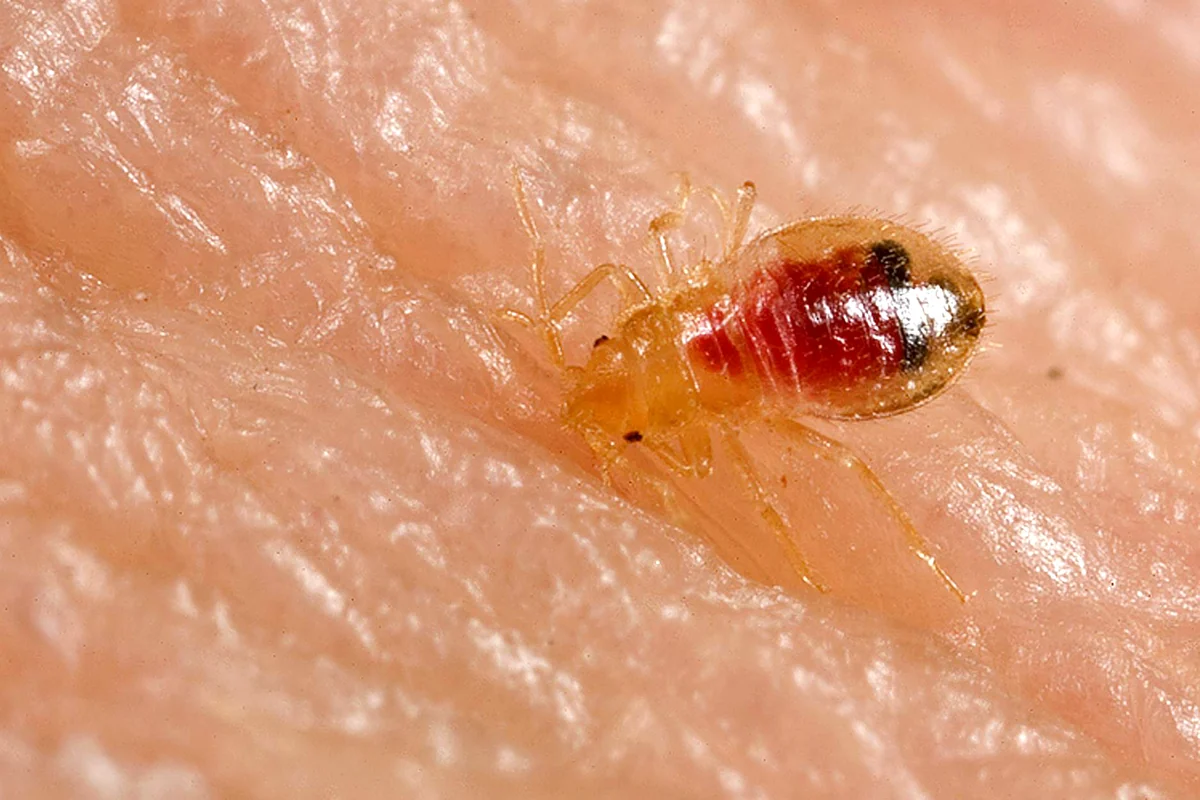
Nymphs and adults alike die under sustained heat exposure — no chemical resistance involved.
What to expect on treatment day
Pre-treatment prep
Heat-sensitive items are removed — electronics, aerosol cans, candles. Most furniture and mattresses stay in the room.
Setup and monitoring
Heaters and fans are positioned, with sensors placed to confirm even heat penetration into furniture interiors.
The heat cycle
The room holds at lethal temperature for several hours while airflow is adjusted to reach voids and dense furniture.
Verification and cool-down
Sensor logs confirm every monitored point held lethal temperature before the room cools and reopens.
Interceptor follow-up: how you know it worked
Interceptor cups under bed and furniture legs catch any commuting bug, and a two-to-four-week recheck confirms zero activity. In an attached duplex or multifamily building, bed bugs travel wall voids between units, so an adjacent-unit check is worth asking about.
What heat treatment doesn’t fix by itself
Heat clears what’s present at treatment time, not what arrives afterward. The matched operator can outline simple habits — hot-drying travel luggage contents, inspecting secondhand furniture before it enters a bedroom — that keep a treated space from becoming a repeat call.
Ready when you are.
One call gets you matched with a licensed local operator.
Talk to a licensed exterminator now
Call and we’ll connect you with a licensed, local exterminator who covers your address. It takes about two minutes, and a real person answers.
Free to call. Free to get matched. The licensed operator gives the quote.
Before you call: have your address ready, plus what pest you’re seeing and where. Staying on the line about two minutes helps your local operator confirm details and get you scheduled.
Availability of same-day and emergency service depends on the provider.
Questions, answered straight
Does heat treatment kill bed bug eggs?
Yes — sustained exposure above roughly 118°F is lethal at every life stage, including eggs, which is the main edge over some chemical-only programs.
How long does a heat treatment take in Auburndale?
Most single rooms or apartment-sized units finish in six to eight hours, including setup, the heat cycle, and verification.
Will I need to throw away my mattress?
Usually not. Heat penetrates mattresses and upholstered furniture without destroying them.
Can heat damage belongings in the room?
A licensed operator removes heat-sensitive items first. Most household items tolerate the treatment temperature range.
Is heat treatment better than chemical-only treatment?
For established infestations, heat is often faster because it kills every life stage in a single visit and sidesteps chemical resistance. Some programs combine heat with a residual chemical step for longer prevention.
What does it cost to get matched with an operator?
Nothing. Free to call and free to get matched. The licensed operator assesses the space and quotes the job.
One call. A real person. Straight answers.
Get matched with an FDACS-licensed operator who covers your address.
Talk to a licensed exterminator now
Call and we’ll connect you with a licensed, local exterminator who covers your address. It takes about two minutes, and a real person answers.
Free to call. Free to get matched. The licensed operator gives the quote.
Before you call: have your address ready, plus what pest you’re seeing and where. Staying on the line about two minutes helps your local operator confirm details and get you scheduled.
Availability of same-day and emergency service depends on the provider.
Disclosure
Lakeland Exterminators is a dispatch and matching service. We connect Polk County callers with FDACS-licensed pest control operators. We are not a licensed pest control operator. We do not perform treatment, set prices, issue warranties, hold bonds, or carry pest control trade insurance. All pricing, scheduling, treatment plans, warranties and service terms are determined by the FDACS-licensed operator dispatched to your address under Chapter 482, Florida Statutes.
Same-day and 24/7 emergency services are subject to provider participation, location, technician availability, and demand. Availability is not guaranteed and may vary by market and appointment capacity.
License status of any operator you connect with is publicly verifiable at the FDACS license search.